Human Nature and Suffering
Routledge Mental Health Classic Edition
Human Nature and Suffering
‘Human Nature and Suffering is a landmark work that sets the stage for decades of research and practice of a psychotherapy better suited to the realities of evolved human motivation and emotion. The re-release of this classic is a godsend for this generation of psychologists and the next.’
Dennis Tirch, PhD, Founder, The Center for Compassion Focused Therapy
Human Nature and Suffering is a profound comment on the human condition, from the perspective of evolutionary psychology. Paul Gilbert explores the implications of humans as evolved social animals, suggesting that evolution has given rise to a varied set of social competencies, which form the basis of our personal knowledge and understanding.
Gilbert shows how our primitive competencies become modifi ed by experience – both satisfactorily and unsatisfactorily. He highlights how cultural factors may modify and activate many of these primitive competencies, leading to pathology proneness and behaviours that are collectively survival threatening. These varied themes are brought together to indicate how the social construction of self arises from the organisation of knowledge encoded within the competencies.
This Classic Edition features a new introduction from the author, bringing Gilbert’s early work to a new audience. The book will be of interest to clinicians, researchers and historians in the fi eld of psychology.
Paul Gilbert, OBE , is Professor of Clinical Psychology at the University of Derby and has been actively involved in research and treating people with shame-based and mood disorders for over 30 years. He is a past President of the British Association for Cognitive and Behavioural Psychotherapy and a fellow of the British Psychological Society. He was awarded the OBE for contributions to mental health in 2011.
Routledge Mental Health Classic Edition
The Routledge Mental Health Classic Edition series celebrates Routledge’s commitment to excellence within the fi eld of mental health. These books are recognized as timeless classics covering a range of important issues, and continue to be recommended as key reading for professionals and students in the area. With a new introduction that explores what has changed since the books were fi rst published, and why these books are as relevant now as ever, the series presents key ideas to a new generation.
The Plural Psyche (Classic Edition)
Personality, morality and the father Andrew Samuels
Evolutionary Psychiatry (Classic Edition)
A new beginning, second edition Anthony Stevens and John Price
The Wounded Healer (Classic Edition)
Countertransference from a Jungian perspective David Sedgwick
Four Approaches to Counselling and Psychotherapy (Classic Edition)
Windy Dryden and Jill Mytton
The Therapeutic Use of Self (Classic Edition)
Counselling practice, research and supervision Val Wosket
Depression (Classic Edition)
The evolution of powerlessness Paul Gilbert
Human Nature and Suffering (Classic Edition)
Paul Gilbert
Human Nature and Suffering
Classic Edition
Paul Gilbert

Classic Edition published 2017 by Routledge 2 Park Square, Milton Park, Abingdon, Oxon OX14 4RN
and by Routledge 711 Third Avenue, New York, NY 10017
Routledge is an imprint of the Taylor & Francis Group, an informa business
© 2017 Paul Gilbert
The right of Paul Gilbert to be identified as author of this work has been asserted by him in accordance with sections 77 and 78 of the Copyright, Designs and Patents Act 1988.
All rights reserved. No part of this book may be reprinted or reproduced or utilised in any form or by any electronic, mechanical, or other means, now known or hereafter invented, including photocopying and recording, or in any information storage or retrieval system, without permission in writing from the publishers.
Trademark notice: Product or corporate names may be trademarks or registered trademarks, and are used only for identification and explanation without intent to infringe.
First edition published in 1989 by Lawrence Erlbaum Associates
First edition reprinted in 1992 by Routledge
British Library Cataloguing in Publication Data A catalogue record for this book is available from the British Library
Library of Congress Cataloging-in-Publication Data Names: Gilbert, Paul, 1951 June 20– author. Title: Human nature and suffering / Paul Gilbert. Description: Classic edition. | Milton Park, Abingdon, Oxon ; New York, NY : Routledge, 2017. Identifiers: LCCN 2016003340 | ISBN 9781138954755 (hbk) | ISBN 9781138954762 (pbk) | ISBN 9781315564258 (ebk) Subjects: LCSH: Mental illness—Etiology. | Psychobiology. | Sociobiology. | Suffering.Classification: LCC RC454.4 .G54 2017 | DDC 616.89—dc23 LC record available athttps://lccn.loc.gov/2016003340 ISBN: 978-1-138-95475-5 (hbk)
ISBN: 978-1-138-95476-2 (pbk) ISBN: 978-1-315-56425-8 (ebk)
Typeset in Times New Roman by Apex CoVantage, LLC
To June with love and immense gratitude for without you this would not have been possible
This page intentionally left blank
Contents
| Foreword | xi | |
|---|---|---|
| Acknowledgements | xv | |
| Introduction to the Classic Edition | xviii | |
| 1 | Introduction and overview | 1 |
| Outline 4 | ||
| 2 | A legacy from the past: the role of human nature | 6 |
| Historical background 6 | ||
| Evolution in the social context 10 | ||
| Evolution of biosocial goals and social strategies 15 | ||
| Biosocial goals 18 | ||
| A rough classifi cation 24 | ||
| Models for the interaction of cognition, behaviour and affect 30 |
||
| Concluding comments 33 | ||
| 3 | The mapping of human nature | 36 |
| Jung’s theory of archetypes 36 | ||
| Ethological approaches to human nature 41 | ||
| The evolution of social roles 56 | ||
| Interpersonal approaches to human nature 59 | ||
| The cognitive approach 71 | ||
| Concluding comments 73 | ||
| 4 | The psychobiology of some basic mechanisms | 77 |
| Defence 78 | ||
| Safety 82 | ||
| The neurobiology of go–stop processes 84 | ||
| Neuropsychological aspects of defence and safety 91 | ||
| Concluding comments 96 |
viii Contents
| 5 | The psychobiology of peripheral systems | 99 |
|---|---|---|
| The endocrinology of defensive go states 99 | ||
| Defensive stop states 102 | ||
| The psychobiology of changing states 110 | ||
| Concluding comments and the defensive drift hypothesis 113 | ||
| 6 | Care eliciting and attachment strategies | 117 |
| Attachment theory 117 | ||
| The importance of the infant’s experience of mediators 121 | ||
| The psychobiology of separation 126 | ||
| Confl ict in early relationships 133 | ||
| Concluding comments 134 | ||
| 7 | Care eliciting and theories of psychopathology | 138 |
| Early interactions with mediators 138 | ||
| Theories of vulnerability 144 | ||
| Care eliciting and psychopathology 148 | ||
| Developmental issues revisited 153 | ||
| The relationship of personality disorder to depression and anxiety 156 |
||
| Concluding comments 159 | ||
| 8 | Care giving and nurturance | 162 |
| Dimensions of care giving 162 | ||
| Evolution 168 | ||
| Affects related to care giving 172 | ||
| Psychotherapeutic points 176 | ||
| Concluding comments 180 | ||
| 9 | Disorders of care giving | 183 |
| Child–adult interactions 183 | ||
| Adult–adult relationships 192 | ||
| Concluding comments 195 | ||
| 10 | Co-operation | 198 |
| The importance of human co-operativeness 198 | ||
| Evolution 201 | ||
| Issues in co-operative relationships 203 | ||
| Transaction in interpersonal relationships 216 | ||
| Concluding comments: co-operating versus competing 221 |
| 11 | Co-operation: some blocks and pathologies | 225 |
|---|---|---|
| Deception 226 | ||
| Guilt 235 | ||
| The relationship of guilt to shame 243 | ||
| Belief systems derived from co-operation | ||
| and reciprocal altruism 248 | ||
| Concluding comments 251 | ||
| 12 | Competition: status, power and dominance | 256 |
| Status 257 | ||
| Power and dominance 261 | ||
| Submission 268 | ||
| The psychobiology of status, power and dominance 271 | ||
| Gender: status, dominance and power 275 | ||
| Competition and sibling rivalry 281 | ||
| Concluding comments 284 | ||
| 13 | Some psychopathologies of status, power and dominance | 289 |
| Theories of psychopathology 289 | ||
| Type A personality 295 | ||
| Narcissistic personality disorder 301 | ||
| Concluding comments 308 | ||
| 14 | Beyond the power of reason | 312 |
| Social mentalities 312 | ||
| The self 322 | ||
| The mind as a system 332 | ||
| Psychotherapy implications 334 | ||
| Concluding comments 339 | ||
| 15 | Conclusions and refl ections | 341 |
| An overview 341 | ||
| Personal refl ections 344 | ||
| References | 352 | |
| Appendix 1 | 375 | |
| The monoamine system 375 | ||
| The distribution of monoamine pathways 379 | ||
| Early neurochemical insights 379 | ||
| Current ideas on neurobiological mechanisms 381 | ||
| Appendix 2 | 383 |
|---|---|
| Homeostasis and beyond 383 | |
| Oscillating systems within the central nervous system 384 | |
| The psychobiology of ecological and climatic variation 386 | |
| Internal oscillators 389 | |
| Author index | 393 |
| Subject index | 401 |
Foreword
Towards a basic science of the clinical mental sciences
Clinical work proceeds best if guided by clarity in the clinician’s mind about normal processes that would have existed if something hadn’t gone wrong. We require a basic science of these processes as well as their correlated pathologies for functioning best with our patients and clients. Such knowledge orients the participants, provides rationale for procedures, gives direction and purpose for the exchanges thereby countering demoralisation, and enhances the “meaningmaking” for which we, as living creatures, possess innate neural mechanisms and, as humans, have particularly well-developed talents. We need a guiding framework formed not idiosyncratically and perhaps on the spot, but stemming from consensually derived concepts and procedures, and critical assessment of the data. We need a science, in short, that renders our helpees less at risk from our individual ignorance and personally derived communicative trends, some of which may indeed be helpful, while others may not. We need to be “mediators”, to use another term of Paul Gilbert’s with which you will become acquainted, providing these “sufferers” with mediation between them and the outside world of accumulated, systematic and valid – meaning useful – information about their complicated psychologies and psychotherapeutic experiences.
Development of such a basic science for the clinician in the mental illness and mental distress arenas comes with diffi culty. Models for such disciplined collections of information stem from domains that often seem remote from clinical work with the psyche. For physician members of these clinical areas (such as myself) the functional pathology course in medical school provided this type of model. I learned there that disease in medicine results when this or that tube is blocked or ruptured, when supplies consequently don’t get to an area, or waste accumulates or pressure builds or other assorted regulated functions go awry and can’t get easily realigned. What the patient says and exhibits is correlated with what the pathologist describes after biopsy or death, the radiologist suggests from computerised tomographic or magnetic resonancy outputs, or the chemical laboratory indicates from quantifi ed blood and urine constituents.
The clinical mental sciences don’t yet have such a model implemented although many would like to see it formulated as soon as possible. Thus, the dexamethasone suppression test was fashionable for several years in psychiatry, imaging techniques are seen as popular “cutting edge” potential diagnostic tools for mental disorders, and DSM-III (DSM-IIIR) has gained considerable ascendency as a tool for clinicians despite its empirical origins, seemingly atheoretical.
Actually, there have been problems with the rigorous implementation of such “basic sciences” within general medicine to which we should pay attention in our (as yet) less-developed science. Though the prefi x of “psych-” may not apply to those specialties dealing with diseases of the liver, heart or bone, patients with these disorders possess psyches still. To the extent that they become active receivers of information about the etiopathophysiology of their condition and “cooperate” or “collaborate” with the “guidance” that the clinician provides, things may go fi ne. But to the extent that the situation is less clear than some ideal-typical model of their condition, that their psyche contributes to the complaint or the behaviour, that demoralisation persists, that the person feels uncared for, that the clinician experiences the person to be a “bad patient” – to these extents, the medical basic science has failed; complete models of the illness and of the person’s distress have not yet been provided. Basic science knowledge limited to cellularmolecular referents insuffi ciently orients the participants, rationale for procedures attenuates, direction and purpose for clinician-potential helpee-exchanges goes astray, and demoralisation piles up. This helps explain the reason that patients have complained that US medicine (for example) has become dehumanised and that large-scale movements toward “primary care” medicine have been underway for several decades. They reject Shively’s “Damn It” differential (1987, p.449):
If it’s not Degenerative Anomalous Metabolically imbalanced Neoplastic Infectious or Traumatic Then it’s either healthy or dead.
How is it then, if what the patient feels is so important, that the psyche component of human suffering has counted for so much less than the cellular correlates of physical disarray? Part of it stems from all of us being experts. Each of us has felt distress as a part of the human condition. No-one has been exempted from human nature and the animal nature that gave rise to our humanness. Any of us snort sceptically as we hear of the experts giving contradictory evidence in courts of law, seemingly dependent upon which side is paying the fee? If the topic of psychopathology is broad, conceptualisations of the normal psyche and the numerous facets of brain function related to it range much more widely yet, as far as the eye can see. Daily we read about the meaning-making of psychologists, historians, philosophers, anthropologists, religious leaders, politicians, archeologists, administrators, novelists, poets, painters, psychoanalysts, sociologists, psychiatrists, neurologists, epidemiologists, public opinion pollsters, journalists and whole varieties of others who consider the human condition in the pages of books, journals, newsletters, magazines, newspapers, radio, television and notices posted upon campus trees. Each of us feeling equal claim to personal experience feels expert. The Greek historian Thucydides stated that “Of the Gods we believe, and of men we know, that by a necessary law of their nature they rule whenever they can.” Nowhere is this more the case than with the informational “territories” of human nature.
And in this lies part of the problem with our basic science and why the pathophysiologic model provided by organ pathology remains attractive: The microscope and its successors constitute arbiters, deciders, about who will rule in this opinion-making and theory-deciding and on what basis. Concrete evidence should decide not whose basic science will prevail but how an eventual comprehensive discipline will guide the clinical behaviours of most psyche-specialists – whatever the specifi c designation of the individual practitioner. Of course, whatever we are called, who among us dislikes being called an expert? The early Greeks in their numerous city-states struggled with the concept of the rule by law rather than through battle or under the tyranny of single individuals. They institutionalised cooperation and rule of the many rather of the individual or group that somehow triumphs. Our desire for a basic science to guide our work is parallel. Such discipline is assisted by this book, as Paul Gilbert mediates among the numerous citystates we inhabit. And assists our puzzled consumers in a media-driven culture trying to decipher varied claims of expertise.
As you will see in reading Human Nature and Suffering , Paul Gilbert has a fi tting defi nition for expert: “When a therapist was once called an ‘expert’ on human problems, he responded”Well, ‘x’ is an unknown quantity, and ‘spurt’ is a drip under pressure.” This sense of perspective guides his writing. Gilbert recognises clearly the interim nature of his presentation (and at the same time comments wryly on the multiple starts that so many have made in trying to conceptualise the fi eld). Rather, this is a broadly informed, comprehensively viewed perspective of our budding science. He is respectful of its varied subcomponents. But most importantly, he writes from the perspective of one who deals immediately, daily and compassionately with suffering human beings. While not over-awed by the microscope and its instrumental relatives in providing information, he respects them greatly. Perhaps his early training as an economist helped in his unusual sense of overview and in knowing the importance of general laws as guides to behaviour. Most of all, however, his training as a cognitive psychotherapist seems to have enhanced his regular exercise of meaning-making not only for the clients or patients in his consulting room, but for those of us who would be better “psyche-specialists” and who require an ever-improving basic science to guide us ever more precisely and care-fully. Dr Gilbert orients us to things both that we do know and that we need yet to learn, improves our rationale for a variety of our procedures, and directs and gives purpose to not only our direct clinical work but to our reading and to our collection of new information. Reading this book will acquaint one with an exciting “meaning-making” experience.
Russell Gardner, Jr. University of Texas Medical Branch, Galveston, Texas
References
Shively, M.J. (1987). The “damn it” differential. Perspectives in Biology and Medicine . 30 , 449.
Thucydides (1910). (Trans.). History of the Pelopennesian War . Crawley, London and Toronto: J.M. Dent and Sons Ltd. (p.397)
Acknowledgements
A book of this form has been in my mind for a number of years. It is not until one sets for oneself the task of producing it that the fragmented themes and half understood ideas become coherent and start to make sense. I cannot claim much originality here since, as the reader will discover, much of what follows is a tapestry woven from the work and ideas of many. On my journey of articulating a scheme of human nature which underpins suffering, many people have given freely of their time and knowledge. They have guided me away from the darkness and the ridiculous and unreserved thanks goes out to them.
John Teasdale, Chris Brewin, Meinrad Perrez, Shirley Reynolds and Shirley Fisher have commented most helpfully on the various ideas and drafts. Thanks also to Peter Trower for his immense support and for pointing out all kinds of unnoticed implications. Tim Beck gave freely of his time when in England and also read some sections and wrote letters covering important points. Special thanks go to Russell Gardner for my early introduction to the importance of evolved social roles. Russell not only read various sections but wrote many letters trying to clarify my misty understanding of these matters. John Price commented helpfully on an earlier version and saved me from some serious errors. Special thanks go to Michael Chance who has tried (I hope reasonably successfully) to educate me in ethology and has signifi cantly infl uenced my ideas on social behaviour and the formation of human mentalities. He also read various chapters and was painstaking in his reviews and comments. Any errors of understanding, however, obviously lie at my door alone.
In my work environment there would have been little insight without the sharing of experience that many patients have provided. Their education is beyond repayment. Thanks also to Bill Hughes, a most valuable and supportive colleague of analytic persuasion and insight. Support also came from Catherine Lawrence and Chris Reynolds and more recently in Derby Chris Gillespie. My close friend, Elspeth McAdam has not only been her usual encouraging and supportive self, commenting and inspiring, but has had a profound infl uence on the tones and textures of my thinking with her knowledge of Maturana and systems analysis. Regretfully, the need for editing loses some of that sophistication. Thanks also to Brigitte Cole for her outstanding library services and making it possible to survey a wide literature. Also thanks must go to the energetic helpfulness at LEA, especially Michael Forster, Rohays Perry and Sue Wiszniewska.
The wives of those who choose to write often, for long hours, carry a heavy burden, and deepest appreciation and love go to Jean for the tea and empathy; and for understanding some of my ridiculous reasons for wanting to write; for help with the references, the checking and the sharing and for helping me to let go. Moveover, for allowing experiences of a deeper nature. The love of my children, Hannah and James, has also been inspirational. Thanks for teaching me how to be young again and that monsters, hide and seek and the Faraway Tree really are great fun. And last, but not least, thanks to my sister June. When she discovered my plans for the book, she immediately offered to type it on her wordprocessor. Neither of us realised at the time what this would entail. Over and over again, work was returned for re-editing and re-typing and June gave freely of her time and energy. To her I owe a great debt.
I have no doubt that science is the way out of darkness, yet to help us, science must not be a competitive enterprise but a co-operative one. It requires the generation of alternatives from which to choose and test; it requires cross fertilisation of ideas and it requires humans to think creatively and to contribute to the process of the application of knowledge. Whenever one paradigm is competitively defended, it inevitably leads to stagnation. Science requires us to be compassionately sceptical, to encourage each other to take part in the journey of understanding, to be ambitious in what we seek but cautious in what we affi rm; for it is not the mountain in the distance but the rock at our feet that will trip us up. This book is ambitious, but science is no respecter of ambition. There are still many unknowns, errors and falsehoods to be revealed.
All reasonable effort has been made to identify the copyright holders of the material reproduced in this volume. If the editor has inadvertently failed to obtain permission, please contact the publisher so that the necessary arrangements may be made.
Man is not determinate, clearly defi ned once and for all; he is something in process of development, and experiment, an intimation of the future, the quest and yearning of nature for new forms and new possibilities.
Herman Hesse: Refl ections
Introduction to the Classic Edition Foreward, reflection and update
I’m delighted that Routledge has decided to reissue Human Nature and Suffering ( HN&S ) (1989). This book took me six years to write and was the grounding for a lot of what emerged subsequently, including the development of compassion focused therapy (Gilbert 2000; 2010). I was also honoured when Dr Fraser Watts, then President of the British Psychological Society, having read the book, invited me to apply for a fellowship of the society. That was one of the great joys of my professional career.
The journey towards HN&S was seeded long ago. As a late teenager and young man I became fascinated by Jung’s concepts of archetypes, the evolution story and the fact that we humans are part of the fl ow of life. We are a species amongst many billions of others past and present, becoming what we are because of the struggles of reproduction and survival. Our bodies and brains are built by our genes and are shaped by our social life histories (Slavich and Cole 2013). Our capacities for anger, anxiety, love and hate arise from evolved brain systems. We choose very little of the way we experience ourselves and the world. Both Freud and Jung, indeed the whole early psychodynamic movement, thought they were working out the ways in which our evolved natures, with their different motives for sex and power, operate through our newly evolved, self-aware and culturecreating competencies. At the heart of this movement was the idea of the human mind as one of multiple motives, desires, emotions and memories, derived for earlier epochs, that could and often did confl ict. Indeed, by 1986 prominent psychologists like Robert Ornstein were arguing that:
The long progression in our self-understanding has been from a simple and usually “intellectual” view to the view that the mind is a mixed structure, for it contains a complex set of “talents,” “modules” and “policies” within. . . . All these general components of the mind can act independently of each other, they may well have different priorities.
The discovery of increased complexity and differentiation has occurred in many different areas of research. . . ., in the study of brain functions and localisation; in the conceptions of the nature of intelligence; in personality testing; and in theories of the general characteristics of the mind.
And even in standard undergraduate textbooks, this idea of the multiplicity and inherent confl icts of mind was well recognised. In 1992 Coon opened with:
You are a universe, a collection of worlds within worlds. Your brain is possibly the most complicated and amazing device in existence. Through its action you are capable of music, art, science, and war. Your potential for love and compassion coexists with your potential for aggression, hatred . . . murder.
(p.1)
The importance of motivational confl icts was also prevalent in behavioural work reaching back to Pavlov and the concept of experiential neurosis. Early cognitive therapists such as Beck also had an interest in the evolutionary basis of mind and psychopathology. In Beck et al’s. (1985) classic book on anxiety, the authors spent the fi rst third of the book discussing the evolutionary mechanisms upon which cognitive processes operate, although they did not articulate the issue of motivational and emotional confl icts that can be unconscious (Huang and Bargh 2014). Nonetheless, during the 70s, and 80s and even more so now, some schools of psychotherapy have been moving away from a focus on how evolution shaped the mind, particularly its confl ictual motivational and emotional nature. Also absent is that, as an evolved being, we have emotional needs. There are those Bowlby (1969) noted for security, care and affection, and if these aren’t met, particularly early in life, then the brain is affected; and we now know so are genes (Slavich and Cole 2013). We can’t learn to speak unless others speak to us, and our capacities for empathy can’t develop unless we experience the minds of others in a certain way. We are a very socially needy species; we need the status to feel valued included and connected, rather than marginalised and excluded.
Despite early cognitive interest in evolution, this did not infl uence the development of therapy. Beck was clear that he derived his therapy from clinical observations of “streams of thinking” that individuals could capture/learn to observe, refl ect on and learn to alter. Albert Ellis, another leader in the cognitive movement, was also clear that his approach was based on older philosophical concepts, especially the Stoics. His focus was on reasoning and self-directed behaviours as mechanisms for understanding emotion and emotion regulation, rather than psychological science of say attachment and moral development, social contextualism or evolved physiological mechanisms and their constraints and trade-offs. This was also a time of computers and artifi cial intelligence, with metaphors and terms like “information processing” used to imply “cognition”. Unfortunately, information processing can be an unhelpful term, because computers are information processing devices, as is our DNA, but these don’t have “cognitions” or “thoughts” in a meaningful sense. So while, of course, the human brain is an information processing system par excellence, information processing should not be equated with “cognition” and especially conscious cognition or reasoning – which is a very special kind of processing.
Though the cognitive movement was and is a major advance, and I began my therapuetic life here, I was always attracted to evolutionary psychology, which, during the 70s and 80s, was exploring some of the serious problems we have with the way the human brain has evolved (Bailey, 1989; Gilbert 1998; Gilbert and Bailey 2000). As Ornstein (1986) indicated so well, thinking was emerging around the idea that we may have specialised processing systems to do specifi c jobs. These include mechanisms for language acquisition, attachment, sexual behaviour, caring behaviour and competitive behaviour. Crucially, these various psychological processes could be seen as modular (Gazzaniga 1989); that is they could function independently of other modules in a way that I called “encapsulated” (see Chapter 14 , ‘Beyond the Power of Reason’). Encapsulation wasn’t just rooted in biological constraints, but could also arise as a process of learning; people could dissociate due to trauma or fail to integrate certain experiences, so they remained split off and literally encapsulated. Part of therapy is creating the conditions for increased awareness of these aspects of the self and their (safe) integration.
My fi rst book was called Depression: From Psychology to Brain State (1984). In it, I started to address evolutionary issues. Doing a PhD on an MRC unit in Edinburgh in the 1970s and surrounded by (friendly) biologically orientated psychiatrists, I became very keen on discussing how social and psychological processes could have major impacts on physiological systems; it was always a two-way street. They would talk to me about serotonin receptors and I would talk to them about the impact of helplessness on those receptors. In Depression , I tried to make the argument that we can understand depression against a backdrop of the evolved motivational and emotional infrastructures upon which our “psychology” operates. HN&S was an effort to develop these ideas further, not just for depression but also to try to build a model of mind that could relate human suffering (and mental health diffi culties) to processes arising from the evolution of our brains. Basically human life is (as the Buddha also taught) one of intense suffering a lot of the time (Gilbert 2009); hence, the somewhat grandiose title.
As I was starting to write HN&S , I developed some important mentoring friendships. One was with Anthony Stevens a well-recognised Jungian therapist who was also interested in linking Jung’s idea to modern evolution theory and attachment theory (Stevens 1982). John Price another evolutionary theorist who helped me focus on social rank and social competition as a separate motivational system to that of attachment, became a good friend too (Price et al. 1994). In addition, Russell Gardner, a professor of Psychiatry in Texas, shared generously his developing ideas about social communicative states that he called PSALICs. You will see these discussed in Chapter 3 – all too briefl y I now realise. He wrote a more developed paper for me in a special edition of The British Journal of Medical Psychology (Gardner 1998). So the 80s was an opportunity for a young man like me to talk to many colleagues and mentors, and the ideas I developed then were very much refl ections of some of those conversations, with much gratitude for the sharing of their wisdoms. My idea was that we could consider archetypes in terms of social mentalities, where a social mentality was a social motivation system with processing competencies that guided animals to seek out and then to “know” what kind of relationship they are in (say caring, sexual or competitive) and thus orientate them to behave accordingly, in moment-by-moment interactions played out or fantasized as interactional dances. Again Chapter 14 articulates this. In this way we could root archetypes in modern motivation and signal detection theory. So in HN&S you will see how I tried to do that.
When HN&S was fi rst published, we obviously knew rather less than we do now about the fact that we have competencies and motives that stretch way back to our reptilian ancestry (Bailey 1989); well, actually, a key ancestor of ours was a turtle. My wife says I can still act like one! Our reptilian ancestors evolved brains capable of food seeking, self-defence, territoriality, status-seeking, sexual pursuits and living together in proximity, or as some say, the four F’s : feeding, fi ghting, fl eeing and intimacies. The brain mechanisms underpinning these life tasks are phylogenetically well conserved. The evolution of warm-blooded mammals brought into the world motives, emotions and competencies supporting live birth, kin-caring and alliancebuilding. Mammals carry forward older reptilian motives and emotions (and the four F’s ) but in addition evolve certain prosocial motives, emotions and competencies, particularly with the formation of caring for offspring, attachment and alliance formation. Motives for caring for and responding to being cared for require brains and bodies that create the physiological infrastructures for mammals to be sensitive and competent performers of different social roles (e.g., as parents and infants). These are discussed in Chapters 6 through 9 (see also, Gilbert 2013). In addition, the mammalian evolutionary process laid the foundations for the evolution of affi liative motives and competencies for grooming, support, sharing, co-operation and a whole range of other prosocial motives and competencies (Dunbar 2010). In HN&S I brought these under the general concept of co-operation ( Chapters 10 and 11 ). One of the things I would change now is to highlight the fact that guilt is very different from shame in terms of the social mentalities that underpin them. Guilt is linked to care-focused motives and harm avoidance/repair, whereas shame is status regulation, reputations, and self-evaluation (Gilbert 2007 ). In addition, of course, is the (older) important social mentalities that allow us to compete in the world and engage in the power dynamics and struggles for resources (where supportive relationships are key resources), survival and the competitive, confl ictual and sexual dynamics of life. These are discussed in Chapters 12 and 13 . It follows, then, that being able to quickly identify what role relationship one is in with another would be essential for the appropriate performance of that role and therefore its contribution to survival and reproduction. Hence, processing competencies attuned to specifi c social signals evolved to have specifi c impacts on physiological systems of interacting actors. So, for example, signals of sexual displays activate very different physiological systems than signals of distress that require caring, which in turn activate very different physiological systems than signals of friendship or threat dominant displays.
In those early days, then, evolutionary psychologists tended to think of four or fi ve basic motivational systems (Buss 1991). It’s these motivational systems that underpin our main social mentalities. The big fi ve included: caregiving, care eliciting/seeking, co-operating, competing and sexuality. Each of these requires different types of attentional focusing and cognitive processing, different types of physiological process and different types of behaviour. The key idea was to try to roughly articulate certain types of self–other role relationships that had an innate infrastructure underpinning them – and which would then mature and become patterned by life experiences. Table 1 gives a brief overview of the big fi ve, although I didn’t address sexuality much in HN&S . The last thirty years have seen major advances in this type of thinking (Huang and Bargh 2014).
To get a fl avour of social mentality theory, consider that competitive motives are linked to high self-monitoring, social comparison, drives to do as well as or better than others, need for achievement and desires to undermine competitors; aspects of narcissism are also linked to competitive motives. The threat system is attuned to vulnerability to shame, self-criticism, social rejection and put down, or simply being marginalised and ignored, along with narcissistic anger and/or depression and complex regulation of the dopamine system. In contrast, caring motives are linked to attention focused on the other, empathic engagement, desires to be helpful, desires to avoid causing harm and happiness in sharing and helping.
Obviously, things are more complex than simple encapsulated modules, because these motivational systems can become enmeshed and integrated too. For example, they could blend, and of course as noted above, they could confl ict with each other. They can also be context sensitive. So individuals who are highly competitive may be less likely to access caregiving and compassionate motives in certain contexts – and indeed there is now quite a lot of evidence that this is case (Van Kleef et al. 2008). Some individuals can be very competitive in one context (e.g., on the sports playing fi eld) but very caring in other contexts, such as family life. Other people
| Self as | Other as | Threats | |
|---|---|---|---|
| Care eliciting/ seeking |
Needing input from other(s): care, protection, safeness, reassurance, stimulation, guidance |
Source of: care, nurturance, protection, safeness, reassurance, stimulation, guidance |
Unavailability, withdrawn, withholding, exploitation, threatening, harmful |
| Care giving | Provider of: care, protection, safeness, reassurance, stimulation, guidance |
Recipient of: care, protection, safeness, reassurance, stimulation, guidance |
Overwhelmed, unable to provide, threat focused, guilt |
| Co-operation | Of valued other, sharing, appreciating, contributing, helping |
Valuing contribution, sharing, reciprocating, appreciating, affi liative |
Cheating, nonappreciating or reciprocating, rejecting/shaming |
| Competitive | Inferior/superior, more-less powerful, harmful/benevolent |
Inferior/superior, more-less powerful, harmful/benevolent |
Involuntary subordination, shame, marginalisation, abused |
| Sexual | Attractive/desirable | Attractive/desirable | Unattractive, rejecting the interest |
| Table 1 A brief guide to social mentalities |
|---|
| ——————————————— |
can be very competitive and tyrannical within the family yet submissive outside the family. Individuals can have a power relationship with carers (parents) and get caught in resentful or fearful subordination strategies. They can be very frightened to acknowledge hostility or rage at parents for example (à la Freud). Others can close out care-seeking behaviours in favour of compulsive self-reliance and dominant control. Sometimes psychotherapy requires not only a toning down of some motives and strategies but a toning up of others. Indeed, I discussed these issues with Anthony Stevens (who thought this was exactly Jung’s view) and also Tim Beck during the 1980s. Beck, Freeman and Associates (1990) also talked about the importance of personality disorders in terms of the under- and over-development of certain evolved strategies and motives. So there was a zeitgeist for these ways of thinking in those days that is sometimes forgotten now.
What was crucial to Jung’s view however, and was not captured well enough in HN&S , is that these different motives mature, blend, integrate and can contribute to “individuation” (Stevens 1982). The human capacity for integrating different motives, emotions and dispositions becomes important for mental health and wisdom in contrast to a series of disconnected, competing and at times unconscious processes (Huang and Bargh 2014). Today we see the capacity for increasing awareness of inner states, our motives and drivers, along with competencies for refl ective functioning, as central to the process of integration and individuation (Gildersleeve 2015). Compassionate self-training seeks to support integrative functioning (Gilbert 2009, 2010; Gilbert and Choden 2013)
Emotions
Just as motives can be understood from an evolutionary functional analysis point of view, so can emotions. For a long time psychological research made it clear that we (like other animals) have (at least) two different types of emotion systems – loosely noted for punishment and rewards (Gilbert 1993). First are emotions that are associated with threat detection and defence; second are emotions that can arise when animals are relatively safe from risk of harm, and are able to seek out rewards, are explorative and are acquiring and enjoying resources. The way in which threat and positive affect systems work, and how they link to “stop and go” behavioural systems is outlined in Chapters 4 and 5 . It’s interesting to see how things have changed in this area since those chapters were written (Gilbert 2009).
We have known for many years that the threat system is organised to be “better safe than sorry”, sensitive to threats to whatever motivational system is operating, but also survival and injury threats. We also know that there is a hierarchy of threats. For example, if one is out walking with others but feeling socially anxious and then hears the sound of a lion nearby, social anxiety has to be quickly replaced by predator threat anxiety and the need to run. Indeed, this fundamental “hierarchy of threats” turns up in clinical work all the time. Humans can also feel threatened by internal cues and stimuli. Individuals can be fearful of their anger for example if it risks rejection or counterattack. Classical conditioning theory was very clear that one physiological state could be conditioned to another and block it. So, for example, a bell might be associated with food and become a conditioned stimulus for saliva, but if the bell is also paired with a punishment (mild electric shock), this causes confl ict and seriously disrupts the animal response systems, causing high distress arousal and disorganised states and suppression of the salivation response. Compassion focused therapy was to go on and use, and root itself heavily in, classical conditioning concepts like this (Gilbert 2010). Individuals may become unaware of the cues that trigger anger because anger is conditioned to anxiety (as in the case of a child who is repeatedly punished for being angry or expressing emotion). Awareness of, and sensitivity to, addressing the stimuli that triggered anger are suppressed in favour of addressing the threat (punishment) that the (expression of) anger can cause. Clearly, even if one cannot process anger, anger can still be triggered, but one doesn’t know how to be assertive. The consequnce can be that one ends up feeling defenceless, out of control and in a submissive position, vulnerable to anxieties and depressions.
Threats can also knock out positive emotions because pursuing positive resources in the face of high threat is obviously maladaptive. This was to become a crucial issue in compassion focused therapy, because individuals who are threat dominant, self-critical and live life trying to stop bad things happening, often struggle with allowing and experiencing positive emotions, particularly affi liative emotions (Gilbert, McEwan, Matos, & Rivis 2011). The point here, though, is that rather than thinking of anxiety systems or anger systems I focused on the idea of a threat system “as a system”, because it’s the variety of the actual defences that links evolved threat detection responses to the human experience of emotion. Also, within the threat system there is a constant interplay of one defence response such as anger suppressing another such as anxiety. Indeed, I invited Keith Dixon (1998), a noted ethologist and researcher at the time, to write a paper on this for a special edition of The British Journal of Medical Psychology that I was editing. In HN&S I referred to threat processing as the defence system (Gilbert 1993, 2001).
One of the core issues I focused on was the fact that some responses to threat are active whereas others are passive . These are linked to different physiological systems. Fight and fl ight are obviously active whereas fainting and freezing are more passive. However, an important passive form of defence is the loss of positive emotion and explorative drive – the “stop moving, hide and hunker down” response. Beck et al. (1985) referred to this as demobilisation . Bowlby (1969) referred to it as despair states and learned helplessness. Seligman (1975) described it as a helplessness state. These states are associated with major changes in neurotransmitters, which can be conditioned, and are common with anhedonic types of depression. These defences are typical in situations where active defences are not going to work or could be dangerous, such as actively searching alone for a lost parent/caregiver, making one vulnerable to predation and dehydration, or coping with down-rank aggression (Gilbert 1992, 2006 ). Consequently, the “action” systems are switched off.
A second important emotional system relates to seeking out rewards and resources conducive to survival and reproduction. In order to do that, animals have to sense a degree of safety, because without that safety, such seeking behaviour would be (defensively) blocked. I was interested in the emotions that we can experience when we feel safe. While there is a menu of threat-based emotions (anger/fi ght, anxiety/fl ight, anxiety/freeze) is there also a menu of emotions and behavioural dispositions for when we feel safe (joyful, playful, excited, happy, contented, peaceful)? Again, it seems there is an active, energised and energising dimension of positive emotion, and a passive dimension to (what I called then) safety. So when we are active and safe, we can explore and enjoy exploring – running around and having a good time; whereas when we are safe and passive, we are more parasympathetic and in the rest and digest domain of safeness (Gilbert 1993).
You will notice I have used the word “safeness” here, because actually “safeness” is a better term than “safety”. The late ethologist Michael Chance read HN&S and suggested that safeness and safety are different. Safety is focused on becoming safe from threats. Safety focuses on stopping bad things happening , whereas states of safeness are linked to freedom to act. This seemed to me an important distinction but came some years after HN&S (Gilbert 1993, 2001). Certainly in therapy we have to make a distinction between the focus on preventing bad things from happening (where one defence can block another) in contrast to enjoying a sense of freedom and safeness. Freedom allows us to be active, have fun and be joyful. It also creates a secure base (in Bowlby’s terms) from which we may move out to explore more threatening things – gain confi dence and grow. Thus, the concept of feeling “safe enough to try”.
Today we can (based on evolutionary functional analysis) distinguish between three types of emotion regulation systems. This is guided by the work of Depue and Morrone-Strupinsky (2005), Ledoux (1998), Panksepp (2010) and Porges (2007). What has become clearer since HN&S was fi rst published is that positive affect has two very different types of evolutionary function and is experienced in two very different types of ways with very different impacts on the body. These emotion regulation systems are given in Figure 1:
- Threat and self-protection focused systems enables detecting, attending processing and responding to threats. There is a menu of threat-based emotions such as anger, anxiety and disgust, and a menu of defensive behaviours such as fi ght, fl ight, submission, freeze etc. Various subdivisions have been suggested by Panksepp (2010).
- Drive, seeking and acquisition focused system enables the paying of attention to and responding to stimuli indicating resources, and with some degree of “activation”, an experience of pleasure in pursuing and securing them.
- Contentment, soothing focused system enables a state of contentment, peacefulness and openness where individuals are not threat focused or seeking resources, but are satisfi ed. Also linked to feelings of well-being. This is linked to the parasympathetic system, which is sometimes called a “rest and digest” system.
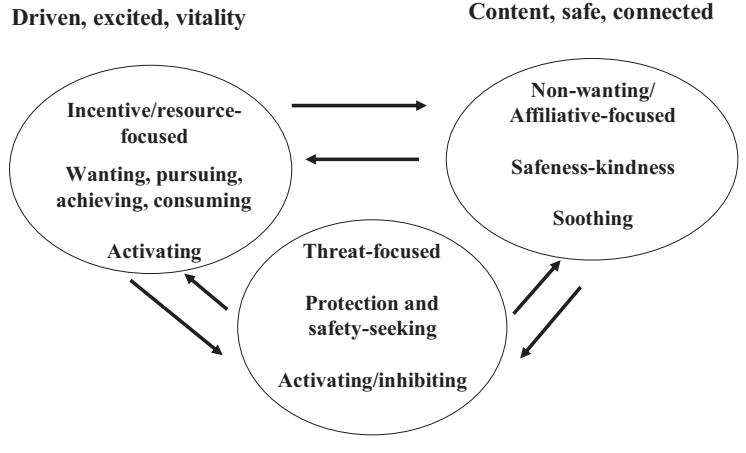
Anger, anxiety, disgust
Figure 1 Three types of affect regulation system
From Gilbert (2009) The Compassionate Mind , with kind permission from Constable Robinson.
The evolution of social behaviour was to have a major regulatory impact on all of these systems. For example, threat systems can be stimulated by threats to others, particularly one’s own offspring, loved ones or allies; joy and excitement states can be stimulated by friends and the pleasure of doing things together; and importantly, soothing and calming can be generated by comfort, support and helpfulness. Indeed, a sense of social safeness is very important to well-being (Kelly et al. 2012).
In essence, we can separate out the passive and active elements of positive affect. The active elements are linked to drive and sympathetic arousal, and the more soothing sense of safeness is linked to the parasympathetic system, keeping in mind that the relationship between the two is complex.
The idea of there being two different types of positive emotion that are linked into active and passive and different degrees of sympathetic and parasympathetic arousal became very important and was to underpin compassion focused therapy (Gilbert 2000, 2010).
Compassion focused therapy notes that our drive emotions can be linked into safety-seeking strategies , where we are constantly trying to do things to stop bad things happening. We are rushing around doing this and that, and we can feel relief when we do those things, but they are not necessarily a source of joyfulness or freedom. We rush around at work not because it’s joyful necessarily, but because we need to keep our jobs and pay the mortgage. But there is also an active form of safeness that is pleasurable and allows us to be joyful, play and have fun, such as when we share jokes at a party of friends or go on holiday. This kind of safeness allows us to feel free to move, free to think, free to act. Safeness allows us to do things. The passive forms of safeness give rise to a sense of contentment, the ability for just being as opposed to doing – for resting. We can just “be” experiencing the present moment with out doing – although purposely focusing on the present moment is a form of doing in a way. What’s important about “safe” passive states is not only their “rest and digest” aspects, but also that when we are able to slow down a little, we bring the parasympathetic system online. This is associated with improved heart rate variability, which has a whole range of benefi cial health effects (Kemp and Quintana 2013; Porges 2007) and is associated with prosocial behaviour (Kogan et al. 2014). Heart rate variability also facilitates better frontal cortical functioning (Thayer et al. 2012). Human Nature and Suffering hinted at these points, as you will see, but was not able to articulate them as clearly as we can today with all of the new research.
Cognition
HN&S also touched on the nature and role of evolved human cognitive competencies, and their impact on suffering – and it is rather amazing, tragic and tricky (Sapolsky 1994). The fact is that about 2 million years ago our ancestors (probably beginning around the time of Homo erectus ) began to evolve a range of cognitive competencies such as language, imagination, systemic thinking, conscious awareness of self, self-identity formation and self-monitoring. Two million years is actually a short time for such major competencies to evolve, and one of the reasons for this runaway evolution is that these competencies – especially social intelligence – had huge advantages (Dunbar 2010). However, it is only in the last 10,000 years or so that these “intelligences” impacted and changed the world with the advent of agriculture, writing, culture and the sharing of knowledge. These cognitive systems also produced completely new ways for human benefi t but also for suffering to emerge. We literally “brought stimuli inside our own head”, responding to symbolic thoughts and images almost identically as if they were happening in the outside world. A moment’s refl ection will reveal that if we lie in bed imagining or rehearsing an argument we’ve had, it will stimulate anger physiological profi les, but these will be very different physiological patterns than if we, on purpose, choose to create a sexual fantasy. Back to social mentalities. What role are we in – or in this case imagining? The key here is that what comes into consciousness, either deliberately or not, and how we deal with that, can play our physiological systems – emotions and motives – like fi ngers on a piano.
Another example highlights how we can hold things in the mind, particularly things that have upset us. Imagine a zebra that escapes from a lion. It will quickly go back to the herd and graze, whereas humans are more likely to ruminate and imagine the worst: “Can you imagine if I’d been caught? Imagine what it would be like to be eaten alive!” And of course we can (under the direction of the threat system) anticipate the worst: “What if there are two lions tomorrow? What if I can’t get to the waterhole? What if my children wander out? What if . . . what if . . . what if . . .?” This is not deliberate recall, but once it enters the mind, it can get stuck there constantly fuelling threat processing and physiological activation. Another example is that we can go through a day where people are kind and helpful to us, but if we have an argument with somebody, then those kindly events are easily forgotten, and we ruminate on the one person who really annoyed us. Cognitive therapy has focused very clearly on this tendency to selectively abstract and focus on threatening things but hasn’t always articulated that this is how the threat actually works. It is not our fault that it does this. In fact, shortly after HN&S was published, a wonderful book by a Stanford primatologist (look him up on YouTube) came out with a book titled Why Zebras Don’t Get Ulcers in which he outlined how our newly evolved cognitive competencies and the cultures they have created combine to (potentially) drive us all crazy and make us sick.
So we now know that these ways of thinking play a really important role in the stimulation and maintenance of mental health problems. And of course there is a huge range of symbols that can stimulate anxiety, such as putting your hand in your pocket and fi nding that you have been robbed of your credit card or passport (credit cards and passports don’t exist in nature), or when someone you want to care for you forgets to send you a birthday card. It is their symbolic representation – the network of meanings that symbols are linked to – that links them to threat system; it is the implicational network that is crucial. It is the same with the self. As far as we know, animals don’t have a sense of self-identity or symbolic representations of themselves, but humans clearly do, which makes us vulnerable to shame on the one hand but also causes us to fi ercely defend our selfidentity on the other. Again it is the implications of certain kinds of judgement that are crucial, and of course at a deep level, it is the implications that are related to survival and reproduction opportunities/threat that are the most emotionally disturbing. For example, events that have implications for any form of social rejection in a desired relationship will have survival and reproductive implications – at least as far as brain processing considers them.
Self-monitoring is also a hugely important evolved competency for human mental functioning. No other animals, as far as we know, can monitor their heart rates and worry about dying, or monitor their emotions and worry about what they are feeling and fantasising. No other animal tries to monitor or anticipate what’s going on in the minds of others, or worries about being disliked or rejected – at least not in the detailed way humans can. Humans constantly self-monitor. While this has advantages, it is also a source for judgements and projections and can be a basis for our ongoing self-criticism.
And, of course, we are fantastically creative problem solvers and have developed culture, science and medicine. It has made us the dominant species, but this same brain, that is a creative developer of solutions, a bringer of medicines, can also develop hideous tortures and the most horrendous cruelties. Humans are amongst the cruellest of species that have existed on this planet – to ourselves, each other and animals. We must always remember that these recently evolved cognitive competencies come with trade-offs, as well as extraordinary and important responsibilities for insight into and regulation of our actions that humans still struggle to take. These new brain competencies are not the creators of emotions and motives that fl ow through the body; they are elaborators and conductors. They are not the orchestra; the actual orchestra is part of the evolved emotional motivational brain.
Learning how better to deal with the orchestra is part of the challenge of humanity. So clearly it’s the use of our intelligence that is going to help us to understand our own brains and begin to gain deeper insights into the nature of human suffering and generate solutions to it. We are a questioning, seeking, restless species and one of the questions all humans ask is: why do we suffer (Gilbert 2009)?
Summing up
Refl ecting back over 30 years, it is interesting how some things have changed and yet others remain the same. Our science of mind is clear that the human brain has some very serious diffi culties as a result of the way it evolved . It’s a tricky brain. The great thing about science is that we can study things as they really are, not just how they appear to be from the outside. As I often say to my students, “It is (y)our responsibility to try to help us understand humanity, the human mind, and the human predicament and the solutions for it; no one else is going to do it; not the physicists, nor the chemists; not the geologists, nor the farmers. Sometimes, physical scientists make fun of psychological science and see it as”not real” science – or sometimes call it soft science. But what many psychologists are concerned with now is to really root our understanding of psychological processes in the systems that give rise to them – the evolved and socially shaped body and brain.
The science of mind can dig deeply into the roots of our suffering and can recognise that the way we treat each other is one of its causes and cures; suffering is created between us, not just in us. The more we understand how this comes about (and of course it’s hardly a new insight), the more it becomes obvious how important it is to use our science to work out how to promote prosocial values and behaviours in our families, schools, workplaces, businesses and governments (Gilbert 2009). The most profoundly important challenge of this century is to promote human fl ourishing through prosocial behaviour and human compassion. Nearly three decades after the publication of Human Nature and Suffering , psychological science is taking the study of compassion and prosocial behaviour seriously, and understanding their fundamental importance in humanity’s future. For me, my personal journey into compassion focused therapy began more than 30 years ago here in a book called Human Nature and Suffering . I hope you enjoy revisiting this with me.
References
Bailey, K.G. (1989). Human paleopsychology. New York: Lawrence Erlbaum. Beck, A.T., Emery, G. & Greenberg, R.L. (1985). Anxiety disorders and phobias: A cognitive approach . New York: Basic Books .
- Beck, A.T., Freeman, A., & Associates. (1990). Cognitive therapy of personality disorders . New York: Guilford Press.
- Bowlby, J. (1969). Attachment. Attachment and loss , Vol. 1. London: Hogarth Press.
- Buss, D.M. (1991). Evolutionary personality psychology. Annual review of psychology , 42 , 459–491.
- Coon, D. (1992). Introduction to psychology: Exploration and application (6th edition). New York: West Publishing Company.
- Depue, R.A. & Morrone-Strupinsky, J.V. (2005). A neurobehavioral model of affi liative bonding. Behavioral and brain sciences, 28 , 313–395.
- Dixon A.K. (1998). Ethological strategies for defence in animals and humans: Their role in some psychiatric disorders. British journal of medical psychology, 71 , 417–445. Published online: 12 July 2011. doi:10.1111/j.2044-8341.1998.tb01001.x
- Dunbar, R.I.M. (2010). The social role of touch in humans and primates: Behavioural function and neurobiological mechanisms. Neuroscience and biobehavioral reviews, 34, 260–268. doi:10.1016/j.neubiorev.2008.07.001
- Gardner, R. Jr (1998). The brain and communication are basic for clinical human sciences. British journal of medical psychology, 71 , 493–508.
- Gazzaniga, M.S. (1989). Organization of the human brain. Science, 245 , 947-952.
- Gilbert, P. (1984). Depression: From psychology to brain state . London: Lawrence Erlbaum Associates.
- Gilbert, P. (1993). Defence and safety: Their function in social behaviour and psychopathology . British journal of clinical psychology, 32 , 131–153.
- Gilbert, P. (1998). Evolutionary psychopathology: Why isn’t the mind better designed than it is? British journal of medical psychology, 71 , 353–373.
- Gilbert, P. (1992). Depression: The evolution of powerlessness. London: Lawrence Erlbaum.
- Gilbert, P. (2000). Social mentalities: Internal “social” confl icts and the role of inner warmth and compassion in cognitive therapy. In P. Gilbert & K.G. Bailey (eds.), Genes on the couch: Explorations in evolutionary psychotherapy . Hove: Psychology Press.
- Gilbert, P. (2001). Evolutionary approaches to psychopathology: The role of natural defences. Australian and New Zealand journal of psychiatry, 35 , 17–27.
- Gilbert, P. (2006). Evolution and depression: Issues and implications (invited review). Psychological medicine, 36, 287–297.
- Gilbert, P. (2007). The evolution of shame as a marker for relationship security. In J.L. Tracy, R.W. Robins & J.P. Tangney (eds.), The self-conscious emotions: Theory and research (pp. 283–309). New York: Guilford.
- Gilbert, P. (2009). The compassionate mind: A new approach to the challenge of life. London: Constable & Robinson
- Gilbert, P. (2010). Compassion focused therapy: The CBT distinctive features series . London: Routledge.
- Gilbert, P. (2013). Attachment theory and compassion focused therapy for depression. In A.N. Danquah & K. Berry (eds.), Attachment theory in adult mental health: A guide to clinical practice . London: Routledge.
- Gilbert, P. & Bailey K.G. (2000) Genes on the couch: Explorations in evolutionary psychotherapy . Hove: Psychology Press.
- Gilbert, P. & Choden. (2013). Mindful compassion . London: Constable Robinson.
- Gilbert, P., McEwan, K., Matos, M. & Rivis, A. (2011). Fears of compassion: Development of three self-report measures. Psychology and psychotherapy, 84 , 239–255. doi:10.1348/147608310X526511
- Gildersleeve, M. (2015). Unconcealing Jung’s transcendent function with Heidegger. The humanistic psychologist, 43 , 297–309. doi:10.1080/08873267.2014.993074
- Huang, J.A. & Bargh, J.A. (2014). The selfi sh goal: Autonomously operating motivational structures as the proximate cause of human judgment and behavior. Brain and behavioral sciences, 37 , 121–175.
- Kelly, A.C., Zuroff, D.C., Leybman, M.J. & Gilbert, P. (2012). Social safeness, received social support, and maladjustment: Testing a tripartite model of affect regulation. Cognitive therapy and research, 36 , 815–826. doi:10.1007/s10608-011-9432
- Kemp, A.H. & Quintana, D.S. (2013). The relationship between mental and physical health: Insights from the study of heart rate variability. International journal of psychophysiology, 89 , 288–296.
- Kogan, A., Oveis, C., Carr, E.W., et al. (2014). Vagal activity is quadratically related to prosocial traits, prosocial emotions, and observer perceptions of prosociality. Journal of personality and social psychology . Advanced online publication.
- LeDoux, J. (1998). The emotional brain. London: Weidenfeld and Nicolson.
- Ornstein, R. (1986). Multimind: A new way of looking at human beings . London: Macmillan.
- Panksepp. J. (2010). Affective neuroscience of the emotional BrainMind: Evolutionary perspectives and implications for understanding depression. Dialogues in clinical neuroscience, 12, 383–399.
- Porges, S.W. (2007). The polyvagal perspective. Biological psychology, 74 , 116–143.
- Price, J., Sloman, L., Gardner, R., Gilbert, P. & Rohde, P. (1994). The social competition hypothesis of depression. British journal of psychiatry, 164 , 309–315.
- Sapolsky, R.M. (1994). Why zebras don’t get ulcers: Guide to stress, stress-related disease and coping. New York: W.H. Freeman & Co.
- Seligman, M.E.P. (1975). Helplessness: On depression development and death . San Francisco: Freeman & Co.
- Slavich, G.M. & Cole, S.W. (2013). The emerging fi eld of human social genomics. Psychological science . Advance online publication.
- Stevens, A. (1982). Archetype: A natural history of the self . London: Routledge & Kegan Paul.
- Thayer, J.F., Ahs, F., Fredrikson, M., Sollers, J.J. III, Wager, T.D. (2012). A meta-analysis of heart rate variability and neuroimaging studies: Implications for heart rate variability as a marker of stress and health. Neuroscience and biobehavioral reviews , 36, 747–756.
- Van Kleef , G.A., Oveis, C., van der Lowe, I., LuoKogan, A., Goetz, J., & Keltner, D. (2008). Power, distress, and compassion: Turning a blind eye to the suffering of others. Psychological science, 19 , 12 1315–1322. doi:10.1111/j.1467-9280.2008.02241.
This page intentionally left blank
Introduction and overview
Despite a radically different view of human psychology than existed in Freud’s day, psychoanalytic theorising continues to exercise a powerful hold over western imagination. Why should this be? There appear to be many reasons, none of which necessarily tells us of the truth or falseness of psychoanalytic formulation. First, at least on the surface, it speaks to us in a familiar language; a language of description which resonates with the personal. We may experience symptoms and desires we cannot explain. We recognise the aggressive and vengeful in ourselves and also the desires to be approved of, loved and respected. Second, it places these personal propensities at its centre, to be explained systematically, and it attempts to provide answers to the contradictory and paradoxical. Third, while it speaks in terms of mental mechanisms as fragmented wishes, desires and fears, it nevertheless offers some possibility for coherence and union. Fourth, it offers a new principle of knowing, based on free association which requires the individual to suspend moral and logical reasoning.
Psychoanalytic theory in common with some philosophical forms of enquiry appeals to our sense of the mythic. We can analyse fi lms and books in terms of archetypal relations; e.g. the journey and trials of the hero, the search for truth, the fi ght between good and evil, the lost anima (animus) object, treachery, deceit and war. These are repetitious human themes of interaction. In these we fi nd mirrors to our own personal lives and those subjects and discourses revealed by the tellers of fi ction and myths. Perhaps, as some suggest, it was his talent for mythic story telling and literary style that made Freud so popular.
And yet for all this, it is becoming increasingly clear that the cure of suffering most often requires action. The behavioural and social learning sciences have impressed on us the vital importance of behavioural confrontation with the feared; the need to strengthen the will to act rather than the power of understanding or insight alone. Indeed, the latter may at times depend on the former. Despite powerful arguments (Wachtel 1977; Erdelyi 1985), these two procedures, the introspective free associative, revelatory and the behavioural are not easily married. Nevertheless, psychotherapeutic practice and theory are becoming more eclectic, trying to pin down the crucial elements that facilitate change (Karasu 1986; Beitman 1987).
2 Introduction and overview
At the time when psychoanalysis was getting bogged down in increasingly jargonistic complexities of the human psyche, and the refi ning of technique (which gradually evolved into increasing distance between patient and therapist) the behaviourists offered new, simpler and more scientifi cally verifi able explanations for suffering. In this sense the operant approach offered (at least superfi cially) a rebuke to individualism and pointed the fi nger at external contingencies. Behavioural therapists suggested that previous contingencies of reward and punishment could result in neurosis. For example, Ferster (1973) argued that the suppression of anger arose from a child’s early conditioning of external punitive consequences to assertive and aggressive behaviour. In other words, the child came to fear the consequences of its own assertive and aggressive behaviour. For these theorists, neurosis was not a thwarting of instinctual drives, but the consequences (usually) of a punitive environment. For them, there was no necessity to consider how a punitive environment interacted with an evolved system of varied mental structures, the activity of which was (presumed) mostly unconscious. Neitzche’s will to power and the existentialists’ will to meaning were rendered the products of personal environmental history.
No theory can be fully understood without recourse to its historical culture of embeddeness (Ellenberger 1970). It is from this source that any direction of enquiry must commence. There would have been little medieval philosophy, no St Augustine or Thomas Aquinas were it not for a set of religious and ethical premises set up by Christianity. Whereas some religious healers saw suffering as the result of transgression (Zilboorg and Henry 1941) Freud saw neurosis as the fear of transgression, the result of a submissive will, fearful of knowing and acknowledging. Thus, for Freud suffering arose from too much adherence to authority, rather than too little. Hence, in his day, Freud became the focus for the loss of prohibition, the liberation of the sexual, the release from guilt and the preference for knowing over ignorance, prejudice and obedience. Up until the 1930s the BBC banned the broadcasting of talks on psychoanalysis and the establishment continued to see sexual desires as needing to be tamed by punishment or cold showers. Homosexual acts were sins against God and worthy of punishment. The institutions of power and the continuance of the culture of command were the way of correct order.
But liberating or not, resonating or not and freeing or not, the psychoanalytic method of understanding the psyche has always been in doubt, and its treatment of suffering even more suspect. Maybe it was not free association and dream analysis or even “the knowing” that cured, but rather the relationship between therapist and patient. Maybe it was the recapture of a certain form of empathic intimacy that made the difference as Rogers, and later Kohut, were to argue. Maybe the Oedipus complex was rare or even irrelevant, as both Jung and Horney argued; and maybe we do not need to have much insight into the structures of mentality in order to work as therapists, as the behaviourists argued. What emerged was a schism between the observed, the pulse that psychoanalysis had put its fi nger on, and the theoretical monuments erected to explain it.
More recently through the work of Neisser (1967, 1976) the behaviourist hold over academic psychology has loosened. The result of this was called a cognitive revolution (Mahoney 1974, 1984). At the same time, new movements in psychotherapeutic endeavour have grown out of the post-behavioural and postegoanalytic period and are marked especially by the works of Beck and Ellis. The post-cognitive revolution has now given rise to a new theoretical paradigm called “cognitive constructionism”, and a recognition that cognition is a biological issue (Maturana 1983; Dell 1985: Mahoney and Gabriel 1987).
However we wish to plot the history of the last fi fty years, there seems to be an increasing wish to return to the grappling with the ageless questions of understanding human beings as coming into the world in states of preparation. What is born after nine months gestation is not a tabula rasa, but a potential human being that, like any other species, be it plant or animal, will, given a genetic and structural suffi ciency, proceed to grow in a species-typical way. What we see in maturation is as much an unfolding as it is a moulding. When we begin to see this unfolding from an evolved perspective and are able to liken and distinguish ourselves from our animal relatives then the full impact of what it is we need in order to grow and fl ourish, both as individuals and as a species, is more easily recognised.
Increasingly, we are beginning also to understand that the brain is constituted of a number of special-purpose units. These may be called small minds (Ornstein 1986), modules (Fodor 1985) or special intelligences (Gardner 1985). These individual, special functional units exert various effects on and through consciousness. They are most easily revealed by experimental research and also examination of the functioning of brain-damaged subjects. The human power of reason is now seen as a special faculty which can operate relatively untainted by personal needs (e.g. mathematical reasoning) or, alternatively can be recruited to fi ll in the gaps of an already crudely formulated reality thrown up by smaller functioning units for the interpretation of experience. Hence, the reasoning of the successful is different from the reasoning of the defeated; the reasoning of the loved is different from the reasoning of the abandoned; the reasoning of the neurotic is different from the reasoning of the psychotic, and the therapist needs to be schooled in these various ways reasoning is put to work. Additionally, the state of the physiological relations pertaining within the brain at any point in time profoundly affects our personal and social logics. This must be true otherwise no psychotropic medication would work, not to mention the power of drugs like LSD or alcohol.
Behaviourism is beginning to grapple with the problem of our innate capabilities for knowing and behaving (Rescorla 1988). The study of facial expressions (Tomkins 1981), innate sensory motor patterns (Leventhal 1984) and the study of the prepared basis for phobia (McNally 1987; Trower and Gilbert 1989) are also examples. It is no longer possible to regard humans as a tabula rasa without a developmental process (Kegan 1982; Goldstein 1985; Mahoney and Gabriel 1987). Watson’s behavioural triumph over MacDougall’s instinct theories, won in the 1920s, is coming to an end (Eysenck 1979; Goldstein 1985). We stand at one of those moments in history where it is possible to integrate what scattered details of knowledge of the human psyche we now possess. Sociobiology, ethology, biology, philosophy and of course, psychology are all enticing us with new ideas that demand an increasingly fl exible theoretical structure capable of dealing with both the evolved prepared basis of human mentality and its medium of modifi cation via the culture in which it comes to express itself. Hence, the complexities of human psychic life stretch out in wondrous diversity as perhaps at no other time in history.
This book is a personal journey through these complexities. It is an attempt to articulate the basic strands of human nature that can both resonate with the personal and yet be objective. In this I try to explain the basis of human suffering as arising from maladaptive deviations in the expression of our individual humanness. Such a grandiose scheme can never fully achieve its aim and this book must denounce any claims to be fully comprehensive. In casting such a wide net, it is sadly the case but inevitable, that there are parts of the net where the mesh is extremely fi ne and loosely woven. However, I hope this will not detract from the overall sketch that is given.
Outline
Chapter 2 begins our journey by examining some of the general issues pertaining to sociobiology and the implications some of these have for our understanding of our evolved mental structures and capabilities. It is argued that there are four main classes of biosocial competencies (called biosocial goals) which account for much of our susceptibility to suffering. These are labelled as care eliciting, care giving, co-operating and competing. In Chapter 3 different approaches to the study of human nature are taken up. These include archetype theory, ethology, interpersonal psychology and cognitive psychology. In exploring these themes, we will note how the issue of dominance (captured by Neitzche’s concept of the will to power) and also the role of affi liation versus hostility appear to be prominent mental capabilities co-ordinating the personality. Chapter 3 also provides the basis for the theoretical rationale for analysing systems of defence and systems of safety (although in our discussion of defence systems, we are talking in ethological rather than psychoanalytic terms).
In Chapter 4 we examine various subdivisions and psychobiological mechanisms of the defence and safety systems, which have special-purpose capabilities for dealing with different contexts. We will argue that there are different kinds of threats that social animals have to deal with such as predators and conspecifi c threats. We will also note how conspecifi cs can confer safety as well as threat. We will try to illuminate the role of psychobiological factors, showing that the mental and biological must be integrated to avoid our study of psychopathology becoming either a brainless or mindless science (L. Eisenberg 1986). Chapter 5 examines peripheral physiological systems and shows that the pre-existing physiological state of an animal has a major impact on the response it emits to excitatory stimuli. Towards the end of this chapter I also present a view called the defensive drift hypothesis which suggests how various symptoms tend to become locked together. In Chapters 6 to 13 , each biosocial goal is considered in turn. This offers a detailed look at the biosocial goals of care eliciting, care giving, co-operating and competing. These chapters are in pairs, the fi rst looking at the biosocial goal and the second examining the kinds of sufferings and disorders that can relate to distortions in that goal. In our fi nal chapters I will try to bring these various threads together and use a systems analysis for the construction of the self based upon the activity of these various aspects within the human psyche.
This then is the brief sketch of the book. At various times in the writing I have been confronted with a profound sense of ignorance which has been so strong as to make me wish I had never started the journey. However, in the end I have taken the view that a sketch must only be a sketch and hopefully a focus by which others may come to modify and also to appreciate the concepts and theories being developed in other areas apart from their own. This book is, above all, an attempt to illuminate Mind as an expression of evolution.
We put much too narrow a defi nition on personality! Our personality, we tend to believe, is only that part of ourselves which we regard as individual, as deviating from the norm but we, each and all of us, contain within us the entire history of the world, and just as our body records Man’s genealogy as far back as the fi sh and then some, so our soul encompasses everything that has ever lived in human souls. All gods and devils that have ever existed are within us as possibilities, as desires, as solutions. If mankind were to die out except for one halfway gifted child, who had been taught nothing, the child would rediscover all history; it would create gods, demons, paradises, commandments and prohibitions, the old and new testaments.
Hermann Hesse: Refl ections, 1979 p.86
A legacy from the past
The role of human nature
Historical background
Freud’s birth in 1853 preceded the publication of Darwin’s Origin of Species by three years. From our present standpoint it is sometimes diffi cult to appreciate how profoundly the acceptance of the idea that species are transformed through time (evolve) was to change Western thought. This change in our conceptualisation of ourselves, our history and our relationship to other animals set the stage for much of what was to come in modern psychology (Weiner 1972; Gilbert 1984). Like all major shifts in meaning-making this one had been building for some time by a gradual accumulation of threads of evidence from different directions.
Linnaeus (1707–1778) had noted certain uniformities in the structural forms of many animals, which he regarded as evidence of God’s “ideal ground plans”. The discovery of fossil evidence laid in rock strata, and questions concerning the probability that some animals have become extinct were issues long pre-existent to Darwin (Weiss and Mann 1975). In fact, the idea that species transform and change through time can be traced back to early Greek philosophy and Tson-Tse, a sixth-century Chinese philosopher who wrote: “All organisms are originated from a single species. This single species has undergone many gradual and continual changes and then given rise to all organisms of different forms. Such organisms were not differentiated immediately, but on the contrary they acquired their differences through gradual change, generation after generation.” (Ellenberger 1970, pp.229–230).
This idea suggested 1200 years earlier, caught the scientifi c imagination and became an acceptable paradigm because of a gradual accumulation of evidence to support it. In this, Tson-Tse had not been so fortunate. For Darwin, the case for evolution – species transformation – had to be argued against strong religious traditions of species fi xedness as created by God. As Freud grew in this challenging and changing intellectual atmosphere, Karl Marx had published his Communist Manifesto and Frederick Nietzsche, among many others, had attacked Christianity for its profound suppression of aspects of human nature, especially desire and passion. Christian morality separated fl esh and spirit and perpetuated the belief that through struggle, the control of the former advanced the latter. Nietzsche had articulated the consequences of this split with its attempts to suppress innate predispositions of human nature. One is impressed by Ellenberger’s (1970) depiction of Nietzsche as a prominent predecessor to many psychoanalytical theories (Gilbert 1984).
With hindsight, it is clear that Freud neither discovered the unconscious (it had existed as an idea for many hundreds of years) nor was he the fi rst to propose that the repression of the evolved, primitive aspects of the mind was the source of madness (Ellenberger 1970; Whyte 1960). Nevertheless, with the desperate wish to be a discoverer, Freud set about developing a structural model of the mind which both allowed and explained the operation of primitive predispositions as products of earlier evolutionary stages (referred to collectively as id) within unconscious mechanisms.
By 1890 neither the idea that psychological processes could occur outside consciousness nor the theory of evolution were particularly controversial. Indeed, Ellenberger claims that negative reactions to Freud’s early papers were primarily because his ideas were not new. Many of the subsequent controversies over Freudian theory lay with Freud’s attempt to integrate these two different conceptual aspects of human nature (evolution and unconscious) and his focus on fantasy data as a method of exploration. Thus, it was in areas such as displacement, symbolisation, mechanisms of libido, energy transfer and so on that his opponents found most to criticise. Because the unconscious has become so identifi ed with Freudian analysis many critics of the concept of the unconscious have shown some ignorance in not realising that they are generally criticising a particular model only. Not surprisingly, the role of unconscious processes has made a comeback (Dixon 1981, Mandler 1985, Brewin 1988). Although behaviourists have been the most critical, there is nothing in classical conditioning theory that explicitly rules out associations operating below or outside consciousness. Indeed, a rather different view might be taken dependent upon the age at which associations occur (Jacobs and Nadel 1985). Recently, Erdelyi (1985) made a fascinating attempt to integrate analytical, cognitive and conditioning paradigms.
In the immediate post-Darwinian era, it is not surprising that the mechanisms of species transformation reappeared as unconscious motives within psychoanalytic thinking. For Freud, the individual served two purposes: the preservation of the species and the preservation of the individual. From the clash of these two evolved directives, or rules (inherited and acquired), arose the predisposition for psychopathology. Much has now been written on the way in which neurosis represents some kind of uneasy solution to the confl ict of unconscious wishes with those permitted in specifi c social environments, and we will not engage a detailed treatise here.
Freud’s contemporaries took differing views on the importance of evolutionary mechanisms behind neurosis and the mechanisms of the unconscious. In 1909, Freud was invited to give a series of papers in America at Clarke University. (For an interesting discussion of Freud’s general approach to these lectures see Efron 1985). Following this presentation William James wrote to his friend Theodore Flournoy “I hope that Freud and his pupils will push their ideas to their utmost limits, so that we may learn what they are. They cannot fail to throw light on human nature”. (Evans and Koelsch 1985). Hence, there seems to have been a general enthusiasm for Freud’s attempt to look at human nature through an evolutionary lens. As to the specifi cs, and by this we may imagine James had Freud’s view of the unconscious in mind, he said “I can make nothing in my own case of his dream theories and obviously symbolism is a most dangerous method.” Later, James was to say that the notion of the unconscious could be regarded as a “scientifi c tumbling ground of whimsies”. Thus, on the issues of the evolved nature of humanity and the question of the unconscious, James at least took differing views on Freud’s psychoanalytic theory and its methods. Nevertheless, unconscious processes (as distinct from the rarifi ed entity of the unconscious) are clearly linked to evolved CNS structure (Mandler 1985). If we are to progress in our understanding of psychopathology, then Freud’s endeavour should be rekindled, but with a different methodology and in the light of new theories and evidence.
There is a further aspect to Freud’s thinking that we would be advised to seriously reconsider. This was his concern to understand the psychobiology of neurosis. Many theorists abandoned this effort and hence gave scant regard to symptom clusters that are clearly the result of disturbed physiologies. Freud, until the age of forty, was fi rst and foremost a neurologist and it was from this direction that the tone of psychoanalytic theory was set. Moreover, Freud had experimented often with the use of cocaine and some, like Gillie (1981), have argued that it was from Freud’s use of cocaine and his own introspective methods that many of his ideas were developed. Indeed, in 1909, James is believed to have said “I strongly suspect Freud, with his dream theory, of being a regular hallucine”. (Evans and Koelsch 1985). Of course, Freud was not the fi rst and not the last to erect complex theories of the mind, and even the nature of reality from drug-induced experiences. The use of LSD in the 1960s produced a multitude of books describing altered states of consciousness and reality. Some continue in this fi eld (Grof 1985). It is undoubtedly the case, however, that it was Freud’s neurobiological concepts that set the conceptual style of the psychoanalytic model.
It is notable that few of the early breakaways concerned themselves much with the details of Freud’s neurophysiological axioms, even though many analytical theories and ideas were based explicitly on them. Yet Freud was interested in how the neurophysiological processes transformed evolved predispositions into the symptoms and syndromes of neurosis. Freud attempted to describe a comprehensive model of these interactions and worked with haste on the Project for Scientifi c Psychology in 1895. Although this was never completed to Freud’s satisfaction, many scholars believe that it was this work and the ideas developed at this time that were the well from which he drew many of his ideas (McCarley and Hobson 1977).
If the breakaways, especially Jung and Adler, did not concern themselves with the neurophysiological side of Freudian thinking they certainly shared with Freud the spirit of the times. This concerned the basic premise that psychopathology had to be understood within an evolutionary context. For Jung, heavily infl uenced by Nietzsche’s philosophy, but suspicious of Freud’s libido theory, there were the concepts of the collective unconscious with its archetypal components. These were seen as evolved and inherited aspects of the human mind and as such they were present and potentially active in every member of the species. He made important distinctions between the collective unconscious (the contents of which were totally inherited and need never have been conscious) and the personal unconscious, the contents of which, now repressed, had at one time been conscious. More recently, sociobiologists (Wenegrat 1984) have recognised that archetypes are useful and important ethological concepts. Stevens (1982) also offers an ethological analysis to the concept of archetype.
In Adler we see the concern with competitive (often sibling) elements, the struggle to overcome inferiority and for power and dominance; again arising from a concern with the innate predispositions within humanity. Adler had a number of evolutionary assumptions and models of human nature, although he was signifi cantly more interested in the importance of social interaction and education. Adler’s individual psychology, through the work of people like Karen Horney and Albert Ellis, has had a notable impact on interpersonal and cognitive psychotherapy developments.
A key issue on which the breakaways departed from Freud was related to the issue of libido as a primary causal mechanism, or fuel of neurosis. Indeed, many analysts would seem, perhaps erroneously, to have given short shrift to the sexual aspects of analytic theory (see Efron 1985 for a comprehensive and fascinating review). However, there was little disagreement on the importance of understanding the evolution of human nature as a key to understanding psychopathology. But time is a great destroyer of trails and with the passing of years, psychotherapeutic practice became increasingly detached from the original assumptions and spirit of the age from which they had grown. The central concern with how phylogenetic infl uences operated in psychopathology was lost in more and more esoteric theorising. There was a gradual but continual detachment from concern with both the physical (and sexual) body (Efron 1985) and evolutionary structures of the mind. Psychosomatic medicine became a poor relative to psychoanalysis. It has been comparatively recently that mind–body interactions have again become an important area of study, as for example in stress research and the role of attitudes to heart disease and cancer. It is fair to say, however, that like Freud, Pavlov’s ideas of classical conditioning were in the realm of psychosomatics and recent work on the conditioning of immune response promises to be of considerable importance (Ader and Cohen 1984; Engel 1986).
Nevertheless, most analytic theorists followed a path that seemed to lead further and further away from consideration of psychobiology, with the unconscious being the central focus of interest, theory and speculation. Scientifi c language, almost incomprehensible to those not schooled in the jargon, became the order of the day. Scientifi c study was by-passed or given up in exchange for a more esoteric and social process. Indeed, debates still rage as to whether psychoanalysis is, or can be, a science. This disdain for science, in preference for case studies used to expand theories, was a fatal mistake and opened the door for laboratorybased psychologies of behaviourism to gain ascendancy in academia. 1 Nevertheless, while the methodology and procedures of analysis may be unsatisfactory it is erroneous to believe it has nothing to teach us. Today we fi nd major schools of psychotherapy erecting complex theories of psychopathology with no concern whatsoever with the fact that humans are evolved animals with physical bodies. Furthermore, many schools of psychotherapy are rather silent on issues of the evolution of social behaviour and its relation to forms of psychopathology. The idea that certain forms of cognitive appraisal relating to attachment or power motives have a biological basis is absent from most cognitive models. Hence, the fact that certain social behaviours represent the expression of evolutionary solutions and have neurophysiological mediators and correlates is often ignored. The body has been relegated to a machine operated by the punch codes of thoughts, fantasies or behaviours. In fact, the birth of the computer has produced a cultural schematic shift in our construction of mind–body relations.
Berman (1986) in an excellent paper has highlighted the not inconsiderable dangers to this current cultural style of meaning-making. If the philosophy of dualism led medicine to lose its mind, much psychotherapy has lost its body! The essential tensions and paradoxes of mind and body, objective and subjective experience are not easily bridged. Many who have tried have ended up dissolving the bridge with false models requiring evaporation (however sophisticatedly done) of one or the other (Berman 1986).
In many schools of psychotherapy terms and ideas from an earlier age remain, like “energy transfer”, “inferiority” and the like, but with a tendency for these to fl ap in a theoretical breeze having lost the foundations from which they grew. Recently, cognitive psychotherapy has become suffi ciently robust to take up once again the issue of the evolved structure of the mind and study the importance of biological mechanisms and the various predispositions to disorder. (Beck et al. 1985; Gilbert 1984). Attachment theory, as we shall see, has also been one of the few exceptions in that its theory is evolution-based and it has spawned considerable physiological research. Ethological theories are also beginning to bridge this gap (Gardner 1988; Price 1988).
From a historic point of view, we are confronted with two central problems. First, humans stand at the end of a long phylogenetic road where structural alteration has occurred in relation to evolutionary processes. Second, the adaptive behaviours that fl ow out of these evolutionary inventions are in large part co-ordinated and controlled by biological processes designed to perform certain functions. In the remaining part of this chapter attention is given to the fi rst of these considerations.
Biosocial goals
In line with the views expressed by Fox (1986), we can pursue the investigation of biosocial goals as vehicles to inclusive fi tness. In other words, sucess in the pursuit of biosocial goals facilitates inclusive fi tness. This being the case, biosocial goals can be investigated as sources of motivational mechanisms in their own right. But fi rst a few words of caution. When we try to cut Nature at its joints we immediately run into trouble. This is because evolution tinkers with the system adapting old and pre-existing structures and capabilities, rather than developing something entirely new for each adaptation. Consequently, the pursuit of each biosocial goal will be co-ordinated within general arousal systems which facilitate invigorated goal behaviour or inhibitory-disengagement behaviour. But the behaviours, cognitions and affects that are activated depend on the goal that is being pursued. Furthermore, there can be confl ict in the pursuit of different biosocial goals, or indeed confl ict over different strategies and tactics to secure the same goal.
So far, evolution has been discussed as a process of social selection. This has given rise to the propensity to exhibit various communicative states (Gardner 1988; Chapter 3 , this volume) but people are motivated to behave in ways that appear not directly social; the most obvious are the avoidance of pain and injury in its various forms and the pursuit of food, warmth, shelter, etc. Some researchers have suggested that biological goals or needs may be stacked up in some hierarchical fashion (Maslow 1971). These range from physiological needs (food, warmth, shelter and so on) to social and self-actualising needs. But even for something as apparently straightforward as the avoidance of pain, the social context may be powerful enough to override this. In my own case, as a boarding school sufferer, talking after lights out was a caneable offence. In some dormitories pupils would take turns to own up to this appalling crime and get caned whether or not they had offended. Much prestige was gained or lost by such a preparedness.
In this analysis the distinction between social and non-social goals is made without any view being offered as to their hierarchical arrangement. In my view, it is the bio social goals that are the most important sources of much of human psychopathology. Generally speaking, mental distress resides in navigating the social challenges of life; in developing and articulating self constructs and behaviours that are inherently relational. These are often more profoundly involved than diffi culties in securing physiological goals or needs. 2
This is by no means a watertight position. Various monosymptomatic phobias need not be social. Moreover, insofar as panic disorder can arise from abnormal physiological arousal, consequent to misinterpretations of physical sensation (e.g. hyperventilation; Beck et al. 1985) a case can be made for non-social psychopathology. But by and large, the vast majority of mental distress, from personality disorder through to depression, social anxieties and various psychoses, may be viewed as representing diffi culties of self in relation to others. These diffi culties may arise from endogenous (biochemical) sources which mediate communicative states and/or from cognitive or contextual sources which carry important information as to the short- or long-term threat to the capacity to derive desired social outcomes (e.g. status, respect, love, care, non-persecution and so on). Even in patients who fear death it is not unusual to fi nd that the common theme igniting most affect is related to a sense of abandonment and isolation from loved others (the world carrying on without them).
In my view then, we can identify, in a crude form, four distinct types of biosocial goal. These are care eliciting, care giving, competitive (power) seeking and co-operating. Each biosocial goal will be looked at from a psychological point of view in separate chapters in this book. Here, we wish to outline the idea of biosocial goals in a limited form to provide a conceptual map for the rest of the book.
Evolution and the brain
In my view the brain evolved primarily as a meaning-making system with the purpose of facilitating behaviour. Behaviour evolved solely for the purpose of maximising survival and the execution of competent inclusive fi tness strategies. In other words the brain is an information processing organ capable of creating meaning from stimulus arrays, but in such a way that appropriate survival and inclusive fi tness strategies can be selected and enacted. The basic structures of the brain can therefore be investigated as a kind of phylogenetic history of meaningmaking and inclusive fi tness enactments.
It is useful to note that the nervous system lies along the dorsal surface of the human body because of evolution in the sea some 400 million years ago. This basic design has never changed and is the design for just about all life forms with nervous systems. Around 250 million years ago land-living reptiles appeared and this transition from sea to land marks one of the important transitions to human evolution. As we shall now note, any full understanding of human mental life must include consideration of our reptilian beginnings. MacLean (1985) has presented some important ideas on the basic mechanisms and behavioural patterns of the lizard in regard to inclusive fi tness behaviours. Many of these basic behaviours can be viewed as power-competitive which facilitate advantageous control over resources by the acquisition of control via power over conspecifi cs. 3 Dominance is often the medium for the control of access to preferred nest sites, food and sexual partners, i.e. control over survival and reproductive opportunities. These include the establishment, guarding and marking of territory, ritualistic display of challenge and threat, the guarding of mates and nest sites, and so on. 4
MacLean notes that many of the ritualistic displays of the lizard are not dissimilar from phenomena like the military goosestep of humans. It is as if there are various phylogenetically old components of basic behavioural patterns which are still operative in human behavioural repertoires. These phylogenetically old patterns may well have been adapted and added to in order to meet the requirements of evolutionary change but are still detectable and operative in humans. (See also Morris 1977 for discussion on the consistency of display behaviour.)
Indeed, MacLean (1985), from his long series of research studies, has suggested that the human brain is divided into three basic components ( Fig. 2.1 ). The oldest he refers to as the R-complex, or reptilian brain. This is the site of a complex assembly of behavioural repertoires which serve the reptilian reproductive strategies. These strategies are mostly individualistically competitive. The R-complex also exerts powerful control on attention and arousal. Recently, evidence has been accumulating to suggest that our reptilian brain is the source of many of our pathologies and destructive acts. Furthermore, that it is far more involved in the construction of our personal and social meanings than we would like to admit. A provocative and fascinating account of the implications of these ideas has recently been given by Bailey (1987). He says, for example (p.63):
. . . We must acknowledge that our species possesses the neural hardware and many of the motivational–emotional proclivities . . . of our reptilian ancestors, and, thus our drives, inner subjective feelings, fantasies and thoughts are thoroughly conditioned by emanations from the R-complex. The reptilian carry-overs provide the automatic, compulsive, urgency to much of human behaviour, where free will steps aside and persons act as they have to act, often despising themselves in the process for their hatreds, prejudices, compulsions, conformity, deceptiveness, and guile.
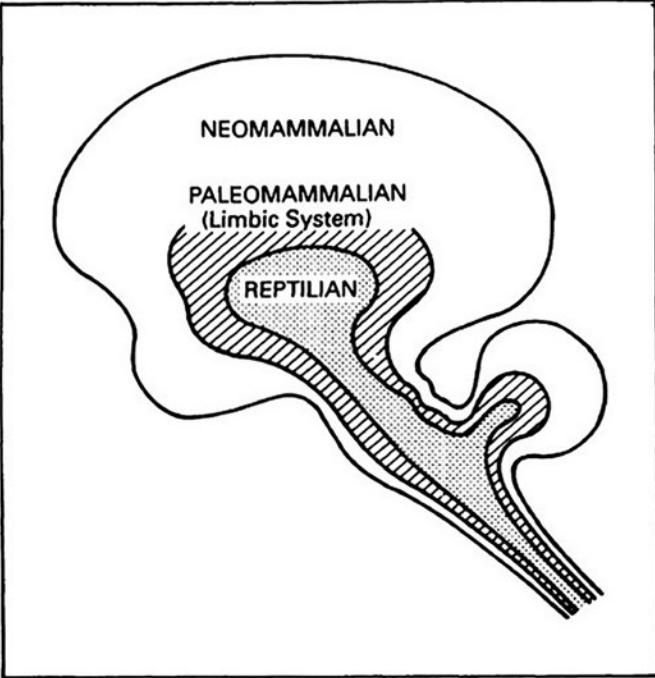
Fig. 2.1 Components of the human brain. The forebrain evolves and expands along lines of three basic formations that anatomically and biochemically refl ect ancestral commonalities with reptiles, early mammals and late mammals
(From MacLean 1985).
Some of these characteristics became inhibited by evolved inclusive fi tness strategies encoded in higher (limbic and cortical) brain areas. Nevertheless such inhibitory control can be weak or easily overridden producing phylogenetic regression (as Bailey 1987, calls it).
The evolution of new ways to secure gene advancement via live birth in mammals was accomplished with the development of the limbic system. In this second component is a complex pattern of structures which facilitate care eliciting (distress vocalisation) and care giving. The complex patterns of emotion necessary for such prosocial and attachment repertoires are to be found here. At the same time, the limbic system exerts some inhibitory control over the R-complex. The limbic system also facilitates play behaviour in siblings and limits serious competitiveness. Nevertheless, this inhibition is not perfect and sibling rivalry, especially for parental attention, does occur (see pages 281–284). The third major development is the neomammalian brain. The enormous advantage for symbolic representation, planning, foresight and linguistic communication resides here. As MacLean (1985) suggests, the ability to plan for and have insight to the needs of self and others provides a major leap forward.
Importantly however, the co-ordination of these complex repertoires and capacities, laid down at different points in evolution, is not straightforward or always easy. The power of higher centres to inhibit lower centres is important but various combinations of behavioural patterns, arising from old and late evolutionary adaptations are possible, indeed, likely. When spoken of in these terms it seems we are not too far away from Jung’s concept of archetype, although we may wish to investigate it rather differently.
It is of some interest that a number of psychiatric disorders may represent maladaptive amplifi cation of some of these phylogentically old dominance-type behavioural patterns. Jealousy disorder, for example, may be considered in such light. Individuals with this disorder have diffi culties in allowing their “mates” to wander. They are permanently on guard, so to speak. Considerable attentional attunement (e.g. looking for evidence of cheating, checking up on the movements and associations of mates) is directed by these mechanisms (i.e. a form of bottom-up rather than top-down information processing). Most of the behavioural patterns outlined by MacLean are social to the extent that they are designed to be expressed for the purpose of intraspecies communication, i.e. to be exhibited to members of the same species. Hence, a central propensity that runs through the evolutionary process is one of “power” and control over others for (social) advantage.
Competition
In this presentation I refer to competition primarily in terms of individualistic behaviour (unless explicitly stated otherwise). Competition exists in at least three major domains of social life: (1) competition for natural resources (food, water, nest sites etc.); (2) intra-sexual competition for mates; and (3) intersexual competition (see page 15). Individualistic competition in this book refers to those situations in which one individual is in direct (personal) competition with another for some resource or desired outcome, and where part of the strategy is often to impede the other’s chances of acquiring these resources or outcomes. That is, the aim is to gain (selective) survival advantages. In other words I compete with others when I steal, cheat, attack, humiliate, or put down the other; my success has negative consequences for the other. I increase my control of access to desired outcomes and reduce those of the other. This is the domain of hostile dominance (see pages 59–61). In addition to impeding the other, competitive behaviour may be aimed to control the other (e.g. enforce compliance to my desires, wishes, needs etc.). In the human arena where males and females are pursuing similar goals, competition between members of different genders may be just as likely as between members of the same gender. Finally within some contexts (e.g. marriage) competitive behaviour to control the behaviours of the spouse may be rife.
Co-operation
Gradually however, individualistic competitiveness (dominance–power seeking) appears to become adapted and modifi ed in species that, to a limited extent, are able to associate themselves for prosocial interactive behaviour. This has necessitated the evolution of social signals (e.g. smiling) that indicate friendship and no threat. These are both innately and culturally determined (Morris 1977; Chance 1980; Eibl-Eibesfeldt 1980). In Gardner’s (1988) terms there is a change in the laws that govern spacing and linkages. The early prototype of mammalian cooperative behaviour may be play (McLean 1985).
This is not the place to offer a phylogenetic history of the evolution of cooperativeness (see Crook 1980) and it is discussed in more detail in Chapters 9 and 10 . Here, we simply accept this as an evolutionary adaptation to primitive individualistic competitive acts. Co-operation, when evolved to the level of providing social rules, results in the division of labour. Hence, resource exploitation, for some species, involves complex interplays of individualistic competitive behavioural patterns and co-operative ones. The skills required to function co-operatively as a member of a social group often require training and a preparedness to learn species-specifi c co-operative practices and skills. This presents a new and important concern since individualistic competitive (i.e. power) behaviour has to be modifi ed by the demands for co-operative action (e.g. group hunting). Lizards do not do this but humans have built complex social systems and rules of justice to facilitate cooperative action. Indeed, the role of law in human society is specifi cally designed to inhibit exploitation by those with power over those without.
Many social-philosophical treaties have been written on this subject. Karl Marx, who believed he was writing the social evolution of human culture, tried to consider social contexts that would entirely override individualistic competitiveness in preference to a fully co-operative and non-exploitative society. However, any social system which does not allow for confl icts of interests, as communism for example fails to do, will have diffi culties. The essential dialectic and confl ictual process of individualistic competition (power) versus co-operation has engaged many minds as one of the great problems of human nature yet to be resolved (Foucault 1984). Any social theory of human social relations that stubbornly refuses to see humans as evolved animals will come to grief.
It is of importance nevertheless to recognise that evolutionary adaptation proceeds with solutions that solve certain ecological challenges. Consequently, social context will be a powerful co-ordinator and elicitor of different behavioural patterns. It has been shown for example, that whether managers act competitively or co-operatively with subordinates is signifi cantly infl uenced by the social context in which such action takes place (Tjosvold 1985).
In summary then, we can suggest that co-operativeness evolved as a strategy for a particular kind of resource exploitation within social and ecological contexts. More specifi cally, it can be viewed as an adaptation to individualistic competitiveness.
Care eliciting and care giving
The second major adaption to individualistic (power) competition has been the evolution of nursing. As MacLean points out, many primitive species do not recognise their own young and are cannabalistic. Gene survival depends on the numbers produced. However, this strategy changes over evolutionary time in such a way that there is a switch from quantity to quality. 5 MacLean (1985) argues that a quantum leap occurs with the evolution of infant–mother nursing; the genetic offspring are recognised and their survival is facilitated through nursing and caring. With the evolution of live birth and maternal care, a new set of complex social behavioural patterns evolved. The advantage of this shift has been enormous, allowing, among other things, for prolonged periods of dependency during which an infant is afforded some protection from predators and, via suckling mother’s milk, from infectious and other diseases. This period of dependency also allows a safe exploration of the environment and interaction with peers to acquire social skills and insight. The parent acts as a mediator and safety signal to the infant. These issues are discussed in more detail in Chapters 6 , 7 , 8 and 9 .
A rough classification
This very brief ordering of phylogenetic concerns suggests a rough nosology. We can speculate that with the evolution of brain structures to accommodate increasingly sophisticated patterns of social behaviour, there emerged at least four types of biosocial goal which acted as proximate mechanisms for inclusive fi tness. The fi rst of these is the biosocial goal of direct competitive advantage via the exhibition of power (primitive Alpha PSALIC – see next chapter). During evolution, with the capacity to exploit increasingly varied ecological contexts and social environments, this goal became modifi ed and ritualised and was accommodated within the propensity for co-operative action. Co-operative goals have been so successful for human individuals that now many humans are highly motivated to join teams, to belong to groups; to have a sense of identifi cation through groups, to share interests, to exchange information, pool ideas with others and so on. Hence, the medium of the biosocial goal of co-operation is sharing. Good co-operators will be advantaged in certain contexts, especially those related to the need for reciprocal altruism as in the context of hunting or grooming (parasite removal) (Crook 1980).
The third biosocial goal is, in ontogenic terms, the fi rst goal of life. This is the goal of care eliciting. A mammalian infant invariably dies if it is not cared for during the early part of its life. Hence, care eliciting (the ability to recruit help and life-sustaining resources by various signals) must be the goal of early life. The fourth goal therefore, arises conjointly. Adult individuals must be biologically motivated and prepared to care for their young, otherwise the care-eliciting systems would be pointless.
This admittedly rough nosology is outlined in Tables 2.1 and 2.2 . These tables show how the various biosocial goals of competing and co-operating, care
| Competing | Co-operating | ||
|---|---|---|---|
| Biosocial Goal | Dominance/power: Increase access to resources and resource holding (RHP) |
Increase resource availability & environmental exploitation through joint action |
|
| Social Strategy | Interpersonal competition: engage others directly or indirectly in contest for resources. In humans: seeking symbols of power |
Helping/sharing: preparedness for division of labor; doing different tasks to achieve objective (e.g. by hunting); reciprocal altruism |
|
| Typical Affects (Negative) |
Anger, resentment, shame, envy, humiliation, evaluation anxiety through to defeat/ depression |
Evaluation anxiety, anger guilt, regret, remorse |
|
| (Positive) | Assertive excitement from winner’s elation (success) through to mania |
Friendly love (group), satisfaction, fun, trust, empathy |
|
| Cognitive (Negative) |
Focus on evaluation of threat to or loss of power/control; fear of defeat, attack, criticism |
Focus on evaluations of inability to “play one’s part”, fear of punishment/exclusion from group activities, letting others down |
|
| (Positive) | Focus on evaluation of having power/control; others following/listening to “me” |
Focus on evaluation of good party member, loyalty, confi dence in following social roles; can be replied upon; having value to others (SAHP), morality |
|
| Behaviour (Negative) |
Submission, compliance, appeasement hide, retreat; or attacking belittling |
Withdrawal, refusal to give what would be helpful to others |
|
| (Positive) | Challenge, preparedness to demonstrate aspects of competency from intellectual to physical strength; assertive displays |
Helping, sharing, compromise: planning jointly with others future projects, etc. Resource gathering for sharing; teaching, reassurance, friendship displays |
|
| Typical Evolved Social Context |
Self/other contest for limited supplies |
Self/other contest for limited supplies (parasite control?) |
Table 2.1 Competing and Co-operating
eliciting and care providing give rise to specifi c behavioural affective and cognitive patterns. When any particular goal is activated there will be certain patterns of behaviour, cognition and affect that will steer the organism along a path which facilitates the acquisition of the goal. Hence, the activation of care-eliciting goals will tend to activate behaviour directed towards fi nding a supportive or caring other; the activation of dominance–power goals will activate a seeking for the means to guard, defend and obtain power over others.
| Care-eliciting | Care-giving | ||
|---|---|---|---|
| Biosocial Goal | Nurturance from signifi cant others |
Nurturance given to others | |
| Social Strategy | Proximity seeking/ maintenance: elicit from others what is necessary to support, continue or advance life; access to providers |
Proximity/respondent seeking: preparedness to mediate the environment on behalf of others; provision of resources (e.g. food, tactile and verbal comfort, safety or information as context requires) |
|
| Typical Affects (Negative) |
Yearning, separation, anxiety, anger, tearful dysphoria, through to serious depression |
Mediated through sympathy mechanisms; anxiety, distress, anger; inadequate |
|
| (Positive) | Secure, content, comfort, pleasure, joy, intimacy, relief, gratitude, trust |
Secure, content, pleasure, joy, intimacy, relief, compassion |
|
| Cognitive (Negative) |
Aloneness, beyond help; focus on need for others; attentional search for proximity cues |
Focus on what “I” can do to relieve distress; attentional processes aimed at matching giving distress-reducing outputs with effectiveness |
|
| (Positive) | Help at hand; trusting to/ in others. Have control over mediators; attend to other goals |
Focus on the sense of being a good provider, helper, comforter, listener, etc. |
|
| Behaviour (Negative) |
Distress call, searching, agitated psychomotor activity through to retardation; verbal expression of distress; complaints, requests, demands, etc. |
Other approaching or seeking; invigorated activity of caring but which is not required; over protection or caring intrusion |
|
| (Positive) | Behaviour liberated to secure other goals, explore |
Confi dent, nursing, caring; attunement with recipient of care |
|
| Typical Evolved Social Context |
Infant/care giver | Infant/care giver |
Table 2.2 Care-eliciting and Care-giving Goals
Affects as incentive monitors
The presence of affective arousal prevents animals from acting as “out of sight, out of mind”. An animal does not stop fl eeing once a predator is out of the visual fi eld. Emotional states ensure that an animal continues its behaviour long after an immediate threat is out of the sensory fi eld. Emotional states tend to change more slowly than cognitive processes. For example, following a near-miss car accident we may remain in a shaken-up or anxious state long after we cognitively realise that we have survived. Sometimes these kinds of experiences can ignite other kinds of psychopathological diffi culties (see Yalom’s (1980) personal example). One patient revealed how a car accident had activated a fear of being alone and a fear of the dark, something she had not had since a child. The biological response to a stress (e.g. cortisol) may activate other fears coded in the stress state.
The capacity for emotions to maintain a behavioural pattern (e.g. running away) lies partly 6 with the physiological processes underlying the affect. The arousal of affect involves complex neurophysiological and hormonal changes and these take time to settle back to some homeostatic state. Following the death of a loved one, individuals may continue to “search” for the lost other in spite of logical recognition that the dead person is gone. In fact, new affects may be required before highly valued incentives are disengaged (Klinger 1977). In other words, affects help both in maintaining the pursuit of incentives and in the giving up or the switching of incentives (Scheff 1985). Affects help then to (re)focus many cognitive, attentional and behavioural processes that are relevant to incentive pursuit.
Affects as amplifi ers
Tomkins (1981) has suggested that: “the primary function of affect is urgency via analogic and profi led amplifi cation to make one care by feeling.” (p.322) He suggests that this function should not be confused with attention or response, but should be seen as an amplifi cation of urgency: “without affect amplifi cation nothing matters and with its amplifi cation anything can.” (p.322) He proposes that affects can become co-assembled with various incentives and response profi les to give urgency to responses. Although Tomkins provides a most comprehensive analysis of the amplifi cation function of affects, in its main thrust it is not dissimilar to other analytical reviews. Freud, borrowing ideas from the philosopher Brentano, suggested that perception was not a passive process, but was endowed with psychic energy (Ellenberger 1970, p.542). More recently, Zajonc (1980) has suggested that affective judgements are heavier on energy than are purely cognitive judgements. Such a view is reminiscent of nineteenth-century concepts. The role of affects as amplifi ers is a very important function.
Affects as the road to value
Many theorists suggest that it is affect that provides us with a sense of value (Tomkins 1981). The manner in which incentives become valued relates to their affective properties or consequences (Klinger 1977; Plutchik 1984). Mandler (1985) outlines three types of value: (1) innate value based on approach/avoidance tendencies; (2) cultural and social values based on the acquisition of cultural rules bestowing value on objects or relationships; and (3) structural values arising from the cognitive evaluation and structuring of relationships and features of objects. Affect is involved in all three types of value. MacLean (1985) suggests that much of our capacity for affect arises from limbic system activity. Stimulation of various parts of these brain areas can induce feelings ranging from fear and rage to ecstasy. This presents us with a problem, since perceptions of what is “real”, “true” or “important” may depend on activity in the limbic system. As he says: “It is one thing to have such an animalistic brain to assure us of the authenticity of food or a mate, but where does confi dence lie if we must rely on this same brain to supply the feeling of belief and conviction in regard to our neocortically derived ideas, concepts and theories?” (p.412)
It is in the paradoxical nature of things that those who are most seriously ill or those for whom psychotherapy may have least to offer are those who appear the most certain. The neomammalian structures may only come to our aid when we allow room for manoeuvre, when we can doubt all things; otherwise we may hand over control to lower brain centres and reasoning becomes no longer a matter of problem solving but of faith and emotional commitment. Under these conditions, logic is recruited to fi ll in the gaps, to back up a position already taken as fact. Beware the true believers. 7 It is, of course, as in all things in Nature, a question of balance. Without affect would we have the energy to carry our beliefs through or, maybe, be bothered with them overmuch?
We can also suggest that affects relate to different domains. They can be recruited into task pursuit, maintaining behaviour according to moral belief systems and codes and can be self-evaluative.
Motives and affects
So far we have suggested that biosocial goals evolved from inclusive fi tness and give rise to motivational systems necessary for interpersonal interaction. In an important sense biosocial goals are similar if not identical to primary motives. Just as the motive in many games is to score points, we can also say that the goal (aim) of the game is to score points. In this book we are concerned with social goals. It is important, however, to be clear of the distinctions between emotion and motivation. Plutchik (1984, p.214) has outlined some of the salient differences. These are outlined in Table 2.3 .
Emotions are in the service of motives (biosocial goals). They energise and predispose to action. Emotions can co-assemble with motives in idiosyncratic ways (Tomkins 1981). But without a motivational base, emotions would not be aroused. The young infant experiences emotion to the presence or absence of
| Emotions | Motivations |
|---|---|
| Aroused by external stimuli | Aroused by changing internal states of the organism |
| Aroused by the presence of a survival related event |
Aroused by the absence of homeostatically signifi cant stimuli. |
| There are few “natural” objects in the environment toward which emotions are automatically directed |
There are specifi c “natural” objects towards which motives direct the organism (e.g. food and water) |
| Induced after an object is seen or evaluated |
Induced before process of search is begun |
| Depend on events in environment which may occur on a random basis |
Tend to have a rhythmic character |
| Table 2.3 Distinction Between Emotions and Motivations | |||||
|---|---|---|---|---|---|
| – | – | – | – | – | ——————————————————– |
care givers because he is born motivated to target behaviours to others, elicit care and interact with them. As Plutchik (1984) points out, learning can modify emotion in a number of ways. First, individuals may learn to inhibit the expression of emotion. Second, an individual’s day-to-day experience effects the arousal of the emotions that he will become used to. Third, reinforcement history effects the strength and stability of emotion and also the blending of emotion. Basic emotions are not learned but refl ect the genetic endowment of a species and individuals. 8
Models for the interaction of cognition, behaviour and affect
Over the last ten years there has been debate in the literature over the independence or otherwise of cognitive processes versus affective processes (Lazarus 1982; Rachman 1981, 1984a; Zajonc 1980, 1984; a good selection of papers covering these issues can be found in Scherer and Ekman 1984). Greenberg and Safran (1987) have explored the therapeutic implications of these debates in detail. Recently, two interesting models have been proposed which attempt to outline the interaction between cognitive and affective processes.
Buck (1985) has suggested that emotional systems can be viewed as serving three basic functions. The fi rst and most primitive he labels as Emotion I: this is concerned with general homostatic and physiological adaption processes. As such, it is essential to the functioning of various neurochemical and endocrine processes. The second function of emotion, Emotion II, arises out of the evolutionary requirement to negotiate a social world with communicative, affective displays. The third function of emotion, Emotion III, is to provide animals who have cognitive capabilities, with information about motivational state. Emotion may then become a source of information. Indeed in various forms of psychotherapy penetrating the meaning of affect (e.g. by trying to elicit images and pictures in the mind) is a key process for change. Cognitive processes may inhibit or amplify emotional states in line with long-term aims derived from the capacity for foresight and planning.
Another fascinating and potentially highly productive approach to investigating the interaction between affect, cognition and behaviour has been represented by Leventhal (e.g. 1984). He distinguishes between three kinds of affect systems:
- 1 Sensory-motor. This is viewed as the “elementary core of emotional processing”. It is an innate motor system which appears to function from birth. Infants respond, even at 36 hours, to different adult facial expressions (sad, happy) with different motor patterns which are accompanied by different autonomic responses. Leventhal suggests that these major patterns are “a basic vocabulary of emotional response and experience.”
- 2 Schematic emotional processes. The repeated stimulation of sensory-motor patterns provides a set of non-verbal associations and memory structures from episodic experiences. However, one should be slightly cautious here, since there are various types of memory, some of which may not be fully operative until certain stages of biological (e.g. hippocampal) development (Jacobs and Nadel 1985). Nevertheless, the idea that schematic emotional processing capacity arises out of innate sensory motor structures is an important one. It may be that learning facilitates neuronal connections between sensory-motor patterns and other limbic systems. These then add to sensory-motor experiences degrees of affect amplifi cation to stimuli associated with sensory-motor activation. Leventhal believes that emotional schemata are “tightly integrated structures of eliciting situations, subjective feelings and expressive and autonomic activity.” He argues that these kinds of schematic processes are rapid and automatic. He goes on to suggest that: “It resembles recognition and intuitive preference, not reasoning, because there is no need for the eliciting stimulus or the choice process to enter conscious awareness. Attention is required only to bring the eliciting stimulus into the receptor fi eld. Once a component of the schemata is activated, the other components are activated instantly.” (1984, p.276)
- 3 Conceptual processing. This level relates to the ability to refl ect on past emotional experiences which are accessible to linguistic structures. It also allows for the capacity of voluntary performance of emotional acts. This level involves self-awareness and insight and conscious knowledge of predictable consequences, i.e. it functions as a conscious and voluntary system. It can activate emotional schemata but in so doing may become less voluntary in the process, i.e. we may be able to “think” ourselves into emotional states, but in so doing (i.e. once affect is strongly aroused) our voluntary control may be weakened.
Complexes
This hierarchical system bridges evolutionary, conditioning and cognitive views of affect interaction. (For a recent development of this theory see Leventhal and Scherer 1987). It has been considered to have great potential in aiding our conceptualisations of psychopathology (Greenberg and Safran 1984, 1987). I would like to add two ideas for further consideration. First, the concept of emotional schemata may have some parallels with the Jung’s and Adler’s concept of a complex. Complexes (taken at their simplest) were viewed to be collections of memories, images and attitudes which were held together by affects. Complexes could function relatively autonomously and, when unconscious, gave rise to strong affects, images and compulsions which the patient had diffi culty in explaining or coping with. The second point is that we might profi tably give more time to parallel processing, at which the brain, unlike the computer, is very good (Crick 1979). I shall expand on this briefl y at the risk of taking a digression.
It may be that there are innate sensory-motor patterns that are selectively attuned to different confi gurations of stimulus information. The reader may guess that I am going to propose certain classes of feature detectors related to the four biosocial goals I have outlined. In other words, there are innate mechanisms sensitive to cues signalling distress (care eliciting), care giving, competition and co-operation. These mechanisms may work at preattentive or preconscious levels. These need not all be available at birth but may come on line with biological maturity (e.g. as with the recognition of strangers). Moreover, various elaborations of gestures such as hand shaking and so on may be learned as culturally transmitted information regarding an individual’s threat or non-threat (Morris 1977; Eibl-Eibesfeldt 1980). Voice tone may be another such stimulus. The innate feature detectors will sample information in each of the biosocial domains to provide information as to whether an individual is attempting to elicit care, is attempting to provide it, is attempting to compete and exert power or is co-operating. For example, when we form relationships, there may be complex sequences going on in parallel which alert us to the potential attractiveness, competitiveness or caring qualities of a person. In other words, social information processing is multi-channelled and concerned with a variety of biosocial issues. We may be attracted to someone because they appear confi dent and capable, but less sure of how caring they may be. Sometimes people give us a sense of unease or discomfort without our exactly knowing why. But in all probability, one of our biosocial goal feature detectors is picking up on non-verbal communication which may be amplifi ed by emotional schemata (à la Leventhal). This means that different affects may be recruited into different but parallel processes monitoring competitive threat, co-operative availability, caring and care eliciting. In consequence we may experience approach/ avoidance confl icts or dilemmas to the extent that we are attracted by, say, a person’s knowledge and standing and would like to avail ourselves of his competencies, but at the same time are concerned at his potential to be competitive and to make us feel inferior.
Hence, there is probably parallel processing covering a variety of different biosocial concerns. Each circuit that monitors for competitiveness or cooperativeness in other people may activate different emotional schemata residing in different brain areas. The most positive relationships we share with others are probably those in which there is some degree of harmony between our main biosocial concerns. But this is often not the case and different parallel processes operating in the service of both social and non-social biological goals may come up with different affective evaluations. Which we attend to most closely in consciousness and base our action on is a complex matter. In other words, people may be literally in two minds, or indeed, many.
Finally, combining a view of parallel processes with Leventhal’s original views may help us to understand more about why some patients appear to have anxieties that they regard as illogical. One of the problems here may be competition in parallel multi-channel processing. This can present many diffi culties. Patients may say they know it is illogical for them to feel anxious or to engage in the repetitive behaviours that they do, but nevertheless they are compelled to do so. It took me a little time to realise that the behavioural view that patients do not believe that their anxieties are rational was incorrect. In fact, most patients are unsure and are often in two minds about it, not fully convinced one way or the other. In therapy, in the presence of a caring other it may be that voluntary control over emotional schemata is more powerful, and they can see the irrationality of their behaviours, but when these patients are alone fears of survival may be more powerfully disinhibited. Limbic activation is greater and the ideas do not now seem so irrational. This is not the place to engage in a detailed discussion of these kinds of issues. Suffi ce it to say here that we have examined some models of emotion which are of great interest and which may be tied in with the theory of biosocial goals and inclusive fi tness.
Concluding comments
This chapter has spread a broad net. We began with an overview of Freud’s post-Darwinian approach to mental mechanisms. In fact, all of the early analysts grew up in a European climate heavy with the new theories and ideas of evolution, Marxian social economics and Nietzsche’s philosophy. These individuals looked at human affairs on a grand scale. Counterposing this was a scientifi c approach to human affairs based on positivism which selected, dissected, experimented and recorded; this was the source from which behaviourism grew. The former approach sought large-scale (macro) systems and answers. The latter preferred a piecemeal approach, limited to what could be (directly) observed and gradually accumulating facts that would hopefully all fi t together some day. Many critiques for and against these differing approaches have been, and continue to be, made. Some of these have been co-operative, seeking to refi ne, adapt and develop insights from both sides. Others have been competitive, with the wish to smash the opponent’s view out of sight.
There is little doubt that reinforcement is a powerful shaper of human beings. Yet there are salient differences between the horse shoe crab, the rat and the human being. Humans have evolved the capabilities for an enormously complex social life, a fact that some place at the centre of theories of mind (see Farr 1987; and Chapter 14 of this volume). In fact, this social evolution can be found in many mammals of both land and sea. Humans are not a tabula rasa on which environment is the only author of life’s scripts. The themes that concern us today are echoes of the Greek tragedies where love, deceit, heroism, trust and loyalty continue to dominate our personal and social lives. Culture changes the details but not the themes. Consequently, the way love or power may be expressed in one culture may be completely meaningless in another. Eskimo men lend their wives as a form of co-operative relationship. A full American Indian head dress would not signal much to my colleagues (except that I may need a little less imipramine). But the fl exibility and creativity of human beings do not alter the fact that all human beings share the same nature. The blends may vary, but the underlying deep structures do not. Some cultures amplify some aspects (e.g. competitive individualism). Other cultures amplify different aspects. Since the social life of humans is so overwhelmingly important to healthy functioning, we would be advised to try as best we can to keep both the “approach on a grand scale” and the “dissecting scientifi c” approach in some kind of partnership. Each without the other renders either meaning without facts or facts without meaning. Meaning resides within the person; facts reside within shared knowledge (between individuals).
Keeping our attention on the evolution of social behaviour, it is possible to posit the existence of biosocial goals which serve inclusive fi tness. These goals in turn are serviced by emotions (energisers) and incentives. Cutting through a great deal of complexity and controversy, and at the risk of oversimplifying, it has been suggested that the biosocial goals of human beings are of four types. These are care eliciting, care giving, co-operating and competing. Although individuals may co-operate within a group structured around a central theme or value (a shared idea), we have been less successful in fi nding ways for groups to co-operate, especially when values are not shared. Unless we solve this diffi culty, we may not last long enough to see how things might have worked out or to learn about the evolution of intelligence in other parts of the Universe. As Sperry (1986) points out, human values are linked to goals, and the science of human values is very much called for in our new age, confronted as we are by immense socio-economic inequalities and confl icts. He articulates how such a science may commence. In one sense, I hope this book aids this endeavour in some small way by showing that at root we are all more similar than different. What evolution has done to bring us to our current position is the road to human salvation. The development of attachment and co-operative capabilities giving rise to empathy, compassion and friendship is our ticket to continued success. The obstacle seems to be the cultural amplifi cation of shadow, the intoxication with old, reptilian power struggles as solutions to confl ict.
Notes
- 1 Gardner (personal communication) has suggested that the analytical movement did not so much “disdain” scientifi c method, but rather failed to acknowledge that different groups must agree on what constitutes “evidence”. It was this lack of consensus about evidence that provoked so much controversy. Moreover, many analytic theories were formulated and articulated in a manner which makes their scientifi c testability and refutability diffi cult, if not impossible. Nevertheless, many branches of science are able to infer the presence of phenomena long before the technology exists to directly observe or experimentally test for them.
- 2 This should not be taken to mean we can ignore the serious consequences of poverty, malnutrition and the intense anxieties and depressions related to economic hardship. However, these seem self-evident and a deliberate focus on the social dynamics of life does not mean that economics are in any way unimportant (see for example Conger 1988).
- 3 The term “competitive” is used here (unless otherwise stated) to refer to the psychological meaning, not the biological meaning. In other words, “competitive” refers to the action of individuals who are engaged in direct struggle to win status or dominance over others. These terms however, remain vague (see Ellyson and Dovidio 1985).
- 4 Of course, many primitive (especially aquatic) species do not adhere rigidly to territorial boundaries, but evolution adaptation needs to be viewed as a ladder or chain which, for humans, begins with land-based reptilian life forms.
- 5 This adaptation is controlled by what are called R-selective factors, “intrinsic rate of natural increase” and K-selective factors, “caring capacity of an environment” (see Crook 1980, p.45 for a more detailed discussion).
- 6 I say “partly” here because it is known that a fair degree of desynchrony can occur in cognitive, behavioural and affect systems (e.g. see Weiner 1985).
- 7 In cognitive therapy patients are often asked to rate degree of belief in any particular idea. The strength of a belief may (especially in the presence of high arousal) relate to an attitude’s amplifi cation by limbic activity. Drugs which work on the limbic system may reduce “certainty” of beliefs.
- 8 For further information on the psychobiology of affect see Pribram (1980). Also at the time of going to press Frijda (1988) has published “The laws of emotion” which gives a different approach to the conceptualisation of emotion to that outlined here.
The mapping of human nature
In the previous chapter, it was suggested that biosocial goals were vehicles to inclusive fi tness. Furthermore, these goals give rise to motivational systems and are involved in the structuring of the CNS (Fox 1986). This chapter examines various approaches to the study of human nature. Each of these approaches, in their different ways, attempts to map out some basic ground rules of human nature; to answer the question “What has evolution made of us?” From the start I should disclaim any attempt to be comprehensive but rather I offer something of a personal bias to this exploration.
We begin with one of the theorists who has had an important although often unrecognised impact on many. This is the work of Carl Gustav Jung (1875–1961). Jung’s introverted interests in mysticism, the soul, life after death and so on were the target of ridicule by the scientifi c community. This is unfortunate, since many of Jung’s ideas are most useful, even though we may wish to reconceptualise them in the light of modern data and concepts. Following this, some recent ethological models are considered, followed by Leary’s (1957) model, and lastly, a cognitive approach.
Jung’s theory of archetypes
Jung believed that the human mind is made up of different constituent parts. These he labelled “archetypes”. For Jung, humans inherit a nervous system designed by evolution to function according to the evolutionary strategies of the species. That is, humans respond and make meaning from certain kinds of experience; being mothered, joining a peer group, selecting a mate, becoming a parent, growing old, and dying. Although Jung was erroneously Lamarkian in some of his ideas, as Hall and Nordby (1973) point out, Jung’s theory is entirely consistent with Darwinian theory. Just as humans are biologically prepared to learn, use and understand language, so other attributes of human social behaviour are prepared for. In these ideas Jung was following the philosophical traditions of Plato and Kant.
Although exact defi nition of “archetype” remains unclear (Ellenberger 1970; Hall and Nordby 1973; Stevens 1982; Samuels 1985), approximate defi nitions can be made. In my understanding, the concept of archetype suggests the existence of special-purpose, data processing capabilities, for making meaningful interpretations out of certain kinds of input. They represent a potential ability, a potential for the construction of meaning; like a computer program waiting for instructions (data) which will then perform certain operations on the data to provide meaningful responses. These programs are wired into the system from birth, ready to unfold and become articulated by life’s experiences. Jung (1972, pp.13–14) himself puts it this way:
. . . . The archetype in itself is empty and purely formal, nothing but a facultas praeformandi, a possibility of representation which is given a priori. The representations themselves are not inherited, only the forms, and in that respect they correspond in every way to the instincts, which are also determined in form only. The existence of instincts can no more be proved than the existence of the archetypes, so long as they do not manifest themselves concretely. With regard to the defi niteness of the form, our comparison with the crystal is illuminating inasmuch as the axial system determines only the stereometric structure but not the concrete form of the individual crystal. This may be either large or small, and it may vary endlessly by reason of the different size of its planes or by the growing together of two crystals. The only thing that remains constant is the axial system, or rather, the invariable geometric proportions underlying it. The same is true of the archetype. In principle, it can be named and has an invariable nucleus of meaning – but always only in principle, never as regards its concrete manifestation. . . .
One of the problems with archetype theory, as Samuels (1985) points out, is that there has been a tendency to make archetypes into entities. Just as the ancient Greeks made gods out of interpersonal processes (hence, they worshipped the god of war, the goddess of love and saw deities controlling many human interactions) so archetypes (which actually co-ordinate construct systems mediating meaning-interpretative, affect and behaviour) were personifi ed. To some degree this tendency to personify has been to provide explanatory systems for patients rather than to convey meaning about the nature of archetypes. Hence, individuals may more easily understand and gain insight into their own dynamics by labelling certain processes “persona”, “shadow” or “hero”, but this should not be taken to mean that these sub-personalities actually exist in any rarefi ed form. The degree to which these functional properties of the mind might be located in specifi c brain areas is unknown. In my view, archetypes relate to biosocial goals and strategies and modes of social interaction (e.g. dominance, nurturance, etc.). To make entities of them would involve making the same errors as the Greeks who personifi ed war, love and so on via the construction of gods.
Among the most central archetypes are those related to: (1) the persona – the predisposition to form a social role model for self which fi nds acceptability in the eyes of others; (2) the anima (or female characteristics of the male) and the animus (male characteristics of the female) which relate to the predisposition to be capable of behaviours typical of the opposite gender. This idea mirrors the Hindu view that each personality contains a masculine and feminine aspect. Hence, men, via the mobilisation of their anima would be capable of nurturing and compassionate behaviour, and women, via the mobilisation of the animus, would be capable of competitive and heroic behaviour. In fact Jung used these terms in two different ways. The fi rst was to describe psychological attributes of gender contained within the opposite sex, as described above. The second referred to the “ideal images” that individuals have of the opposite sex (i.e. the characteristics of one’s ideal man or woman). This latter usage may fi t with the fi ndings that suggest there are indeed innate aspects to mate selection (Buss 1988); and (3) the shadow – the predisposition to conceal (sometimes even from the ego) the less pro-social or persona-threatening qualities of the personality. Archetypes then, are ways of “knowing” and responding to the world and are also internal generators of fantasy (e.g. fantasising being a very famous rock star relates to the hero archetype; fantasies of one’s ideal woman or ideal man to the anima and animus, etc.).
Jung believed that each archetype had a positive and negative pole. That is, it could function positively and creatively in a system of social relationships or it could function negatively and be destructive. 1 Hence, the mother archetype for example, functioning positively facilitates growth and development in the eliciting object (e.g. the infant). When this archetype functions negatively, nurturance is withheld, leading to problems in the infant’s development.
In fact, the way archetypes operate in social interactions and are developed by experience, can be illuminated by considering the child–mother situation. Suppose that an explorative child interacts with an anxious, overprotective mother. The interactive style arises from the temperamental exchange of both parties. If the explorative child comes to experience his mother as inhibiting, constraining and confi ning of his own explorative nature then the mothering experience may be internalised as that – inhibiting, constraining, confi ning. Given that there may (or may not be) a mother archetype (or special-purpose processing capacity for structuring care-giving experiences) then what is activated in the child is a representation of mother which is inhibiting. Later in life, should this archetype (or special-purpose processing capacity) be invoked by, say, relationships with other women (or times when nurturance becomes necessary), then the activated aspects of the mother archetype will be the fi lter through which the relationships are structured and evaluated.
Note that the interactive styles of each – mother and child – feed each other. If the child protests against his mother’s overprotective caring, this may be evaluated as a rebuff, igniting evaluations of self as a bad or rejectable mother. The mother may then resort to all kinds of tactics, like guilt induction, to have her child conform with her own image of how a child should be in order to confi rm herself as a good mother; i.e. the child can elicit the negative pole of mothering from the mother. Thus, we may imagine that out of the interactional style grow various self-evaluations for both parties. Furthermore, it is from interaction that complexes are formed (Hall 1986 gives a clear insight into these processes).
The child, when adult, may succeed in fi nding culturally accepted outlets for his explorative temperament, but still be caught in some confusion in close relationships. This is because the experience of being mothered affects the child’s anima and his perceptions and appraisal of other women. Closeness (or dependency) may again activate fears of confi nement and the individual swings between searching for close relationships and disengaging or becoming highly controlling when they are found. In such a case it may be found that the fear relates to assimilation versus autonomy. Closeness seems to threaten with assimilation and constraint, when the individual cannot be free without feeling guilty or losing control to the other. Being autonomous, however, threatens aloneness. A neurotic strategy may be to fi nd spouses who are easily controlled. The only problem here is that such spouses do not rescue the patient from his dilemma but usually maintain it. These kinds of confl ict would relate to a mother complex (see also Jung 1972 for further discussion of the mother complex and its relation to psychopathology).
Needless to say, a child of different temperament may experience an overprotective mother quite differently. On the other hand, a more temperamentally inhibited child may fi nd an easygoing mother problematic for all kinds of reasons to do with security, and as a result develop a different set of neurotic problems. Hence, the temperament of both child and mother affect the interactional style, but it is the interactional style that is incorporated and puts the fl esh on the archetypal skeleton, and builds complexes.
What emerges from this analysis of interactional style with archetypal development is that it may be the “goodness of fi t” between care giver and child that determines what he subsequently fi nds acceptable about himself and what he does not. The goodness of fi t therefore places the blame (if there be such) on the interactional style (goodness of fi t) rather than either the individual mother or the individual child. A good fi t of care giver and child may provide few opportunities for confl ict (Stevens 1982). The less confl ict, the less the child may come to regard aspects of himself (or the other) as unacceptable, or threatening or bad. This may help to explain why different children in one family may have different problems (Plomin and Daniels 1987). The goodness of fi t depends critically upon the child’s innate temperament which the parent tries to mould (Crook 1980). Goodness of fi t may also be affected by factors such as birth order, the timing of certain traumas and separations, how different temperaments react to these traumas and separations, how parents react to their children’s reactions and so on. Therapy offers a new opportunity for acceptance of the forbidden or feared aspects of self by encouraging exploration in a safe and acceptable relationship (Mackie 1982). Hence, the way in which therapist and patient match up may have an important bearing on the therapy.
Ethological approaches to human nature
Ethologists have long been in the business of trying to identify fundamental rules which underlie animal behaviour. Unlike laboratory-based psychologists, ethologists study animals in their natural habitats and gain insight into the nature and function of various behavioural repertoires as expressed within these environments (Morris 1977; Crook 1980; Hinde 1982; Chance 1980, 1988). From the long years of study, various systems of classifi cation of function have been proposed. These relate to major classes of behaviour such as bonding, mating, fl ocking, competing and so on. As Hinde (1982) points out, unlike those interested in immediate causation of particular responses, ethology is more concerned with the observation and description of forms of behaviour in regard to function and survival relatedness. It was from ethology and not Jung that Bowlby (1969, 1973) developed many of his concepts of attachment behaviour. But attachment is only one class of interpersonal behaviour. For a full understanding of human nature one would need a theory which was much more encompassing and broad. For this one must look for underlying mechanisms controlling social behaviour. As Gardner (1988) points out, brought down to the basics, social behaviour is about linking and distancing.
It is not possible to cover all the fascinating ideas provided by the ethologists in this short chapter. Rather, I will focus on what, to me, are important attempts to systematise a broad description of social interaction according to the various classes of behaviour and which have special relevance to understanding human suffering. Psychopathologists who have approached human suffering from this direction note the overlap with Jungian notions of archetypes (e.g. Ohman 1986).
In a series of papers, the ethologist Michael Chance (1980, 1984, 1986, 1988) has reviewed evidence suggestive of the idea that human mentality consists of two basic systems. These he calls agonic and hedonic. They represent the outcome of evolution working on both individual and group-interactional processes. To understand these systems they need to be outlined separately. I will argue that the agonic and hedonic modes are expressions of particular subsystems of defence and safety. Following this we will look at the implications of these two systems for the structure of social attention.
The defence system
The defence system is essentially concerned with the avoidance of all forms of threat, injury and attack. It is a self-protective system with attentional, evaluative, affective and behavioral components designed to protect the animal. The defence system has a number of subsystems which Chance (1984) divides into individual and breeding. Here I have divided them into non-social and social. The social defence systems are referred to as territorial and agonic.
The safety system
Many psychopathologists who use ethological and evolutionary theories tend to be narrow in their focus by selecting one system for special study. In so far as one is interested in specifi c questions, e.g. those arising from learning theory (Ohman et al. 1985; Ohman 1986; McNally 1987), this may seem fair enough. But I doubt that they will be able provide comprehensive insights unless we take the human being as a whole. As we have seen, there are three forms of defence, but there are also three forms of safety. Hence, anxiety and other forms of psychopathology relate not just to the degree of threat in the environment but also to the degree of safety.
The attachment system
The attachment system evolved to reduce aversive arousal in the defence system in species where infants could not defend themselves. The presence of an attachment (parental) object mediates between the environment and the infant. Food, shelter, warmth and protection are afforded by the parent. We shall look at the attachment system in greater detail in Chapters 6 – 9 . Here however, we simply bring to the reader’s attention the fact that the parent acts (among other things) as an agent of safety. In his/her presence the infant is able to explore the environment without major shifts of defensive arousal. In this way, attention is liberated away from defensive concerns. This facilitates the possibility of rapid learning during which protection is given. Under threat, there is an innate switch of attention to calling and searching for the object of safety, e.g. the parent. Reunion, under normal conditions, is positively reinforcing (relief), reduces arousal and, after a period of time, infant exploration recommences. Hence, in most mammals, threat to the infant not only involves rapid shifts of arousal but also we see a new defensive response – safety seeking from another social object (parent). Hence, the attachment system is basically one for the provision of safety, and the control and termination of defence system arousal.
This leads to an interesting hypothesis. The attachment system evolved in part as protection against predation. The anti-predator system involves rapid shifts of arousal related to immediate threat and physical danger to the infant. The parent acts to reduce all major physical dangers to the infant. If this is true then maybe we have a way of explaining why some conditions, which involve rapid shifts of arousal (possibly related to cognitive misinterpretation), will activate the distress call and safe-other seeking. What could be suggested here is that the increases of arousal that are associated with disorders such as panic are due to the activation of a rapid short-term escape system. This system is activated by either low thresholds for activation and/or by interpretations of physical dangers to the self. The response to this shift of arousal would activate the distress call because in evolutionary terms these two input–output systems are biologically co-assembled. In other words, the distress call evolved as the response to the fast arousal antipredator system of the infant. It is also the case that panics can increase in contexts of aloneness (i.e. absence of attachment objects). Aloneness seems to reduce an individual’s sense of safety.
Agoraphobia in this scheme relates to the failure of the safety system to control explorative behaviour. Agoraphobics suffer from anxiety related to travelling away from the home base, which is usually accentuated by the presence of strangers and/or high density (proximity) of others. Various situations which block access for escape reliably activate anxiety in these people. As for the infant, so for the adult; safe (attachment) objects may be suffi cient to provide cues of a modicum of safety. The main focus for the agoraphobic is access to the home base. Other safe objects may include cars or even bicycles. Agoraphobia often proceeds from panic where the individual fears becoming incapacitated by anxiety (e.g. of having another panic) which may provoke an unsuccessful dash for home (at least in fantasy). However, avoidance behaviour need not necessarily relate to high arousal (Rachman and Hodgson 1974; Weiner 1985).
Enough has been said to provide the reader with a fl avour of the interactive nature between defence and safety. Anxiety can be triggered by either an increase of fear (external physical danger) or a loss of safety (which at one level are opposite sides of the same coin). Hence, we can see how the person who is punished for exploration (e.g. by parents or spouse) may fi nd exploration no longer a safe activity. Most clinicians will have come across agoraphobic patients whose hidden anxiety is in leaving a spouse or partner. There are two fears here: (1) what will happen while they are away – will the house be damaged or attachment object leave or die?; and (2) possible aversive consequences, e.g. anger from another for exploring. In these contexts, inhibition of change and exploration relate to anticipated possible aversive consequences of change and leaving the home base or what might happen on the person’s return. Behaviour therapy that does not deal with the anticipated aversive consequences of exploration may be less successful than when fear is only of external danger. In the former case, it is not unknown for assertiveness training, dealing with marital and separation issues (combined with a behavioral exposure programme) to be effective. These cases however, tend to be more chronic and diffi cult to treat because separation anxiety and relationship diffi culties often play an important role. In other words, some agoraphobic conditions are to do with the loss of the ability to explore safely and this in turn may relate to many factors which produce anticipated aversive consequences to exploration.
The hedonic mode
The hedonic mode is marked by reassurance signals given between conspecifi cs (Chance 1988). The social structure is one of mutual dependence rather (as in the agonic mode) mutual defensiveness. Whereas in the agonic mode arousal tends to be high (e.g. with braced readiness) and priming of self-protective behaviours, the hedonic mode is arousal reducing, and maintains arousal at lower levels. It facilitates increased proximity to social others and deactivates the defensive behaviours which would otherwise be aroused by close proximity. This allows for a safer exploration of the social environment without a major preoccupation with potential threat from within the social domain. Perhaps the earlier forms of this mode of social transaction occur in mother–child interactions. Under threat the child seeks out the mother who, under normal conditions, is able to reduce arousal by stroking, holding and cuddling (see Chapter 6 ).
Chance (1980) has shown that in some primates, especially chimpanzees, the hedonic mode of social communication predominates group interactions. In these transactions, there is the capacity to send various signals indicating “no threat.” But these signals are reassurance signals, not submissive appeasement. This is marked by much physical contact, stroking, hugging, lip smacking and sharing. The social interactions are more relaxed, as are the individual members of the group, and there is much focus on physical contact. This is in marked contrast to other more primitive primates, where the agonic mode dominates social behaviour. Associated with the hedonic mode of social interaction is an accentuation of co-operative behaviour especially exploration and problem solving. Chimpanzees often split up into small groups for foraging (Power 1986, 1988). Hence, the social behaviours arising from the hedonic mode are basically those of confi dence giving, mutual support and reassurance. These are quite different, indeed the exact opposite, of those of the agonic mode in which the structure of the social organisation is basically based on dominance and defence. These three subsystems of the safety system are summarised in Table 3.2 .
The structure of attention and mental mechanisms
A crucial aspect of Chance’s (1988) theory is his analysis of the patterns and structures of social attention and the development of mental mechanisms arising out of the different systems (agonic and hedonic). In the agonic mode, the focus of attention is towards the centre, the dominance hierarchy and to those animals from whom threat may come. Any new approach behaviour must include some awareness of the whereabouts of these animals. In other words, the pre-attentive mechanisms are threat sensitive. This limits both capacity and time that can be allocated to attend to other explorative ventures. Chance (personal communication) suggests that when the agonic mode dominates attentive processes (i.e. the individual is in an agonic state), it does not allow just any information to come in but is rather focussed on cues signalling threat. In humans, where this mode is dominant in the personality there tends to be reduced fl exibility and limited change over the lifespan. Rather, the person is restricted to habitual (usually defensive) forms of behaviour and to cling to old values. Furthermore, arousal tends to be high. Given the increasing experimental interest in the relationship between neuroticism and attention (Matthews and MacLeod 1987; Eysenck 1988), the possibility that neurotics more easily recruit defensive and agonic mental processes becomes fascinating.
The structure and patterns of attention in the hedonic mode are quite different to those of the agonic mode. The absence of threat signals and the presence of reassurance signals given between conspecifi cs, act to reduce the arousal of the
| Involves: | Sensitivity to safety cues (familiar environment) and sensory information (sight, sounds, smells) indicating the absence of danger/threat |
|
|---|---|---|
| Facilitates: | Controlled arousal, exploration, attention liberated to other tasks and away from defence and threat |
|
| Outputs: | All positive behaviours not directly involved with threat avoidance (e.g. food gathering, sexual behaviour, nest building) |
|
| Comment: | Can be highly activated in explorers and maybe sensation seekers; the desire to make safe, explore, easily assured or arousal controlled in circumstances of potential danger (can lead to unwise risks) |
|
| Attachment System | ||
| Involves: | Sensitivity to specifi c conspecifi cs and responsiveness to them (e.g. parent–infant). Capability to reduce defensive (threat) arousal |
|
| Facilitates: | Infant’s exploration. A movable safe object which encourages infant to move with the mother (also parent can come to infant’s aid when called); care giving and care eliciting. Interpersonal activity is rewarding; trust |
|
| Outputs: | Infant–mother (specifi c) interactional behaviour; feeding, exploration, |
| Table 3.2 The Subsystems of the Safety System | ||||
|---|---|---|---|---|
| – | ———————————————– | – | – | – |
| play, attentional control; distress call; protest–despair response repertoire, crying (in parent love and sympathy) |
|
|---|---|
| Comment: | This system is often accessed in times of physical danger, and distress call accessed via loss of safe object, i.e. removal of safe (social) stimuli |
| activates defensive arousal, and primes searching for the lost object. When attachment system works well attention is liberated to maximise |
| Hedonic System | |
|---|---|
| Involves: | Sensitivity to reassurance signals from conspecifi cs who might otherwise |
| engage in agonistic behaviours; reduces arousal in defensive systems |
the integration of new information; trust and affection are developed
- Facilitates: The extension of attachment-like behaviours to conspecifi cs, allows joint exploration, co-operative enterprise, mutual support of status and increased proximity. Seek “value to” others (SAHP)
- Outputs: Affi liative behaviour, positively reinforced sociability, compassionate empathy, co-operative behaviour, friendship
- Comment: The evolution of the hedonic mode provides for a radical departure to social systems organised around threat and dominance position. The hedonic mode allows conspecifi cs to be positively reinforced for close proximity co-operative behaviour (whereas in the agonic mode proximity behaviour triggers threats). It is also a mode in which defence arousal is low since the social environment itself is supportive rather than potentially threatening (as in the agonic mode)
defensive systems and maintain arousal at a lower level than in the agonic mode. Basically, animals are able to trust each other and know they will not be attacked if they encroach on the space of the other or turn their back on the other. The result of this is to liberate attention away from the centre and potential sources
Environmental Safety System
of harm, towards mutually reinforcing social and environmental exploration. In other words, social others function more in the role of safety conferring. Furthermore, the response to predator threat is a group response rather than an individual response. Chance (1980, pp.89–90) puts this distinction this way:
. . . the essential properties of the hedonic mode arise from the periodic nature of the social cohesion, which enables attention to be organised in relation to the exploration of objects in the physical environment without the environment itself being regarded as a source of danger. The difference between the agonic and hedonic modes is evident in a simple mammal’s reaction to danger, in which the individual employs defensive strategies on its own. As an illustration, the response of a group of hedonic chimpanzees may be cited. They gather together as a group, making body contact, slapping and hugging each other, from which activity each member gathers confi dence to attack the predator on its own. The group is not the source of common defense as in the agonic mode, but a source of mutual confi dence from which the individual makes individual assaults, signifi cantly harassing the predator before it is in the mood to attack. Hence, the statement that all activity is rewarded in the hedonic mode applies also to defensive strategies.
Hedonic behaviour is therefore a refl ection of a brain mechanism that supports fl exible attention and hence, diverse types of awareness. Hedonic behaviour is capable of controlling attention. It also rewards experience, especially social relations, and maintains through frequent body contact a fl uctuating, predominantly low arousal. Such arousal, later in life, is often controlled by facial gestures, by voice modulation, and, in humans by restricted linguistic codes . . . (italics added).
Chance believes that it is the hedonic mode which has been the spur to human creative intelligence. In the hedonic mode, the attentional capacity is more open and fl exible and allows for different inputs to be integrated. In so far as co-operative behaviour requires that individuals are often in close proximity and fi nd co-operative enterprises mutually reinforcing, then this would only be possible in hedonic states. Furthermore, in terms of psychotherapy, Chance suggests that it is only by operating in the hedonic mode (which involves reducing arousal) that change and growth of the personality can take place. All the time a person remains in an agonic (defensive) state, there is a restriction of attention and a limited capacity for integrating new information. Perhaps it is not surprising therefore, that trust is cited by most psychotherapy patients as the most important ingredient of therapy.
There is now overwhelming evidence that sociability is positively correlated with happiness and well being (Argyle 1987). There may be a clue to this in that those individuals who get on well with others are able to send and receive and be reinforced by friendship signals, tend to operate primarily in hedonic states which are capable of reducing aversive arousal. Those individuals who are constantly on the defensive and have attentive and pre-attentive mechanisms focussed on potential threat tend to be in a higher arousal state, e.g. the agonic mode. Hence, the implications for this ethological work to the study and understanding of psychopathology and its treatment are important.
The evolution of social roles
In line with most theorists, Gardner (1982, 1988) argues that social behaviour is concerned with communicating and receiving messages from conspecifi cs. This communication enables conspecifi cs to organise themselves into relationships according to role. For Gardner, roles represent states of communication which are understandable and readable in other conspecifi cs. As such, they are responsible for signalling intent and need, and guiding and co-ordinating the behaviour of the animal in a manner recognisable to (and hence allowing, facilitating or calling forth a response from) conspecifi cs. The origin of these communicative states can be traced back to times preceding language in human social evolution and is manifested in non-human primates. Because these communicative states existed before the evolution of language, they rely on visual–auditory and olfactory displays. Gardner (1988) has labelled these communicative states PSALICs. This term derives from Programmed Spacings and Linkages in Conspecifi cs and from Propensity States Antidating Language in Communication. Gardner (1988, pp. 210–211) suggests a defi nition of PSALIC as follows:
a primitive communication state mediated by a deeply homologous neural structure, which, when stimulated and activated, causes the organism to demonstrate unusual readiness to assume distinctive roles relating to functional activities involving one or more of its conspecifi cs.
An example of a PSALIC is the alpha, or top ranking role (as in animals with dominance hierarchies). Alpha animals demonstrate characteristic patterns of activity with other members involving vigilance to subordinate intrusions: upright posture, challenge behaviour, gaze non-avoidance and increases in approach behaviour to various biologically relevant resources (e.g. food, territory, mates – see also Harper 1985). There are also neurotransmitter and neurohormone differences between dominant and subordinate members. Hormonal baseline states may “prepare” animals to express certain PSALICs, i.e. make certain PSALICs more readily elicited (Leshner 1979).
In some cases a preparedness to intervene in confl icts of lower-ranking individuals is also noted for alpha animals, especially primates (Crook 1980). In other words, a PSALIC provides an expressive pattern readable in many domains (visual, auditory, etc.) mediated by physiological, affective and behavioral components. In humans, this probably extends to cognitive and attitudinal aspects. These expressive patterns (which are principally via behavioral, emotive displays) not only act as messages to others, but also operate context-appropriate behaviour and affect in the animal expressing it. In other words, PSALICs provide for the expression of social roles. It may also be that various cognitions are organised through the activation of underlying PSALICs. There is evidence for example, that attributional processes may be secondary to the perception of non-verbal cues of status, dominance and submission (Ellyson and Dovidio 1985). PSALICs appear to have much in common with Jung’s concept of archetype.
Gardner has provisionally listed eight possible (distinguishable) PSALIC patterns. These are shown in Table 3.3 . In general, this classifi cation of role behaviours, which refl ect the underlying individual psychobiological state(s), can be sub-classifi ed in the following way. First, in terms of the dominance hierarchy, Gardner regards three
| PSALIC | Abnormal Human | Normal Human | Non-human Animal |
|---|---|---|---|
| Nurturant (N) | Kidnapping without fi nancial aims |
Parenting Caretaking |
Parenting Nest-tending |
| Nurturant Recipience (NR) |
Dependency. Anaclitic depression |
Normal offspring behaviour with parents (and other caretakers) |
Normal care-seeking behaviours |
| Alpha (A) | Mania. (?) Early stages of alcohol intoxication |
High profi le normal. Charismatic leader |
Dominant member of a social grouping |
| Sexual (S) | Perversions. Rape | Being in love. Sexual intercourse |
Oestrous behaviour. Male sexual behaviour |
| Alpha-Reciprocal (AR) |
Loss of values as in a mob or with an inappropriate leader. Conversion disorder |
Followers Audiences. Hypnotic trance |
Non-omega subordinates in a grouping |
| Ingroup Omega (IGO) |
Melancholic depression |
Very low ranker who exhibits submissive behaviours to others in the group |
Lowest ranker in a social hierarchy |
| Outgroup Omega (OGO) |
Paranoia delusions. Persecutory delusions |
Persecuted member of an outgroup |
Persecuted member of an outgroup (non-member of an ingroup) |
| Spacing (Avoidant) (SA) |
Schizoid behaviour. Autism |
Hermit Isolated living |
Avoidant behaviour towards conspecifi cs |
Table 3.3 Eight PSALICs
Source: Gardner (1988). With kind permission Lawrence Erlbaum Associates Ltd.
roles as relevant: (1) the alpha role – the role of top rank; (2) the alpha reciprocal role expressed by middle ranks – those existing in the state of following rather than leading; and (3) the ingroup omega role – the low-ranking individuals showing high submission and avoidant behaviours. Context, especially for humans, may play a part here in that in one context individuals may manifest alpha roles and in another context alpha reciprocal. Presumably there will be some mechanisms that tend to turn these potential roles into traits, e.g. individuals who always aspire to be leaders. Various forms of the alpha role can be observed in politicians, comedians, actors, etc., and all those individuals who wish to display and direct (and control) social attention towards the self.
For attachment, Gardner suggests the traditional roles of nurturant and nurturant recipience. The activation of the nurturant role may relate to caring in general with affects such as sympathy (see Chapters 6 and 8 ).
In addition, unlike my approach or Leary’s (1957 – discussed in a later section), Gardner postulates a separate role, the sexual role relating to love and sexual intercourse. This role is probably the least satisfactory since, while love does play an important role in human sexual behaviour, it relates to complex forms of attachment. One can have love without sex and sex without love.
Gardner, like Wenegrat (1984) also distinguishes between communication between conspecifi cs of the same group and those involving outgroup members. The outgroup animal is usually treated like a low ranker and attacked, hence, the outgroup omega. The fi nal role – spacing – is probably also an outgroup role but one in which the subject removes himself rather than being driven out.
Unlike other theorists (e.g. Leary 1957; Chance 1984, 1988), Gardner does not see these classes of behaviour as arising out of two dimensions. Nor does he distinguish between hostile or friendly forms. For example, alpha roles may be enacted with hostility or friendliness (Leary 1957). Nevertheless, it seems that as mentioned above, at least three roles can be related to dominance–submissive interactions and two roles to nuturant, attachment interactions. Gardner does not articulate the importance of co-operation and this would seem to constitute a most important interactional role (see Chapters 9 and 10 ). It remains for future research to decide whether Leary’s, Gardner’s or my proposals better advance our understanding. A model that combined these different approaches would be highly productive since they address slightly different questions. However, in common with other theorists, Gardner believes that different roles (PSALICs) can be blended together and this may be a mark of maturity and health. A blending of alpha and nurturant roles may underlie friendly dominance and co-operation. A failure to blend nurturant roles with alpha roles might lead to more hostile forms of dominance.
PSALICs and psychopathology
Where PSALIC theory comes into its own is in organising the data it was designed for, that is, abnormal “states” of mind. Gardner’s biological expertise and insight in this area represent a fresh and highly productive avenue to the study of psychopathology.
It will be noted, therefore, that abnormal variants of these roles can exist. The reason for PSALICs being labelled abnormal is that usually they are highly amplifi ed and often context inappropriate and unblended (somewhat raw or archetypal, to put it another way). Mania for example, may be seen as an amplifi ed and context-inappropriate alpha state (Gardner 1982). Depression represents an amplifi ed omega state. Paranoia may represent an outgroup state. An understanding as to why such a state should have become so amplifi ed within the animal’s repertoire can be sought in both the animal’s biological or psychosocial sensitivity and/ or sensitising processes operating before and after birth (Hofer 1981). Whether abnormal variants of PSALICs should be considered dimensionally or categorically remains a research question which parallels all classifi cation nosologies (Gilbert 1984). But in any event, this approach makes a major effort to look at psychopathology in evolutionary terms. It moves us away from thinking of psychiatric disorders in terms of mood, behaviour or physiology (i.e. disjointed bits and pieces) and points instead to a better systems analysis of disorder. Furthermore, one would expect this approach to have great appeal to family therapists for obvious reasons.
Gardner has provided something of a missing link between the pursuit of biosocial goals and the means of achieving then within a social (other existing) context. It offers a way of conceptualising a link between biosocial goals (and motivational processes) and social roles. We can see how social roles are enacted with particular patterns of behavioral–emotional displays (e.g. gestures, gaze, etc.) (see also Morris 1977). I believe PSALIC theory may offer a major advance in evolutionary theorising on the structure of the human mind. PSALICs are descriptive clusters of syndromes of communicative acts involving changes in behaviour, emotion, physiology and probably cognition. Because PSALICs are regulated as expressive patterns activated through “deeply homologous neural structures” and function to co-ordinate behaviour and affect, they have a particular bearing on our understanding of the neurophysiology of mental disorder. However, while these expressive modes are probably essential for understanding psychiatric and normal patterns of interaction there still exists the question of what exactly are the social goals being pursued? In other words, a PSALIC (just as a social role) must have a goal or aim behind it.
Finally, one should point out that there may be states, like hibernation or migration, which are not about communication but relate to an animal’s interaction with its physical environment. These states may also lie behind some forms of psychopathology (see Appendix 2 ).
Interpersonal approaches to human nature
In 1957 Leary published an outstanding text on interpersonal behaviour called Interpersonal diagnosis of personality. Leary did not derive his model from ethological or biological work, but he does acknowledge the infl uence of Jung and other analysts, notably Sullivan and Karen Horney. Leary’s approach is derived primarily from psychometrics, the application of statistical procedures to derive basic constructs of personality. From this work he derived two orthogonal constructs labelled dominance–submission and love–hate. The love–hate dimension may also be labelled in different ways such as linking–distancing. These orthogonal dimensions produce what is called a circumplex model as illustrated in Fig. 3.1 .
The reason for using a circumplex model relates to the pattern of correlations obtained whereby ratings of different behavioral traits are highly correlated to their immediate neighbours but with movement around the circle the degree of correlation falls. In this system, the model suggests four basic classes of behaviour: friendly-dominance, friendly-submission, hostile-submission and hostiledominance. These in turn can be subdivided into eight further categories and have been labelled as: managerial-autocratic, responsive-hypernormal and so on, as represented by the outer circle in Fig. 3.2 .
Fig. 3.2 is taken from Carson (1969), who extended Leary’s work. Looking from the perimeter inwards, the second circle suggests the types of behaviour associated with the various subdivisions. The circle nearest the centre suggests the least extreme versions of these classes of behaviour. Hence, the model has built into it a strength of arousal component measured via the radius of the circle. The central circle suggests the complementary behaviour that is provoked in others.
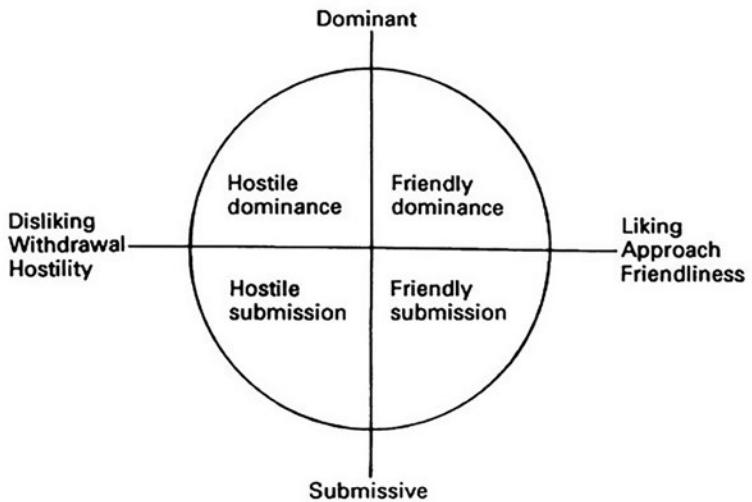
Fig. 3.1 Circumplex model of status and solidarity in interpersonal behaviour From Crook 1980; reproduced with kind permission of Oxford University Press
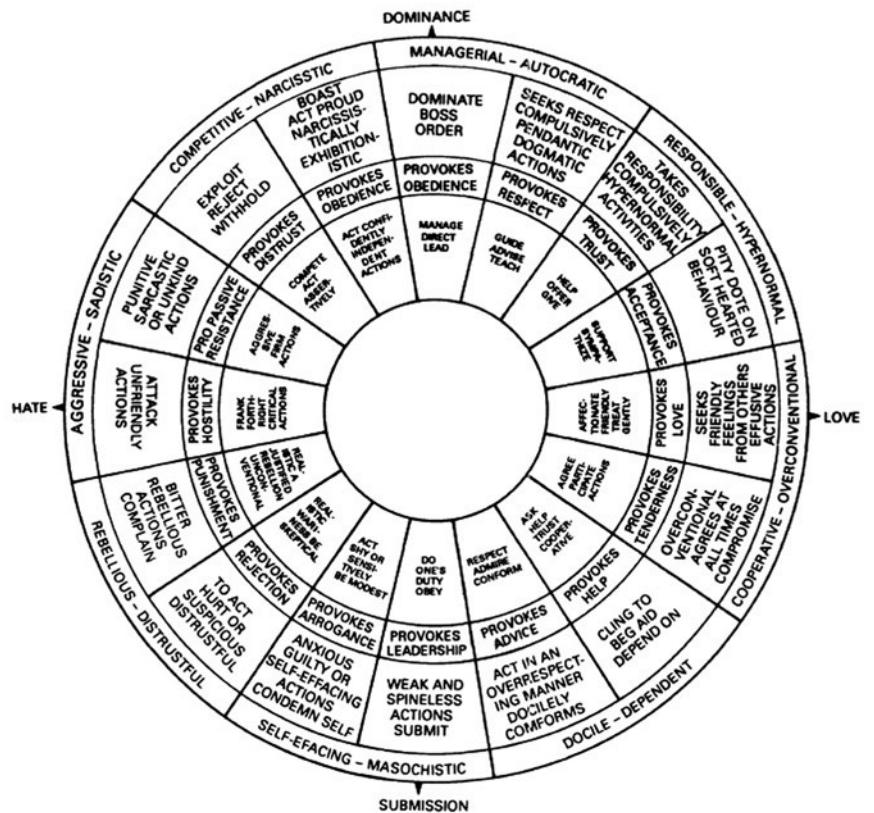
Fig. 3.2 The circumplex model of Fig. 3.1divided into 16 behaviour categories. Circle segments defi ne qualitative contrasts in behaviour and distance from centre suggests strengths. In the outer ring the 16 categories have been reduced to 8 names defi ning overall dispositional traits; the fi rst word indicates the less extreme form of the type
From Crook 1980; reproduced with kind permission of Oxford University Press.
Adjustment through rebellion: the distrustful personality
These individuals “compulsively askew closeness with others; they are traumatized and threatened by positive feelings.” (Leary 1957, p.269). They seem to evaluate interpersonal closeness as potentially reducing highly valued autonomy, freedom and individuality through closeness, nurturing and co-operation. In their extreme activation they actually provoke the distrust and rejection they feel themselves. This leads to a vicious circle of more distrust and rejection in both sender and respondent. Not only do they distrust the nurturing and co-operative behaviour of others, they are prone to distrust the same feelings in themselves. It is likely that they are poor empathisers (as indeed all those on the hostile dimension may be). 2 They can be cynical, wary, uncompromising and, in the extreme, paranoid and prone to schizophrenia and psychosomatic complaints. In the theory of biosocial goals these individuals would be regarded as highly competitive in the dimension of autonomy and power and be very sensitive to power displays and possible loss of control, i.e. they engage in spacing from others and have diffi culties in linking with and trusting others.
Adjustment through self-effacement: the masochistic personality
These individuals have more acutely amplifi ed submissive tendencies. They respond to interpersonal diffi culties and dilemmas with submissive gestures: “I am a weak, inferior person.” These individuals ward off anxiety of interpersonal threat by submission. There is experimental evidence that this may indeed be so (Forrest and Hockanson 1975). In terms of the theory of biosocial goals these would be individuals who tend to construe interpersonal confl ict in terms of competition for power but are also easily overwhelmed. There seems to be a fear or taboo on assertive responses; hence, submission is the solution to avoid interpersonal threats, injuries and losses (much as ethological models suggest). These behavioural styles tend to provoke arrogant, punitive and leadership behaviours in others. This style is highly represented in depressive conditions and is marked by low assertiveness with a tendency to suppress the open expression of anger/rage, and a harbouring of secret grievances.
Adjustment through docility: the dependent personality
This style is also submissive but less hostile, and there is generally a more open and affi liative component. They give out responses such as: “I am a meek, admiring person in need of your help.” Hence, nurturance seeking rather than the avoidance of interpersonal attack is more of a central concern here. Autonomy and competitive competency may be inhibited because of self doubt and the fear that a demonstration (display) of autonomy would threaten help provision from others. These individuals believe that a degree of self humility and admiration of the other is required to secure help. (A religious style?) Whereas when the masochist tends to get depressed there is a good deal of self castigation, the dependent personality is more tearful, pleading and reassurance seeking. He does not endear himself to those personalities on the more hostile dimension but may provoke caring, helpful, nurturing responses from those on the more friendly side of the dimension. Carson (1969, p.109) suggests: “The extreme of this form of behaviour is a clinging, ingratiating dependency that may become very sticky indeed for the person towards whom it is directed.” According to Leary, these individuals are more prone to diffuse anxieties, phobias and obsessions. As with other submissive postures there is a tendency to inhibit competitive assertiveness.
Adjustment through co-operation: the over-conventional personality
The strategy for solving interpersonal dilemmas and confl icts here is primarily one of co-operation. In the extreme, these individuals are inappropriately and excessively agreeable, striving to maintain harmony in their interpersonal domains. They are easily infl uenced by others but are uncomfortable in the presence of hostile, unhappy, or power-oriented feelings in both themselves and others and avoid these if possible. They tend to be self-sacrifi cing. Brotherly love is preferred together with the avoidance of aggression. They tend to provoke friendliness and openness in others since they pose no competitive threat, nor threaten to become dependent on or needy of others. Anxiety is aroused by situations which call for assertive, non co-operative responses. They run the risk of being seen as kind but bland and unforceful people. In some cases they can activate aggressive responses in people who are looking for some defi nite viewpoint or positive reaction from them. Although they co-operate they may have diffi culty in co-operating with others when there is an intra-group aggressive dispute. They may not like to take sides.
Adjustment through responsibility: the hypernormal personality
Of these, Leary says: “Here we deal with the individual who attempts to present himself with a ‘normal’ persona. He presents himself as strong, but his power and self-confi dent independence are used in an affi liative way. He strives to be close to others – to help, counsel, support and sympathise. He wants to be tender with his intimates, reasonable and responsible with his acquaintances.” (p.315) These behaviours tend to invite others to lean on him and foster dependency. In the extreme this may manifest as inappropriate overprotectiveness. They may need to be needed to fend off their own anxieties and helplessness or fears of loss of importance. In Leary’s view the majority of these individuals do not self-refer but are referred by physicians for psychosomatic complaints. These patients may repress and deny a good deal of inner confl ict in their efforts to maintain the hypernormal persona.
Adjustment through power: the autocratic personality
These are individuals with highly developed competitive goals; they use status, respect and prestige to secure and maintain self-esteem. In today’s arena some of these may fall into the category of people labelled Type A (see Chapter 12 ). These individuals in the extreme are prone to be energetic, compulsive, perfectionist and prone to mania. There is an avoidance of anxiety related to inferiority, weakness and helplessness via striving. Like the masochist, their interpersonal activity tends to be basically one of social competition but unlike the masochist who surrenders quickly, the autocrat challenges and pushes for success. They can be overly controlling and demanding of respect from others and attribute weakness or incompetence to subordinates; usually in the emotional domain. That is they may see in others what they fear in themselves. These individuals may be poor therapy clients in the normal course of events manifesting distress through psychosomatic diffi culties and overactive autonomic systems. They have a tendency to abandon therapeutic methods quickly. It may also be noted that these individuals, insofar as they relate to Type A personalities, are prone to defeat depression and cardiac disorder.
Adjustment through competition: the narcissistic personality
These individuals are also a status seekers but as the model suggests are rather more hostile, arrogant and smug. They may be boastful in words rather than deeds although also inappropriately exhibitionist. They are prone to focus on their outward appearance, dress, physical beauty or superior talents. “These individuals feel most secure when they are independent of other people or feel they are triumphing over them.” (Leary p.332). There is a greater tendency than with the autocratic personality to use people for selfi sh ends (boost self-esteem) and a signifi cant lack of empathy. They tend to be envious and disdainful of others, instilling resentment. They tend to provoke in others more passive, hostile and negative submissive responses. They are prone to break down with anxiety about weakness, shame and humiliation. They describe their parents as sadistic.
Adjustment through aggression: the sadistic personality
These individuals are the most destructive of all the personality types so far considered. Self security is based on the wielding of power through threat, physical and verbal abuse. Leary includes all those who maintain dominance through the humiliation of others. Although the narcissist uses other people primarily for his own ends, the purpose may not be primarily to humiliate but to acquire independence, admiration and prestige. To strike humiliation, fear or guilt is not the primary purpose of the narcissistic type but is so of the sadistic personality. Leary says: “We think here, for example, of the stern unforgiving father, the bad-tempered wife, the moralistic guilt-provoking mother, the sharp-tongued mocking husband, the grim-faced punitive offi cial, the truculent fi ery-natured colleague, the disciplinarian. We include all those law-abiding, often pious and self-righteous individuals who maintain a role for potential insult, degradation or punishment.” (p.342). As Leary points out, these styles are by no means confi ned to the delinquent few but can be found to various degrees in the ruling classes of many societies and subgroups. These individuals do not, interestingly, come to the clinics for phobic anxieties or depressive problems but primarily for marital and interpersonal diffi culties. Delinquency, bed wetting and phobias often appear in the offspring of these patients. (p.347) As with the distrusting personality that we met earlier, these individuals fear intimate, loving and nurturing responses in themselves. Sometimes they are in states of vengeful retaliation to cruel early parental experiences. Again, there is a lack of empathy.
Developments of the interpersonal model
Each of these personality styles represented in different personality acts “is an attempt to establish the emotional relationship of the actor towards himself and towards the other, as well as to establish the social relationship of the self and the other with respect to a larger reference group. . . . Each behaviour serves the purpose of giving or denying love and status to the self and to the other.” (from Foa, as quoted by Carson 1969, p.113). Carson suggests therefore, that dominance–submission and love–hate present three dimensions: (1) acceptance vs rejection; (2) self vs other; and (3) emotional vs social. Thus, for example, the co-operative behavioral style offers love to both self and other, but is rejecting of hostile, status-seeking, competitive responses in both self and other. The masochist denies status to the self but amplifi es it in the other. In other adjustment styles amplifi ed emotional needs of the self may be denied because these might make them ineffective as helpers, and so on. In effect therefore, each style has implications to both self and other in the domain of acceptance–rejection in regard to social (status) vs emotional needs. 3
As Carson (1969) points out, social context may recruit these various patterns to greater or lesser degrees. The same style may not be seen in all contexts. An autocrat may be quite loving and docile at home. A co-operative individual may be quite loving of the world at large (e.g. religious) but rather neglectful of his close relationships or deliberately avoid aspects of intimacy (e.g. as in celibacy). Hence, both in terms of the relationship between these different personality types and the severity to which they manifest they should be regarded as a dimensional rather than a categorical concern. The role of context is crucial; for example, in Chapter 2 we explored the distinction of intimate, personal, social and public. Someone who behaves as an autocrat with his intimates may behave as a submissive type in a public and socially unfamiliar environment. People who show brotherly love in public may farm their children out to others as they rush around doing good works (i.e. there can be an avoidance of intimate loving).
Some recent developments
Leary was of the view that high self-esteem related to the ability to co-ordinate the complex repertoire of social displays in context appropriate ways, i.e. an individual can nurture and trust when appropriate, distrust when appropriate, submit, follow or lead when appropriate, and so on. The knowledge that one can enact these roles provides some security for self-esteem. In social learning theory, this ability to respond according to context might be called self-effi cacy (Bandura 1982). In this sense, it is like a sports person who can play all the shots and is therefore able to treat each one on its merit. This is in contrast to the player who has a limited repertoire and must continually navigate himself into a position that enables him to play his limited range (sometimes quite awkwardly). Furthermore, this is close to Jung’s concept of individuation, i.e. the individual who has articulated and mastered and blended the full keyboard of his human archetypal nature.
In a recent new approach to personality, Paulhus and Martin (1987) provide some evidence for this view. They found that self-esteem does indeed relate to mixed capabilities. For example, people who are capable of being nurturant are also capable of being hostile. Hence, high self-esteem individuals are not fi xed in any one interpersonal style. These authors also highlight important distinctions relating personality to social behaviour. These are: (1) ability – related to knowledge and degree of skill for enacting certain social behaviours; (2) capability – related to the ease of enacting particular social repertoires; and (3) traits – relating to index-typical behaviour.
In their view, capability, i.e. the ease by which certain social repertoires are expressed, may be important to self-esteem. Capability may be signifi cantly infl uenced by anxiety. Anxiety will not only lower the probability of attempting the behaviour, but will also disrupt the performance if it is attempted. In this regard, anxiety does not affect the ability, since individuals may know what to do, but it does affect capability; i.e. there is a distinction between knowing what to do and actually being able to do it. This mirrors Bandura’s (1977) distinction between outcome expectations and effi cacy expectations. 4 In regard to the disruptive effects of anxiety, however, it may be that any strongly aroused emotion, be it anger, anxiety or even sympathy, may disrupt performance. For example, some individuals may be so overcome by their own emotions while caring for others that they are unable to perform the necessary nurturant response. Hence, underlying capability may be a general dimension of emotional arousal such that when an individual engages certain archetypal social repertoires, he experiences (or feels he will experience) an inability to control it. In Jungian terms we might say the archetype takes him over. Hence, when considering the adjustment theory of Leary, this idea of capability seems to be a crucial concern. Moreover, individuals may inhibit certain classes of behaviour for all kinds of reasons, e.g. fear of becoming too angry or anxious (losing control), catastrophising the counter-response (i.e. fear of being overwhelmed), moral beliefs related to self-esteem, and so on.
The interpersonal approach has generated much research and many ideas, although its impact on psychotherapeutic practice has been disappointingly limited. Many of these ideas have been expanded and well articulated in a classic paper by Kiesler (1983). The interested reader is also referred to the work of Horowitz and Vitkus (1986). 5 These authors have articulated some important ideas on the value of using interpersonal theories to study pathological behaviour and also psychotherapeutic processes. In regard to this chapter however, enough has been said to simply introduce the ideas and work supportive of classifying systems of human behaviour which can be mapped against evolutionary strategies, and ultimately, biological processes. To recapture its essence, these social dimensions relate to dominance–submission and love–hate. These combined to produce various combinations of linking and distancing in interpersonal behaviour.
Leary’s concept of levels
In the theory of biosocial goals it was suggested that the potential to activate each goal and the relevant social strategy associated with it is given a priori; they are embedded biological potentials in all humans. This is very close to Jung’s concept of archetypes. Individuation arises from the integration and mature development and harmonisation of the potential competencies for being in the world. It is the vigorous pursuit of a limited range of innate possibilities which detract from personal growth and lead to vulnerability. In these cases, the person avoids elements of his own personal nature. The masochist avoids (denies) his own competitive, assertive and aggressive control over resources (although it may appear in fantasy or dreams). The sadist avoids (denies) or fails to develop his empathic, nurturing, loving capacity. They remain undeveloped, primitive and unarticulated components within the psyche. 6 In cognitive terms there is a developmental arrest. Important schemata for integrating these potential functions into higher, meaningful structures are absent. If these primitive, unarticulated processes threaten to break through via context-triggered crises, they are experienced as potentially powerful, overwhelming, non-integrated elements of the psyche. This may invoke even more strongly a desire to adjust to these inner crises with well tried and practised methods (i.e. interpersonal coping responses). Alternatively various forms of regression may occur (Bailey 1987) 7 which signifi cantly disrupt and disorganise a person’s sense of self (Horowitz and Zilberg 1983; and Chapter 14 of this volume).
Leary offers a discussion of these kinds of issues in a most fascinating way. He suggests that there are various levels of psychological activity. These are:
Level I. The Level of Public Communication. This is the level of the actual behaviours that the person emits; but such evaluations are made by the outside perceiver. Recent evidence suggest that people are often inaccurate in judging the impressions they make on others (DePaulo et al. 1987).
- Level II. The Level of Conscious Communication. This level relates to the conscious reported beliefs (the individual’s perceptions) of himself and the world of (social) objects. These are conscious reports and may be different from both Level I (how others see him) and Level III.
- Level III. The Level of Private Communication. This “comprises the expressions that an individual makes, not directly about his real self and his real world but indirectly about his imagined self in his preconscious or symbolic world.” (Leary 1957, p.154). Leary sees these as potentially conscious to the subject but sometimes not. An actual vs ideal selfconceptualisation may apply. For example, an individual may aspire to high standards (status), report feeling superior, talented and even be seen as such, but at Level III there may be fantasies of weakness, helplessness and inferiority. These beliefs may not be fully acknowledged or articulated until crises emerge which are evaluated as overpowering the competent view of self. This level seems closely in tune with Beck’s (1967) concept of latent cognitive schemata. According to Leary this level uses a more symbolic language and is active in fantasies and dreams.
- Level IV. The Level of the Unexpressed. “This level comprises those interpersonal themes which the patient consistently, signifi cantly and specifi cally omits in the other three Levels.” (p.192). These themes do not exist in preconsciousness as may an inferior view of self in the above example. As Leary says: “It must be shown that he has been exposed to a situation in which he is naturally or consensually expected to perceive, react to or express these themes and that he refuses to do so.” (p.193). Leary associates this level with the level of repression. In Jungian terms this level tends to be the level of the repressed and unactivated aspects of the collective unconscious. The refusal to acknowledge or deal with potentially serious or overwhelming aspects of one’s own potential nature or that of others is what is at issue here. As Carson (1969) says: “This is the level of the ‘not me’.”
- Level V. The Level of Values. Leary calls this level the level of ego ideals. These are the values of goodness and rightness held by the person; a kind of moral belief system. It is the level of idealisation of both aspired to goals and the idealisation of others. I am not sure, however, whether this level requires specifi c separation from Level III.
Evaluation of the other
To understand and predict how an individual will act and respond to behaviours of others, depends critically on accurate decoding of the interpersonal message. There is no reason to assume, except in the most gross and obvious cases, that different individuals will perceive the same interpersonal act in exactly the same way. At this juncture, we must engage the person’s appraisal and evaluative system. For example, if a businessman gives a thousand pounds to charity, one observer may perceive this as an altruistic act which leads him to feel favourably towards the businessman, whereas another may explain it cynically as an act to buy favour and put on a good image. In other words styles of personal adjustment will also refl ect attributional style. The point is that individuals tend to respond socially to their appraisal of the motivation of behaviour and not just to the surface appearance of the behaviour as the interpersonal model may imply. A considerable amount of work has been done in this regard in the area of helping behaviour (N. Eisenberg 1986).
The way construct systems are developed for explaining another’s motivation is an important area of consideration. Although much attributional research has examined how individuals explain their own behaviour and the reasons for adversity or good events befalling them (Brewin 1985, 1988), rather less is known of how attributions work in regard to explaining other peoples’ motivation (but see N. Eisenberg 1986; Brewin and Furnham 1986; Brewin 1988). One of the confounding factors here is that individuals may distort both the attention-perception processes to cues (in other words they selectively attend to specifi c aspects of interpersonal behaviour), and from this derive attributions of intent. In regard to the latter, projection seems to be a problem. The capacity for empathy may be one process that allows accurate appraisal of intent and motivation in other people, whereas projection may work against empathy and accurate appraisal. In fact, Dymond as long ago as 1950 was aware of this. She suggested: “Projection seems to be an antithetical process to empathy since projection involves the attribution of one’s own wishes, attitudes and behaviour to something, or someone other than the self. If projection is involved, therefore, the thoughts and feelings of the self are attributed to the other rather than (as in empathy) those of the other being experienced.” (as quoted by Goldstein and Michaels 1985, p.8)
This issue raises a number of important questions. First, suppose an individual tries to act in a caring way (Level II) but secretly believes that he is not caring and secretly feels angry and resentful. Then it may be that what is conceptualised at Level III is attributed to others. Maybe individuals tend to see in others what they conceptualise in themselves at Level III. For example, if I deceive others maybe others deceive me. Hence, if I secretly perceive myself as a deceiver maybe I am more likely to suspect others of deceptions. Put another way, projection may relate to perceiving others in the modes of the private self – or in Jung’s terms “the shadow”. Hence, as Jung says, the shadow is the most easily projected of all the archetypes. The second point is that in (group) psychotherapy, individuals may be able to reveal their Level III constructs and so have empathy for others who reveal similar ideas and feelings. From here may begin a journey to more accurate empathy in general and opportunities for re-evaluating and integrating Level III or latent schemata. This, of course, is a speculative view. Moreover, this process may quickly break down if groups start to become highly structured in a dominance hierarchy. Thirdly, be it projection or not, how we explain other peoples’ intent may relate to what Bowlby (1980) calls defensive exclusion. Here, explanations of intent are handed to the child, e.g. if the parent punishes the child this may go along with the explanation that the punishment was due to the bad behaviour of the child and not the aggression of the parent. Subsequently, when adult he will tend to evaluate the motives of others according to early parental labelling practices. This may make it diffi cult for him to accurately gain insight into the motives and intents of others. He may miss-attribute aggressive responses or loving responses. For example, nurturing responses may be seen as no more than an attempt to manipulate him. Hence, a nurturant response would be miss-explained as a dominant response. Whatever the true case, the point is a central one that people react to others according to how they explain the motives and intentions of others and not simply the surface behaviour though both are involved.
The cognitive approach
The cognitive approach to psychopathology, like the behavioural approach, has, until recently (Beck et al. 1985; Beck 1987) found it unnecessary to articulate a theory of human nature. Dissatisfi ed with what the analysts made of evolutionary ideas, behaviourists have preferred a more empirical approach based on learning theory derived from experimentation in the laboratory. While there can be no doubt of the enormous benefi ts that this has brought, there is overwhelming evidence that individuals respond to the world in terms of inner constructions. 8 These in turn serve attentional, expectancy and attributional processes. Moreover, these constructions of the world are not created out of the blue but are based upon innate capabilities for knowledge organisation. For example, without some theory about the evolution of dominance hierarchies various forms of pathology such as Type A behaviour or depressive submissive behaviour would simply be related to behavioral reinforcement history. The focus of this book, however, is the idea that our constructions of ourselves and others relate to ways of knowing and responding to a social world which are built upon species-specifi c meaning-making systems. Children do not learn either language or fear of strangers by reinforcement contingencies alone. Rather, they are innate potentials which unfold and are then shaped by external experience.
Beck (1976) suggested that from early relationships individuals are predisposed to articulate schemata about the self and about others. These schemata form the basis from which individuals come to predict and attribute outcomes. Consequently, such schemata can be positive (predicting positive reward outcomes) or negative (predicting punishment or loss of reward outcomes). At the level of cognition, self and others are constructed in such a way that they are endowed with certain properties or characteristics. This approach can be represented as in Table 3.4 .
From Leary’s (1957) model, these schemata arise according to the degree to which status and love are bestowed on others and self. Beck (personal communication) suggests that people have various degrees of articulation of their positive and negative self and other schemata. The greater the degree of personality disorder, the less robust or developed are the positive schemata. For those without
| Early Relationship History 1. Nuclear family (parents and siblings) 2. External individuals (peers, teachers etc.) |
||
|---|---|---|
| 3. Traumatic experience (physical/psychological injury) | ||
| Self | Other(s) | |
| Positive | Friendly, popular, worthy, strong, effective, able, etc. |
Friendly, supportive, strong, effective, able, accepting, etc. |
| Negative | Unwanted, inferior, weak, inadequate, selfi sh, bad, etc. |
Hostile, unfriendly, controlling, rejecting, etc. |
Table 3.4 Formation of Cognitive Schemata
signifi cant personality disorder, psychopathology may arise from a switch from positive to negative schemata. The negative schemata are normally latent in such individuals (Beck 1967). Switching off psychopathological states is easier if the individual is able to reactivate positive schemata.
These schemata need not be used equally in each domain of intimate, personal, social and public (see Beck et al. 1985, pp. 78–81). Furthermore, various mixtures of positive and negative schemata may exist. For example, individuals may have negative schemata of themselves but not of others, a common fi nding in some depressive conditions. Alternatively, individuals may have positive schemata of themselves but not of others which may lead to exploitative and arrogant behaviour. Schemata relate to role relationships and expectancies which are stored in long-term memory and are recruited according to social cues.
The activity in these schemata signifi cantly infl uences how individuals internally monitor their ongoing behaviour and social transactions. This self-monitoring gives rise to what Beck (1967, 1976) calls automatic (self-evaluative) thoughts. Automatic thoughts tend to be schema specifi c. For example, if I have a strongly articulated self schema such as, “I am inferior”, then my automatic thoughts will tend to monitor my social behaviour in terms of its inferiority (e.g. when swimming on a beach, I would tend to think how much better other people can swim than me). In this way, automatic thoughts act as a positive feedback process retaining and strengthening the schemata being used.
Recently, there has been increasing research into the relationship between depression proneness and neuroticism. For example, vulnerability to depression and neuroticism may have a common focus in that these individuals are selectively attentive to negatively toned information (Teasdale and Dent 1987). There is increasing evidence then, that proneness to neuroticism may, in part, relate to the way individuals construct themselves and others and the degree to which attentional mechanisms are focussed on negatively toned information (Argyle 1987; Matthews and MacLeod 1987; Eysenck 1988). It would seem to me that this suggests the possibility that neurosis prone individuals are more reliant on the evaluation/appraisal of information derived from construct systems located within the agonic and defence systems.
The other aspect that cognitive theorists need to consider is the idea fi rst suggested by object relations theory. This is that some people tend to construe other people not as a whole but in terms of constituent parts (part objects). Thus, some individuals will tend to relate to others primarily in terms of how the other can satisfy their own personal needs or threaten those needs. Part object construing mediates against empathy and may distort evaluation of the motives and intents of others.
Concluding comments
This chapter has been concerned with various approaches that have attempted to understand human nature as the product of evolution. Evolution does not ensure that one adaptation necessarily operates smoothly with another. MacLean (1985) has shown this to be the case in regard to brain structures.
We began our exploration on the products of evolution with a brief consideration of Jung’s concept of archetype. It was suggested that archetypes could be considered as special-purpose processing competencies that facilitate the construction of meaning. These are inherited and allow for the unfolding of species-typical patterns of social behaviour; e.g. being parented over a long period, becoming a member of a peer group, seeking a mate, becoming a parent, nurturing offspring, growing old and dying.
With this as the background canvas we then looked at mechanisms that were of major importance in conspecifi c competitive behaviour. Discussion centred on the abilities of primitive animals to gain and hold breeding territory and attract mates. This provided the view that many psychobiological response options are controlled by intraspecies comparative, evaluative competencies; that is, even reptiles and birds are able to generate estimates of their relative resource-holding potential/power and respond according to this estimate. This competency may well have originated in the reptilian brain and may be a core evaluative competency that underlies self-esteem. Many of our human dispositions to suffering may be due to a poor or threatened evaluation of self-esteem and the degree to which this calls forth primitive programs of response and state modulation (Bailey 1987).
Work on primate social organisation suggests that although there are some major differences in group living as opposed to territorial breeding behaviour, nevertheless the structure of the social group is still a dominance hierarchy. In group-living primates subordinates are able to send signals that convey information that they recognise their subordinate status; these are submissive and appeasement gestures. This social competency acts to give coherence to the group structure and stops it fl ying apart from continual agonistic encounters. The social mode that exists between conspecifi cs with the intent of controlling agonistic encounters is called the agonic mode. Individuals that evaluate others primarily in relation to their ability to attack or reduce RHP (self-esteem) are in an agonic (psychobiological) state. In this state various options including anxiety and submissiveness are primed (Gilbert and Trower 1990; Trower and Gilbert 1989).
In distinction to the agonistic and agonic modes are the attachment and hedonic modes. The attachment mode evolved as an inclusive fi tness strategy that facilitated the survival of offspring. The hedonic mode represents a different form of conspecifi c relating. There is suspension of agonistic and agonic behaviours which allows conspecifi cs to come together in a mutually supportive and enjoyable manner. This mode of social behaviour is especially noted in chimpanzees with their relaxed social style to each other and mutual enjoyment of physical contact. In this presentation these ideas were embedded in the notion of there being a defence and safety system that relates to punishment and reward areas of the brain (see Chapters 4 and 5 ).
Out of the different options for social relating (both phylogenetically old and late) it is possible to describe a typology of social roles. These have been labelled PSALICs by Gardner (1988). To enact any social role correctly requires competencies for the decoding and emission of the appropriate social signals/behaviour. These competencies may be the basis for a new understanding of archetypes or innate mentalities (see Chapter 14 ). They may also have important implications for current work on sensory-motor patterns (Leventhal 1984).
The work of Leary and the interpersonal theorists has also been concerned with the basic social behaviours of humans, although their models lack any close link with evolution theory. In a sense this has been attempted here. Of special importance is their notion of the interpersonal circle and the idea that certain behaviours have eliciting properties on the recipient. Leary’s concept of patterns of adjustment is of importance because it suggests that different people adjust to life with a varied combination of phylogenetically late and early options. Some are preoccupied with dominance and personal control, and are somewhat agonic and agonistic in their social relations; others are more co-operative and friendly. The style of adjustment presumably infl uences psychobiological state, accounting for the differences in proneness to types of pathologies.
The cognitive theorists have articulated a theory that places considerable emphasis on the construction of self and others. However, we should emphasise that these are not independent since how I evaluate others will signifi cantly effect whether I need to defend against possible humiliation or can be more open and friendly in my behaviour. If I evaluate that others will try to punish any signs of weakness then I must make sure that my presentation either conceals it or dominates them and in this way inhibit their attacks on my self-esteem. However, the most important point here is a Jungian one. People are not a tabula rasa. Information comes into the person and is structured and encoded in line with innate information-decoding competencies. Self concepts are grown on a seed bed of archetypal potential. Hence the propensity to evaluate ourselves as inferior or superior to others comes from the fact that we have innate encoding competencies that facilitate ranking behaviour in all mammals. Indeed, we may spend much of our lives trying to get over this biological preference!
There are many other implications to this sort of approach that can not be outlined here. One that should be mentioned, however, is that the evaluation processes suggested by the object relations theorists, especially those of the paranoid-schizoid position, may represent a greater involvement of reptilian-like competencies in the person. In the paranoid-schizoid position the individual seems especially concerned with boundaries; inner and outer. The schizoid individual seems uninterested in relationships and appears distant and cold in his behaviour. Gardner (1988) has suggested that this kind of diffi culty may relate to spacing as a preferred response option.
The next chapters attempt to build on these brief outlines. In my view a science of human nature should attempt to integrate what is known of our evolution and we should be cautious of theories that are not comprehensive in this regard. For all the great advances made in our understanding by attachment theory, this theory does not grapple with the essential issues of power which have dominated philosophical enquiry over many centuries. Nor does it grapple with the human problems posed by our sense of moral dilemmas. Attachment, love and trust may well have evolved as new opportunities to organise ourselves (both inter- and intrapersonally) differently from the more agonistic species, but this does not mean that potentials for construing our selves and others in agonistic roles is now dissolved. Indeed, without the adequate inputs from our fellow human beings, be these parents, friends or lovers, these more aggressive, submissive, anxious and depressive response options may be easily (re)invoked.
Notes
- 1 To see how this system of thinking can be used therapeutically to understand disturbed relationships see Young-Eisendrath (1985).
- 2 Those in whom adjustment to the social world is mediated by hostile defence may also fi nd it diffi cult to act on developed moral beliefs (see Chapter 9).
- 3 It would be inappropriate here to articulate these issues in more detail. The interested reader can pursue them in Carson (1969); Anchin and Kiesler (1982); Kiesler (1983); Orford (1986). Orford (1986) has reviewed the evidence in favour of some recent adaptations of Leary’s model. He points out, however, that hostile dominance tends to provoke hostile dominance which is not predicted by any of the current theories. Hence, the issue of status defence is of importance in understanding the social dynamics of this model.
- 4 The reader will fi nd a similar distinction between knowing and doing discussed in relation to moral behaviour in Chapter 9.
- 5 This paper appeared in Clinical Psychology Review in a special issue dedicated to the discussion of issues pertaining to personality assessment. Individuals interested in personality will fi nd a number interesting of papers here.
- 6 Of course, it may be that constitutional genetic or other biological aspects make these human capabilities very weakly encoded. We cannot assume that every individual has the same biological capability, just as individuals vary in terms of innate strength, potential and so on. But probably the greatest block to prosocial functioning resides in the
social history of the individual. And even for those who fi nd empathetic skills diffi cult, specifi c re-education may be a signifi cant help.
- 7 This may mean that certain forms of limbic activation are not well co-ordinated with cortical processes.
- 8 At the time of going to press, Rescorla (1988) has published a review of recent fi ndings which helps to connect evolutionary theory with conditioning theory. In his view much classical conditioning concerns the provision of information by processes of association. He makes a convincing claim that many advocates and critics of behaviour theory cling to a theory of conditioning that is twenty years out of date!
The psychobiology of some basic mechanisms
One of the central ideas of this book is that much of what is regarded as psychopathology is not equivalent to medical notions of disease or illness. For example, are subordinate animals, who show high levels of fear and defensive arousal, ill or diseased? Does the yielding subroutine constitute an illness? Of course, much depends on the defi nitions of disease and illness (Kendell 1975). What we sometimes regard as pathology may represent the activation of brain states that have evolved as potential states; i.e. they are part of various psychobiological prepared options. This leads us to Hill’s (1968) distinction of the differences between posture, reaction and disease.
We cannot engage these important debates here, but we can suggest that a better understanding of evolution’s designs will help us formulate answers (Gardner 1988). The second complication to our science of psychopathology comes from mind–body dualism, which L. Eisenberg (1986) has aptly called “brainlessness” and “mindlessness”. Such confusions lie behind disputes between the hard versus the soft approach in psychiatry (Akiskal and McKinney 1973).
We are a long way from resolving these issues, but a science of human nature would be helpful in this endeavour. In this chapter, it will be argued that we can profi tably advance our science with recourse to the concepts of defence and safety. Furthermore, all life forms are equipped to defend against threat and also to advance their own life form. We take as our starting point the fact that living systems have various forms of recognition-response capabilities for doing just that. In Maturana’s (1983) terms all living systems know how to exist in their domain of existence. In other words there are species-specifi c (innately given) forms of construing which are essential for that member to live as an example of the species. Although we cannot explore this here, recognition–response systems operate at a multitude of levels; for example, the immune system is an example of a biological defence system based on recognition–response. In this chapter we will assume some familiarity with neurochemistry but for the unfamiliar reader, Appendix 1 is offered to illuminate some of the main processes. We begin our exploration with a discussion of defence and safety and a more detailed investigation into their function.
Defence
Stimulus detection and recognition appear to be organised in two fundamental ways. First, animals need to be sensitive to and to recognise cues signalling threat, injury and harm. Second, animals need to be sensitive to (recognise) cues signalling positive reinforcers and safety. The defence signal detection system is built upon simple refl exes and sensory-motor patterns. A chick, for example, will crouch in the nest when a hawk-like stimulus passes overhead. In humans, some of these recognition systems are also innate (Eibl-Eibesfeldt 1980; Tomkins 1981) and bear on the recognition of social signals (e.g. the baring of teeth). There appear to be specifi c brain areas that are responsible for carrying out this function. Damage to these areas reduces capability for facial discrimination.
Threat requires defensive, self-protective action, and cues signalling threat trigger avoidance behaviour (Gray 1971). This behaviour is designed either to remove the animal from the threat (fl ight) or to reduce the signals being emitted (freeze, faint, camoufl age). The general descriptive term that is given to this system, concerned with the appraisal of threat, is the defence system. The use of this term implies the behaviour that must follow, i.e. defensive action. In Chapter 3 we noted three systems of defence: (1) anti-predator; (2) territorial breeding; and (3) group living. We should emphasise that these are in no way comprehensive. For example, there are other systems which involve defence against noxious substances and involve the affects of disgust (Rozin et al. 1986; Rozin and Fallon 1987) and probably involve various specifi c responses like the vomiting refl ex. Rozin’s work provides fascinating insights into the development of contamination beliefs which might be of value in understanding certain obsessional disorders. Another important defensive refl ex is that of falling, and losing balance. This sensory information elicits arousal and motor behaviours to restore balance. Fear of falling, tipping forward, is noted in some agoraphobics. The idea of a defense system is important because then it becomes possible to understand how various responses of the defence system (e.g. vomiting) may be activated via routes which do not necessarily involve the perception of (say) noxious substances.
Beck et al. (1985) have outlined three major forms of anxious reactions:
- 1 Mobilisation: involving active behaviours; this may be anxiety but could also be aggression, i.e. fi ght/fl ight (cognitive imagery impels action).
- 2 Inhibition: involving interference with normal functioning (e.g. freeze); mind going blank; cognitive inhibition.
- 3 Demobilisation: involving weakness and faintness; lowering of blood pressure.
Input and output
The output and psychomotor components of the defence and safety systems bear careful consideration. I shall argue that the psychomotor system of defence is organised around go–stop, whereas the outputs of the safety system do not have a stop component but are regulated by increments or decrements in arousal acting through the positive reinforcement system. In other words, the outputs of the safety system can be regarded as either “go” or “no-go”. “Go” is simply a descriptive term for various forms of invigorated activity which can be observed in various domains (for example running, jumping, playing). “Stop” refers to various forms of braking, suppression, withholding or defensive closing down. For the most part, stop is usefully considered in regard to the psychomotor system. For example, freeze represents a high state of arousal but is not discharged due to psychomotor braking. Other forms of stop behaviour may be regarded in terms of parasympathetic nervous system activity which involve bringing about various shutdowns in energy expenditure or reducing the probability of displaying certain classes of behaviour. In other words, stop is only relevant to the defence system.
Beginning with the anti-predator system, we can observe that following an increase in arousal, behaviour may be discharged in psychomotor activity, e.g. fl ight. This constitutes “defensive go”. Another form of defensive go would be a distress call. In this case, defensive arousal is channelled into calling to and seeking a nurturant other. In contrast, other forms of defensive behaviour may be under signifi cant braking control, for example “freeze”. Freeze involves high arousal but with tense musculature. Another form of stop is “faint”. In faint, the musculature is relaxed and not tensed as in freeze. This is a form of demobilisation response. However, both freeze and faint involve defensive reactions which inhibit the discharge of psychomotor activity (e.g. fl eeing, moving and so on). Hence, freeze and faint represent different forms of stop; the former but not the latter working through a psychomotor braking system. Although there are species differences in the propensity to exhibit these responses (e.g. rabbits always freeze to threat), in humans an array of possible defensive responses may be primed by aversive stimulation and cognition (Beck et al. 1985).
In terms of neuropsychology, the concept of braking is of major signifi cance. Carlton (1969), for example, has pointed out that freeze may be the fi rst response in active avoidance conditioning trials. He suggests that acetylcholine, especially in hippocampal structures, is important to this response pattern. Altman et al. (1973) have suggested that the hippocampus acts as a form of central nervous system braking and that little effective action is discharged as long as the brakes are on. Gray (1982), as we shall discuss shortly, has identifi ed the hippocampus as part of a behavioural inhibition system.
The anti-predator system evolved to deal with short-term, immediate threat, and therefore, responses tend to be short term with quick recovery. When we look at social behaviour however, the defence system operates in rather different ways. We begin to see the capacity for the defence system to produce major changes in state, recovery from which may take considerable time, if it occurs at all. John Price (personal communication) gives a fascinating example. Mimic cleaner fi sh are highly territorial, for unlike real cleaner fi sh, they bite chunks out of larger fi sh instead of cleaning them. The need to maintain a very low percentage of mimics to real cleaners in any locale is therefore obvious. When two mimics fi ght for territory, the loser loses his colour, no longer looks like a real cleaner and is preyed upon. Hence, defeat for a mimic produces signifi cant biological changes which are not part of the fi sh’s own predatory system; indeed, defeat severely compromises his anti-predator ability.
Such fascinating examples illustrate the biological differences in responses to social and non-social threat. Furthermore, it is not only fi sh that behave this way. Defeated male lizards may die shortly after a defeat (MacLean 1985). The study of defeated birds from which the term “pecking order” originally arose shows serious changes in presentation and behaviour following defeat (Price and Sloman 1987). Importantly, losers in such contests lose their ability to retaliate and show major reductions in various survival and reproductive promoting behaviours. (See Chapters 3 and 12 .)
These changes of state, which have long-lasting effects and alter many psychobiological responses, have been studied by a non-evolutionary paradigm. Chronic stress over which the animal has no control results in a state of helplessness (Seligman 1975). We shall be looking at this more closely in a later section. Suffi ce to say here, one plausible hypothesis is that chronic uncontrollable stress recruits the psychobiological pattern of yielding. After all, in Nature, predators are unlikely to be a source of prolonged uncontrollable trauma, whereas conspecifi cs may be. For the moment therefore, we simply wish to make the distinction between short-lived defensive responses and those that involve a more radical change of state and take considerably longer to extinguish.
In many group-living animals (e.g. rats but not mice) we see variations to the yielding subroutine. In group living, animals do not disperse if they have lower relative RHP. Instead, subordinates signal “no threat” to dominants and are at the ready to engage submissive acts should they be challenged. Occupancy of low rank in agonic groups results in high states of arousal which are not discharged in activity. They are “at the ready” to take defensive action, are watchful and attentive to possible sources of attack and are generally timid. They appear apprehensive, even when engaging in positive reinforced behaviours. Subordinates may also be more susceptible to separation depression (Rasmussen and Reite 1982; Gilbert 1984). The full yielding subroutine may be easily activated in subordinates in part because of the biological state associated with low status, and in part because subordinates have very little control over social positive reinforcements.
Being at the ready to take defensive action and showing less ease and confi dence than more dominant animals, we may consider the subordinates to be in a state of “braced readiness”. Chance (1988) has pointed out that braced readiness may result from the confl icting tendencies of the reverted escape response. In this situation, the animal is motivated to approach, or remain within some proximity to more dominant animals (i.e. not exist as an isolate) yet at the same time is motivated to avoid the possible aversive consequences of invoking ritualistic, agonistic behaviour in the dominant. As a result of this confl ict of motivation, the prevailing state is one of braced readiness. Positive reinforcers are pursued in the face of high defensive arousal.
To summarise we can outline three forms of stop:
- 1 Demobilisation and braking of psychomotor activity which is characteristic of the anti-predator system. This is a short term, but usually intense response, e.g. freeze, faint or camoufl age.
- 2 More general inhibitory processes of psychomotor activity and biological functions which are the result of a major change of state, as in the case of yielding in defeat and/or exposure to chronic uncontrollable stress.
- 3 Inhibition applied to the psychomotor system which is a form of braced readiness. This is characteristic of confl ict when two competing motivations and action tendencies are being held in check.
At the present time, the degree to which these three forms of inhibition (stop) are related is unknown. 1 At this point, my main concern is to raise questions regarding different kinds of stop that have evolved as part of the defence system. A summary of these response options is given in Table 4.1 .
| Function: Forms: |
To alert animal to danger. Designed to defend ‘and/or’ protect. Involves the focus of signal analysers on sensory information and passing on to various appraisal systems for evaluating “meaning” of sensory data. 1. Non-social (predator and non-social, physical injury) 2. Social (breeding); territorial and group living. 1. Increase in arousal (e.g. startle, alert), priming go-stop options. 2. Increased activity in various psychobiological systems (e.g. sympathetic/parasympathetic HPAC, hippocampus in control mode) to mobilise resources for defence and protection activity. |
|||
|---|---|---|---|---|
| Psychobiology | ||||
| Response (Psychomotor) Options | ||||
| Go | Stop/Demobilise | |||
| Anti-predator, non-social, injury |
Fight/Flight. Active avoidance. Distress (alarm) call? |
Freeze/Faint. Camoufl age. Passive avoidance |
||
| Territorial conspecifi c |
Ritualistic agonistic behaviour. Flee from occupied territory. Ritualistic guarding (homesite, mate, etc.) |
Yielding subroutine. Helplessness | ||
| Group living (agonic) |
Signalling (dominance) power by gesture. Retreat, avoid. Reverted escape |
Submissive acts by gesture (appeasement). Brace readiness (high but undischarged arousal) |
Table 4.1 The Defence System
Note: The stop/demobilisation responses of the anti-predator system are short term, whereas yielding and helplessness are longer-lasting changes in state. The short-term responses are dependent on sensory data, whereas it is social behaviour that triggers the dominance and yielding routines.
Safety
The second way stimulus detection and recognition appear to be organised relates to safety. Animals need to be sensitive and to recognise cues that signal safety (e.g. the absence of threat cues, reassurance signals, burrows, holes, etc.). This is additional to cues signalling positive reinforcers themselves. When safety cues are present in the environment, the animal is able to pay less attention to threat and be less sensitive to the need to take defensive action and in consequence, can explore for positive reinforcing stimuli, i.e. there is movement towards biosocial incentives. Cues that signal safety activate the reward system. In humans for example, trusted care givers, especially via tactile comfort, can reduce defensive avoidance arousal. Also, the role of the reward system in avoidance learning is now established (Gray 1971). In Chapter 3 , we called the prosocial aspects of the safety system, hedonic and attachment. The activation of the defence system releases primitive (innately available) response routines (fi ght, fl ight, freeze, faint, submission, etc.). The activation of the safety system, when following defensive activation, reduces defence system arousal and can release innately available response routines (e.g. positive reinforced exploration, goal fulfi lling behaviour, play, humour, sharing). Although the safety system normally operates with low fl uctuating arousal, arousal can also be high if there is success after struggle (elation). More work needs to be done before we can fully understand which behaviours and affects become manifest and are released by the activation of the safety system. I believe the safety system releases the pursuit of exploration for positive reinforcers, but it is more than a purely reinforcement system. For example, the safety system is involved in sleep and relaxation.
The output and psychomotor components of the safety system differ from those of the defence system. The safety system has no equivalent of psychomotor braking or demobilisation. The purpose of the safety system is to liberate attention and behaviour for the exploration of positive reinforcing behaviour. When arousal is low in both defence and safety, the animal is in a state of relaxation. In terms of everyday functioning, there exist complex interplays between defence and safety. Too much safety can be boring and people seek control in order to expand mastery over their personal domain. As Gray (1971) points out, successful escape activates the reward areas and such a factor may lie behind the enjoyment of risk taking, e.g. parachuting.
Generally speaking, there are no braking or inhibitory processes in the safety system itself. For example, to a hungry animal stimuli previously associated with food cue arousal and food-seeking behaviour. Any inhibition to this behaviour will come from either some other positive incentive being more important or from defence system activity (e.g. a perceived threat of some kind). If the animal is satiated however, stimuli associated with food do not cue arousal, rather the animal ignores them. In other words, the safety system works on a gradient of go/no go, but has no braking system of its own to stop arousal from being discharged. This only comes from the defence system. Further evidence for this view comes from Gray (1971, pp.190–192) who discusses evidence that under normal conditions, the cortex exerts inhibitory control over the punishment areas and these in turn exert inhibitory control over the reward areas. Hence, any braking or demobilisation is always from the defence system.
Further insight into the fact that the safety system has no stop mechanism can be gleaned from infant–mother research. Return to the mother acts as a safety signal which calms defensive arousal but does not inhibit behaviour. As we shall note in Chapter 7 , sometimes the parent does not seem able to have this effect. The capacity for human beings to send safety signals to each other which have the effect of reducing defensive arousal is crucial to the hedonic mode. Friendship signals act as calming signals on defensive arousal. This reduction in defensive arousal allows activity in the safety system to fl ow. Hence, we see co-operation, sharing, joint exploration and so on; all of which are associated with wellbeing (Argyle 1987). In other words, wellbeing and probably general health are associated with low arousal in the defence system. The individual no longer has to be vigilant to the punishment-worthiness of behaviour but is free to explore. Those who are high, social approval seekers appear unable to operate without continually testing out others and need constant inputs to reduce defensive arousal. The importance of the hedonic mode and its impact on defensive arousal can be seen in many domains. (For a discussion of the relevance of such an approach to social anxiety see Gilbert and Trower 1990 and Trower and Gilbert 1989.) The response options coded in the safety system are given in Table 4.2 .
Another set of factors which appear to reduce defensive arousal is self effi cacy and control. Gaining control makes the individual feel safe. Bandura et al. (1985) have shown that learning to cope with feared stimuli signifi cantly reduces biological activation to those stimuli. Similarly, research on control over stress has shown that control reduces the tendency towards stop.
| Function: | 1. To alert animal to safety “no-threat cues”. | ||
|---|---|---|---|
| 2. Signal analysers scan environment for stimuli leading to positive reinforcement. |
|||
| Forms: | 1. Non-social: cues in the physical environment cueing exploration. | ||
| 2. Social: attachment, affi liative and co-operative cues, presence of supportive others. |
|||
| Psychobiology | 1. Reduce defensive arousal, maintain low fl uctuating arousal. | ||
| 2. Deactivate (if necessary) biological defence responses (e.g. HPAC). Defence against conspecifi cs not necessary. |
|||
| Table 4.2 The Safety System | ||||
|---|---|---|---|---|
| —————————– | – | – | – | – |
(Continued)
| Response (Psychomotor) Options | |||
|---|---|---|---|
| Go (Active) | No-Go (Passive) | ||
| Physical Environment |
Appetitive. Explorative | Relax, calm sleep (related to low arousal not psychomotor braking) |
|
| Attachment | Mutual reinforcing exchanges; cooing, smiling, exploring; intimate sharing. Proximity control (although may also be controlled by evaluation of threat) |
As above but in the presence of attachment object |
|
| Group living (hedonic) |
Joint action; friendship co-operation seeking, sharing, helping, seeking to contribute, group rather than egotistical goals. Close proximity; reassurance signalling, deactivating (defensive) braced readiness |
As above, but in the presence of other conspecifi cs |
Table 4.2 (Continued)
Note: The hedonic safety system promotes health by maintaining defensive arousal at a low level. This is achieved by rendering the social environment safe (by reassurance signals) rather than a source of potential aversive stimulation as in agonic groups.
In summary, we can make the following points:
- 1 Threat stimuli which activate the anti-predator system produce rapid shifts of arousal which trigger short-term (automatic) psychomotor discharges (e.g. fl ight), output braking (e.g. freeze), and/or demobilisation (e.g. faint).
- 2 Cues that signal social threat activate the social defence system. If an external threat is evaluated as being controllable (e.g. an animal evaluates it has higher resource holding potential than a challenger) then action is discharged to overcome the threat (e.g. aggression).
- 3 If an external threat is evaluated as being uncontrollable (e.g. an animal evaluates that he has lost resource holding potential) then arousal remains high but various inhibitions on outputs are noted. These inhibitions are not short-term responses but involve major changes of brain state, especially if the animal has to stay in proximity to those with higher RHP (i.e. potential sources of punishment).
- 4 Cues that activate the safety system increase activity in the reward areas and may decrease defensive arousal, but there is no psychomotor braking in the safety system. Any inhibition of responses is due to evaluations of risk of losing positive reinforcers or encountering (evoking) aversive stimulation.
The neurobiology of go–stop processes
A behavioural model which helps to illuminate the underlying biological mechanisms of go–stop patterns arose from learned helplessness research (Seligman 1975; Hellhammer 1983). The learned helplessness model proposes that when trauma is fi rst encountered there is an invigoration of psychomotor and psychophysiological activity which can loosely be labelled as fear. Defensive-go responses, like running or jumping, are usual but stop responses also occur, as in freezing (Carlton 1969). In most cases (but not all) defensive-go facilitates the animal’s attempts to explore the means to control or escape adversity. In looking for escape it is looking also for safety (Gray 1971). But if the animal’s efforts are unsuccessful, this response routine does not carry on indefi nitely. In fact, it shows a radical change to a pattern closely resembling depressive passivity (Seligman 1975; Gilbert 1984). This may be regarded as a special class of defensive-stop; a form of yielding to adversity. It may be seen as a switch away from activity, exploration and psychomotor energy expenditure. However, it should not imply that an animal now necessarily ceases to be anxious, or is in a low arousal state since passivity and anxiety can co-exist. Passivity as a specifi c coping response (passive avoidance, for example) is different from passivity which is brought on through lack of control, i.e. helplessness. Passive avoidance is a short-term braking response, whereas depressive passivity represents more of a global change in state.
What is important in this model is that the unfolding of the helplessness (depressive) routine is marked by many changes; in appetite disturbance, reduced aggressiveness, changes in dominance–submissive behaviours, weight loss, psychomotor retardation and noradrenaline depletions. Whether or not one believes that helplessness is learned, and there is some controversy over this (Gray 1982), undoubtedly, certain symptoms such as sleep disturbance, weight loss, psychomotor retardation and vegetative changes are not learned but manifest as part of the invocation or release of a psychobiological response routine which inhibits high levels of activity and exploration. This pattern seems to be observable in a number of different species. According to the theory outlined here, this pattern is a shift towards “defensive-stop”. This defensive-stop pattern is innately coded and prepared for, and it involves reducing inputs and reducing movement around the physical domain as might be necessary in the presence of a dominant.
Considerable research has examined the underlying neurochemical changes that occur during both the fear stage and the helplessness stage in confronting uncontrollable events (Anisman 1978; Anisman and Zacharko 1982; Weiss et al. 1979; Gray 1982; Weiss and Simson 1985; Willner 1985). Anisman’s review remains a concise statement on the neurobiological changes that are believed to occur from exposure to uncontrollable stress, they are repeated here. According to Anisman (1978, pp.159–160), the following observations have been noted:
1 Moderate levels of stress tend not to affect the endogenous level of NE and 5-HT. Given that stress does result in faster disappearance of labeled NE and 5-HT, and since stress after enzyme inhibition results in greater reduction of NE and 5-HT, it is probable that stress increases both synthesis and release of NE and 5-HT. 2
- 2 Besides increased synthesis of amines, partial inhibition of MAO occurs thereby preserving NE and 5-HT. The net effect of the increased synthesis of amines together with MAO inhibition is that the demands of the organism are met. Indeed, with relatively mild stress an initial increase of NE and 5-HT levels may be observed.
- 3 With intense stress, a decline in endogenous levels of NE and 5-HT is seen. Presumably, synthesis does not keep up with utilisation. The effectiveness of NE released apparently is also reduced by increased re-uptake of NE under these conditions.
- 4 With mild stress, DA, ACh and 5-HT are unaffected. As the stress severity increases, ACh levels rise. While DA has been reported to decrease, the effect of stress on DA is considerably less than on NE neurons. The differential effects of stress on DA and 5-HT relative to NE might indicate that the former two systems are superior regulatory systems, thereby maintaining balance between synthesis and utilization of the neurochemical . . .
- 5 Under conditions of stress, activity of anterior pituitary hormones increases as do levels of plasma corticosterone.
- 6 Under conditions in which control over the stress is possible, whether this is considered of actual escape/avoidance responding or coping by fi ghting, NE levels are not found to decline. Moreover the source of degradation is also varied away from the side of COMT and toward MAO. Additional reports also indicate that with controllable stress neither ACh nor corticosterone levels are affected.
- 7 The effect of stress on neurochemical activity varies as a function of the excitability of the organism and may vary as a function of the strain involved.
- 8 After repeated exposure to stress, neurochemical adaptation may occur i.e. NE and corticosterone levels which might otherwise vary, remain constant after exposure to stress over a series of sessions.
- 9 Stimuli associated with stress may come to elicit neurochemical changes.
Anisman makes clear that it is the coping response to stress, i.e. its controllability, which is the crucial factor for determining neurochemical change, and it is worth highlighting two fi ndings. First, ACh activity increases as the severity of stress increases, i.e. ACh change is also associated with non-coping and mediates braking, inhibiting and curtailing active avoidance behaviour. Second, under mild stress, changes occur in the animal’s catecholamine systems which allow the animal to actively pursue a coping effort (safety seeking). These changes seem to be the biological mediators of go or activated states. This facilitates exploration in both cognitive, behavioural and affective (energising) systems. When the animal begins to switch into a stop (helplessness) state there is an increased level of ACh and a defi cit in the transmission of NA. Thus, at some point of the unfolding of the defensive response routine (fl ight-escape) to uncontrollable stress, factors of biological signifi cance come into play to force a change in course and produce a change in the psychobiological pattern. Freeze is a short-lived response which dissipates quickly, whereas depressive retardation and passivity are designed not to dissipate quickly because a large section of the whole environment is deemed dangerous or beyond control. It will be recalled that in Chapter 3 we linked this routine to a territorial breeding psychobiological routine.
In 1984 I presented a model suggesting that it was the pattern of activity in both go (activating) and stop (inhibiting) systems that infl uenced symptomatology. Whether or not one sees inhibitory systems being mediated primarily through 5-HT or ACh, is a neurobiological question that we will not take further here. But it is worth considering that both 5-HT and ACh have been suggested as mediating certain depressive phenomena. (See Willner 1985 for a review.) There is evidence that endogenously depressive prone subjects have hypersensitive cholinergic systems (McCarley 1982; Sitaram et al. 1982). Dilsaver (1986) has given a comprehensive review of the role of ACh in depression. Beckmann et al. (1984) suggest that certain drugs without anticholinergic properties may be less effective for endogenous type depressions. They offer an interesting discussion of the interaction between NA and cholinergic systems in relation to dexamethasone, cortisol suppressors and non-suppressors. This interaction has also been considered elsewhere (Gilbert 1984).
To simplify somewhat then, it seems that there is a “go” psychomotor output system which may be activated as the fi rst response routine to stress or loss, but if this is ineffective, the physiological mechanisms change so that inhibitory stop switches in. 3
The learned helplessness model is a highly generalised model. It makes no distinction between social and non-social trauma, but emphasises only the dimension of control. This is both a strength and a weakness. It provides general insight into go–stop mechanisms which is useful. However, in treating social and non-social events as equivalent many researchers (including myself) have rather overlooked what the animal may be attempting to achieve during states of “go” or invigoration. Consequently, this model could not easily be integrated with PSALIC theory and has considerable diffi culty in explaining the high variety of behaviours, affects and cognition that arise in “go” states. Hence, it cannot account for the enormous heterogeneity in neurotic depressive and anxiety disturbances which in the model presented here are related principally to “go” and “stop” options of the defence system. Nor can the model explain the associations in the literature between depressive disorders and various forms of anxiety such as panic attacks, social and evaluative anxiety and even paranoia (Zigler and Glick 1988). These can be explained if we understand that they represent a general sensitivity to threats. The type of threat, the cognitive appraisal (e.g. global versus specifi c – Beck et al. 1985) and the coping response perceived to be available (e.g. fi ght, yielding or access to a nurturant fi gure) will determine whether the defence system operates primarily in go or stop mode (e.g. maybe the depressive yields to threat, but the paranoid does not). However, there is almost always an interaction between these two modes, rather than just one or the other acting alone (Gilbert 1984).
Some depressions refl ect a greater degree of “stop”. This is refl ected in many psychomotor and physiological systems (Lader 1975). These may be the severe endogenous or melancholic or retarded group of patients, and learned helplessness is reasonably consistent with this sub-grouping (Depue and Monroe 1978). There is also consistent statistical evidence that this group does exist as a subgroup of depression although it may be dimensionally related to other groups (Gilbert 1984).
To sum up then, there is a variety of defensive routines which are innately coded (see Table 4.1 ). These range from short-term fast response fi ght–fl ight– freeze–faint and camoufl age (and include short-term dominant and submissive acts) right through to global long-term inhibition and retardation as may be found in yielding subroutines or prolonged exposure to uncontrollable events. These are all part of the same system but are used according to different contexts and appraisals. Once we see them as various evolved “options” which are part of the defence system then we are some way towards understanding not only the heterogeneity of many disorders, but why depression and anxiety and other pathologies often co-exist both personally and within a family. There is (for either genetic and/or learning reasons) an increased tendency to process information using schemata coded in the defence system (i.e. an attentional attunement to threat). Moreover, endogenous, biological fl uctuations occurring in defensive systems (e.g. cortisol) may lead to anxiety at one time and depression at another.
One of the problems to integration in psychobiology is getting the language right; in deriving descriptive models that suggest links. I do not think that the language of approach–avoidance or reward–punishment succeeds here. By understanding the different subsystems of the defence system (e.g. predator, territorial breeding and group breeding) we can advance our understanding of “neuroticism” in terms of sensitivity in threat (defensive) systems. Furthermore, we are better placed to understand why sociability is positively correlated with well being (Argyle 1987), why social support works (by increasing safety, activating hedonic modes and reducing arousal in the defence systems).
A more detailed look at go–stop
“Go” responses and states
In the analysis put forward so far, it is suggested that there exist various coded response patterns in the CNS which can be activated by various animal– environment interactions. At the most general level, these exist as go–stop patterns which unfold according to the animal’s control over incentives (Henry and Stephens 1977; Gilbert 1984, 1988a, b). Further, we distinguished between defensive and safety systems. Unfortunately, the idea that go–stop can be described as single systems is a gross oversimplifi cation. In relation to arousal there is more than one type (e.g. emotional versus behavioural). NA may relate more to explorative and attentional processes, whereas DA links incentives to reward properties (Tucker 1981; Tucker and Williamson 1984; Willner 1985). Hence, “go” or invigoration involves many complex subroutines and processes which are dependent on different neurochemical transmitters and patterns.
Catecholamine function has also been linked to personality characteristics such as sensation seeking (Zuckerman 1984). To complicate the picture further, neurochemical pathways tend to be lateralised so that changes in activity on one side of the brain may produce different consequences to similar changes occurring on the other side of the brain (Mandell 1979; Tucker and Williamson 1984). Another complication is that the coupling of different arousal or activating systems may break down. Individuals may remain highly committed to incentives but not be able to pursue them. It is not inevitable that behavioural disengagement as may be necessary in states of exhaustion, ability or explorative defi cits, necessarily reduces emotional or cognitive commitment. This can represent a failure to mourn, give up pursuit of the unobtainable, and to work through and redirect efforts. Individuals can remain deeply committed to incentives (e.g. status, achievement and/or love) even though they perceive themselves unable to obtain them (Gilbert 1984).
Yet another complication involves the important concept of confl ict. One may be motivated to seek power but also want to pursue co-operative and care-giving goals. It may be that processing in left and right brain structures pulls and pushes individuals in different directions. This may explain brain state switching where disinhibition swings from right to left (or vice versa). (See Gilbert 1984 for a catastrophe model of such confl ict mechanisms. See also Simon 1987 for a catastrophe model of psychotherapy.) Both fi ght and fl ight relate to defensive go systems. Also, the manner in which individuals evaluate changes in emotional state within a dynamic of interpersonal relations may signifi cantly disrupt the fl ow of activated states. In other words, one may become angry or tearful and yet fearful of the expression of these states. Hence, the manner by which we attempt to integrate neurochemical insight with psychotherapeutic insights and models remains complex (Mandell 1979). In spite of these complications it does seem reasonable at this stage to suggest that NA and DA mediate many of the energic processes of incentive pursuit, be these defensive or safety focussed.
“Stop” responses and states
The situation for “stop”, inhibitory systems or the brakes of the CNS is also complex. Here, one must not only consider a role for inhibition but also a role for disinhibition and regression (Bailey 1987). The role of inhibition and disinhibition of functional activity in the CNS is important, especially for social animals. The reason for this is that evolution has been able to adapt CNS structures, not only by addition on to, but also by inhibiting more primitive forms of response (Bailey 1987). This is a major issue. In other words, primitive and perhaps impulsive response potentials are largely under inhibitory control rather than being removed by evolutionary adaptation. This may be partly because these potentials remain useful in certain contexts. Indeed, much of the theory of physiotherapy rests on the idea that damage to higher brain centres “releases” more primitive forms of response and refl ex. If one considers for a moment nursing behaviour, then inhibition of cannibalistic and aggressive behaviour towards offspring is essential. Sadly, it is the case that such inhibition as may be supplied by higher brain centres does break down. In one recent highly publicised case of fatal child abuse the infant was found to have over one hundred bites on her body, in addition to other multiple injuries.
In regard to inhibitory processes, recent work has focussed on the role of 5-HT. Soubrie (1986), in a major review of the data, has suggested that 5-HT is an important neurotransmitter mediating impulsiveness. Impulsiveness relates to the capacity to withhold responding in confl ictual situations. Schalling (1986) suggests that the various index measures of 5-HT correlate well with personality dimensions such as impulsiveness and hostility. Van Praag (1986) has also offered a major review which is suggestive of the role of 5-HT in aggression and auto aggression. Auto aggression may terminate in suicide. Anger towards the self involves destructive self-harming acts and may be related to 5-HT activity. Generally low levels of functional 5-HT increase the probability of impulsive and aggressive behaviour.
Soubrie (1986) suggests that the brain operates in a powerful dynamic between response facilitation and inhibition. The behavioural switch from go to stop (and vice versa) is especially marked when there is competition between restraining and acting to acquire an anticipated reward. In social animals, anticipated rewards may relate to social outcomes, e.g. power over another. Low 5-HT seems to signifi cantly disrupt the capacity to restrain behaviour. Low 5-HT may also switch the system more into defence mode with an increased tendency to respond to ambiguous cues as threat, and to be less sensitive to positive social signals. However, 5-HT does not operate alone in this but is part of a system (Willner 1985).
If one stands back a little from the details of neurochemistry then some interesting speculations can be formulated. The NA and 5-HT cell bodies lie deep in the area of the brain called the R-complex or reptilian brain (MacLean 1985). Efferents of these monoamines stretch out from here and innervate many higher structures. Is it possible that 5-HT pathways evolved with the capacity to exert inhibitory control over brain functions that would disrupt prosocial behaviour? Is it possible that among other things, low 5-HT reduces inhibitory tone so that more primitive and impulsive forms of social and nonsocial behaviour are released? Making a speculative jump then, the patterns of behaviour one might expect to be disinhibited by low 5-HT are the following: (1) low frustration tolerance; (2) susceptibility to power-aggressive acting out, especially to constraint; (3) guarding of many forms including sexual (e.g. jealousy) proneness; (4) increased susceptibility to evaluative dominance related anxieties such as shame; (5) depressive shifts to competitive defeat and loss of control over status pursuit; and (6) a variety of ritualistic behaviours, including checking, that are encoded in the reptilian brain (MacLean 1985; 4 Bailey 1987).
Not only may this class of behaviours emerge, but cognitively there may also be an increased preoccupation with these incentives; e.g. status and dominance and sexual activity, especially in men (but used as an act of dominance rather than love) and tendencies for territorial isolation and control, e.g. a tendency for distancing and desires to escape. It is often noted that in highly aggressive subjects and suicides there is sometimes a history for them to be labelled as “loners” and as emotionally “cold”. It is also the case that in these kinds of patients there appears to be an oscillation between self-schemata focussing on inferiority and defi cit at one pole and grandiosity and superiority at the other pole. Mandell (1979) has also noted a possible connection between the activity of 5-HT systems and certain forms of personality disorder. In other words, reductions in 5-HT may reduce the opportunity of higher brain areas (involved in prosocial behaviour) to exert inhibitory control over lower and more impulsive brain areas. This would reduce the capacity to integrate within the personality the various prosocial options of human potential.
It is as if the psyche is stripped of its more advanced phylogenetic possibilities. The reduction in 5-HT inhibitory tone releases certain classes of behaviour, and shifts the balance to impulsivity, i.e. away from integration. There is no doubt that early experience affects the brain’s maturation along the lines of defensive go– stop and safety go–stop. Early life experiences have a major impact on how the central nervous system grows and functions (Meyersberg and Post 1979; Hofer 1981).
Finally, it can be noted that many of the breeding behaviours that ignite invigorated dominance behaviour are seasonally coded. This, among other things has led to internal oscillating mechanisms which are of major cyclic importance. To avoid disruption of this chapter these aspects are outlined in Appendix 2 .
Neuropsychological aspects of defence and safety
In our discussions so far we have spoken at a very general level of neurotransmitter systems. However, the brain is a complex set of interconnecting structures out of which fl ow functional properties. Function, to a considerable degree, is located in structures. These structures are innervated by many neurotransmitters and to discuss neurotransmitter activity without some concept of local versus global action would be simplistic. To understand the activity of the defence system, we need to separate the appraisal (evaluation) from the response. Defence is the result of the appraisal of threat. Such appraisal may occur through innate stimulus releases (e.g. a hawk-shaped shadow passing over a nest of chicks), or from a symbolic thinking process which confers meaning to specifi c classes of event (Gilbert 1988a, b). Threat relates to different domains, but includes species-specifi c social threats such as abandonment, rejection, defeat, humiliation, right through to individual threats such as disease, injury and death (Beck et al. 1985, pp. 71–78). The appraisal part of the defence system overlaps with Gray’s (1985) depiction of a behavioural inhibition system (BIS). He provides a useful description of how such a system may work (p.8):
. . . . the central task of this overall system is to compare, quite generally, actual with expected stimuli. The system functions in two modes. If actual stimuli are successfully matched with expected stimuli, it functions in “checking” mode, and behavioral control remains with other (unspecifi ed) brain systems. If there is discordance between actual and expected stimuli or if the predicted stimulus is aversive (conditions jointly termed mismatch), it takes direct control over behaviour, now functioning in control mode.
This leads Gray to outline the descriptive model of the BIS as given in Fig. 4.1 .
Anti-anxiety drugs
From work with anti-anxiety drugs, Gray (1982,1985) suggests that it is only stimuli associated with punishment, with non-reward and with novelty that activate this system. Primary punishments do not. In other words, it is a system related to anticipation and checking. Note how novelty also activates the BIS, yet novelty is often necessary for excitement. Moreover, novelty is essential for the fun of using our creative intelligence. The limbic structure that co-ordinates checking (as may be necessary from attention to cues signalling punishment, nonreward and novelty) is the septo-hippocampal system. This system is designed to interrupt ongoing activity and co-ordinate checking and routine searching operations. The septo-hippocampal system operates in tandem with many other brain
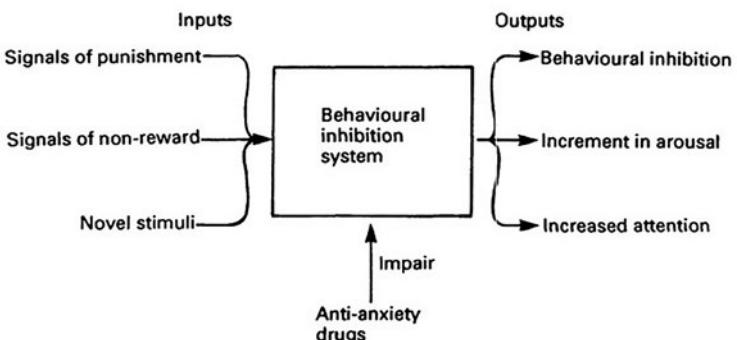
Fig. 4.1 The behavioural inhibition system (Gray 1982).
structures. With regard to the neurochemistry of this system, Gray (1982, p.460) suggests the following:
The role of the ascending noradrenergic projection to the septo-hippocampal system is to tag certain stimuli (entering the septo-hippocampal system from the entorhainal area) as “important”, i.e. requiring particularly careful checking; that of the ascending serotonergic projection is to add to this “important” tag the information that the stimulus is associated with punishment and/or to bias the operation of the septo-hippocampal system more strongly towards the inhibition of motor behaviour; that of the ascending cholinergic projection is to facilitate stimulus analysis; and that of the adrenergic projection to the hypothalamus is to mediate the increased arousal output of the behavioral inhibition system by priming hypothalamic motor systems (especially those involved in fi ght and fl ight behaviour) for rapid action when required. . . .
Gray suggests that this system accounts for anxiety. As he suggests, this view of anxiety relates most closely to obsessive compulsive disorder. Furthermore, it is very much a theory that places a central emphasis on attention. We can see from the way that Gray separates the neurochemistry in terms of attention (appraisal) and its motor outputs (e.g. fi ght/fl ight behaviour) that the system concurs with the distinctions made between go–stop and defensive–safety systems as portrayed here. In other words, the activation of the BIS focusses attention on potentially threatening stimuli and cues, which increase arousal and inhibit ongoing activity. The word to stress here is “ongoing” for it must not be confused with the output side. For example, “go” behaviour may be a direct consequence of this checking as in the case of the animal that takes fl ight. Or, the animal may freeze in which case we have a “stop” behaviour. This checking routine may also relate to internal cues (e.g. increased heart rate, breathlessness) which also activates the defence system. However, in the absence of any perceived external physical danger, the eliciting stimuli may become the focus of a “physical threat” explanation (e.g. an oncoming heart attack).
Safety
There has been less work on safety systems than on defence systems. Safety systems presumably relate to two aspects. First, there is reduced activity and attention to threatening stimuli. Maybe this constitutes the BIS acting in checking mode. Second, there is increased activity in approach behaviour. Gray argued that skilled escape behaviour increased activity in reward systems of the brain (Gray 1971, pp. 188–192). Hence, successful escape produces relief which is positively reinforcing. When it comes to social behaviour however, we must be cautious. Submission, for example, may well bring relief in that it heads off an attack, but may not be experienced as positively reinforcing (Ohman 1986). This is because it is related to hostility and signals “reduced access” to reproductive resources.
Chance (1980, 1984, 1988) has argued that in social animals that maintain low levels of threat via high levels of reassurance behaviour (not to be confused with appeasement), attention is directed away from defensiveness toward outwardly directed problem-solving activities which liberates creative, co-operative intelligence. Furthermore, it is known that approach to caring social objects reduces arousal provoked by threat (see Chapter 6 ). This relates to the attachment system (Bowlby 1969, 1973, 1980, 1988). In other words, the capacity to feel safe relates not only to the distance between the animal and a potential injurious stimulus, but also the nearness to safety-providing stimuli and social others (see also Rachman 1984b).
The neuropsychology of the safety system
The neuropsychology and neurochemistry of the safety system have been poorly studied. However, MacLean (1985) points to some very important fi ndings. First it has been shown that the cingulate cortex (which sits on the dorsal surface of the limbic system, see Bailey 1987, pp.63–67) is essential to maternal interest and behaviour (nest building, nursing, and retrieval of young). Animals with lesions to this area showed serious defi cits in these behaviours and survival of their young was low (12%). Second, MacLean (1985, p.413) observed that hamsters with cingulate cortex lesions:
. . . failed to engage in play behaviour with control littermates. I was particularly struck by this defi cit because in observations on lizards and other reptiles, I had never detected any behaviour resembling play. Contrary to usual interpretations, I would suggest that the development of play behaviour in mammals might be construed as serving originally to promote harmony in the nest and then later on social affi liation.
This evidence points to the important role of the cingulate cortex and related structures, in what has been termed here the social safety system. This system includes both attachment behaviour and co-operation (see pages 49–53). (I am grateful to Michael Chance for discussion on this point.) MacLean (1985, p.414) also suggests:
. . . the cingulate cortex has a higher concentration of opiate receptors. Is it possible that one of the attractions of the opiate drugs is that they provide some people with a surcease from persistent feelings of “separation” or “alienation”?
The above observations may link the safety system with opiate activity. The possible implications of this are important. First, do maternal behaviours (cuddling, holding, nursing, retrieving) act on the infant’s opiate system increasing the sense of safety and inhibiting or deactivating the defence system? If so does this then facilitate the growth of hedonic and co-operative behaviour? Certainly various components of the attachment interactions do have psychobiological regulating functions (Meyersberg and Post 1979; Hofer 1981, 1984). Would children who suffer maternal abuse and neglect be rendered less able to experience safety with their fellow human beings as a result of neurochemical failures of control in these brain areas? Further, what are the classical conditioning implications of this if true? Does the cingulate cortex have any modifying effect on the BIS?
Second, MacLean makes the point that many of our psychotropic drugs operate in reptilian brain structures. But would it not also be useful to discover more about the safety system and to think about increasing safety rather than working by perhaps inhibiting activity in the R-complex? It may be, however, that such drugs are going to be addictive. Does psychotherapy work primarily through the safety system? (Mackie 1982).
Third, as described by Chance (1988) the hedonic mode of the higher primates seems to be a composite of attributes that involve both attachment (e.g. reassurance giving via physical contacts, answering the distress call of conspecifi cs with help rather than fl ight) and co-operation (task-orientated joint problem solving, and division of labour). Are these capabilities governed by activity in the cingulate cortex? Are the brain areas involved in play also central to the enactment of co-operation, especially those forms of co-operation that depend on the ability to value “the other” and inhibit status attacks on the other? (see Chapter 10 ). Does social support work (in part) by inhibiting activity in the defence system leading us to feel less vulnerable in the world?
At the present time all we can do here is allude to possibilities. Hopefully, however, enough has been said to give credence to the separation of defence and safety and to highlight that these should not be confused with go–stop systems.
Concluding comments
In this chapter we have suggested some ideas to help integrate biological with psychological theory. For this a common descriptive language is necessary. We need to know what the ground rules of CNS organisation are (and these Freud tried to establish). A science of psychopathology must bridge the biological– psychological divide, otherwise psychological approaches become a brainless science (L. Eisenberg 1986). At the same time, however, we need a language which is ecologically meaningful and which can be used to study animals as interacting social members. Concepts such as approach–avoidance and reward–punishment are insuffi cient to meet the last criteria although they remain important.
This fact has been recognised by ethologists. Chance (1980, 1984, 1986, 1988) for example, has pointed out that the style of social organisation of a primate group signifi cantly determines the attentive processes of interacting members. In the presentation expounded here, this has been a prominent consideration. To help us derive ecological meaningful concepts, I have used the idea of defence–safety. The defence and safety systems are related to the control of attentive and primary appraisal mechanisms. The defence system is primarily concerned with threat cues and switching outputs to take defensive action. This may be fi ght (such as is noted for Type A’s under challenge) or fl ight, or in social contexts submissiveness or hiding as in the socially phobic. The more global the evaluations and the higher the density of negative uncontrollable events, together with low social support, the more the tendency for the combination of these to turn submissive acts into yielding (depressed) states. The defence–safety system will be sensitised by past relationship history and also by internal models of self-esteem (RHP). High self-esteem (favourable relative RHP) seems to lower the tonic activation of the defence system by rendering many cues as non-threatening or easily dealt with (i.e. one can defend oneself against conspecifi cs should the need arise). Hopefully, the reader will obtain from this description a fl avour of how internal models of the self may exert an impact on defence–safety activation (i.e. control and coordinate attentional mechanisms). Some individuals will operate in self-protective mode (defence) across a wide range of stimuli, whereas for others the sources of threat are much more narrowly defi ned. The more insecure an individual (the lower RHP and self-esteem), the more he operates in defence mode.
The defence–safety systems are related to the BIS in some way. It may be that safety is the BIS in checking mode, whereas defence is the BIS in control mode; in addition, in regard to the social domain the cingulate cortex may play a crucial role in a person’s sense of safety with others. It seems to me that our theories of psychopathology must start off from a study of what the individual feels threatened about. All therapists, in different ways, try to help the individual switch out of defence mode into safety mode; what was dangerous is made safe(r); what was threatening is made less threatening. Here lies, I believe, the commonality of psychotherapy and an approach that offers an alternative to brainless theory.
I should impress upon the reader that the psychobiological discussion here is very simplistic. One is very much trying to throw across a line whilst standing on the opposite bank. My main concern has not been to provide adequate or detailed outlines to the complexity of our biological minds but rather to open possible areas for discourse or common language. I also wish to highlight that suffering is as much biological as psychological. Some states of mind are not easily turned around once they have been ignited. There are some depressive and anxious states that it would be cruel indeed not to treat pharmacologically. Equally, I hope it has been suffi ciently highlighted that this is often only part of the treatment and that we must look to the person as an individual who lives in a social world.
Finally, to highlight further the evolution of biological systems I have presented in Appendix 2 some ideas which show that biological systems are not homeostatic. Homeostasis is often assumed by psychological therapists and this view is simply wrong.
Notes
- 1 There is some controversy over whether the stop system is energy conservational or not. Insofar as it allows the individual to disengage from incentives which are unobtainable, and over time redirect its efforts, then some arguments may be made that it is energy conservational. However, long-term activation of stop states cannot be seen in this way, since if the animal remains here for too long, body weight may signifi cantly drop and the animal will die. Furthermore, there is little evidence that stop reduces arousal as would be necessary for it to be truly conservational. This form of stop should not be confused with hibernation, which is energy conservational (see Appendix 2 ).
- 2 NE equals norepinephrine which is the American term for noradrenaline.
- 3 Remember however, sometimes the fi rst response to stress (e.g. shock) is not “go” at all, but “stop” as in the classic freeze response noted to occur on the fi rst trial of avoidance learning in some animals (Carlton 1969). The preference to “freeze” may relate to genetic or pre-sensitising factors.
- 4 This, of course would make 5-HT an important transmitter in hostile-dominance behaviour. 5-HT is very sensitive to status change (Raleigh et al. 1984). But we should treat such speculations cautiously.
The psychobiology of peripheral systems
In the last chapter, we looked at various aspects of the CNS which regulate the systems of defence–safety and go–stop. The CNS co-ordinates attention, appraisal and action in the world. Action is carried out by the body that literally moves the brain around in its environment. Major systems of feedback exist between body and brain. Consequently, any complete picture of psychobiology would fall short of its mark if it did not acknowledge the body as a major source of information and control. The liver, for example, is sometimes called the butler of the brain because amine transport is regulated here. Moreover, the brain must protect the body if it is to survive. Hence, avoiding injury and overload is one of the coordinated functions of the brain (mind)–body relation.
The body consists of many peripheral organs designed to control energy and body outputs. These organs are activated by direct stimulation from the sympathetic and parasympathetic nervous system, and by various hormones secreted into the bloodstream. Hormones are secreted from many places throughout the body (e.g. pituitary, thyroid and adrenal glands). Hormones secreted into the bloodstream from one organ (gland) can have as their target an organ(s) located in some other place.
The word “hormone” derives from a Greek word meaning to excite or arouse (Soloman and Davis 1983). The origins of chemical transmission, as central control mechanisms within the physiology of the cell, are very old. Even protozoa appear to have substances that may be early forerunners of vertebrate neurotransmitters and hormones identifi ed in humans (Roth et al. 1982).
In this chapter, attention is focussed on these peripheral systems. This review will follow the line of thought developed in Chapter 4 , which distinguished between go–stop and defence–safety. Good introductory texts to accompany this chapter are Leshner (1978), Cotman and McGaugh (1980) and Soloman and Davis (1983, especially Chapters 12 and 14 ).
The endocrinology of defensive go states
The idea that there are two basic systems in the nervous system regulating defence systems and safety systems is further refl ected in the activity of endocrine activity. The activation of the go–stop components of the defence systems work through three basic mechanisms: (1) the sympathetic adrenal medullary system; (2) the parasympathetic system; and (3) the hypothalamic pituitary adrenal cortical system. The operating and control processes of each system are outlined in the following. The endocrine responses of the defensive system facilitate the animal’s physical capacity to avoid injury and cope with it if it occurs.
Activation of the sympathetic adrenal medullary system involved in defence states is outlined in Fig. 5.1 . Research on this system has suggested that events which represent threat or novelty activate hypothalamic processes which release noradrenaline
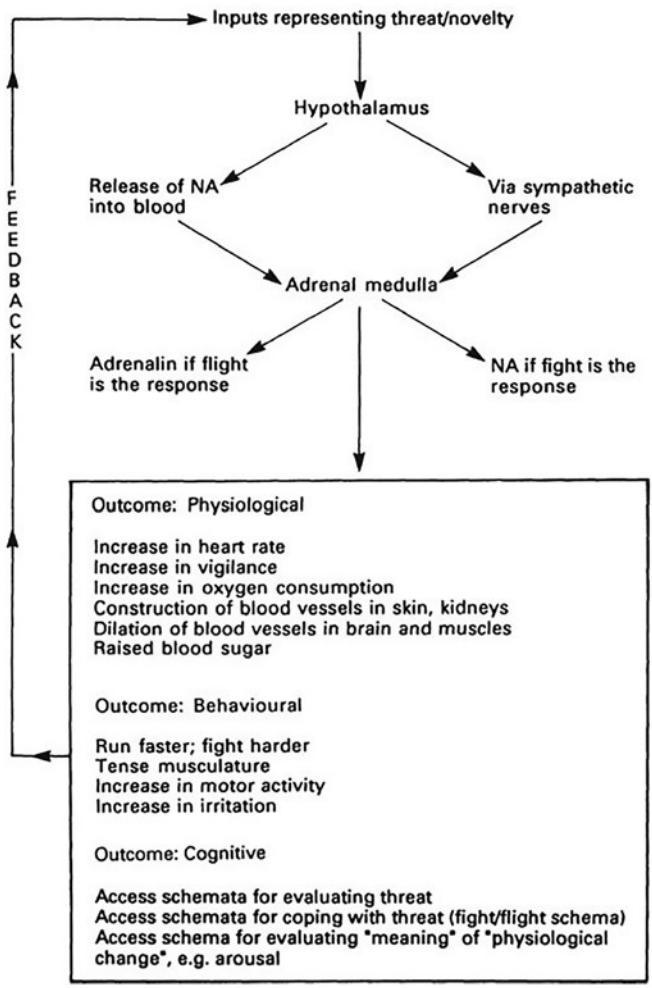
Fig. 5.1 The sympathetic adrenal medullary system
Sources: Price 1982; Soloman and Davis 1983.
into the blood and also activate sympathetic nerves. These have an effect on the adrenal medulla which in turn releases adrenaline and noradrenaline (NA).
The sympathetic medullary system appears to serve the function of activation of psychological states for “defensive go” in the periphery and facilitate fi ght/ fl ight behaviour (Stokes 1985). It prepares the organism to deal with threat and regulates a number of physiological processes that would facilitate dealing with threat (and possibly novelty). Blood vessels to skin and kidneys are restricted but are dilated in the heart, brain and muscles. There is also a lowering of thresholds in the reticular activating system increasing alertness (Soloman and Davis 1983). About 80% of the medullary output is adrenaline. Both NA and adrenaline have similar effects on the cardiovascular system but by rather different mechanisms. Henry and Stephens (1977) and Price (1982) review the evidence on the operation of this system and suggest that noradrenaline tends to be associated with increases in irritation and preparedness for aggressive behaviour, whereas adrenaline is associated with anxiety and preparedness to fl ee. Hence, these chemicals may have differential effects on fi ght/fl ight. Crucial however, is the appraisal of the event (Stokes 1985). Bandura et al. (1985) found that teaching twelve spider phobics coping techniques for their phobia signifi cantly reduced the peripheral output of adrenalin and NA to the feared stimulus. This research demonstrated that perceived self effi cacy had a signifi cant modulating effect on the sympathetic nervous system. Such research demonstrates the biological effects of successful psychological therapy.
In a different research paradigm on Type A, Price (1982) reviews much of the evidence suggesting that Type A’s show accentuation of peripheral NA during their normal working day. This may be due to the increased tendencies for Type A’s to see life as a struggle to gain and protect status and self-esteem by competitive endeavours. NA mediated effects seem more likely to be activated to status threats where the chosen response is to fi ght. Henry and Stephens (1977) suggest that the hypothalamic activation of the sympathetic medullary system is infl uenced by the amygdala. The amygdala is especially involved in social dominance behaviours.
Roy et al. (1985) investigated the activity of the sympathetic nervous system in depression. They measured plasma levels of NA in standing and lying down positions. Comparing controls, dysthymic disorders, major depressive disorders, melancholia and manic depressive episodes with a past history of melancholia, a steadily increasing level of NA was found across these groups. Controls had the lowest levels of NA and major depressive episodes with past history of melancholia had the highest. Overall, their fi ndings suggested that both the sympathetic nervous system and the hypothalamic pituitary adrenal cortical system can each be disturbed in some groups of depressed patients (indicating again that go and stop systems can be activated at the same time). Interestingly, within a group of unipolar melancholics, higher blood plasma of NA correlated with self-reported anxiety, a fi nding noted by others. It is unclear in what light this throws Price’s (1982) and Henry and Stephens’ (1977) view that NA is more associated with fi ght profi les. Does it suggest, one wonders, that there is a heightened aggressiveness in depression but which is under some form of inhibitory control and manifests as anxiety? Are certain types of depression the results of failed competitive efforts, i.e. manifesting defeat-like depressive states? (Gilbert 1984; Price and Sloman 1987)
There is considerable work showing that depressives do show increased levels of intrapunitive and extrapunitive hostility (Blackburn 1972, 1974; Cochrane and Neilson 1977; Fava et al. 1986). Weissman et al. (1971) found depressed women expressed greater hostility towards those with whom they shared a close relationship.
Further research is needed to discover whether the correlation of plasma NA holds for hostility measures. Most certainly, the relationship between depression and intrapunitiveness is an interesting one (Freud 1917) and inhibited aggressive feelings can be prominent during psychotherapy with some depressed patients. Price and Sloman (1987) have suggested that whether depression is associated with increased hostility to a spouse depends on the dominance relationship in the marriage. If the depressed partner was the more dominant then depression would be associated with more external hostility. Cochrane and Neilson (1977) found that inhibited aggression is especially marked in endogenous depression. “Fight” is one aspect of the defensive system which may be sensitised in some depressions but is also under inhibitory control (Leshner 1978).
Rudorfer et al. (1985, p. 1191) have extended their line of research (Roy et al. 1985) and concluded that:
. . . we believe that the current studies provide clear evidence of dysregulation of peripheral release of NE in affective illness with a difference in the pattern of dysregulation between unipolar and bipolar patients. Put most simply, the bipolar patients appear to have a reduced to average resting output of NE with a highly exaggerated NE response to the standing stimulus, while unipolar patients have an average to elevated resting NE with moderately exaggerated response to the same stimulus.
One may note again that Blackburn (1972, 1974) showed important differences between intrapunitiveness and extrapunitiveness in unipolar and bipolar patients. Bipolars were more intrapunitive (self critical). This looks like an interesting psychobiological research area. Taken as a whole, these studies indicate that “defensive go” is mediated by the sympathetic nervous system. The system is specially involved in preparing for (go) action(s), be these fi ght or fl ight.
Defensive stop states
The parasympathetic system
The parasympathetic nervous system uses the neurotransmitter ACh and tends to oppose the sympathetic system, acting like a braking system. It emerges from the brain as part of the cranial nerve III. Soloman and Davis (1983) suggest that the parasympathetic nervous system is concerned with the conservation and restoration of energy. Its effects tend to be localised and of brief duration. Long-term activation of this system could be detrimental to survival. It is interesting to note that about 75% of all parasympathetic fi bres are in the vagus nerves which pass down through the neck. Sensory neurons of the vagus nerves transmit information from many organs including the heart and abdominal viscera, and neurons associated with the vagus neurons are involved in breathing control (see Soloman and Davis 1983, pp.326, 358). There is increasing evidence that the parasympathetic system is involved in panic attacks (Dilsaver 1986). Hence, the relations between hyperventilation, panic attack and the parasympathetic system are of interest. In research on helplessness it was found that under some conditions of intense uncontrollable stress, animals died quite suddenly. At autopsy there were suggestions that the heart had become engorged with blood, suggesting parasympathetic hyperarousal (Seligman 1975).
A number of organs and tissues are innervated by both sympathetic and parasympathetic nerve fi bres. Hence, both systems can be activated and have differential effects on the same target organ. There is suggestive evidence that some depressed states, especially retarded states, demonstrate parasympathetic hyperarousal (Lader 1975).
The interactions between the sympathetic and parasympathetic nervous system are outlined in Fig. 5.2 .
The hypothalamic–pituitary–adrenal–cortical system
Just as there are the sympathetic and parasympathetic systems, control of “defensive go” routines (e.g. fi ght–fl ight) and defensive stop, so there appears to be another form of “defensive stop”. This involves the hypothalamic–pituitary–adrenal– cortical system (HPAC). This system is probably more involved in long-term states of stop and possibly has a signifi cant impact on “state” processes (see pages 88–91). Furthermore, the sympathetic nervous system and the HPAC interact (Stokes 1985). Interestingly, the inhibitory processes of the HPAC start off with signals relayed from the hypothalamus. It will be recalled that signals from the hypothalamus activated the sympathetic adrenal medullary system. The hypothalamus itself, of course, will be acting under instructions from a number of different brain areas.
Current research suggests that various interpretations such as low expectations of success, low self-esteem and expectations of defeat and depression activate the HPAC system (Price 1982). This suggests that to some degree individuals may be biologically preparing to downgrade activity and avoid situations that cannot be controlled. Under these conditions the hypothalamus releases corticotrophic releasing hormone (CRH). CRH has recently been discovered to be released with an opiate substance call β-endorphine. However, it is probably CRH’s activity on the pituitary which activates adrenal corticotrophic releasing hormone (ACTH) which in turn activates the adrenal cortex. The activation of the adrenal cortex produces cortisol plus other adrenal cortical steroids. Cortisol has many important functions in the peripheral systems. It mobilises fat, is anti-infl ammatory, raises blood sugar 1 and stimulates amino acids into liver cells.
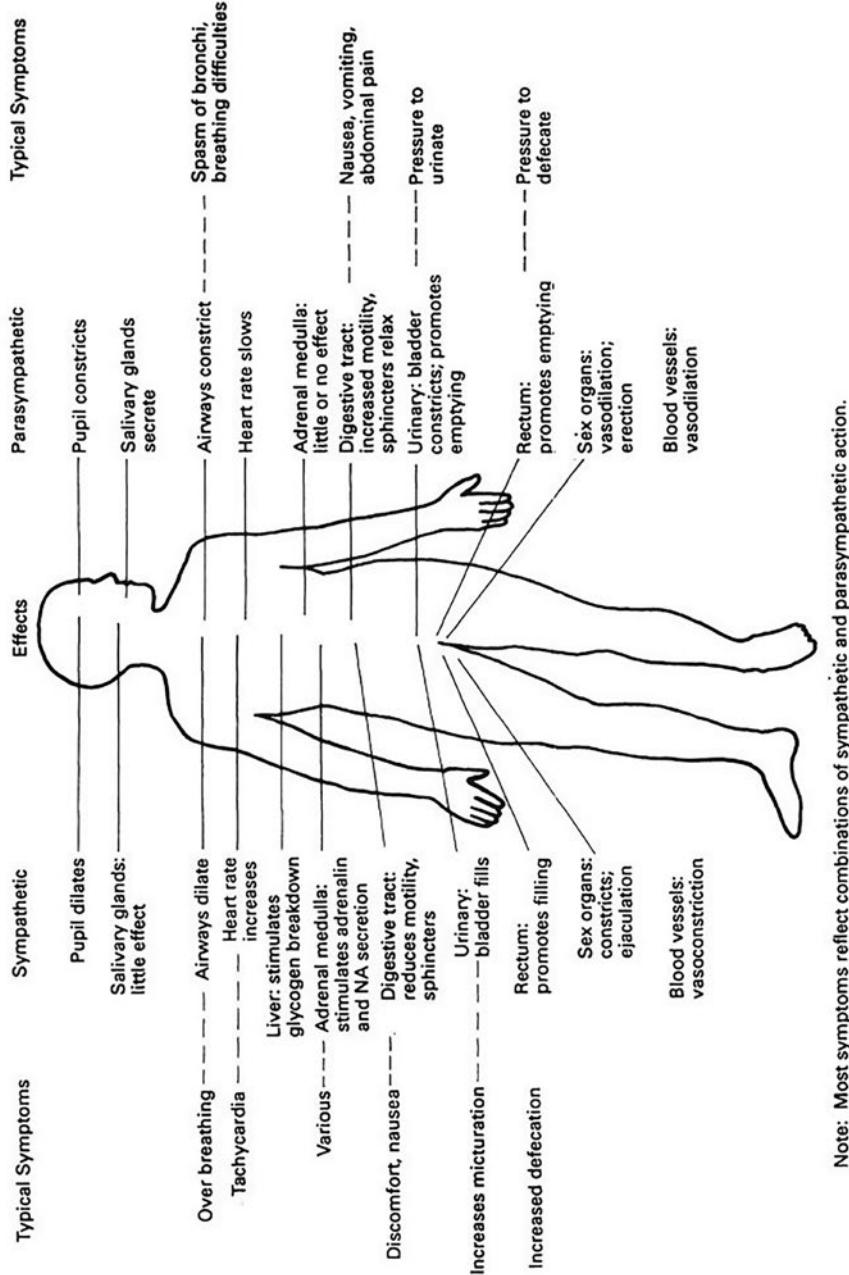
Fig. 5.2 Sympathetic-parasympathetic actions
Sources: Cotman and McGaugh 1980; Soloman and Davis 1983; Beck et al. 1985; thanks also to Martin Ward.
The physiological outcomes of such activation include decreased heart rate, increased blood pressure, increase in emotional arousal and basoconstriction in the viscera. But it can also have a detrimental effect on the immune system. The behavioural outcome is a reduction in psychomotor activity, reduction in emotional expression and passivity. It is interesting to note the distinction between increases in emotional arousal and reductions in emotional expression. Again, we see a distinction between activating and inhibiting systems. The cognitive events may be triggered by this physiological sequence, and also predispose to it. These relations are outlined in Fig. 5.3 .
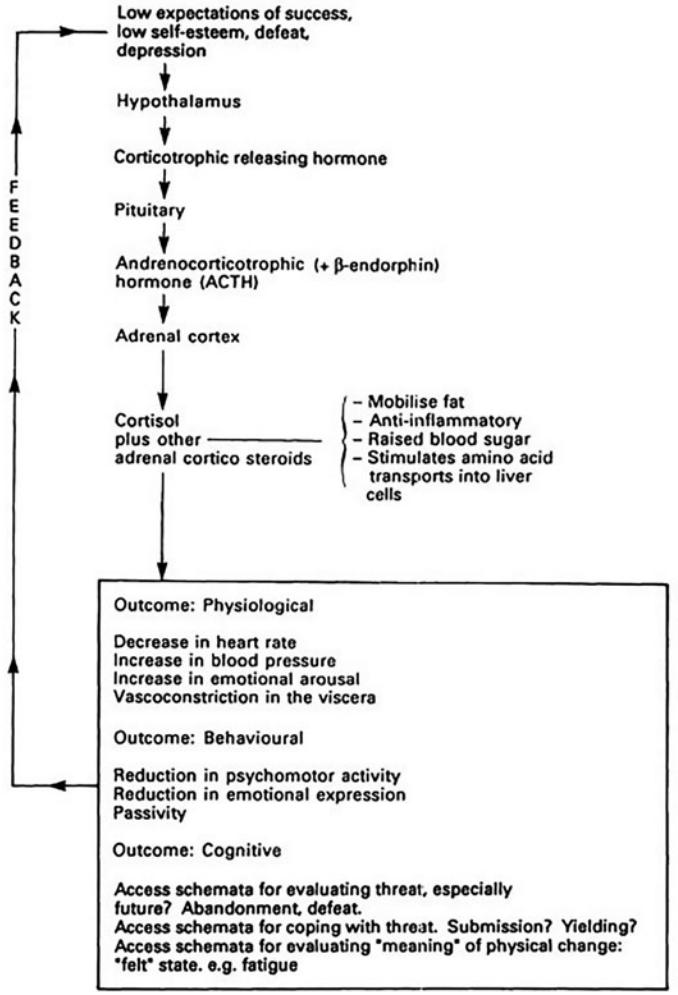
Fig. 5.3 Hypothalamic–pituitary–adrenal–cortical axis
Sources: Price 1982; Soloman and Davis 1985.
Interestingly, the septo-hippocampal systems appear to have receptors for cortisol (Gray 1982; Jacobs and Nadel 1985). Hence, the tonic level of activity of the BIS may in part be controlled via feedback effects of cortisol. It may be suggested that cortisol plays a role in preparing the BIS (see pages 88–93) for long-term work. In other words, the long-term states of defensive arousal may be (in part) mediated by the cortisol response. Unlike freeze, depression is a longer-term response to threatening (punishment and non-reward) cues. Low-ranking animals, for example, have much higher levels of cortisol than high ranks (Henry and Stephens 1977; Leshner 1978). If cortisol does play a role in the BIS then more research is needed to understand how these feedback effects may relate to different long-term states, as opposed to short-term (stop) responses mediated by the parasympathetic system. In other words, sensitivity in HPAC and hippocampal systems may refl ect status position. Low status (unfavourable RHP) increases the tonic arousal of the defence system. One prediction would be that neurotics have higher HPAC activation than non-neurotics.
Some recent evidence
The HPAC system has been extensively studied over the past twenty years and more. Many psychiatric conditions are now known to involve considerable alteration in this system. The neurobiological control of HPAC is also highly complex and is infl uenced by a multitude of neurotransmitters. Kalin and Dawson (1986) provide an excellent overview of these control processes and their possible role in depression. Stokes (1985) has reviewed the evidence that the HPAC system may be involved in anxiety conditions.
The most frequently studied index of HPAC activity has been cortisol production. Some depressed patients appear to have circulating blood levels of cortisol similar to patients with a disease of the adrenal cortex known as Cushing’s disease. Interestingly, Cushing’s patients may manifest a number of psychiatric symptoms including psychotic and depressed states. Yet these are regarded as secondary disorders to cortisol dysfunction and would not be diagnosed as primary psychotic or depressive disorders. The work of Carroll and his colleagues (e.g. Carroll et al. 1981) suggested that hypercortisol secretion (measured by the dexamethasone suppression test) relates principally to depressive endogenous disorders. However, this is looking less certain now. For example, Christie et al. (1986, p.64) suggest that in drug-free patients raised plasma cortisol is more a feature of psychotic illness especially for those with “paranoid and grandiose delusions, hallucinations and loss of insight”. They also suggest that the return to normal levels of circulating cortisol follows recovery irrespective of choice of treatment (tricyclics, phenothiazines, ECT or lithium). Such evidence may again point to the fact that there are sub-groups of patients whose psychotic symptoms (or some of them) are not related to a primary psychiatric condition but are secondary to hypercortisol secretion. It would be quite important to get the causative arrow the correct way round. Do certain forms of psychosis lead to hypercortisol, or does hypercortisol invoke psychosis as in some of Cushing’s patients? If the latter turned out to be true, then treatments used in Cushing’s disease might be of value to some psychotic patients. One wonders whether dexamethasone, for example, has anti-depressant or anti-psychotic properties. However, this is a complex area because in some physical conditions requiring steroid treatment, individuals can experience mood elevation. The idea that some patients may have idiosyncratic responses to their own stress hormones is not new (Whybrow 1984).
In a different line of research, Dolan et al. (1985) explored the HPAC activity in relationship to the neurotic–endogenous depressive distinction and life events. In addition to fi nding no distinction between cortisol suppression/ non-suppression to dexamethasone, these researchers did fi nd an interesting association between life events and urinary free cortisol. This, as they point out, again raises the important issue of environment – biological interaction. Sachar (1967) also demonstrated that urinary cortisol in depressed patients was increased following focus on stressful loss events in psychotherapy. If loss does have the effect of reducing the estimate of relative RHP then this may be an important link.
By way of an aside, we may note that the physiological changes that take place during psychotherapy may either aid or hinder the process of therapeutic change. If the stress of critical incidents in psychotherapy activates too much “stop”, then the patient may withdraw (as a way of self-protection) and become passive and unresponsive to further inputs. This is another area desperately in need of research. Dolan et al.’s study also highlights the possibility that life events in some patients may activate the HPAC system. Increased circulating cortisol feeds back into neurobiological processes (e.g. the BIS), possibly changing neurotransmitter mechanisms and invoking further symptoms in patients’ 2 setting up a vicious circle. What is clear is that cortisol does have central neurotransmitter modulating effects (Kalin and Dawson 1986).
The dexamethasone suppression test
Another line of research has come from studies which have attempted to look at the HPAC system under biological challenge. This area of research uses dexamethosone. Given in a 1mg dose at about 11 p.m., dexamethasone will significantly suppress cortisol output for the next 24 hours or so in non-psychiatric patients. (There are a number of exceptions, however, including those suffering signifi cant stress, weight loss, liver disease, etc. See Carroll et al. 1981.) However, from the many studies of Carroll and his colleagues a test for melancholia was suggested (Carroll et al. 1981). Melancholic patients, given 1mg of dexamethasone, were found to show early escape or non-suppression of cortisol. There has been some interest in the timing of this non-suppression with blood being taken at different times during the day. However, it looks as if the disturbance of the HPAC system could override the dexamethasone inhibitory effects. The exact way this happens is not our concern here, and recent evidence using different research designs and time sampling suggests that the abnormal cortisol of depressives may not be closely related to ACTH activity (Charlton et al. 1987).
Since 1981 the dexamethasone suppression test (DST) has been used in a variety of settings with a variety of patients. Both its specifi city (specifi city means: how specifi c to melancholic affective disorders is non-suppression or do fair numbers of other psychiatric patients show non-suppression) and its sensitivity (sensitivity means: what percentage of patients with diagnosed melancholic disorder demonstrate non-suppression) have been examined. The high specifi city and sensitivity rates reported by Carroll et al. (1981) have not been found so promising as was originally hoped. Hence, while the DST is a major contribution to our study of psychopathology, some caution is required as to its interpretation. Arana et al. (1985, p.1200) have provided a comprehensive review of the area and conclude the following:
The DST is limited in sensitivity in major depression (44% in over 5,000 cases), and rates of non-suppression appear higher in melancholic, psychotic or mixed manic depressive disorders . . . When a broad range of affective states is considered, there is a striking progressive increase in the rate of DST non-suppression from grief reactions and dysthymic disorders, through major depression, melancholia, psychotic affective disorders and depression with serious suicidality . . . This relationship suggests that non-suppression in the DST may be an indication of severity of affective illness.
Hence, the DST studies also show a relation between severity, possibly psychotic states and hypercortisol secretion. The detailed biology we must leave to the biologists, but evidence is now overwhelming that once an illness has started considerable biological changes take place. It would be very naive indeed to believe that these biological changes did not have important feedback effects on psychological processes. Whether an auto-hormonal hypothesis has any validity is unclear, but it may be the case that in some instances these kinds of physical processes interact with psychological events (changes in incentive hierarchies, etc.) which play a central role in the timing and activation of (other) biological processes.
Quite recently, research has also shifted to the newly discovered role played by corticotropic releasing hormone. An interesting pilot study has looked at corticotropic releasing hormone stimulation in patients with panic disorder. Roy-Byrne et al. (1986) found that patients with panic disorders also had elements of hypersecretion of cortisol like depressed patients but in addition demonstrated a more acute ACTH response not seen in depressed patients. In a recent study, Schweizer et al. (1986) found that 27% of patients with generalised anxiety disorder ( n = 79) also demonstrated DST non-suppression. The existence of depressive symptoms did not account for this fi nding. Hence, over the next few years we can expect researchers to continue to investigate the mysteries of the HPAC system and its role in psychopathology.
Attempts to relate the cortisol dysfunction to cognitive processes have produced variable results. Zimmerman et al. (1984) did not fi nd any signifi cant difference between attributional style and DST suppression/non-suppression (although interestingly some patients could not fi ll in the questionnaire). Giles and Rush (1982) found that severity of symptoms correlated with dysfunctional attitudes in a nonendogenous group. Unfortunately, they found that DST did not correlate with severity of depression, a fi nding which has not been replicated (Arana et al. 1985). So it’s diffi cult to interpret their results. However, the view that some dysfunctional attitudes may be state phenomena rather than causal is of some interest. Do depressed Cushing’s patients endorse dysfunction attitudes? Do negative attitudes have to be learnt or can a biological state provoke or recruit innate forms of negative construction of the self and the future, perhaps as a result of an unfavourable estimate of RHP? Recently, Beck (1987) would seem to support this possibility at least for some cases. Brain state theory (Reus et al. 1979; Gilbert 1984) suggest that it is indeed the case that certain types of appraisal are innate, and are activated by psychobiological states.
The degree to which conditioning plays a role in subsequent HPAC hypersensivity is also unknown. Brown and Harris (1978) suggested that loss of the mother before the age of 11 acted as a symptom formation factor for psychotic depression. There is also increasing evidence that early experience (like loss) can sensitise the HPAC so that under stress it shifts into hyperactivity (Henry and Stephens 1977) – see Chapter 6 .
Before leaving this system, it should be noted that an increase in cortisol production should not be regarded as all bad. Coe et al. (1985) discuss evidence that increases in cortisol may facilitate new (especially avoidance) learning. Hence, although the HPAC system may be a system mediating stop behaviour, it could also be seen as a physiological component of disengagement from incentives which helps to reduce the purposeless pursuit of unobtainable incentives and clears the way for new learning. A failure to switch to new incentives is probably due to many complex environmental, psychological and biological factors. In states of psychopathology the opportunity for new learning may not be taken and the individual becomes stuck in a physiological state which inhibits exploration of new alternatives. As discussed elsewhere (Gilbert 1984), many neurotic diffi culties lie in a psychological failure to disengage under environmental and physiological conditions where disengagement is called for. Individuals may remain deeply wedded to incentives even though their biological systems have long ago given up the ghost. This may happen as a result of all kinds of developmental and personality factors. Some individuals have unrealistic aspirations and (in Ellis’s terms) are “musturbatory” (I must win, I must never make a mistake, etc.).
The psychobiology of changing states
In the fi rst part of this chapter we looked at some peripheral systems of the body that are involved in psychopathology. However, it is useful to recognise that individuals are in constant states of fl ux in regard to the activity of the defence and safety systems. Consequently, we may entertain the idea that the physiological “state” of an animal helps to bias or preselect the response outputs to specifi c stressors. The issue of endogenous oscillating mechanisms (e.g. seasons, menstrual cycles) are examined in Appendix 2 . This preselecting (or state) aspect may bear no relationship to a stressful event that actually triggers a pathological or amplifi ed defensive response. Bailey (1987) refers to a similar idea as priming. The state of the organism acts more to bias the attentive and response systems. These issues are discussed in the following paragraphs, and we end our discussion with the “defensive drift” hypothesis.
Yesterday I drove my car out of the garage and down the road. Coming to a junction, I stopped and then pressing on the accelerator again I found the car had stopped dead. Five minutes later when the engine was warmed up, the same action produced a smooth acceleration. There is no mystery here of course, once it is understood that my car behaves differently to the same stimulus in cold and warm states. Consider a psychological example. A man has had a row with his boss over a raise. He returns home where he fi nds his wife upset about the bad behaviour of the children that day. The man listens for a while and then storms out of the house saying, “That’s the last straw – I can’t take any more,” or proceeds to be angry with the children or his wife. A week later the boss relents and gives the man his raise. The man returns home again where his wife has had another bad day. This time, he looks at his wife and says, “You’ve had a bad day. You take a break and I’ll bath the children tonight.”
Both of these examples seem common enough, but they refl ect the fact the “state” of a system before an encounter or excitatory stimulus infl uences the response to the stimulus. In this sense, the state of a system signifi cantly predisposes the potential responses of the system. In psychobiology, therefore, it is useful to distinguish between factors that preselect the stress response from those of the stress response. 3
These issues are fundamental to the psychobiology of psychopathology. As Rachman (1978) has pointed out, individuals can be subjected to fear-eliciting stimuli time and again without demonstrating a phobic response. Then one day a phobic response may appear. A simple stimulus–response model which does not allow for variations in state preceding an encounter will fail to make sense of these issues. Consider also the learned helplessness research paradigm. Once animals have been rendered helpless, then an active coping repertoire appears unavailable to the animal. In other words, the biological state has changed, such that the “recruitable” response profi le is also changed. Moreover, a whole array of responses such as aggressiveness and appetitive behaviour appear to be affected by the switch to a learned helplessness state (Seligman 1975). In other words, changes of state can produce changes across a varied array of potential responses. Put simply, the animal responds very differently to a stress depending on the preexistent state. State effects have been demonstrated for memory, effort, mood, assertive responding and so on (Reus et al. 1979).
If certain classes of antidepressants are given to non-depressed subjects, these tend to disrupt their cognitive functioning, whereas these drugs improve cognitive functioning in depressed subjects (Thompson and Trimble 1982). Once it is recognised that the state of an organism helps to preselect a set or an array of potential responses, then factors antecedent to encounters with events can be shown to be of major signifi cance to the actual response to an event. Moreover, it allows us to distinguish between factors pertaining to state properties and those pertaining to response properties. Individuals may vary in terms of their background states and/or they may vary in terms of the responses that are available in specifi c states.
Biological factors relating to state-reponse
This issue has been taken up by Leshner (1978, 1979) who drew a similar distinction in relationship to hormonal states. He proposed that baseline hormonal states existing before an animal encounters an excitatory stimulus affect the responsiveness of neural mediating mechanisms. Hence, some responses are more likely and some are less likely according to background hormonal state. This is in contrast to hormonal effects on behaviour which occur during or subsequent to stimulation. These effects are known as feedback effects which, over time, may have an effect on background hormonal state. Leshner (1979, p.70) puts it this way:
What is important to the distinction made in this paper is that the behavioral effects of the base line hormonal state begin to operate or prepare the organism before stimulation in the particular instance being studied, whereas feedback effects on behavior begin to occur during or after that particular case of stimulation . . . Feedback effects take place rather rapidly often within minutes whereas most base line effects are relatively slow to develop, taking hours and often days to be seen.
The crucial difference then is that baseline and feedback effects vary according to the speed at which they occur. Leshner cites two interesting examples which bring home the importance of this distinction. If a mouse’s androgen levels are experimentally reduced before an aggression-provoking encounter, it will not attack. However, androgen levels are known to fall after defeat, but artifi cially maintaining androgen levels after defeat does not affect subsequent aggressiveness. In other words, different hormones are involved in facilitating aggression before a competitive encounter and inhibiting aggression after one (i.e. if the mouse is in a “defeat state”). In the second example, Leshner considers sexual behaviour. Coitus results in an increase in progesterone that reduces sexual responsiveness. Artifi cially increasing progesterone before coitus also reduces sexual responsiveness. But preventing the progesterone response to coitus has no effect on subsequent sexual responsiveness (i.e. it still declines). Again, such evidence suggests that different hormones are involved in different ways in facilitating or inhibiting responses before and after encounters. In both examples, we see that hormones effective in infl uencing behaviour in one state appear to be less effective in infl uencing that behaviour in a different state.
These ideas are profoundly important. For example, once an individual has become depressed or anxious, various biological changes may be noted. It need not automatically follow however, that targetting these changes with drugs will automatically reinstate the predepressive or pre-anxious state. Recall that although androgens affected aggressiveness before an aggressive encounter they did not do so after defeat. Hence, treating defeated mice with androgens would be an ineffective therapy. These considerations bear centrally on many issues of the drug control of behaviour. For example, some patients report that if they take a tranquilliser before a stressful encounter, it appears to be much more effective than if they wait until they become anxious. Lithium exerts its effect by acting preventatively, but is less effective as an antidepressant, i.e. has less effect once the state of depression is under way. Maintaining monoamine levels with an MAOI before treatment with uncontrollable stress prevents learned helplessness, but MAOI’s are not immediately effective in depression although, again, they may prevent relapse. Hence, drugs have different effects on behaviour according to their action before as opposed to after various events and state changes. In other words, much depends on the state the animal is in when the drugs are given (see also Weiner 1982 for an important discussion).
In this sense, we may see some drugs as state switching inhibitors (e.g. lithium). Amine levels may relate to the immediate capacity to perform certain classes of response, whereas receptors may be more involved with long-term baseline effects. Drugs like amphetamine and heroin may have immediate effects on various response systems (e.g. affect) but have a deleterious effect on baseline states. Antidepressants, on the other hand, may have little immediate effect on various responses but exert a powerful effect on baseline states. Checkley (1978) has pointed out that one should distinguish between the euphoric response and the antidepressant response to methylamphetamine. Interestingly, the euphoric response tends to occur fi rst with the antidepressant response following some time later. Again, what is suggested here is that the euphoric response represents a change in specifi c response systems, whereas the antidepressant response may refl ect changes in the state properties of the organism which spread to a whole array of response profi les, i.e. changes the accessibility of certain response patterns or profi les. Furthermore, challenging depressive states with amphetamine-like drugs can produce euphoric but not antidepressant effects; indeed such effects can be viewed negatively (Silberman et al. 1981). Some of this data fi ts a model called catastrophe theory (Gilbert 1984). This theory predicts that in switching from one state to another, the exit and entry points are different. In other words, switches between states need not be represented by linear relationships. I do not wish to articulate again this aspect of the theory because this would lead us away from the main thrust of the book. The interested reader is referred to Gilbert (1984, pp.119–122) for a more detailed discussion. However, the data given by Leshner (1978, 1979) would seem to support such a view.
The above discussion does slightly confound Leshner’s (1979) idea, since he separates hormonal from neuro-mediating mechanisms. Nevertheless, the idea of the biological environment being important before an encounter is of major signifi cance. Indeed, many experimental behaviourists know this only too well, and this is why experimental animals are often kept below their normal body weight to make them good experimental subjects. But in a sense, such a procedure misses the point of the distinction of “stateness”. Baseline states appear to be processes which change the animal’s reponse profi le for the long term, whereas response systems represent the immediate responses that animals make to environmental events.
When we begin to think in cognitive terms, could it not be that gradual (or sudden) changes in baseline state increase the activation of latent negative schema? Do defensive background states maintain negative schemata? How is that both diet and exercise alleviate depressions in some people? (Rippere and Adams 1982; de Coverley Veale 1987; Simons et al. 1985) Is it not possible that these change background physiological state which somehow makes negative cognitive schemata less prominent or powerful or recruitable? Other questions arise, such as to what extent does background state affect rumination?
Concluding comments and the defensive drift hypothesis
Let us now review our thoughts. First, it is known that feedback effects between peripheral hormones and neurochemical control systems are profound and important. Second, we should become more aware of the state that pre-exists any particular stressful encounter. These psychobiological factors are often missed by pure psychological theorists, especially those who prefer computers to people. Individuals will encounter specifi c stresses when their lives are going well or badly for them; how can we assume that these differences are biologically neutral? It is often the case that pathological switches occur against a background of chronic stress or life events, and for which there may be few safety conferring supports (Brown and Harris 1978). Sometimes, background stress relates to recent loss (common in panic disorder), chronic insecurity or confl ict at work or in important (e.g. marital) relationships. These stresses may represent a gradual loss of control and sense of self-effi cacy or esteem; or an increase in the need to struggle to maintain biosocial incentives, or increasing confl ict between balancing biosocial concerns. Whatever the source, there is increased activation of defence (self-protective) activity (Henry and Stephens 1977). According to the theory proposed here it is not necessary to relate all psychopathology to childhood trauma, as important as this often is; indeed, excessive striving for achievement or love may relate to unsatisfactory childhoods. But even without this vulnerability people may still become signifi cantly disturbed later in life (a view Jung also endorsed).
In this theory we would suggest that for whatever reason there is often a gradual “drift” towards defensive activation, brought on by stresses as outlined above. Sir Lawrence Olivier for example, in a recent interview, told of how he suffered stage fright panic attacks for the fi rst time at 60 years of age. He had in fact been under a lot of confl ictual stress for some time, and then one night he was stage panicked. He gave a fairly clear account of his panic attacks. Only by repeatedly going back night after night trying to get through just one line at a time, did he overcome the fear. Had he not, he said, “I would have been fi nished.”
There are the cases of the fi rst panic which follows a divorce, the death of someone close, the arrival of an aggressive boss and so on. A recent case was of a 40-year-old woman who had fallen in love with a sadistic man who beat her. She developed agoraphobia. When she fi nally got free of him her panics continued. While going through the usual cognitive behavioural approach, I suggested to her that her defence system had been highly aroused, that it would take time to settle and then she would be all right. She listened to my simple explanation and then said she had previously worked with abused animals and she had seen this time and again – she only wondered why she had never thought of it that way! Sure enough, she turned out fi ne. Her pathology (if you want to call it that) was in her choice of partner, although she has now married a gentler man. I have found that helping patients understand a little biology helps to set up a useful explanatory system. It helps especially when patients say “Why now? Before, I was so outgoing, so confi dent, etc.”
The drift of state hypothesis simply suggests that for some people, ongoing stress loads the gun, so to speak. The next question is, what fi res it?
In my view, the trigger may be something quite subtle, which under normal conditions the person could have coped with. Furthermore, the trigger may be one that has some innate meaning. Triggers can include being trapped in traffi c or with strangers and suddenly switching to the potential for humiliation or death. Public speaking or being called upon to do something that requires extra effort can produce a sense of being overwhelmed. Suddenly, the world is no longer safe and the defence system is well in control. To put this another way, increases in defensive activation can, at some point, break through and override our sense of safety, self-effi cacy, status or coping ability. Even though we know we can perform a certain response perfectly well, and may have done so for years, this is swamped out by an innate trigger which produces a kind of breakthrough, or disinhibition of a catastrophic primitive response, because of the state we are in before the encounter.
I believe that this is one way of looking at things which helps us to understand why (for example) fatigue can so often be associated with the return of anxiety; fatigue sensitises the defence system in some way. Hence, various events which may be unrelated to that actual trigger can skew the psychobiological system towards defensive activation, making the amplifi ed (pathological?) response more easily accessible. Genetic factors bearing on the ease or degree of such amplifi cation may play a role, as indeed may constitutional, or biological distortion arising from early experience. Some individuals live life permanently on the defensive and fi nd it hard to fi nd safety in the inner or outer worlds. Antidepressants may be helpful because they may shift the system towards greater safety or inhibit defensive activation. If people have never felt safe, however (e.g. personality disorder), and life has always been a struggle for some kind of survival or security, then antidepressants may not have such a good outcome.
The next question to ask is: why depression or anxiety or paranoia? Well, for the depression–anxiety distinction Beck et al. (1985) have outlined the fundamental cognitive differences. In anxiety, threats are potentially avoidable. The anxious individual fears not acting (avoiding); the depressed subject thinks it’s too late – loss has already occurred (Beck 1987). To protect the self, the defence system will activate those responses relevant to the evaluation. If avoidance is called for then the “defensive go” or short-term “defensive stop” routines are recruited. If a defeat or loss is irreparable, i.e. an injury has already occurred, then longer-term defensive mechanisms switch in.
There is a risk to such a theory of making all pathologies appear essentially reactive, which I do not personally believe. However, I would simply point up the fact that in many cases, disorders arise against a background of chronic life diffi culties and events. The common factor is that they undermine the person’s sense of safety. Sometimes this safety is bestowed on a dominant other, sometimes an achievement, but however an individual comes to feel safe in the world, a threat to or loss of this safety puts the person on the defensive. Attention is switched towards self-protection. This starts to load the gun waiting for one more event, perhaps quite small, to pull the trigger.
Even though I regard myself as a psychotherapist, in my psychobiological clothes I would have to say that in the end, whatever we teach our patients will only be helpful if it deactivates the defence system and increases a sense of safety both within and without. Patients can learn new ways to “make” the inner and outer worlds safe. This is why nearly all patients cite trust as an essential component of helpful therapy. For all the psychological data we will be looking at shortly, the one aspect that shines through is the loss of safety as a prominent aspect of all pathologies (apart, perhaps, from mania).
Reasoning and rationality are quite secondary to safety provision. These only work if they reduce defensive arousal. Evidence is pointing increasingly to the fact that defence system activation is much lower in people who have internalised a sense of personal status (Henry and Stephens 1977), self-effi cacy, self-esteem or relative RHP. There is evidence that our sense of safety with our fellow humans is also important for deactivating the defensive system.
Notes
- 1 Many anxious patients report that after exposure to fear situations or prolonged anticipation of fear situations, they have a fatigue rebound. One wonders therefore, if this might be due to a rapid using up of blood sugars during times of stress which, when the stress is past and hormones settled down, leaves the patient in a depleted state. The DSM III (this is an American system for diagnosing mental disorders) notes that hypogylcemia is a possible route into panic disorder as is hypothyroidism (see also McCue and McCue 1984).
- 2 It is also known that cortisol response is affected by the social environment during separation stress (Coe et al. 1985). Levine and Coe (1985) have written an important chapter called “The use and abuse of cortisol as a measure of stress”.
- 3 Gosling (in press) has given a more theoretical discussion to these issues and distinguishes between state, mode and mechanism.
Care eliciting and attachment strategies
The early analysts were deeply interested in the relationship between the evolutionary structuralisation of mind and neuroses. In general, the analytic models can be classifi ed as either drive/structure models or relational/structure models (Greenberg and Mitchell 1983). For both, it was the early relationship of infant with care givers that gave rise to subsequent predisposition to psychopathology. However, the degree to which much of their theorising rested on untestable fantasy data made verifi cation very diffi cult. In fact, recent research has shown that some of the key analytical concepts of the psychic life of the infant may be seriously fl awed. For example, two central assumptions – symbiosis and omnipotence – do not appear to be supported by experimental evidence (Horner 1985).
Attachment theory
A signifi cant alternative to the Freudian drive/structural model which maintains a central interest in the evolution of mother–child interaction has been put forward by Bowlby (1969, 1973, 1980, 1988). This approach, labelled “attachment theory”, shifted the focus away from evolutionary theory in general, and the inner fantasy life of the infant, to social evolution in particular and the behavioural and affective consequences of disturbances in the mother–child relationship. Attachment theory focusses on the survival advantages of interpersonal relationships (mother/child) and suggests that the key determining factors controlling the subsequent emotional life of the child relates to internal representations of attachment bonds gained from early experience. Attachment is viewed as an evolved capacity with major implications for survival. The central axioms of attachment theory have been reviewed many times (Bowlby 1977a,b; Gilbert 1984) but for completeness they are repeated here:
1 Attachment behaviour is instinctive and goal directed. There is an inherited predisposition to behave in a way which maintains proximity and communication with attachment fi gures. This inherited predisposition has survival value, and as a consequence, it has evolved in a variety of species.
- 2 Some systems which mediate attachment behaviour may be activated under conditions where the functions of attachment behaviour (e.g. to protect) are threatened. In other words, situations which are potentially threatening to the survival of the infant (e.g. aloneness, strangeness, noise, strangers) are capable of activating a sequence of behaviours (e.g. distress calling and searching) which are designed to secure proximity to, and nurturance and protection from care givers.
- 3 Many affective consequences are related to the making and breaking of attachment bonds. For example, interrupted or unstable attachments may be experienced as insecurity; threat to attachments can be experienced as anger and/or anxiety; loss of attachments can be experienced as depression; the renewal of attachments can be experienced as joyful. The affective consequences will be a function of many variables, antecedent and subsequent to the actual changes in attachment.
- 4 Attachment behaviour is a source of varied emotional experience and it is present through all stages of life and need not be a sign of pathology or regression.
- 5 In addition to providing survival advantage, by protecting the young infant from predators, attachment can also provide a secure (safe) base from which to explore the environment. The ability to explore safely conveys considerable advantage in that it facilitates discrimination learning and the development of the necessary skills for adaptation to a social life. In this sense attachment is part of the safety system, i.e. it confers safety.
The reader will note that the conceptualisation of biosocial goals and innate social strategies (see Table 2.2 ) is derived from attachment theory. The observations of infant–mother interactions showed how specifi c behaviours in the infant (cooing, crying, looking, smiling, reaching, etc.) activated behaviours and feelings in the mother directed towards the infant. The mother’s behaviour and emotional displays in turn changed the infant’s behaviour and emotional displays 1 (Field 1985). The cultural universality of the “dances” between care giver (mother) and care receiver (infant) and their operation (in perhaps less sophisticated form) in other species suggests a high degree of innate preparedness. From the infant’s point of view, this relates to behavioural systems that are object targetted, to elicit certain classes of event and response (comfort, warmth, food, etc.) most of which arise from close proximity or contact with a care giver. Petrovich and Gewirtz (1985) provide a valuable discussion of the interaction between cultural and biological evolutionary factors impinging on this relationship. In Bowlby’s view, attachment is controlled by goal-directed positive and negative feedback.
Since the 1970s, attachment theorists have signifi cantly infl uenced thinking about certain forms of psychopathology. The importance of signifi cant others and the role of early attachment relationships as forerunners to adult pathology has infl uenced existential theorists (Yalom 1980), cognitive theorists (Beck 1983), Jungian theorists (Stevens 1982), structural cognitive theorists (Guidano and Liotti 1983) and others (Gilbert 1984). We shall be looking at these in the next chapter. It was Bowlby, however, who stressed the innate and survival relevance of attachment and who gradually won out over the behaviourist notions of learning as the sole determinants of attachment, operative in the absence of a prepared biological system.
Synchrony and mutuality
Theories of the phylogenetic origin of attachment were central to the development of Bowlby’s theory (1969, 1973). As mentioned in Chapter 2 , MacLean’s (1985) theory drew attention to the evolution of synchronicity facilitated by the growth of the limbic system. He regards this as a quantum jump in evolution. For example, at some point in evolution, some species became able to recognise their own offspring and not regard them as just another meal. In a cannibalistic setting separation/distress calling would have been positively disadvantageous. Parental inattention to a distress call by an infant would only serve to signal the availability of a meal to some other predator. 2 In higher mammals the systems activated by distress call probably operate via aversive arousal and are related to sympathy (see Chapter 8 ). In all likelihood, the maternal side of caring evolved fi rst (however crudely), and subsequently infants evolved the capacity to send signals capable of evoking caring and proximity seeking behaviour in the mother. This implies that in evolutionary terms the parent was probably the fi rst to dispense care from its own evaluation of threat or need to its offspring. Hence the capacity to evaluate the need of another (e.g. an infant) is of major evolutionary signifi cance. Moreover, this may be a link to the later forms of altruism and sympathy.
Clearly, the advantage of being able to activate maternal care rather than relying on the parent to dispense, is enormous. Nevertheless, the care giver must attempt to decode the distress call to know what the child requires. In some cases, the distress call may relate to needs for proximity, in other cases, warmth and in other cases, food. Clearly, if an infant cries because it is hungry it would not be helpful for the parent to attend to the needs of warmth. Secondly, and this is fundamental to conditioning theory, if the mother has been absent for a period of time, when she returns, the likelihood is that she will feed the infant. Hence, the availability of food (oral supplies) may became conditioned to separation distress curtailment. In fact, the issues for conditioning theory go far beyond this and refl ect extremely complex issues of infant–caregiver interactions which have major effects on the entrainment of various infant endogenous cycles and biological processes (Tronick et al. 1985).
Given these biological requirements there evolved increasingly sophisticated interpersonal (child–mother) communicative strategies and signals to exploit these requirements. Moreover, both parties in certain contexts appear to experience relief (anxiety reduction) at reunion, and positive affects from a continuance of synchrony. This synchrony probably resides in some communication between sensory-motor patterns between care giver and receiver, as is consistent with Leventhal (1984). Although the sociobiologists tend to stress genetic relationships in synchrony and mutuality, Stevens (1982) provides an alternative view. He suggests that the “goodness of fi t” between child and care giver relates to archetype activity. Some children have (innate) preferences for certain kinds of mother and caring, and equally some mothers have preferences for certain kinds of infants/ children. Stevens provides some interesting research evidence for this view.
The more helpless the infant at birth, the more signifi cant are these communicative acts (Petrovich and Gewirtz 1985). Wenegrat (1984) suggests that “mutuality” refers to the two-sided nature of the attachment relationship such that both infant and mother participate in maintaining proximity to each other.
Mutuality in mother–child relationships occurs for very different reasons in each of the participants. Only the child is (in the fi rst instance) the care elicitor and has no means of its own to provide care either for itself or for its mother. 3 Only another (usually adult) can act as mediator for the infant’s needs for survival-relevant resources and protection and act as entrainer for biological rhythms. Hence, in the fi rst instance the child may experience positive affect only from receiving, and the parent only from giving. If a child’s behaviour is construed as not confi rming the mother as a “good provider”, negative affects may result in the mother.
MacLean (1985) suggests that the separation or distress signal and care giving are under the control of different brain areas. Furthermore, there is suggestive evidence that the elicitation of the distress call may relate to central opiate activity (Panskepp et al. 1985) whereas maternal behaviour may relate to various interactions between the central availability of oestrogen and oxytocin (Capitanio et al. 1985). Capitanio et al. also point out that different factors are involved in the onset of maternal behaviour and its maintenance. Maintenance is infl uenced by interactional style taking into consideration the temperament of the infant and the current mental state of the care giver. Fatigued, hungry or depressed care givers, or those who wish to pursue incentives exclusive to the child are likely to interact with their infant in a very different way from those who do not have these needs.
Wenegrat (1984, p.50) suggests that “specifi city” refers to the discriminatory aspects of proximity maintenance: “Care takers act not to maintain proximity to any infant, but only to an infant identifi ed as the object of their altruism.” However, this is a relative rather than absolute distinction (Stevens 1982). Many humans appear motivated to act as care givers to babies in general; wanting to hold, cuddle and care, at least for short periods. Also, proximity maintenance in humans can be controlled by many complex factors. Factors in the infant relate to whether the infant is of the desired gender, the degree of handicaps, temperamental characteristics of the infant, prematurity and so on. Factors in the mother include whether the infant was wanted or not, age and personality factors, confi dence in the mothering role and post-natal mental health. Care givers also make conscious choices (e.g. some mothers say they do not want to breast feed in case their breasts begin to sag as a consequence). The number of siblings may also play a role. These and other complex factors interact in the infant–mother attachment system.
The importance of the infant’s experience of mediators
In this section, attention is drawn to the role of the parent – especially the mother 4 – as a “mediator” of the environment for the infant. I have used the term “mediator” in preference to “signifi cant other” or “dominant other” because I think it more accurately describes the role of the person for the care elicitor. Mediators are intervening social others between the care elicitor and the world. Behaviour, affective displays, internal (fantasised) desires and cognitive processes are targetted at mediators. With the passage of time, the child may transfer this mediation to what (in Winnicott’s terms) is called a transactional object (e.g. comfort from a teddy bear). The transitional object plays a functional role for the child and is (usually) under its own control, available on demand. With maturity, individuals begin to select and target behaviours to individuals who are seen as capable of performing certain roles (e.g. doctors). At this point I have avoided issues related to the affective domain such as love and affection which probably relate to the mutually reinforcing nature of the interactions.
In the womb the child is totally dependent on the mother for every constituent of life. Various prebirth interactions between foetus and mother can affect the infant’s biological development (Hofer 1981). For example, the amount of progesterone may have an effect on the relative cerebral hemispheric development of the infant. The physical separation of birth is followed by a more gradual separation from the parent as the mediator of the world and regulator of the infant’s biological rhythms. This continues to a greater or lesser degree until, at some point, full autonomy is reached and the life cycle may be repeated. Due to the infant’s immobility and general helplessness as well as other factors, the baby needs to use care givers as mediators between itself and the world (see Wenegrat 1984). In other words, the child learns (and is innately predisposed) to target requests to the mother or primary care givers. They in turn are innately prepared to allow such targetting and respond to it (although this does not mean that psychosocial factors cannot disrupt this role).
The environment becomes controllable in so far as the care giver(s) are/is controllable. In the model suggested in Chapter 2 , care-eliciting goals evolved as a predisposition to target behaviours (signals, requests) to parent/care giving fi gures. It is not the environment that must be controlled and dealt with (as in lower species, e.g. fi sh) but an intervening other. In object relations theory it is hypothesised that the baby can only relate to part objects of its mediator (mother), e.g. aspects or selective stimuli of the external environment (Greenberg and Mitchell 1983). The mother according to this theory is not constructed as a whole object or person but as a collection of different bits (part objects; breast, face, texture, etc.). These part objects (or selective stimuli, such as texture) may each come to be experienced with different affects. Whether this is correct or not, it does seem that the synchrony of infant–mother relating has many subcomponents (Bee 1985; Field 1985). While some dimensions of this synchrony may work well, e.g. eliciting and provision of food and resources, other dimensions may be less well synchronised, e.g. protection-giving or physical comfort.
Whatever the sub-dimensions involved, and there are many, loss of control over these interactions with primary care givers may activate the defence system. Care giver responsivity during early life may increase the infant’s sense of control and counteract powerful feelings of helplessness (Horner 1985) and provide important internal models of the availability of “safe others”. Hence it sets a foundation for trust in the other. This will help to increase the “sense of safety” encoded within the safety system. Parents are the mediators of events both internal (e.g. hunger) and external (e.g. light, comfort and warmth). In addition, they provide opportunities for sensory stimulation by presentation of themselves (faces) and play objects. Because they control so much input for the infant, parents are ideally situated to guide the child’s response repertoire so that newly maturing response competencies are shaped by parental responses (via positive and negative feedback). The degree to which “goodness of fi t” and temperamental differences invoke unresponsive, inappropriate, too aggressive or too passive mothering (mediating) responses may provide various opportunities for negative affects, as may be experienced by the infant (frustration, anxiety, anger, dysphoria), to co-assemble with inner representations (schemata) of interactional styles (e.g. schemata of self and schemata of others). These will be psychobiologically coded in the defence system. There is nothing incompatible here with learning theory. However, we should keep in mind that helplessness may operate in some but not all dimensions of the infant–mother interaction. Moreover, a good enough mother for one child may be less so for another (Stevens 1982). Be this as it may, it is useful and important to look briefl y at different components of the infant attachment system.
Mediators as educators of intimacy
The pioneering work of the Harlows (for a review see Harlow and Mears 1979) has helped us understand how various components of infant–parental interactions work. In one of their experiments infant monkeys were separated from their care givers. The infants were given access to food via surrogates. These surrogates differed in texture, one being of terry cloth and the other constructed of wire mesh. The infants showed a marked preference for the soft-textured surrogates. Moreover, return to the cloth-covered but not the wire mesh surrogates had a signifi cant effect on reducing arousal to a strange environment. Hence, physical contact seems to be the major component in fear reduction (i.e. a safety signal). Indeed, it has long been recognised that stroking, holding and cuddling is experienced by many (but not all) children as the desired care giver’s response to anxiety and distress arising from certain situations. These may effect opiate activity in the cingulate cortex (see pages 94–95).
Some recent research by Field (reported by Trotter 1987, p.34) indicates that physical massage for premature babies signifi cantly helps growth and weight gain. Recent work suggests that physical contact with mother immediately after birth can have a signifi cant impact on subsequent crying and contentment (De Wet Voster 1987, personal communication). It may be that this activates the safety system, reducing arousal and promoting heath. The exact psychobiological effects are yet to be fully understood. In adults, massage by a safe other has long been used for tension relief and relaxation. In 1976, I was involved in a small research project looking at a possible role of connective tissue massage for drug non-responsive tension states. Unfortunately, due to other commitments this was never completed, although early results looked very promising. (At the present time many of our treatments for anxiety are asocial; e.g. drugs, behaviour therapy, yet tension control by massage makes good biological sense).
Montague (1979) has examined some of the data for a distinction between feeding and suckling which takes place within close physical contact. He quotes (p.331) from a talk by Harlow given over twenty years ago:
We were not surprised to discover that contact comfort was an important basic affectional or love variable, but we did not expect it to overshadow so completely the variable of nursing. Indeed, the disparity is so great as to suggest that the primary function of nursing as an affectional variable is that of insuring frequent and intimate body contact of the infant with the mother. Certainly, man cannot live by milk alone.
Since human infants are immobile at birth, this physical contact system may be the prototype for subsequent proximity maintenance systems. Reunions in early life are usually marked by periods of holding, cuddling and so on. In regard to the domains of intimate, personal, social and public it would be the intimate domain that is involved here. Here may be the beginning for sensory-motor patterns to become developed into emotional and cognitive schemata. It is also interesting to consider that primates evolved from marsupials where the infant is born early and remains within the mother’s pouch for some time while it grows. In the hedonic mode confi dence is supported by much physical contact (Goodall 1975; Chance 1988; see pages 52 and 54).
Mother–infant physical contact may also lay the foundation for security in subsequent close contacts with others. There is growing recognition that some elements of this interaction involve sexual arousal 5 (Hofer 1981; Efron 1985; McClelland 1985). The way physical contact is articulated and expressed during early life may have a signifi cant bearing on the subsequent development of sexual schemata. Some mothers may provide close contact for specifi c functions, e.g. feeding or comfort, but be very rejecting following any appraisal of sexual elements within such interactions. Others may cuddle for the pure pleasure of physical contact as an activity in itself. From a conditioning perspective these different interactional styles would presumably exert different effects on the development of schemata of the physical sexual self. An individual’s ability to surrender to sexuality within an intimate relationship may be involved. If this system is conditioned in such a way that sexual arousal or sexual play and exploration invokes punishment or rejecting responses from the mother or others then subsequently the adult may only be able to engage sexually in ways that are not specifi cally intimate (and possibly suffer shame proneness). 6
There is no doubt that in western culture we have over-sexualised physical contact in a crude way. Sexual contact, especially within therapy, is a controversial issue, and rightly so. But it is sad indeed that physical contact such as holding a patient’s hand may be so feared as being construed as a sexual advance that some therapists would prefer to remain impassive behind a desk. If we are at all serious in our conditioning theories then it would be useful to investigate just how physical contact hinders or helps on certain occasions for certain patients. This may be especially pertinent for persons with shame about the physical self. Research has suggested, for example, that a librarian who touched her customers was deemed more helpful than when she did not. On the other hand, touch can also be used as a status signal.
Physical contact is a biologically very active and interactive component of attachment and social signalling. It is especially important in the hedonic behaviour of chimpanzees (Chance 1988). As discussed in Chapter 2 , some cultures seem much more comfortable with close physical proximity than others. In western culture where the individual cot is the hallmark of child rearing, anxieties related to close physical contact may go back to early conditioning experiences. In addition, ecology (warm versus cold climates) may exert various effects on proximity interactions.
Mediators as biological regulators
Increasing evidence points to the fact that the infant demonstrates from birth major rhythms in many domains, including feeding, sleep-waking and so on. Most parents are aware that there tends to be a time of day when babies are at the their most fractious. These rhythms provide cyclic changes in signalling to which the mother accommodates herself. Evidence suggests that what happens here is mother–infant attachment where the mother mirrors or interacts in a manner appropriate to the modality of the infant (Field 1985). A crucial variable appears to be phase relatedness which concerns the interactive “dance” between mother and infant. Tronick et al. (1985) report on the work of Sandler who has also drawn attention to the rhythmic nature of mother–infant interactions. They suggest for example (p.312):
. . . . although there is some endogenous temporal organisation to the sleepwake cycling of the human infant, it is strikingly infl uenced by the timing of the care taking provisioned to it. Care taking that is phase synchronized to the infant’s endogenous cycles leads to faster establishment of the diurnal cycling in the infant than does care taking provisioned at a regular but arbitrary tempo. Importantly, over time, the infant’s cycling becomes increasingly independent of the care taker’s routine, and later in development, infants with different sleep-wake cycle organisation have different patterns of visual attention.
They go on to point out that, among other things, these internal regulators become more capable of becoming autonomous in their function if they have been appropriately entrained. Further, according to Sandler (as reviewed by Tronick et al. 1985), a temporal hierarchy of tasks can be mapped out starting with physiological and state variables and regulation of social exchange through to the formation of self schemata.
These fascinating pioneering explorations attest to the intimacy of infant– mother control. Both have biological effects. Just as the cry of an infant can be a trigger for the fl ow of milk from a mother, so the mother’s attunement to her infant’s cycles can signifi cantly infl uence the infant’s maturing CNS. It is also now known that different components of the attachment system have different effects on the infant’s maturing biology. Milk provides an input that affects immune, monoamine and other transmitter systems in a manner quite different from warmth or physical contact (Weiner 1982; Hofer 1984). It is in these areas that conditioning theory may have much to offer. The manner in which these interactions, working on biological systems, may become articulated into cognitive schemata and stimulus–response co-ordinators is a matter for research. Such work can be seen as providing the basis for a bottom-up information processing model.
Mediators as information providers
The role of mother, or any primary care giver(s), as a mediator of the environment and provider of input necessary for survival and psychological growth continues to be crucial throughout childhood. In an ambiguous world capable of invoking distress and one which the child is not adequately equipped to evaluate for himself, the child (as he becomes able to navigate the environment) may direct attention to the mother’s emotional responses for answers. In other words, primary care givers provide sources of information that guide the child’s behaviour (e.g. exploration). The theme of care giver as mediator is highly signifi cant for, as noted later, some neurotic diffi culties arise from continual searches for safe mediators who are looked to, to provide feedback as to the safety of the environment (both internal and external).
Campos and Barrett (1984) review fascinating evidence that the mother’s facial emotional displays signifi cantly infl uence a child’s preparedness to cross the visual cliff. If mothers posed fearful expressions, no infant tested crossed the visual cliff. If the facial posture was one of interest then 75% crossed. Different emotional facial expressions altered the percentage of children who crossed. Hence, as these authors point out, the affective information the mother displays via facial expressions signifi cantly infl uences the child’s behaviour, especially in the area of approach/avoidance to objects and situations. It does not seem too unreasonable to speculate that since the mother acts as a mediator in an ambiguous world about which the child must learn, then highly anxious mothers may amplify avoidance and fearful reactions in their children. On the other hand, nonresponsive (perhaps depressed) mothers may also leave the child with unsolvable dilemmas. Parents may be physically present without necessarily advancing the security or psychological growth of the child. Depressed mothers especially may show signifi cant defi cits in emotional signalling. The child may learn that certain environments are dangerous, not from direct experience of the environment, but via the parental response.
This and other evidence reviewed by Campos and Barrett (1984, p.243) led them to argue that “both social and non social environmental stimuli can acquire very different valences as a result of the process of emotional communication between one person and another.” Hence, one function of emotion is to co-ordinate behavioural displays which act as sources of information to both sender and recipient. These social stimuli will also exert important effects on the co-ordination of the defence and safety systems.
The psychobiology of separation
Models of emotional disorder including depression and anxiety states, and disorders of maternal and peer group affi liative behaviour have been studied with separation and isolation procedures. From the study of primates it is now known that the stress of separation tends to invoke a biphasic response sequence usually referred to as protest-despair (Bowlby 1973; McKinney 1977, 1985; Mineka and Suomi 1978; Reite et al. 1981; Reite and Field 1985; Gilbert 1988a). Separation triggers the defence system. Attention is directed towards a safe other with a major increase in arousal.
When separation fi rst occurs, the pattern of behaviour that manifests has been labelled as protest. This is marked by an increase psychomotor activity, object seeking, anxiety and anger and sympathetic CNS arousal. Renewed physical contact especially with the mother may reduce this arousal. After a period of time, however, the continued absence of care givers leads to a pattern of activity marked by behavioural withdrawal and passivity including increases in self-stimulatory and huddle behaviour. McKinney (1977) offers a good discussion of the complications and species difference to this particular model (see also Coe et al. 1985). In terms of the neurobiological mediators of the separation response, Kraemer and McKinney (1979) have shown that various historical and social housing conditions interact with despair responses produced with drug challenge to monoaminergic pathways.
In cases of infant isolation, Kraemer (1985, p.141) draws attention to Mason’s early classifi cation. Disturbance occurs in: “1) abnormal posturing and movements; 2) motivational disturbances (e.g. excess fearfulness or arousal); 3) poor integration of motor patterns; and 4) defi ciencies in social communication, such as failure to withdraw after being threatened by a dominant animal.” The separation procedure has been explored in many contexts (e.g. infant from mother, mother from infant, peer separations, short versus long separations, the effects of previous early history of separations, the effects of drugs on separations and antidepressants as reducing subsequent disturbance, and so on). Much of this data has been reviewed by Mineka and Suomi (1978). Hofer (1984) has indicated that protest and despair can be affected by different infant–mother interactions before separation. Infants who have experienced a high level of maternal rejections due to a need for foraging tend to show amplifi ed despair responses. Overall, the four classes of disturbances outlined by Mason, and the fi nal biological effects are dependent on a host of interactions contextual, historical and genetic factors.
Neurobiology of go–stop in separation
Just as with the learned helplessness experiments, there is reasonable evidence to suggest that catecholamine activity, especially NA, is importantly linked with the protest–despair separation response patterns. McKinney (1985) offers a good review of this work. He notes (pp.216–217) that results of data suggest the following:
- 1 AMPT and FA both have interactive effects in rhesus monkeys in the peer separation paradigm. AMPT exacerbates the despair response and FA ameliorates it. Neither drug in the dosage used had behavioural effects when the animals were not concurrently undergoing separation distress. 7
- 2 Drug induced changes in the behavioral responses to separation were associated with changes in CSF NE levels. Increased despair was associated with lowered CSF NE levels, and ameliorated despair was associated with increased CSF NE.
- 3 Across subjective and repeated separations, the lowest CSF NE values were found in the subjects that had the highest mean levels of huddle, and the highest mean CSF NE levels were found in subjects with the lowest mean levels of huddle. CSF NE levels for a given subject are quite stable over time and may refl ect a neurobiological trait that predicts the response to separation.
- 4 CSF HVA and 5HIAA 8 levels were inversely correlated with levels of huddle during the concurrent separation. However, these measures did not refl ect drug-related biochemical changes in separated monkeys despite the fact that drug treatments altered the behavior of separated monkeys and drug effects on these measures were observed in chronically single caged housed monkeys.
Furthermore, current evidence from rhesus monkeys suggests that challenge to catecholamine systems shows a spectrum of sensitivity on certain behaviours: “with single-cage animals behaviours being least affected, social behaviour next, and the separation response the most sensitive.” (McKinney 1985, p.218) Hence, again we have the hypothesis that low levels of NA relate to the syndrome of despair. In addition to effects on reducing monoamine levels, Kraemer (1985) suggests that a consequence of separation may be to produce hypersensitive NA receptors. Animals may appear to make some adjustment to early separation, but disturbance in various domains may re-emerge under stress. This may be because increased synthesis of NA invoked by stress (Anisman 1978) has an amplifi ed effect due to interacting with hypersensitive receptors. Drugs which cause release of NA can produce disturbed effects for the same reason. The cortisol response of stress may also, via feedback on neural mediating mechanisms, cause greater disruption, if NA and other receptors are hypersensitive. Furthermore, this hyperexcitability of NA neurones would presumably cause other neurotransmitters sharing both inhibitory and excitatory relations to NA, to react. Such data points again to the importance of distinguishing biological factors that are in place before a stressful encounter and those that occur in response to stress ( Chapter 5 ). Furthermore, it may be asked whether such receptor sensitivity factors or other structural biological changes as may result from disruptive early experience interact in any signifi cant way with other rhythms such as seasonal and menstrual.
Other workers like Panksepp et al. (1985) also see a role for acetylcholine in despair. They note that humans subjected to cholinesterase inhibitors demonstrate episodes of sadness, tearfulness and feelings of worthlessness, futility and hopelessness. Panksepp et al. (1985, pp.35–36) suggest the possibility that “both the short and long term effects of isolation distress are eventually mediated via a release of cholinergic activity that is triggered partially by a reduced opioid tone in the brain. Perhaps the acute distress may be largely mediated by nicotinic receptors, whereas the protracted phase of depression and grief may be due more to increased muscarinic tone.” As noted previously, acetylcholine is probably involved in some depressive responses (Gilbert 1984; Dilsaver 1986), and may also be involved in “stop” states ( Chapter 4 ).
Taking such data as outlined by McKinney (1985) and Panksepp et al. (1985), the impression is that despair-like states represent low”go” (NA depletions) and high”stop” (ACh increase), a model proposed earlier (Gilbert 1984). Hence, what emerges is a patterned response which involves a change in the relationship of neurotransmitter systems. Despair is therefore a state-like pattern of defensive stop.
The endocrinology of separation
There is considerable evidence that the HPAC system is also activated with separation from the mother. Coe et al. (1985) have provided an extensive review of this area of research. They also examined responses of the immune function which will not be discussed here. Coe et al. (1985) demonstrated that separation produces a heightened cortisol response. However, this response does not always correlate well with the behavioural indicators of distress, e.g. the distress call. For example, infants separated from their mothers but with their mothers in sight showed higher levels of calling than those who were completely isolated. However, plasma cortisol levels were higher for the isolated animals. As these authors suggest, without the physiological indicators they might have erroneously believed that adjacent separation was more stressful than complete isolation (judging from distress calling behaviour alone). Hence, behavioural analysis alone is likely to be defi cient in important respects in this sort of research. This is as true of work with humans as it is with animals.
The authors also investigated the protective infl uence of social vs non-social familiar environments. In one group, the infants were housed in groups of four infant–mother dyads. The other group was housed as an individual infant–mother dyad. Infants were then separated in either a novel cage or the home cage. Novel cages produced a greater cortisol response than familiar cages. However, even a familiar cage was not particularly protective in terms of the cortisol response in isolated animals. Coe et al. (1985, p.174) conclude therefore:
Thus, although overt care giving and solicitous behaviour does not appear to be a prerequisite for a benefi cial effect to occur in the home environment, it does appear that social companionships are essential. Familiarity of the physical features of the cage was not suffi cient for reducing the separation response of the isolated infants. It should be mentioned that the social companions must be familiar to the infant in order for the benefi cial effect to occur. In another study where infants were separated into an unfamiliar social group the infants’ separation response was actually aggravated by xenophobic response to potentially threatening conspecifi cs.
The role of familiar others, alternative care givers (aunts) and known peers is of crucial importance in the capacity to cope with the distress of separation. Moreover, these social resources have protective infl uences on the activation of the HPAC system. This work has important implications in psychological research on life events. At present, this area of research is fairly limited, but given Brown and Harris’s (1978) landmark work in the area, psychobiological research would seem the next logical step. Moreover, Coe et al.’s work would seem to point the way to an interesting area of research on home sickness (Fisher 1988).
This type of research gives us much more data on the value of social support and offers a new psychobiological angle, especially if biological practitioners are going to take indices such as cortisol dysfunction as markers of psychopathology in the absence of concern with social support. It would be very interesting to know whether those who have low social support demonstrate greater HPAC activity in the presence of exit life events. As mentioned in Chapter 5 , there is some evidence that the HPAC system is associated with life events in psychiatric disorder (Dolan et al. 1985).
Coe et al. also bring attention to the possible benefi ts of short-term HPAC activation as opposed to the long-term effects. In the short term they believe that activation of the HPAC system aids the animal in coping with the distress of separation. Interestingly, they found that chemical inhibition of cortisol production with a substance called metyrapone reduced agitated searching behaviour and provoked a more characteristic depressive response to separation.
The need to subdivide the separation response
Out of the work on separation has grown increasing recognition that mother–infant interactions have signifi cant, multiple effects on the child’s developing nervous system (Weiner 1982; Hofer 1981, 1984). In a fascinating paper, Hofer (1984) highlights the fact that the experience of separation reveals that different components of mother–child interaction have different hidden regulatory functions. Since separation removes them all in one go, more careful analysis is required to investigate which aspects of the mother–child interaction govern which aspects of the infant’s response profi le. As already mentioned, the availability of milk affects one psychobiological system including the immune system, tactile stimulation another, rocking and movement affects another and nest temperature and maternal warmth affects yet another (Weiner 1982). Although these different response systems are separable, it is the syndrome of changes, i.e. their pattern in multiple sub-processes, that is ignited during separation. Evidence clearly suggests that different aspects of the mother–child interaction affect the developing nervous system in very different ways.
While it well known that separation of mother from child can have serious debilitating effects on many peripheral and central biological processes (Reite et al. 1981; Reite and Field 1985), further work is required to extract the details of the effects on individual component systems. Moreover, what is fascinating is that although a mother may be present, i.e. no major separation occurs, nevertheless key elements of the interaction may be absent or distorted or badly timed, i.e. tactile, cuddling, rocking, warmth (temperature), distress call responsiveness, provision of milk, etc., all of which may result in subsequent diffi culties in specifi c interpersonal domains in later life. It would seem that the suffi ciency of the mother–child relationship (e.g. cross-modal components, number of separations, etc.) has important effects on the maturing nervous system (Meyersburg and Post 1979; Hofer 1981). In other words, neuro-connections made during maturation (especially in the limbic system) are very much infl uenced by the interactions a child has with its mediators. That is, while a child is dependent on mediators for its survival and growth, the nervous system appears particularly open to structural change in response to interactions with mediators. With maturity and the growth of competency this openness may change because the role of the parent becomes less important for survival.
Of particular interest, Hofer (1984) has demonstrated that the acute and chronic responses to separation are differentially controlled. For example, in rat pups the protest/separation response can be inhibited if the pup is held with litter mates or even an unresponsive, anaesthetised mother. However, it was found, surprisingly, that the more chronic despair state continued to develop in spite of the absence of a protest forerunner. Unpublished data by Plimpton (see Hofer 1984) has also shown that in monkeys, as well as in rats, a mother’s increased need for foraging for food, which results in more evidence of tension and maternal rejections, did not affect the level of protest compared to the control group at separation. However, the infl uence of the high foraging mothers on the separation response of their infants differed markedly from controls in despair. These infants became much more depressed and engaged in less complex behaviours during the second week of separation, i.e. they showed more chronic despair responses.
One form of attachment or many?
By now the reader will be familiar with the idea that there are multiple components to infant–mother attachment behaviour systems. It is also the case that there are different styles and blends of attachment relationship.
Sociobiologists differ from attachment theorists on the issue of infant–mother attachment being the template of all affectional relationships. They stress the point that social bonds are not as homogeneous as attachment theorists tend to imply. Wenegrat (1984, p.60) has this to say about the matter:
. . . . infants, for example, do not characteristically mate their attachment fi gures, nor do adult mates usually maintain proximity in the fashion of child and mother. That certain behaviours characterize both types of relationship . . . should not be misconstrued, since these are mixed with other behaviours and employed to differing ends. Nor can mating, for example, be rationally considered “attachment with sex added” or the mother/child relationship might equally well be called “mating without sex”, an obvious absurdity.
Hence, Wenegrat suggests that “proximity maintenance” may actually be a preferable term for the mother–infant social strategy rather than attachment, since it is avoidance of physical separation that characterises the mother–infant relationship. However, the tendency to disclaim sexual feeling in mother–infant interactions and to deny the infant’s sexuality is almost certainly erroneous (Efron 1985). Furthermore, as we have shown here, the infant–mother attachment system is much more than just a proximity maintenance system. In terms of the model of biosocial goals, by the time of healthy adulthood some harmonisation and co-ordination of biosocial goals related to the domains of intimacy have taken place. In adult love we are not only able to elicit care from our partners, be physically close, cuddle, comfort and copulate, we also know we can have value by being caring of our partners. Moreover, we may co-operate with our intimate mates as in the rearing of children. Nor are we always passive but can be assertive at times and also compete, as in play. Relationships which amplify only one aspect, e.g. having one member who is predominantly a care elicitor and the other the care giver, may stunt the growth of the relationship and the individuals in it.
Like the sociobiologists, the Harlows are of the view that a number of different affectional systems operate in adult life:
We are convinced that there are at least fi ve affectional systems in the primate order: the system of infant-mother affection, mother-infant affection, peer affection, heterosexual affection in adults and parental affection. We believe that these systems go through an orderly series of maturational stages and we also believe that they operate through different behavioral, neural, and biochemical variables.
(Harlow and Harlow 1965, as quoted by Reite and Capitanio 1985, p.246)
It may be however, if the theory of biosocial goals is valid, that care eliciting, care giving and co-operating are suffi cient to give rise to the mixture of affectional styles of adult life. Such heterogeneity raises intriguing questions when applied to psychopathology. What if there are, indeed, subtle but important differences in the responses to loss of different affectional relationships? A mother losing a child, a child losing a mother, a spouse losing a lover, or loss of friends may all give rise to forms of grief. But if the Harlows are correct, then these “griefs” may be neurally, biochemically and behaviourally subtly different. Certainly, the skills to reinstate such losses would vary. It is probably the case that a loss may affect more than one affectional system. For example, loss of a lover may affect not only heterosexual affectional bonds but also peer affectional bonds in that the lost person was seen also as a best friend and affects the manner by which a survivor relates to a friendship system that both once shared (Parkes 1986). Death of a loved child is one of the most diffi cult griefs to overcome.
While taking on board the sociobiologist’s view of the genetic potential for mother–infant confl ict, we should not throw the baby out with the bath water. Elements of early interactional style almost certainly affect later adult styles (Hazan and Shaver 1987), such as in choice of partners, the capacity for trust and intimacy, and so on. It should be emphasised again, therefore, that adult affectional relationships are made up of many elements arising from different relational styles, primarily parental and peer group (Heard and Lake 1986). Adult relational styles are infl uenced by personal developmental history in so far as individuals may seek out others to act as mediators (parent equivalents) to make the world safe. Or, others may be sought who are easily controlled and who do not threaten or compete with a fragile sense of self. From the child’s point of view, what is learnt is the means to activate parental (i.e. mediating) responses for the child’s benefi t. That is, the child learns: (1) the tactics that are used in care eliciting and signalling of distress (as applicable to mediators of the environment) be these complaints, tears, submissiveness, outrage, etc.; and (2) what to expect from mediators: advice, information, encouragement, reduction of ambiguities and meaning, etc. Mediators have a very powerful effect on whether a child comes to view his world as predominantly safe or threatening. The latter case will involve attentional sensitivity of the defence system.
This data, learnt from previous interactional styles, becomes embedded in the innate structures of care eliciting and forms the core emotional and cognitive schemata which co-ordinate when and what is safe and what is threatening, and where and how to elicit care, and what to expect as the response from others. It provides the operating and linking data between sensory-motor and emotional schemata (Leventhal 1984) which will be embedded in either the safety or defence systems, that is, either to serve as arousal reducing (safe others available) or arousal increasing (safe others not available).
Conflict in early relationships
According to sociobiologists, mother and child are each following their own inclusive fi tness strategies. There may be confl ict over the parent’s preparedness to invest in the child all the care that the child seeks. Sociobiologists use such arguments to explain infanticide and child abuse and are critical of attachment theorists who locate all child–mother confl ict and disharmony within a psychological domain (Wenegrat 1984). However, evidence clearly demonstrates that psychological and early learning experiences of the parent, and temperamental aspects of the child (i.e. factors relating to interactional style) are crucial in determining whether a genetic potential for confl ict is translated into a seriously disturbed relationship.
Nevertheless, this potential for confl ict may have important survival advantages to the developing child. What the child attempts to elicit from the parents may not always be in the best long-term interests of the child. At some point, the child must learn to give up his reliance on care givers and develop his own coping capacity. As the child grows, the care giving functions of the parents change to provide different aspects of psychological care.
A clear example of how child–parent confl ict can arise can be seen from a parent’s wish to invest time with other offspring. This may be seen to work in favour of the child under certain circumstances, for as noted, it may foster independence and provide the child with siblings to whom he can relate. In other words, the parents’ refusal to comply with the child’s requests due to the parents’ investment in other offspring and tasks necessary to support those offspring may be benefi cial. Failure to promote independence may have tragic consequences. Indeed our whole attitude to the amount of parental time (investment) considered to be ideal has considerably changed over the last centuries (see Kagan 1984).
Goodall (1975) relates the sad story of a young male chimpanzee called Flint whose elderly mother, Flo, was unable to facilitate such independence in her son. She was unusually tolerant of his demands for play. Flint was her youngest offspring and highly demanding of her time. Although Flint did have a younger sibling, she mysteriously disappeared – possibly killed by Flint himself. Flo did not actively encourage Flint to fi nd companions with whom to play but submitted to this role herself. When Flo died, so much of Flint’s world was lost that he was unable to adapt to his new situation and reintegrate himself with his peer group or the group in general. He died of a depressive-like process some three weeks later having hardly moved from the spot where his mother died.
It is not just inclusive fi tness strategies that make for confl ict over the amount of time the child wants invested and the amount the parent is able or willing to give. High care giving parents who have diffi culties coping with their own evaluated guilt of not being a good parent, or who remember their own painful childhoods may overly accommodate themselves to their child’s every need. This may turn mother love into smother love. Adler (1938) noted the problems of the pampered and spoilt child who arrives at adulthood totally ill equipped for life’s social challenges (rather like poor Flint). In later life the child may continue to seek out all-powerful others and so be overly dependent and demanding, having failed to develop adequate or adaptive competitive and co-operative skills and develop a robust sense of autonomy and value to others. Various newspaper reports carry stories of China’s high incidence and problems of the “the spoilt child syndrome”, where it is current policy that families are limited to only one child. The spoilt child may have narcissistic diffi culties (see pages 282, 305–306 ).
Concluding comments
The capacity of parents to recognise and intervene on their children’s behalf to promote their survival, represents a quantum leap in the evolution of social behaviour (MacLean 1985). With the passage of time, many new brain structures evolved, and were superimposed on the reptilian brain (see Chapter 2 ). This made possible increasingly complex and sophisticated child–parent interactions which were to become increasingly crucial to the infant’s survival and development. The communicative patterns necessary to maintain these complex interactions arise from the evolution of sensory-motor patterns, many of which are active at birth (Leventhal 1984). With maturity and experience of parent–child interactions, sensory-motor patterns become organised (probably via increased complex connections within the limbic system) into emotional schemata and subsequently (via cortical development) cognitive representational models of self and others.
As the child begins to become aware of himself as a separate being (i.e. developing self-schemata), his fi rst experience, and hence, the data forming the schemata of “the other” are derived predominantly from those acting as mediators. That is, he experiences the other principally in terms of the other’s ability to satisfy needs and to provide a sense of safety. When this interaction goes well, the infant will tend to engage those sensory-motor patterns that come to form the basis of affection towards the other. The infant is innately endowed to target behaviours to mediators, and to respond to mediators in specifi c ways. Over time, the child begins to establish a sense of personal control, probably derived from the ability to elicit from another responses that are helpful to growth and a sense of safety and trust. This facilitates explorative ventures into the outside world. Also, with increasing maturity, the child develops a greater sense of control and autonomy such that although he may not be in direct proximity to a safe other, he knows he could become so should the need arise (Kagan 1984).
Mediators perform two essential functions for the infant. The fi rst relates to the control of various inputs which have an important impact on the psychobiological development of the infant (Weiner 1982; Hofer 1984; Tronick et al. 1985; Field 1985). These inputs include food (the constituents of which have important biological effects), suckling and warmth, physical closeness (which stimulates receptors related to the touch modality) and various physical inputs, e.g. human face and play objects which have signifi cant effects on the patterns of visual attention, exploration and internal biological rhythms. However, to be able to engage in any form of exploration, low levels of arousal are necessary. That is, there has to be an absence of defensive (self-focussing and threat avoidant) attention. The second function therefore arises conjointly. That is, in order to facilitate exploration, the mediator must be able to convey safety to the child and via the interaction, be able to reduce aversive arousal which is then capable of resetting attentional mechanisms towards exploration. Indeed, various domains of stimuli that the mediator provides the infant are innately designed to do just this. Especially important are those stimuli which are transmitted via touch, holding, stroking, massage, and also emotional expressions and behaviours. These stimuli are so important that even approximation to them, e.g. terrycloth surrogates, are able to reduce anxiety (albeit to a limited extent).
The infant is biologically predisposed to interact with mediators in such a way that mediators become major sources of input and control facilitating the growing infant’s move towards self-organising, internally controlled, psychobiological regulation. Furthermore, the interaction between mediators and infant (allowing for the temperamental differences of each) serves to regulate and articulate emotional and cognitive schemata that will come to control, co-ordinate and affect arousal thresholds in the defence and safety systems.
The loss or disruption of the primary mediating relationship(s) can, depending on the species, age and availability of mediator substitutes, cause substantial alteration in the functioning of the CNS (Reite and Field 1985). Separation appears to cause an acute activation of the defence system, not to the presence of any tangible threat, but by the removal of a major source of safety. Familiars and “aunts” can attenuate the degree of this arousal (Coe et al. 1985). The removal of the mediator appears to render the environment more threatening. Goodall (1975) points out that the reaction to loss of a mediator (mother) before a certain age has such a major effect on the infant that its chances of survival are very poor. The defence response is principally to regain proximity to the safety-conferring primary mediator. This is characterised by escape to rather than escape from. Here, we see a switch in attention away from exploration towards searching for and calling to the lost other. Nevertheless, because this behaviour is part of the defence system (aimed at maximising self-protection and security) other components of the defence system may also be activated. If these are “defensive go” routines then we may see elements of fi ght and fl ight, bursts of agitated behaviour and so on. Hence, the infant may resist (struggle with) others’ (especially strangers’) efforts to comfort the child. If defensive stop behaviour becomes activated then more freeze and passivity will dominate the presentation. Furthermore, if no satisfactory relationship is made with a substitute mediator, then profound defensive stop (despair) behaviour may dominate the presentation; this, in some, is a fatal switch of state (Goodall 1975).
Severe activation of these defensive routines, causing the nervous system to radically alter its function as it does, can have permanent effects on the developing nervous system (Meyersburg and Post 1979; Hofer 1981; Kraemer 1985). Although the child may appear to make a satisfactory adjustment during later life, the physiological changes associated with stress, especially loss, may reactivate hyperarousal in the defence system.
Finally, we should note that the relationship a child shares with its primary mediators is multi-faceted (Hofer 1984) and infl uences many aspects of the growing internalisation of psychobiological control. Maybe no amount of care substitutes (toys, money) or freedom, autonomy and allowances between the parent and the child can make up for the lack of a close physical relationship. It is from our close physical relationships that we learn about the more intimate aspects of ourselves and can fi nd joy in the arms of another. It is a perceived lack of this emotional caring that appears overly represented in depression-prone people, as we shall discuss in the next chapter.
Notes
- 1 Readers should note that the interactional styles of attachment have been studied by developmental psychologists and are known to be highly complex. It would be too great a task to describe these studies here. A good child development text (e.g. Bee 1985) provides the detail to the general theory outlined here.
- 2 Even crocodiles show this behaviour. When the infant crocodiles break through their shells they give out a certain cry. Hearing this, the mother returns to the nest, digs away the sand covering the eggs and proceeds to put the offspring in her mouth. When fi rst observed this was thought to be cannabilistic, but in fact she gently carries them to the water.
- 3 By care elicitation, I imply a broad defi nition to take in many components of activity (proximity seeking, warmth, food, attention, play) which are elicited by the child and, when forthcoming, promote the growth, development and survival of the child. The behaviours involved include crying, calling and various behaviours related to directing care giving attention.
- 4 I use the term “mother” but it should be borne in mind that this refers primarily to function. It may be better to speak of the “mothering role” which may be enacted by various persons including the father, i.e. “mother” here is used as shorthand for “primary care giver in the mothering role”.
- 5 It is an interesting fact that human females are almost unique in having evolved breasts, while most mammals have small nipples. One is reminded of Nietzsche’s comment that “the female breast is both pleasant and useful.” Whether this evolution of these forms relates primarily to nursing behaviour or sexual attractiveness is unknown. Certainly,
becoming upright and walking on two legs has meant that the sexual (receptive) displays of females can no longer be given from behind as in animals that walk on four legs. Furthermore, sexual feelings are located in the female breast but this is not so (as far as we know) for other primates. Also breasts act as sexual cues to males in a way that does not appear the case for other primates.
- 6 Concern with the nature of sexual arousal in early relationships (Hofer 1981, Efron 1985) should not be taken to mean advocacy of parental encouragement (see Chapter 9). Some young children are interested in guns but no one believes they should be given the real thing. Part of the concern is to educate as to what is normal so that parents can respond with sensitivity rather than invoking fear or shame. One young mother told me how when her young 3-year-old son had cuddled her with an erect penis, she had immediately jumped out of bed and “smacked him hard” telling him he was dirty. She would not allow him in her bed again. Another patient told me of how her parents would never allow her close to them without clothes on and she was never allowed to “touch herself”. This lady had serious shame problems and was unable to enjoy sex without a sense of shame.
- 7 AMPT stands for alpha-methylparatyrosine. This drug inhibits tyrosine hydroxylase and blocks the production of NA and DA. FA is fusaric acid which inhibits dopaminebeta-hydroxylase. Since both drugs affect NA production at different points in the synthesis change, their different effects on the separation response are slightly puzzling.
- 8 Gosling (in press) has given a more theoretical discussion to these issues and distinguishes between state, mode and mechanism.
Care eliciting and theories of psychopathology
Early interactions with mediators
In highly social animals the need for social others to provide safety, support and resources is paramount. Humans throughout life continue to show this disposition to a lesser or greater degree (Heard and Lake 1986). Some individuals have highly articulated incentive structures which are targetted on a need for an other. Safety is imputed in a number of channels, including physical comfort, proximity, the provision of information (e.g. facial cues) and reassurance/approval. The quality of the relationship that the infant shares with its mediators will have major effects on the psychobiological maturation of defence and safety systems. The safer the infant feels in relationship with its mediators, the greater the capacity to liberate attention to external (explorative) operations.
Safety or defensiveness, therefore, will grow from experiences with mediators since mediators will shape not only the unfolding of developmental psychobiological pathways but encoded within these will be expectations, attitudes and affects concerning self in relationship(s). In other words, the experience the infant has with its mediators will help to shape sensory-motor patterns into emotional schemata (Leventhal 1984). These sensory-motor patterns will be assembled in either defence or safety codes. Sroufe and Fleeson (1986, p.52) suggest that what is carried forward in time is not a separate temperament and a separate internalised relationship history but a subtle interpenetration of the two:
. . . . Once the infant has been involved in the attachment relationship, its inherent dispositions are both subsumed and transformed by the relationship. These dispositions cannot be reclaimed as the infant moves forward to new relationships. Congenital temperament, could it be assessed, in large part ceases to exist as a separate entity. An earlier view of the developmental process was that, as the infant moved out from the attachment relationship to the larger social world, he or she took forward congenital temperamental dispositions, plus aspects of the relationship history, like suitcases in each hand. But what the child brings to new relationships (with peers, teachers and others) is not an additive combination of dispositions plus relationship history. The child brings forward only an organization of feelings, needs, attitudes, expectations, cognitions and behavior: that is, only the relationship history as processed and integrated by the developing individual (i.e., everything is in the same suitcase). One implication of this argument . . . is that relationships with peers and others formed in early childhood (and later in more complex ways) would be strongly predicted from the quality of the early primary relationships.
Tyson (1986) alludes to a similar proposition. He contrasts two models of development. The fi rst he calls the “Lego” view. This view suggests that development is built solidly and neatly on top of the preceding structures. It is a brick by brick, hierarchical, developmental process. In contrast, is the “plasticene” view. In this view temperament, experience and developmental stages become blended as in a recipe. For a psychobiological approach, the plasticene model would seem to fi t the facts better. Biologically, dendrites grow, branching takes place and the nervous system increases in its complexity. There is nothing in the nervous system to suggest the existence of separate stages or a separate temperament and relationship history. Rather, there is an increase in complexity.
Out of the interpenetration of temperament, relationship history and developmental stage grows the emergent capacity for self-refl ection and self-knowledge (Rutter 1987a). The child gradually learns what parts of the social domain are controllable and in what ways; what he may expect from mediators and what he may expect mediators to think and feel about him. All this information will tell the person where safety lies and who or what is threatening, requiring defensive responses. Sroufe and Fleeson (1986, p.52) put it this way:
With time, a new organization emerges which is not an organization around the care giver, but an organization around an emergent self. What was dyadic regulation becomes self-regulation as the child learns he/she can perturb and reinstate the dyadic system . . . The transition from dyadic organization to self-organization is of fundamental importance for it profoundly shapes the direction of future relationships. The young child seeks and explores new relationships within the framework of expectations for the self and other that emerges from the primary relationship.
Guidano and Liotti (1983) offer a complex theory of how self-knowledge is articulated out of early interactional patterns. They suggest a notion which they call the “protective belt” designed to protect the self from various forms of injury and hurt. Such views overlap with our psychobiological model based on defence– safety. That is, the child learns about aspects of self and others that become signals for defensive as opposed to safety psychobiological activity. It needs to be stressed therefore, that what happens in dyadic relationships is that emergent emotional schemata become more complexly co-ordinated within defensive–safety psychobiological functioning. The greater the responsiveness of parents, the more secure they may enable the infant to be in the world. The greater the security, the less likely it is that defensive patterns of social interaction (fi ght, fl ight, submission, etc.) will be articulated in later self-defi ning cognitive processes. Hence, it can be suggested that non-responsive or hostile mediating will tend (probably via classical conditioning routes) to amplify and modify defensive psychobiological activation related to certain social signals. In this chapter, we engage psychopathology and psychotherapeutic concepts rather than giving detailed discussion of the fascinating and very large literature on child development. However, in order to light our way a brief overview of some of the useful data regarding early child– mediator interactions is given.
Styles of interaction
Considerable work has examined the quality of infant–mother (mediator) relationships. One of the most researched paradigms has been the infant’s response to separation (Ainsworth et al. 1978). Sroufe and Fleeson (1986) suggest that the behaviours of infants in these situations represent a test of the relationship between child and care giver. The general procedure is to stress the infant in various ways, usually by brief separations, and then observe the behaviour of the child during the separation and on the care giver’s return. In brief, the behaviour of infants can be classifi ed into three basic groups. Sroufe and Fleeson present a useful table depicting these divisions. These are given in Table 7.1 .
Based on a review of a number of studies, Campos et al. (1983) suggest that 62% of children tested in this way meet the criteria for “secure”, 23% “avoidant” and 15% “anxious”). These patterns may vary with parents, i.e. a secure attachment style to a mother may not be mirrored to a father. Moreover, there have been some critical reviews of some of the conclusions derived from the strange situation methodology (Kagan 1984; Lamb et al. 1984). Be this as it may, Bowlby’s (1969, 1973, 1980) theory has been used to explain anxious styles as refl ecting protest, and the avoidant as detached.
What we may be observing here is differences in the psychobiological activation of defence–safety systems. Secure infants seem able to use mediators to reinstate safety and reduce arousal, often with physical contact, if threatened or anxious. Visual cues also provide measures of safety, as does the presence of trusted others. This data would seem to mirror work on cortisol responses to separation (Coe et al. 1985). The capacity for the infant to be able to use the mother to reduce its arousal is of major signifi cance. It means the child can be calmed quickly and thereby redirect its attention to the important tasks of exploration (e.g. safety). Anxiously attached children, however, do not seem to gain the same arousal reduction properties from their care givers. Clearly, the coping response remains targetted to the mediator (i.e. the anxious child remains in a state of clinging to the mother). But somehow the (normal) innately activated response to the presence of the mother (arousal reduction) does not seem to occur. It is as if the mediators of these children are both able to provide safety cues and yet continue to activate (or at least fail to turn off) the defence system at the same
Table 7.1 Patterns of Attachment
Pattern A: Anxious/Avoidant Attachment
- A. Exploration independent of caregiver
- readily separate to explore during preseparation
- little affective sharing
- affi liative to stranger, even when caregiver absent (little preference)
- B. Active avoidance upon reunion
- turning away, looking away, moving away, ignoring
- may mix avoidance with proximity
- avoidance more extreme on second reunion
- no avoidance of stranger
Pattern B: Infants Secure in Their Attachment
- A. Caregiver as secure base for exploration
- readily separate to explore toys
- affective sharing of play
- affi liative to stranger in mother’s presence
- readily comforted when distressed (promoting a return to play)
- B. Active in seeking contact or interaction upon reunion
- If distressed
- immediately seek and maintain contact
- contact is effective in terminating distress
- If not distressed
- active greeting behaviour (happy to see caregiver)
- strong initiation of interaction
Pattern C: Anxious/Resistant Attachment
- A. Poverty of exploration
- diffi culty separating to explore; may need contact even prior to separation
- wary of novel situations and people
- B. Diffi culty settling upon reunion
- may mix contact seeking with contact resistance (hitting, kicking, squirming, rejecting toys)
- may simply continue to cry and fuss
- may show striking passivity
Source: Sroufe and Fleeson (1986). With kind permission Lawrence Erlbaum Associates Inc.
time. There is some work suggestive that the relationship history of these children shows marked interference on the part of mothers. Mothers tend to interfere with ongoing explorative (safety-go) activities and impose their own sense of control and order over and above the child’s. In this sense, the mother would be both a safety signal and an interference signal producing powerful confl ict. Interestingly, we also noted the fact that mediators who are able to entrain themselves to the child’s psychobiological rhythms have a different psychobiological impact in terms of rhythmic control, than mediators who do not (see Chapter 6 ).
The behaviour of the avoidant children is most interesting and I would like to offer a couple of thoughts here. First, these children seem able to explore and show little preference for strangers or care givers. It seems to me that these children may not be relating to their mediators with the usual attachment systems but rather may use power and rank as the organisational structures of their social behaviour with the parent. It is as if the parent has come to activate the same classes of behaviour that might be observed in social relationships based on rank evaluations. In other words, the child responds to the parent as if the parent were a dominant to be avoided. We note the same class of behaviour such as gaze avoidance, proximity avoidance and so on that is noted for low-status animals. In relation to dominants the question would be: “Why should a mediator who, biologically, should activate safety, come to be seen as threatening?”
Some evidence for this view may be gleaned from Sroufe and Fleeson (1986). They point out that secure children paired with avoidant children result in high levels of interactional aggression (power behaviour), i.e. there seems more hostile, rather than friendly, dominance in their interactional style. This was not the case for secure children matched with secure children who engaged in much more co-operative play behaviours, or for the secure, matched with anxious children. Sroufe and Fleeson also review work suggestive of the fact that aggressive children come from parental relationships marked by aggression, power, rejection and marital discord. In terms of the theory proposed here, these patterns of interaction may call forth and recruit interpersonal schemata which are not derived from attachment systems at all, but are derived from rank (dominance system). In other words, the innate response repertoires encoded in the brain structures that control dominance behaviour become articulated in these early relationships. Such data may explain the connection between children with a history of avoidant relationships who often become high status seekers and who use power aggressively. Basically, the problem for the child here is to avoid hostile or critical parents while at the same time attempting to maintain status by exercising control over others. 1
We are only just beginning to understand how developmental processes interact with later attachment styles. Hazan and Shaver (1987) have proposed a theory of love based on Bowlby’s theory of attachment. They suggest that the dimensions of anxious attached, avoidant and securely attached do mirror later affectional styles. However we may wish to organise the data, it does seem to me that the central dynamic here is related to the activation and amplifi cation of defensive and safety systems. Many theories of psychopathology, as we shall see, stress the importance of lack of adequate of mediators (signifi cant others), especially in childhood, for the development of vulnerability to mental disorder. In the next few sections, we review some of these theories, but fi rst some cautions.
Some cautions
Development–environment interactions are of course complex (Sroufe and Rutter 1984). 2 When we try to understand how innate biological systems become articulated into psychological systems mediating self–other schemata we run into some pretty formidable problems. Linking evolved attachment systems to styles of relating is a case in point. There are major historical and cultural differences in the perception of the importance of the infant–mother relationship (Kagan 1984). Some cultures use multiple care takers, for example.
There are probably some key elements of the infant–mediator relationship which make for a good outcome. These are: (1) mediator responsiveness and availability giving a child a sense of control; (2) mediators who are sensitive to the child’s needs and use innate safety signals (cuddling, holding, etc.); and (3) mediators who provide familiarity, predictability and above all, safety. Training mothers in these skills may be very benefi cial (Trotter 1987).
On the other hand, one should not ignore the role of infant temperament as a shaper of parental responding (Kagan 1984). To use Anna Freud’s phrase, “Babies are born themselves.” Irritability, crying, soothability, vigour of feeding, sleepwake cycles, temperature control are all characteristics that vary from the fi rst day of life. The biological environment in the womb preceding birth (Hofer 1981), the ease or trauma of birth (Grof 1985) in addition to genes, are all possible sources of individual variation. Kagan (1984) suggests that some infants and children are more inhibited (i.e. restrained, watchful and gentle), whereas others are rather more uninhibited (free, energetic and spontaneous). Stevens (1982) has presented a more interactional model. He has shown that different infants in a Greek orphanage preferred different nurses to care for them in spite of being assigned nurses by the nursing hierarchy. It may be that the more inhibited the temperament of the child, the less active the desired care giver, whereas the reverse may be true for less inhibited children, i.e. the holding environment should match the child’s temperament. Furthermore, children within the same family can experience their upbringing quite differently (Plomin and Daniels 1987).
The way in which signifi cant others handle a child’s confrontation with trauma (e.g. loss of a mother) can matter as much, if not more so, than the trauma itself (Rutter 1987b). Few seriously doubt that repeated separations (loss of supportive mediators) are undesirable. Although this dynamic is probably at its most important during early life, it does not cease to be important later in life (Heard and Lake 1986). From the mix of temperament and relationship history, children become adults with articulated self–other schemata to guide them in their interpersonal life (Rutter 1987a). In general terms, experience with mediators provides the context of learning what is safe outside (authority, peers, lovers), and what is safe inside (aggression, love, need, anxiety, helplessness), what is threatening outside (requiring defensive or concealing manouevres) and what is threatening inside. At some point the child has learnt to recognise and evaluate aspects of himself as conferring safety (e.g. strength, friendliness) or threat (e.g. loss of control) (Gilbert and Trower 1990). These schemata, in their turn, are embedded within the safety or defence systems and as such co-ordinate attention toward or away from threat. (At time of going to press a recent series of papers in this area has been edited by Peterson 1987.)
There is a general consensus that a predisposition to suffering can arise from an over-reliance on mediators to make the world safe. This reliance has been well examined by many theorists. We begin a brief look at how amplifi ed care-eliciting biosocial incentives set up the individual for suffering. Our journey begins with the existentialists.
Theories of vulnerability
Existential theories
A useful general description of neurosis arising from maladaptive care-eliciting endeavours is offered by the existentialist therapist, Yalom (1980). He refers to an interactional style of some of his patients which he aptly labelled “pursuit of the ultimate rescuer”. This he contrasted with a different interactional style which he labelled “pursuit of specialness”. The label, pursuit of the ultimate rescuer (henceforth called pursuer) captures the essentials of the problem. Unlike many (but not all) of the approaches we shall be examining, Yalom does not see this style as specifi cally related to depressive disorders – a view I share. Existential thinking is also unique in that it stresses death anxiety (i.e. the issue of survival evaluative concerns) as central to the pursuer’s diffi culties. Indeed, over a third of Yalom’s book is concerned with the issue of death awareness and death anxiety. While it is true that Freud played with the idea of a death instinct and Klein posited the existence of innate fears of annihilation, only existentialists have really made death anxiety a central part of neurosis theory. Cognitive theorists are aware that base schemata may indeed relate to beliefs like: “I need others to survive” and of course survival advantages are implicit to attachment theory. Panic disorder is believed by cognitive therapists to be a form of death anxiety in so far as they see the misattribution of physical sensations to ideas of heart attack or disease in some patients as the main cause of panic.
Existentialists see awareness of vulnerability and anxieties about one’s fi niteness as crucial to the construction of meaning and life goals. The avoidance of confronting one’s fi niteness is a central issue for pursuers. Of course, ontogentically, the mother really does protect the infant from death, but if one continues to believe in this capacity into adult life, very serious problems may result. Powerful beliefs can be developed and articulated in adulthood which emphasise the important role a signifi cant other plays in one’s survival. Infants, of course, cannot articulate such beliefs but adults can. Guided by these death-defying beliefs, individuals may fail to individuate, or move on to become more autonomous and meaning-creating in a life that has a beginning and an end. From fear of losing the protection of a signifi cant other, competitiveness may be inhibited; submission and masochism are preferred tactics together with a denial of personal competency and power. The individual is not free to create meaning for himself but has it created for him by the security of allowing control to rest with another.
Yalom’s depiction of pursuers eloquently details the distortions in the development of the personality, life goals and incentives that occur. The incentive structure is highly focussed on one goal – care elicitation or access to a potential rescuer. Yalom also gives a very fi ne analysis to the distinction between need-full and need-free love. This covers a wide domain of philosophical discourse on the dynamics of relating. Few can come away from Yalom’s book without enrichment. Whether one adheres to existentialism or not, this work is of great value to those practising psychotherapy.
Ego analytic theories
Ego analytic theories arose from the work of Alfred Adler (1870–1937), Bibring (1953) and other analytic theorists such as Rado and Jacobson. Arieti and Bemporad (1980) have articulated a theory of depression which distinguishes two types of depressive vulnerability. These are labelled “dominant other” and “dominant goal”. They suggest that individuals whose vulnerability is based on the pursuit of a dominant other are excessively reliant on the other as a source of meaning and self-esteem. In talking about these individuals, Arieti and Bemporad (1980, pp.1360–1361) say:
They do not experience satisfaction directly from effort but only through an intermediary, who gives or withholds rewards. They have formed an imagined agreement with the important other that may be called a “bargain relationship” . . ., in which the individual forgoes the independent derivation of gratifi cation in return for the continuance of nurturance and support of the esteemed other. This pattern of relating was initiated by the parent during the childhood of the predepressive individual but in later life the individual will reinstitute similar relationships in a transferential manner. Other characteristics of this type of depressive personality are clingingness, passivity, manipulativeness and avoidance of anger. These character traits may be seen as the means by which the individual attempts to extract support from the needed other as well as to ensure continuation of the relationship.
Note the role that Arieti and Bemporad see for the intermediary and mediator. Again, it can be emphasised that there is a biological preparedness for such behaviour. This however, through the parental interactional styles has become highly amplifi ed and there has been a failure to engage other aspects of the person’s nature. Psychobiological regulators have somehow not developed robust internal control (e.g. self-reward from achievement, autonomy).
As with existential theorists there is emphasis on the failure to individuate and develop autonomy. In this presentation, I would suggest that this is a failure to harmonise the other biosocial goals and strategies within the potentials of that person’s nature. Key cognitive elements for the organisation of social competitive or cooperative enterprises are missing and so can not be utilised to engage the world in a mature and assertive way.
Analytic theories
Blatt and his colleagues (Blatt 1974; Blatt et al. 1982) suggest two types of depressive vulnerability. In their scheme of things they suggest that the fi rst type refl ects an anaclitic dependent type of vulnerability which when manifested in a depression is characterised by feelings of helplessness and weakness and by fears of being abandoned. The individual wishes to be cared for, loved and protected. This, Blatt contrasts with what he calls introjective, self-critical or a guilt type of depression which he believes is developmentally more advanced and characterised by feelings of inferiority, guilt and worthlessness. There is a sense in which the individual must compensate for having failed to live up to expectations of standards. The self-critical type is very much in line with Bibring’s (1953) formulation of depression as an ego state. (See Zuroff and Mongrain 1987 for recent research on this model.)
Recently Birtchnell (1988) has suggested that various forms of pathology arise from developmental diffi culties. There is a failure to separate from parents and family and to establish a working representation of self which can confer safety to the self in the absence of these attachment fi gures or their substitutes. Like other theorists, Birtchnell suggests that these people have a tendency to relate to others in a domain of inferiority, i.e. access to nurturant objects seems essential to maintain a favourable estimate of RHP. It is important, I believe, to see how the attachment dynamic becomes distorted into evaluations of relative ranking (inferior–superior) when adaptive separation does not occur.
Cognitive theories
Beck (1983; Beck et al. 1985) proposed that there exist specifi c personality styles which may be responsible for vulnerability to depression. The two styles are labelled the “socially dependent” style (sociotrophy), and the “autonomous” style. The socially dependent style is again that of a seeker of mediators in much the same way as is suggested by Yalom and Arieti and Bemporad. Because Beck has given the most precise and articulate conceptualisation of the characteristics of the socially dependent type, these will be quoted in full. To do less would lose the essential qualities that Beck outlines. Beck (1983, p.275) suggests that the specifi c characteristics of the socially dependent personality are:
- 1 Needs people for safety, help, gratifi cation.
- 2 Wants stability of relationship to ensure steady fl ow of supplies and other interpersonal factors.
- 3 Depends on relationship to ensure safety and prevent the pain of social isolation (therefore requires stability and predictability).
- 4 The concerns regarding health and fears of getting lost require an access to a nuturant fi gure.
- 5 Rejection is worse than aloneness particularly if loneliness can be compensated by some access to a nurturant fi gure; rejection represents severing of the tie to the nurturant fi gure (abandonment).
- 6 Needs reassurance continually to make sure that the pipeline is still open and operating (“Do you love me?”, “Can I call you when I need you?”).
- 7 Cannot take any risks that might lead to alienation and closing down of pipelines, e.g. asserting self with signifi cant others.
- 8 Rejection by another person leads to loss of confi dence in opportunity or ability to get supplies. It also diminishes self-esteem in that the individual sees self as having lost the attributes that will attract people to provide what he feels he needs.
- 9 Inclined to take out insurance to protect against alienation, isolation and sickness, etc. (e.g. wide circle of friends, acquaintances, associates who are pledged to come to his assistance).
- 10 Does not want to take chances because he does not feel that he can cope with unexpected eventualities (therefore avoids “strange places”; is reluctant to express hostility or simple assertion).
- 11 Obtains pleasure from receiving.
(Reprinted with kind permission of Raven Press and A T Beck)
Beck goes on to compare and contrast the different symptoms and styles in therapy that the autonomous and the socially dependent type exhibit. Once again, however, one is struck in this presentation by the fact that basically we are talking about care-eliciting endeavours which are innately coded for (for a brief discussion of a questionnaire designed to measure sociotrophy see pages 294–295).
Overview
This list is far from exhaustive. Indeed, there are many psychoanalytic models that emphasise relational/structural issues (Greenberg and Mitchell 1983). New theories and integrations, concerning self–other relationships in psychopathology, are appearing constantly. Two very important models are Ryle’s (1982) cognitiveanalytic integration and Heard and Lake’s (1986) development of attachment theory and object relations theory. It is not possible to go into all these models here unfortunately, but I hope enough has been said to support the view that many approaches to psychopathology stress the role of mediating relationships.
I think these theories speak for themselves and give credence to the fact that care eliciting and the beliefs that have been built around it do indeed present individuals with vulnerability to psychopathology. When the care-eliciting system is activated (threatened) we will see the innate fears of aloneness abandonment, searching for other caring attention coming to the fore. It may be that all the above relate to the classifi cation of “anxious attachment” (see pages 141–143).
Care eliciting and psychopathology
Anxiety
There is increasing interest in the idea that some anxiety conditions might relate to the activation of innate alarm reactions evolved from loss of an attachment object (Bowlby 1969, 1973; Klein 1981). There is no doubt that separation is a stressful and biologically disruptive event ( Chapter 6 ) and this would be more so for those individuals with high sociotropic needs. Recently, there has been some evidence that as many as 27% of patients with generalised anxiety disorder show nonsuppression of cortisol to the dexamethasone suppression test (Schweizer et al. 1986). We also know that the physiological effects of separation are somewhat reduced if it occurs in the presence of familiar others (Coe et al. 1985). Klein (1981) has proposed that the activation of the distress call accounts for panic disorder and agoraphobic disorder. This view equates the mechanisms of separation distress (protest) to panic. There are, however, other innate-like refl exes that produce rapid shifts of arousal that might fi t the bill, such as the falling refl ex or the drowning refl ex. Indeed, it has been argued (Morris 1977) that part of human evolution was aquatic. The problem of “getting one’s breath” may relate to some primitive water-adapted refl ex. Be this as it may, the idea that distress call mechanisms mediate panic and agoraphobia would need to account for the focus on death anxiety (e.g. heart attack) in these patients.
Recently Beck (personal communication) has suggested that there may be internal scanners and attentional mechanisms that monitor physical state and activate arousal when there is a mismatch between expected and actual state. This may cue appraisal of “physical internal danger” (e.g. I am going to have a heart attack, or this is a tumour). It may be that under these conditions the chosen response would be to seek out others (care eliciting) to protect from the consequences of possible immobilisation, or to obtain help for a disease. Indeed in chimpanzees, mothers may respond to the distress call of their offspring even when they are well into adulthood (Goodall 1975). For example, Goodall notes the case of a mother who raced to her son’s aid (he was eighteen) when she heard his call consequent to him falling and hurting his arm. Many factors or triggers may activate the fast arousal systems which call for speedy action. Hence, panic relates to sudden increases of arousal and this suggests some direct life-threat defence system (e.g. the antipredatory defence system? – see Chapter 3 ). However, one of the paradoxes of panic is that although there is an increase in arousal, these increases are small (e.g. heart rate may go up in the order of ten beats per minute) and nothing like the major shifts of arousal seen for example in racing car drivers or actors on a fi rst night. This points to the fact that it is the interpretation of changes in arousal that relate to arousal and sensory information (e.g. mismatches between expected and actual sensory information) and not the degree of arousal, that accounts for panic. Indeed the subjective experience of fear is only weakly associated with physical arousal (Weiner 1985).
An alternative hypothesis is therefore that panic anxiety represents a distorted perception of physiological cues such that the individual believes that he is physically in danger (Beck et al. 1985; Clark 1986). This view might suggest that misperception of sensory data operates a feedback system producing acceleration of “defensive-go”. There is increasing evidence for this idea (Breier et al. 1986). There is little doubt that safety seeking tends to fl ow in the wake of severe anxiety and this safety seeking may well be directed towards places, objects or people. 3 However, the evaluation which triggers panic is usually, although by no means always, survival related. These kinds of panic should be distinguished from anxiety that is not related to physical survival. Safe other seeking did indeed evolve as defence against predators and physical danger to the self ( Chapter 3 ), but can operate for the control of many anxiety conditions. Consider the following clinical examples.
Mrs A was very conscious of her self-presentation. She had had a very critical mother and her husband would often accuse her of behaving like “Lady Muck”. Freedom and control were central concerns for her and she could be quite forceful in a therapy group. When she went out, she was frightened of becoming ill (vomiting or needing to use the toilet). Typical feared situations were queues, hairdressers, restaurants and so on. She was frightened of being taken to hospital, but here again, the fear was of being seen as a nuisance. Her internal self–other schemata were related to social others as agents of ridicule, harm and injury. The source of the anxiety was primarily social others. This appeared to be a form of social phobia based on shame proneness leading to agoraphobia (see Gilbert and Trower 1990). Panic attacks were related to feelings of loss of bodily control which would provoke humiliation (not death); escape was to remove herself from “the stare of others”. As for many agoraphobics, her husband and children could act as safety agents partly because she could direct them to take her home if necessary. As far as I could work out, her husband readily did this because it gave him a sense of superiority over her and kept her dependent on him. Although her focus of attention was on bodily sensations, the perceived threat was coming from other people.
Mrs B had a much earlier onset of agoraphobia than Mrs A. She was much less concerned with her social presentation. However, when she went out she was also afraid of losing control but in her case the themes were different. Her main concern was with dying or going crazy (losing her mind) and being forever cut off from her loved ones. She did not worry about humiliation or “the stare of others” as much as about death and abandonment. Safe others were used not to protect her from the stare of others but for maintaining a source of help that would stop her from dying or getting lost (physically and mentally). Panic attacks could also be brought on by certain situations such as shops, buses, queues, etc.
Mrs A found the hyperventilation test unpleasant, whereas Mrs B had symptoms of panic associated with tearfulness. A key difference between the two ladies was to do with their ability to be alone. Mrs A was not unduly concerned by being alone; Mrs B frequently had panic attacks and episodes of acute dysphoria when alone. Aloneness acted as a stimulus for fears of death and abandonment. To me Mrs A’s fears related to schemata to do with ranking, while Mrs B’s fear related to schemata of abandonment and death. In some patients both themes exist.
One obsessional lady was prone to severe anxiety if alone at night. She believed that she might take a knife and murder her elderly neighbours. The presence of her husband not only distracted her, but also acted as a safety signal in that she believed that he would stop her from doing this deed. Hence, the evaluation or trigger to anxiety should be clearly separated from the coping response. The problem with the distress call model of panic is that evaluation and coping response are entwined. Looking at the response side to anxiety, reassurance seeking occurs in many forms of psychopathology from agitated depression through to hypochondriasis. A recent study has shown some success with hypochondriasis by treating the panic component (Noyes et al. 1986). Hypochondriacal patients also show hypersensitivity to internal sensory cues (see Barsky and Klerman 1983; Kellner 1985). Hypochondriacal patients often seek a lot of reassurance and can panic if alone. Many of the problems with the “panic as distress call” model have been well put in an excellent review by Margraf et al. (1986). Their paper covers the many details of the model more comprehensively than we could do here. The only point I wish to make is that safe other seeking is common in anxiety conditions and being cut off from these safety signals often increases anxiety. However, some panics are specifi cally focussed on death anxiety but this is not the same as conspecifi c threats.
Most panics represent a hypersensitivity to the self (the self in physical danger), derived from sensory information. Much avoidance and safety-seeking behaviour is secondary to fear of panic by exposing the self to potential situations in which the probability of panic is increased and/or access to safety is reduced (Breier et al. 1986). It does seem as if either for cognitive (Beck et al. 1985; Clark 1986), biological (Klein 1981) or behavioural (Wolpe 1987) reasons, there is hypersensitivity in some positive feedback system which both accentuates the perception of self as in danger and activates the physiological defensive response. The capacity to exert personal control over this feedback system by altered breathing is benefi cial (Clark et al. 1985), as is desensitisation with carbon dioxide (Griez and Van Der Hout 1983, 1986; Wolpe 1987). These approaches involve changing either cognitions and/or conditioned responses to sensory data and stimuli. For a major review of theories of anxiety see Tuma and Maser (1985).
Overview
In this view, just about any event, be it change in sensory information, loss, excessive stress, low self-effi cacy or loss of self-esteem may shift the defence system via common biological routes and set the platform for anxiety and panic (e.g. the defensive drift hypothesis – Chapter 5 ). Once we begin to recognise that a whole array of events can sensitise the defence system (reduce the sense of safety), then it becomes easier to see how depression and a multitude of anxiety diffi culties can often coexist (Tyrer 1986). We can also explain the increase in irritability in many of these conditions since, presumably, fi ght, as one of the innate defence responses, will also get primed to some degree. Indeed, anecdotal reports suggest that anger can sometimes be a response to “feeling anxious” or under threat. Furthermore, being struck with an anxiety condition can produce the perception that an individual is going to be limited in their life’s achievement which could have a depressive, knock-on effect (especially for autonomous individuals). What we are suggesting is that many events can activate the physical danger system, one of which may be loss. However, the distress call is a response to this activation. Some individuals in panic states do not make a distress call but hide and withdraw. Furthermore, freeze and faint are not characteristic of separation distress but they are in panic. Freeze and faint are noted to sudden dangers (derived from sensory inputs, see Chapter 3 ) to the self and again suggest a more primitive (early) anxiety system than separation loss. Furthermore, the distress call in social animals is elicited to physical danger; it is a “rescue me” call. Hence, although separation does ignite signifi cant distress in the child, from an evolutionary perspective it is the issue of rescue from a (perception of) danger that is of special interest.
Depression
Loss of a signifi cant other and safety
No one ever told me that grief felt so like fear. I am not afraid, but the sensation is like being afraid; the same fl uttering in the stomach, the same restlessness, the yawning; I keep on swallowing.
At other times it feels like being mildly drunk or concussed. There is a sort of invisible blanket between the world and me. I fi nd it hard to take in what anyone says or perhaps, it is hard to want to take it in. It is so uninteresting. Yet I want the others to be about me. I dread the moments when the house is empty. If only they would talk to one another and not to me.
So begins C. S. Lewis’s observation of his own grief (Lewis 1961). There is no doubt that loss of a signifi cant attachment object is one life event that activates the defence system. Separation does produce major changes in central and peripheral biological systems (Parkes 1986). Interestingly, C. S. Lewis appeared to have invested a fantasy God with safety. Throughout A grief observed we see Lewis in a constant struggle to renegotiate that God back into being a safe, loving, protecting other. Lewis lost his mother in childhood – an event that affected him deeply.
From the theorists we have discussed previously, there is a general view that for some individuals safety appears to be invested in the hands of others. The world is made safe by access to mediators rather than by self-effi cacy as such. Like the infant, it is not so much the world that must be controlled but access to the care giver. As in Lewis’s case care givers may be fantasy fi gures (e.g. God). Cues signalling loss of control or access to safe places or safe others would interact with fears of becoming anxious and abandoned. Appraisal and coping responses are essentially mixed and interactive. As with self-effi cacy, to avoid anxiety one does not need to exert control to feel non-anxious but to know that one could exercise it if necessary. With the loss of the relied-on other, this insurance is lost. With this the individual may fi nd himself sensitive to many archetypal fears. It is not unknown for loss to activate fears of the dark or strangers or exploring.
In 1984 I suggested that there were three key themes underlying depressive evaluations. These are to do with abandonment and status control:
- 1 Abandonment to die through physical injury or old age (a theme also common in some panic and hypochondriacal patients).
- 2 Abandonment by a signifi cant other. In non-pathological cases abandonment by a signifi cant other manifests as grief. Horowitz et al. (1980) suggest that pathological grief results when loss of the signifi cant other reinstates old unresolved negative views of self and role relationships.
- 3 Abandonment through loss of status resulting in loss of control over social outcomes.
Beck et al. (1985) have given a number of distinctions between anxiety and depression. In depression the appraisals are generally more pervasive, global and exclusive whereas in anxiety they tend to be more selective and specifi c. The depressed patient sees the future as blank; he focusses on the fact that he has lost. The anxious patient does not see loss in this way, but sees loss or injury as a potential future event which would increase his vulnerability. The anxious patient does not regard mistakes as irrevocable, whereas the depressed patient does and also takes mistakes as indicative of his bad self.
Price (1988) however, relates depression to the yielding subroutine of agonistic behaviour. How might this be reconciled with the abandonment idea? As discussed, there is evidence that the sociotropic or dependent relies on the dominant other to increase self-esteem (Horowitz et al. 1980). The person prospers and maintains status via the other. Yalom (1980) calls this need-full love. With the removal of the dominant other there may be a release of the submissive psychobiological routines. In this sense the person loses social attention-holding potential since this was invested in the other (now lost). In psychobiological terms, this acts as a loss of status. Such views mirror Freud’s (1917) eloquent distinction of mourning and melancholia as empty world and empty self. The distinction between grief and depression therefore becomes one of degree to which loss also releases yielding and submissive (low status) activity (see also Gilbert 1984).
In addition of course, loss of a signifi cant other(s) cuts us from our confi dant(s), those individuals with whom we have played our signifi cant life roles and invested much of our social incentives (Oatley and Bolton 1985; Parkes 1986). Many of the complications of grief relate to the way the self and the (lost) other existed for each other. Severe homesickness can produce marked changes in state, but this does not always relate to self-esteem (Fisher 1988).
Developmental issues revisited
So far we have examined developmental issues pertaining to early infant/child relationships, theories of vulnerability relating to an individual’s sociotropic needs or needs for a mediator, and looked briefl y at some theories of anxiety and depression. These, of course, are not in any way comprehensive but merely indicate that various forms of psychopathology can be ignited by threat to care eliciting and attachment. There are, of course, many theories that relate vulnerability for psychopathology to early parent–child relations (e.g. Bowlby 1969, 1973; Guidano and Liotti 1983). Indeed, as far as attachment is concerned, Bowlby (1977a, p.206) is very specifi c on the matter:
The key point of my thesis is that there is a strong causal relationship between an individual’s experiences with his parents and his later capacity to make affectional bonds and that certain common variations in that capacity, manifesting themselves in marital problems and trouble with children as well as in neurotic symptoms and personality disorders, can be attributed to certain common variations in the ways that parents perform their roles.
He further suggests that many psychiatric patients, including neurotic patients, have histories which include the following:
- . . . one or both parents being persistently unresponsive to the child’s care eliciting behavior and/or actively disparaging and rejecting;
- discontinuities of parenting, occurring more or less frequently, including periods in hospital or institutions;
- persistent threats by parents not to love a child, used as a means of controlling him;
- threats by parents to abandon the family, used either as a method of disciplining the child or as a way of coercing a spouse;
- threats by one parent either to desert or even kill the other or else to commit suicide (each of them commoner than might be supposed);
- inducing a child to feel guilty by claiming his behaviour is or will be responsible for the parent’s illness or death.
(pp.206–207)
There are, in fact, many other ways parents can have detrimental effects on their child’s psychological development. They may attempt to be overly regulating of the child’s own biological rhythms (e.g. feeding, sleeping and attentional). They may provide a poverty of stimulation (neglect), an excess of hostility (Rohner 1986) or abuse (see Chapter 9 ). Later in childhood, parents may tend to emphasise the dangers of the world which may be modelled by an anxious or ill parent. They may be overprotective or collude with excessive avoidant behaviour in the child, holding back the child’s development of autonomy and exploration. Alternatively, parents may emphasise the danger within the self. The child may be labelled as frail, illness-prone, sensitive or weak, this again being a form of overprotectiveness. Finally, the parent may insist that the child fulfi ls the parent’s needs for love and attention. This is especially noted in dependent mothers with absent (physically and/or emotionally) spouses. In these cases, the child may have diffi culty separating (e.g. spending time with age peers) and be guilt prone and anxious for the parent left in the home. There can be desires to return home not because the child feels anxious for himself but because the child feels anxious for the left parent. Here, the anxiety is for what has happened in the child’s absence.
As mentioned earlier, Heard and Lake (1986) have articulated a very comprehensive theory regarding the attachment dynamic throughout life. Guidano and Liotti (1983) have also articulated Bowlby’s attachment theory from a cognitive constructionalist’s position. They have tried to outline specifi c dynamics in early relationships as relating to specifi c disorders. Although interesting, more research is required. In fact, we know that anxiety and depressive conditions are often mixed and the neat distinctions that Guidano and Liotti suggest may not be fully supported by such evidence. There is however, a growing research literature trying to identify the early emotional life of depressed and anxiety-prone subjects. Generally, retrospective studies, asking patients about their early life, confi rm an impression of emotional impoverishment, high control and guilt proneness. Burbach and Borduin (1986) have offered a major review and methodological critique of many of these studies pertaining to depression. It appears that the data must be treated cautiously. Moreover, there is increasing recognition that children are part of a family and they experience their upbringing in different ways (Plomin and Daniels 1987). Relationship to siblings and peers and frequent moves of school can also present diffi culties. The interaction between early life, developmental stages and vulnerability to psychopathology is very complex (Sroufe and Rutter 1984).
Recently, Perris et al. (1986) investigated the experience of rearing in groups of unipolar, bipolar, and neurotic depressives, and controls. They collected various data on recovery (or discharge). Their results again confi rm that various measures of lack of emotional caring may be an important risk factor to depression. Lewinsohn and Rosenbaum (1987) on the other hand, used various measures of parental–child relationship in depressed, recovered depressed and people who became depressed at follow-up, and controls. Their results indicate a possible state dependency effect for negative memories of upbringing. As subjects recovered, they tended to become more like normals in their recall of their early family life.
Perris et al. (1986) stress their use of trained therapeutic workers in their data collection which was not the case in Lewinsohn and Rosenbaum’s study. Speaking personally, I have frequently had patients present one set of ideas to some staff or myself at one time, only to change their story once their therapeutic relationship had become established. In one case, it was three months before a patient admitted he had hated his father’s discipline and uncaring autocracy. Before this he would express highly idealised views of his father. As depressed patients recover, they may become more concerned with their social presentation and maintaining an image of themselves as “good”. I remember one patient who revealed a very cold and distant relationship with her mother when depressed. I did not see this lady very often and she made a good (symptomatic) response to drugs. Shortly before her discharge we met to have a chat. During the course of this discussion, we again touched on the issue of her parents. She looked at me quizzically and said, “Oh, I guess I was just exaggerating things.” I looked surprised and she added, “Well, after all I was depressed and pretty angry then and that’s not nice, is it? I mean, what kind of person would I be if I went around blaming my mother.” As our discussion unfolded, it seemed to me that she wanted to believe that her parenting had not been so bad. Somehow drugs had settled down the anger and dysphoria she had felt about her mothering experience and she did not want to think badly of her mother because anger towards mother made her feel bad about herself. The patient wanted to believe that she herself did not have these aggressive feelings. Also, her mother lived close by. These experiences make one wonder about drugs sometimes. As Perris et al. (1986) and others suggest, some defensive exclusion may come back on line with recovery. It may be that drugs cannot be regarded neutrally in this respect and it would be interesting to look at drug treated versus therapy treated patients and how they recall various parenting experiences.
The other point to note about state dependency is the question of whether depressed patients are exaggerating how bad their upbringing really was (looking at everything through dark glasses), or whether they are actually more accurate in their recall but this accuracy is state bound; that is, when they feel good, do they positively distort or defensively exclude historical autobiographical data? My own view is for the latter explanation. This would be in agreement with the concept of latent schemata. That is, when individuals become dysphoric they may again remember those parenting experiences. For these patients working through the anger and dysphoria to early life is important. The aim is to facilitate acceptance and as far as possible forgiveness.
These debates will continue as we refi ne our methodologies. Although it is certainly not the case that every unloved child is doomed to psychopathology, or every loved child is promised a symptomatic-free life, negative early experiences can be seen as major risk factors for subsequent disorder. When lonely, down or under stress, there may be an activation of memories and styles of encoding the world which convey the evaluation that the person is being disconnected from his world. He sees himself isolated and abandoned as the result of the invocation of state-bound schemata. Maybe some of these consequences are the result of a poorly developed social system which depends for its establishment on close affectional relationships (see Chapter 6 ). It may also be that an impoverished emotional early life leads the person to make bad choices of partners (via defensive exclusion). It is from these disturbed relationships and the many disappointments that may fl ow from them that the individual may experience loss of support and depressive and anxiety-invoking situations. Furthermore, we should recognise that anxiety and depression can result not only from what others do to us but from what we intend to do to them. Many anxiety conditions are thrown up in the wake of confl icts concerning whether people should leave marriages or not, whether they should be assertive or not, and so on. In these situations the anxiety refl ects more the problem of behaving autonomously; whether the individual himself can let go of his habitual sources of safety and support in order to grow and individuate. One has frequently encountered the case of agoraphobia which follows in the wake of a desire to end a marriage.
The relationship of personality disorder to depression and anxiety
The relationship of personality to affective disorder is complex, but needs to be considered from a developmental point of view (Rutter 1987b). Gunderson and Elliott (1985) have outlined four hypotheses of the relationship between personality disorders and affective disorders. In their analysis, they use borderline personality, but I suspect that the hypotheses are relevant to many other forms of personality disorder.
- Hypothesis I. Affective disorder underpins personality disorder and impulsive drug use and sexual activities are efforts to alleviate chronic depression, hence mood regulation is a central preoccupation of personality disorders. 4
- Hypothesis II. Personality disorder itself can give rise to affective disorders. In this view, impulsivity and poor social relational styles give rise secondarily to poor mood regulation and depression proneness.
- Hypothesis III. Personality disorder and affective disorder are qualitatively distinct (as suggested by the American system of diagnosis; DSM III). Any apparent correlations between them exist from the relative prevalence in the population of these two disorders.
A fourth hypothesis is presented by the authors. They suggest from their review of the data that none of the above hypotheses is fully supported, although each one gains support to some degree. They suggest a fourth hypothesis:
Hypothesis IV suggests that the observed concurrence of affective and borderline symptoms result from that heterogeneity. For either disorder, individuals may start with a biophysical vulnerability that increases their risk of being psychologically impaired in early development. Such early traumas may create vulnerability to either or both disorders, but the actual presentation varies as a function of later physiological and psychological reactions to environment and temperament. The key to the overlap and dissimilarities between these disorders, then, may be a constellation of innate and external factors that are inconsequential individually but combine to shape depression, chronic dysphoria, or borderline behavior – alone or in any possible combination.
(p.286)
This seems an eminently reasonable hypothesis and again suggests that there are a number of dimensions by which those prone to affective disorder and those prone to personality disorder may vary.
The relationship of personality disorder to anxiety disorder is also complex. Certainly, one fi nds a host of different anxiety conditions in those with personality disorder, who can have agoraphobic, panic disorder and generalised anxiety disorder in their presentation. I would suggest therefore, that a similar hypothesis to the one that Gunderson and Elliot suggest for affective disorder could also be used to approach the distinction or otherwise between personality disorder and anxiety disorder.
To understand personality disorder we need to better understand the concepts of temperament and personality. In a major review Rutter (1987b) has examined these issues. He points out that clinicians tend to use the concept of personality disorder in different ways and there are major differences between the American, DSM III psychiatric classifi catory system and the European, ICD-9 system. Nevertheless, three characteristics apply to both (Rutter 1987b, p.450): “1) an onset in childhood or adolescence; 2) longstanding persistence over time without marked remission or relapses; and 3) abnormalities that seem to constitute a basic aspect of the individual’s usual functioning.”
The sources of these chronic diffi culties can be located in various domains, such as affect instability, chronic cognitive styles such as personalisation and catastrophic thinking, and/or personality (e.g. sociotropic or autonomy). But as Rutter says (p.453): “The characteristic that seems to defi ne them is a pervasive persistent abnormality in maintaining social relationships. The abnormality differs from that of the schizoid and schizotypal varieties in that there is no lack of interest in relationships; moreover it is likely that the early childhood pattern is also different.”
The other aspect that characterises some personality disorders is a chronic sense of unease, a diffi culty in feeling safe, especially in a social world and especially when alone. It’s as if the defence system is tonically aroused, and where the chosen defensive (self-protective) solution can be based on any of the innate repertoires (fi ght, fl ight or safe other seeking) which are also used (and reinforced) chronically. There is general agreement that whatever the source of this general unease and defensive (interpersonal) action (be it biology and/or internal social models) these folk are diffi cult to help. Most therapists believe it is not possible to treat simply the symptoms but one should try to treat the person. Sometimes this involves shifting the centre of egocentric construing in interpersonal relations (Kegan 1982). It is with this group that symptom substitution is most likely.
This brings us to a puzzling complexity. If we are going to say that the personality characteristics such as anaclitic or sociotropic behaviour act as a vulnerability to depression and anxiety, then where does personality disorder begin and end? Furthermore, how is it that physical treatments work well in the absence of a personality disorder but not in its presence (Akiskal et al. 1980)? Maybe part of the answer is that drugs will work if there are positive schemata to switch back on (so to speak). The greater the personality problem, the less positive schemata exist (coded in safety systems). One may dull the pain but not “reinstate” a sense of worth and joy in life because these were fragile at the best of times (i.e. they are not there to be reinstated).
In a recent two-year review of chronic cases treated with drugs and psychotherapy, a colleague, Bill Hughes, and I have invited patients to be video taped on their experience of therapy. To date, all have suggested that it was the therapeutic relationship, aided by the stabilising effects of drugs which made the difference. One patient put it like this. Whatever happened in therapy, he knows “he” is a different person; better than he has ever been. It was not just that he (and the others) learnt coping techniques (as they did) but that something changed (grew?) in them. What was this “something”? Talking with them, I believe it was (a sense of) safety; no longer needing to defend the self with achievement, good works, the approval of others or power over others. If we better understand the issue of making safe (which I believe is common to all therapies regardless of technique – although some may do it better than others) then we may be better able to know what is necessary for each individual to engage successful therapy. It may surprise us to learn that “breaking in horses” on the American plains provides a sense of belief in oneself and safety in perceived competency – as a television documentary on delinquent adolescents recently suggested. I think we may need to be more ambitious in seeking answers to the question “what learning experiences do people need to help them feel safe with themselves and in the world?”
The Work of Jung
Jung was of the view that we should not always relate psychopathology to developmental factors. Such an approach has often been overlooked. At times when we seek outside support, the care-eliciting system becomes open again. Safety is sought from another. Finding mediators – be these doctors or other sought out individuals – unavailable, uninterested, rejecting or hostile can have very serious consequences for the motivational systems controlling care elicitation. Indeed, it is not uncommon for anxiety and depressive conditions to be traced back not so much to early childhood but to a major life event which reveals our relationships to be rather unsupportive, i.e. not available at a time of need (Brown and Harris 1978; Brown et al. 1986).
Also physical trauma, if it is handled very badly by people put into the mediator’s role, can set up a sense of loss of safety. A recent case of mine, for example, was of a man who, at the age of 45 had a heart attack. Up until this time he had been reasonably anxiety free (at least by his account). When he got to the hospital he found everybody very busy and rushing around and after a few days he was sent home again. To the medical staff (according to his interpretation) he was a rather uninteresting case. The doctor who signed his discharge seemed to be hurried and rushed and didn’t offer any form of reassurance or interest in him but told him to stay out of cold weather. At the end of a convalescent period he found his employers putting considerable pressure on him to resign, which eventually he did. In this case, the individual seems to have had a major onset of anxiety disorder (primarily panic) and depression fuelled by both a misinterpretation of physical change in his body (he would frequently interpret chest pains as an oncoming heart attack) together with quite extensive anger towards the way he had been treated. He frequently said he felt he had been dumped on the rubbish heap. According to the model outlined earlier (Gilbert 1984), this man suffered depression and anxiety because he felt himself a burden to others and also was very angry and had lost trust in others. He repeatedly said, “I’ve lost my trust in humanity.” Others were no longer agents of safety or care.
The moral of this story is that we should not overlook life events set in the context of a perceived, (un)supportive, mediating network as being powerful ignitors of anxiety and depressive conditions. Not all psychopathologies need be traced back to developmental diffi culties. Stress can reopen or amplify the biosocial goal of care eliciting; when this happens any major disappointments will be evaluated by these particular schemata. When we feel at our most helpless and in need, the sense of having lost control over mediator behaviour can cause serious problems.
Concluding comments
In this chapter, we have looked at the issue of psychopathology from the point of view of care eliciting. In the fi rst stages of life the child experiences others primarily as mediators and providers. There is an innate competency to this such that the child is born dependent and enacting the nuturant recipient role (Gardner 1988). This innate potential is not deactivated by development but changes its form (Heard and Lake 1986). The targetting of care eliciting responses to others is also to provide safety from various potential threats. In some people this targetting behaviour remains a prominent incentive throughout life and becomes a dominant aspect of the personality. Consequently, the person orients his life to remain in constant proximity to safety-conferring others, ever ready to enact the nurturant recipient role, and suffers from various fears of separation and loss of access to the other (Beck 1983; Birtchnell 1988). These people may sacrifi ce the development of other parts of their nature such as autonomy or power for fear of losing the caring attention of the other. Under threat, the psychobiological routines of the nurturant recipient role are activated and revealed as looking for, pining, clinging and demanding the protection and esteem-enhancing attention of the other.
In regard to some anxiety conditions, it is very common to fi nd care eliciting and safe other seeking behaviour. It is doubtful that separation distress itself is the source of this anxiety since although separation may trigger protest behaviour (and protest is not the same as panic); from an evolutionary point of view it is evaluations of danger that trigger the distress call. Hence, in some people it may be sensory misinterpretation giving rise to the interpretations of physical danger to the self, that activates distress call as a response rather than a cause. Nevertheless, the loss (or absence) of safety-conferring signals may increase arousal in the defensive system out of which a hypersensitivity to various danger cues (including physical sensations and fears of death) may ignite various anxiety states.
In regard to depression, distinctions should be made between grief-like states which may or may not also activate anxiety (via common psychobiological routes) and depressive states. In the latter case, the response to loss is nearly always associated with a fall in self-effi cacy beliefs and (the return of) inferiority evaluations (Horowitz et al. 1980). In this way, the loss of the dominant other (the mediator) to whom attention holding was directed releases psychobiological patterns similar to yielding. Loss is then both an empty world and an empty self. The way experiences with mediators in early life affect the psychobiological development of the child is subject to intense research efforts as we have seen. Somehow, adequate mothering allows the child to exist and develop predominantly in safety modes. From this fl ows the ability to explore the social world and interact with others in mutually reinforcing ways with affectionate nurturance, responsive to the channels of communication that are operative between the child and the care giver (which are predominantly physical). The child is able to develop various prosocial competencies from a platform of security and safety. The experience of the security of this early role relationship becomes the basis (probably via the articulation of sensory-motor and emotive patterns) for a secure sense of self-development and of role models of self and others that are generally optimistic. The psychobiological development will interact with various neural mediating mechanisms and (stress) hormone factors that are safety set (e.g. low HPAC perhaps) compared to less fortunate children. Hence, we not only have a psychobiological theory that can account for the return of fears and phobias (Jacobs and Nadel 1985) but also one that suggests that the biological basis (background state) from which development proceeds will have a crucial effect on the progress of that development (e.g. its path of unfolding). It should be kept in mind that genetic factors, possibly operating via temperament, affect the ease by which the defence and safety systems are aroused.
There remain questions concerning the psychobiological plasticity of early life. This relates to the degree to which recovery from early deprivations is possible and also the degree to which valuable early experiences of care eliciting can be undermined by subsequent traumatic experiences (Sroufe and Rutter 1984). Babies also differ in temperament and are not passive in the shaping of their environment; there is an essential “dance” between the carer and cared for. Nevertheless, parents bear a responsibility for the child’s subsequent development especially with the evolution of the nuclear family. However, parents are also partly constrained by their own histories and culture of embeddedness (e.g. poor marriage, poverty, lack of support, cultural attitudes to caring). The dimension and nature of care giving is the focus of our next chapter. In this chapter, the biosocial competencies of care eliciting as a way of making safe and growing have been our main concern.
Notes
- 1 Within our own personal social domain there has been a child who might be classed as avoidant and who was regarded by many of our own children’s friends as unduly hostile. Interestingly, watching the behaviours of this child and his mother (the child was, in fact, adopted) showed that the mother offered many critical and punitive responses to the child. She would frequently talk to other mothers of how often she needed “to whack” the boy in order to get him to behave and on meeting him from school would often pay attention to his poor dress, dirty hands, etc. My understanding was that this mother had adopted a child primarily to belong to a group of individuals who were mothers.
- 2 See also Psychology Today Special Report, “Life Flow”, May 1987.
- 3 However, desynchrony between affect, behaviour and cognition in anxiety is well recorded (H. Weiner 1985).
- 4 In a recent unpublished pilot study, Anne Palmer and I have noted that a large number of substance abusers show panic-like responses to hyperventilation. At the present time we do not know if this is a spurious fi nding.
Care giving and nurturance
Dimensions of care giving
The evolution of care eliciting could only advance if, at the same time, complementary adaptations were taking place in the targets of care elicitation (e.g. parents). In this sense, evolution is dependent on a co-ordination of change in CNS structures which are complementary within an interaction (MacLean 1985; Price 1988). This form of interactional evolution is rather more complex than say, evolution of specifi c characteristics (form, colour, shape, etc.), which (when passed on) result in advantage. The same principles of natural selection apply, but in this case it is not just individual characteristics that gain an advantage but rather the complementary interaction between individuals. In other words, natural selection operates directly on a relationship in which the goal of each is different (the care elicitor to gain from and the care giver to give to). Hence, because the interaction is selected, poor elicitors can be compensated by good providers and, to a lesser degree, vice versa.
For humans, care-giving capability has had profound effects (Rohner 1986). Medicine is an interesting example. Human populations have not had to wait for the CNS to evolve the capacity to defeat certain diseases (e.g. smallpox). I for one would not have been here procreating and writing but for the intervention of medicine twenty years ago. Three hundred years ago neither my wife nor daughter, Hannah, would probably have survived Hannah’s birth. Paradoxically, these advances of care providing may well have slowed down natural selection as it is traditionally understood.
Nurturance and care providing constitute a cornerstone of human culture. Many individuals, for a variety of reasons, dedicate much of their time and energy to the care of others and the caring professions remain as popular as ever even though on economic grounds they are a poor choice of career. Although the social and interactive nature of caring is emphasised here, Fogel et al. (1986) have highlighted the fact that a nurturant relationship need not be social. For example, one may care for and nurture a work of art, a personal creation or a possession. In this type of self–object relationship the core element resides with a recognition of what is best to enable the object to survive and function optimally. The motivation here, however, probably relates to pride in a self-enhancing object.
Fogel et al. (1986, p.55) defi ne the core element of nurturance as: “. . . . the provision of guidance, protection and care for the purpose of fostering developmental change congruent with the expected potential for change of the object of nurturance.” With this useful defi nition they go on to discuss how this relationship may pertain to four classes of objects; humans, animals, inanimate and insubstantial. This last class represents the domain of skill, spiritual growth and so on and is primarily self referent. Indeed, the capacity to recognise one’s own needs to be nurtured by the self, in preference to an internal agonistic internal relationship, is an important characteristic of health. When individuals have not been well nurtured in early life this inner relationship may be problematic.
Fogel et al. (1986) also demarcate four dimensions of nurturance. These are: (1) choice of object (as stated above); (2) expression of nurturant feelings; (3) motivation to nurture; and (4) awareness of nurturance. In this last dimension they suggest that: “awareness of nurturance can be conceptualized as the degree of articulation of an individual’s concepts of their own and others’ developmental processes.” (p.59)
Overall then, nurturance relates to “the intention to foster development”. This cannot proceed without some insight into what the other actually needs for such development. The other central element is that those who nurture must not only gain insight into the other, but be prepared to mediate on behalf of the other to provide something which the other cannot provide for him/herself. In this sense, care givers are always mediators, i.e. they make something available to the object of their nurturance. Exactly what an individual is prepared to mediate may be gender related (infl uenced biologically and/or culturally). Males may be more prepared or educated to mediate instrumental acts (e.g. hunting, doing for, gaining for) whereas females may be more active in intimate forms of mediation (e.g. use of the physical self for distress reduction). Be this as it may, as a child grows, what it requires of its mediators will also change and those acting on behalf of the child may fi nd attempts to elicit new skills and roles from its mediators. Those competent at one stage of the child’s development may be less so at another stage. For example, mothers may be able to care for tiny babies, but have more diffi culty in nurturing positive esteem when this involves the separating and individuation of the child. Various inhibitions of nurturant interaction may come into play as a result of cognitions about the nurturant role. For example, one patient admitted that although he had wanted to, he had stopped cuddling his children when they reached the age of fi ve because he believed that this was unmasculine and that children need a strong masculine father.
Nurturing behaviour is also controlled by attributions of responsibility for being in need of nurturance (Brewin 1988). For example, in one study, attempts to resuscitate patients who were perceived as prostitutes, drug addicts and suicide attempters lasted less time than when the patient was respected by staff (Brewin 1988). Many patients dread the word “neurotic” because they fear this will lead potential helpers (e.g. doctors) to take complaints less seriously. The attribution of blame is therefore a signifi cant factor controlling care giving (N. Eisenberg 1986; Brewin 1988).
When it comes to nurturing, culturally transmitted attitudes have much to take credit or blame for (Boulton 1983; Rohner 1986). First, parents form attitudes on how they should care for their child, what is best for their child, what kind of person they want the child to become, both for the child and as a gleam in the eye of the parent. These are shaped by personal history and culture. Cultural attitudes of care giving vary between facilitating freedom from anxiety and access to loved objects, and reducing aggressive behaviour; to adherence to authority, conformity, discipline and standing on one’s own feet. Some parents in western society spend hours providing fl ash card sessions for their children or letting baby play in cots specially designed to trigger Beethoven’s Fifth, with a movement of baby’s foot. Some send children to boarding school believing education is all important. Current ideas are motivated to helping children develop as “better problem solvers” or “social skills experts”. These are also shaped by sociocultural forces. In a recent magazine article Hardyment (1986, p.34) sums this up:
Far from neglecting our children, I would suggest that we concentrate too much of the wrong sort of attention on them. We are obsessed by the idea of promoting their interests regardless of the world around them. We have all, in a sense, become Frankensteins trying to make our children masters of the universe. Such children may split the atom, but they won’t be much fun to live with.
Of course, many parents do neglect and abuse their children (Rohner 1986), but Hardyment has a point. Although parents may think they are doing what is best for their children this is a diffi cult thing to know. Moreover, under this disguise parents may be doing little more than trying to give their children a social advantage (as sociobiology would predict) and this very much depends on the parents’ evaluation of what constitutes social advantage. For some it might be academic skills, for others it might be fi ghting and defending oneself (being tough). Moreover, this evaluation may refl ect parental pride rather than child developmental needs. Kagan (1984) has also written on how our attitudes to nurturing our children are culturally based. After all, it was not so long ago that it was largely considered acceptable for young children to be sent down mines or up chimneys. I have even read newspaper reports that in some parts of the world mothers sign up their sons as young as fi ve to fi ght holy wars. One cannot read such literature without sometimes feeling pessimistic at the human potential for nurturance to be distorted by cultural beliefs. Hence, although nurturance and care giving are profound capabilities of humans, they are easily distorted by cultural values and many other factors (e.g. stress, personality, lack of social support, etc. – see Fogel et al. 1986 and Rohner 1986). Weisner (1986) has pointed out that even in parents who believe they are making radical changes to the caring of their children compared to their own (American) culture, in fact, compared to other cultures these changes are small. For example, these pronatural parents stress the importance of being with and carrying the child in close proximity. Yet these parents come nowhere near the six to ten hours a day that women in some cultures carry their children around. Hence, care-giving procedures are highly culturally stylised and very varied (Boulton 1983; Rohner 1986).
Styles of care giving
There are major cultural variations in care-giving styles (Boulton 1983; Rohner 1986; Weisner 1986). In this section however, we will focus on psychological variations found within western culture. One arena in which we can examine cognitive schemata of care giving is in how mothers actually conceptualise their roles as care givers. Of course, it is not only mothers but all humans who have a predisposition to develop beliefs, schemata and roles for themselves as providers to others. In this context, the role can be considered as one of mediation; the use of the self to provide for “another” that which the other cannot provide for himself. The cognitive elements help to regulate when, where and how to function in these provisions together with deriving self-esteem relevant evaluations of the role. Looking at the way mothers perform their roles, Raphael-Leff (1986) has presented an interesting although highly psychoanalytic distinction of the mothering roles.
Researching into maternal style, Raphael-Leff proposes two extreme possibilities. Mothers can be described as either Facilitators or Regulators. Raphael-Leff makes no claims as to which of the two styles is superior and it is likely that either style taken to extreme can have detrimental effects.
Facilitators tend to view pregnancy as “an old postponed wish to have a baby of her own”. Labour is perceived as exciting with aims to suckle and relate to the baby as soon as possible, even with the cord still attached. Early motherhood is centred around the baby’s needs as she tries to fi t herself to the routines of the baby. For Facilitators, particularly distressing events causing post-natal distress would be ” enforced separation and obstacles to realising her full potential as a mother. . . .” (p.49). The arrival of the baby gives the mother a central focus for self-evaluation based on her qualities as a care provider and the growth of her infant. The qualities of mothering are exclusive – seen as a vocation based on intuition, spontaneity and gratifying the baby. The unconscious fear is of hating or aggressiveness towards the baby which may threaten self-esteem based on caring. The baby is viewed as knowing, alert, lovable and vulnerable.
Regulators, on the other hand, are quite different. The Regulator tries to maintain a sense of autonomy during pregnancy, not giving in to the physical and emotional disequilibrium of pregnancy, often preferring to work up until the last possible time. She may resent looking tired or her change of shape. At labour the Regulator goes for a pain-free, civilised technological approach to birth. During early motherhood she tries to regulate and control the baby’s demands to her own routines. In this way there is a minimising of unpredictability and a shifting of responsibility to the baby if things go badly. Particular sources of post-natal distress are ” enforced togetherness and obstacles to maintaining her previous identity and skills (which) reduce her self esteem.” (p.49) The qualities of mothering are focussed on shared – occupation; doing routine; the right way; training the baby to fi t the Regulator’s routines. The unconscious fear is of loving and being swamped by the baby’s demands which would threaten self-esteem (in part) by reducing autonomy. The baby may be seen as a competitor or rival whose demands must be controlled.
Raphael-Leff (1986) makes clear therefore, that the way care giving is perceived and carried out depends critically on the individual characteristics of the mother. These characteristics are very much to do with personality and the cognitive structuring of care giving roles. Moreover, she suggests that:
Maternal orientations not only establish but are likely to perpetuate enduring patterns of relating and diverging abilities . . . There is some evidence for instance, that Facilitators encourage social skills, verbalisation and physical intimacy, while Regulators foster muscular control, mobility and physical autonomy. Similarly, mothers are infl uenced too by such factors as the baby’s gender. It appears that some Facilitators fi nd the “differentness” of a male baby threatens their experience of mutuality in early fusion while Regulators express a preference for boy babies fi nding that girls invoke unwanted identifi cations.
(pp.51–52)
Raphael-Leff’s (1986) fi ndings offer many fascinating avenues for thought and research, especially in terms of how the biological function of care giving is construed. What struck me also was the idea that maybe these styles are also observable for many caring acts – not just maternal; that possibly they represent different cognitive styles of care giving across various domains. It may be that because Regulators tend to see the baby as a competitor with their own needs, there is a degree of reciprocal altruistic motivation involved here, whereas Facilitators are more inclined to use kin altruistic systems based on unconditional giving. If this is true, then therapists might also be viewed in the dimension of Facilitators versus Regulators. Perhaps Facilitator therapists are attracted to the more emotional, expressive, nurturing therapies and Regulators to the more controlling, structured therapies. Regulator therapists may be more theory-bound, trying to control the patient’s behaviour with various “techniques”. It would be interesting to see if there are gender differences in this, with Regulator type therapists being more likely to be male (for a further discussion see Gilbert et al. 1988).
A central question is how we develop models of ourselves as care givers. We know that care giving is biologically prepared for. We also know that we need to have cognitive schemata of how, when and where to do it. Certainly, I suggest, none of us would be in the therapy business unless at some level we had a view that we could be helpful to others. A considerable amount of human interaction does seem to be about a wish to act as a helper (N. Eisenberg 1986). The cognitive rules that are used to provide care are often extraordinarily handicapping. There have been parents who have left their children to cry alone, because so-called experts have argued that such behaviour is attention seeking and should not be reinforced. Eagle (1987) notes how Kohut’s self psychology has had such a powerful effect on analytic theory mainly because it has provided a theoretical rationale for therapists to be warm, accepting and involved with their patients. Many therapists, I suspect, get caught in the trap of the tyranny of technique and engage in helping acts which they intuitively fi nd unsatisfactory and depersonalising but the theory dictates the approach.
The care giving role and psychopathology
The role of care giving schemata became a central concern to me during an early experience with a very depressed sixty-year-old man. This individual was well aware that he was well loved by his wife and family but kept referring to his perceived lack of his own ability to love and nurture others. His depression had diminished much of his affectional system and this secondarily produced a knock-on effect to his self-image. With an analytical eye, shared by myself and my colleagues, we obviously considered the role of repressed anger, envy, early paternal rejection of caring behaviours and so on. Some evidence could be found for this but not a lot. Moreover, he readily acknowledged the possibility. None of us were too impressed by the role of anger in his case. Using cognitive therapy I was forced to conclude that care giving had been an important source of self-esteem to him throughout most of his life (he had worked as a teacher and a nurse). One could have made a case for believing that care giving had become an alternative to care eliciting in much the same way that Bowlby (1980) discusses. But again, the evidence for this was not too conclusive. In the end, I formed the view that his depression was being maintained by his loss of feeling. His inability to feel love, empathy or affection for his wife or others was the real problem. Treatment proceeded when we focussed more on caring behaviours and this gradually enabled him to focus more on feeling states. Once one has been confronted with what appears to be a dominant schema: “If I can’t love, feel empathy for, nurture others then I am empty and useless”, one obviously looks out for it. And sure enough, I have seen the emergence of two variants during my years in clinical practice.
The fi rst is usually seen in women. These are individuals whose self-esteem takes a turn for the worse when they discover that they have lost the capacity for empathy or positive feelings towards others. This loss seems to have two possible onsets. One relates to a kind of (psychobiological) exhaustion usually brought on by motherly chores, sleepless nights and worry. This may be aggravated by unrealistic expectations of herself, and/or a lack of help and support to her mothering role, and/or a sleepless or diffi cult infant. The usual scenario involves perceiving herself as a highly nurturing person, but the demands of life in the nuclear family are producing a less caring, less empathic and a more irritable and fatigued person. At night she would typically lie awake refl ecting on the day and ask “What’s happening to me?” The change in her capacity for giving and nurturing invokes secondary, negative beliefs about relationships and, in serious cases, doubts about whether she loved anyone. This would cause a major reappraisal of her incentive structure which, of course, produced more depression setting up a vicious circle. In this kind of situation, depressive withdrawal (lack of investment) might take place.
This scenario is also common in the helping professions. Work overload results in a loss of empathy and the recognition that one is not functioning up to one’s internal schemata of “nurturing or helpful agent”. If this is a cornerstone of selfesteem, then one can be confronted with the more narcissistic needs to be loved and admired. This may shift self-evaluative schemata in a negative direction. If an individual has always prided himself on his caring capacity, even by projection perhaps, then there may be few other sources of self-esteem. Typically, this is called “burnout”. It is very common in psychotherapists (Kottler 1986).
The second major source of diffi culty arises in those who aspire to be caring agents but have always felt defi cient in this role. Usually, the history shows a background of parental reinforcement and labelling practices where the child was led to believe that his caring acts were not good enough, or that he was selfi sh in some way. Sometimes parental sickness or actual death may have occurred. Or, the child may have been a victim of abuse. Unlike the fi rst type, there is considerable anxiety about caring for others (e.g. a child). This may lead to awkward forms of responding or hypersensitivity to cues of distress which may be personalised (e.g. another example of not being good enough). If this anxiety becomes too great the carer may be caught between anger towards the object of her nurturance (because she falsely believes the child is communicating a “you are no good” response) and anxiety about her inabilities. Again, under these conditions depressive withdrawal may result to protect herself from further injury to her self-esteem. Of course, this confounds rather than helps the problem.
These problems are different in subtle ways. In the fi rst case the individuals may have had over-ambitious ideas about their caring ability, or not be able to cope with being unable to live up to their high expectations (hopes, images) of themselves. In the second case, there was never any well-developed schema of being an agent of nurturance. Individuals of the second type sometimes fi nd it easier to nurture animals and inanimate objects. They may also be more personality disordered. The fi rst type have a positive schema disconfi rmed; the second type have a negative schema confi rmed.
Evolution
MacLean (1985) has considered the development of care giving in terms of the evolution of nursing. He points out that specifi c developments in the limbic system facilitate these behavioural routines. The baby emerges into the social world prepared to target requests to a mediator (normally the mother). Mothers are predisposed to give aspects of themselves, e.g. milk to facilitate survival of the infant. Hence, it would make no sense if mediators themselves were not biologically prepared to function as care givers, nurses, helpers and so on.
In sociobiological theory, the care given to offspring is called kin altruism. An important distinction between this kind of altruistic behaviour and altruistic behaviour dispensed to non-related individuals is made. Helping non-related individuals is called reciprocal altruism.
One central difference between kin altruism and reciprocal altruism resides in the role of the expectation of reciprocation. For example, the complex evaluative systems designed to detect and conceal cheating probably do not function when kin altruistic mechanisms are operative. As we shall see in Chapter 10 , reciprocal altruistic mechanisms are related to co-operative biosocial goals. In strict biological terms, the only repayment for any care given to offspring is that the offspring carries the care giver’s genes forward in time.
In Chapter 6 , it was argued that care giving evolved as a synchronous interaction between parent and infant. The evolved social context was the infant/mother dyad. Moreover, there are specifi c structures within the limbic system which facilitate nursing behaviour and distress call responsiveness (Capitanio et al. 1985; MacLean 1985). The evolution of co-operation however, evolved in the context of competition and exploitation of resources. In Jungian theory, care giving relates to mother and anima archetypes.
It can be suggested therefore that evolution has made available two equally valid but different construct systems for evaluating caring acts which are, in practice, highly interactive but also separable to some degree. 1 As suggested later, care giving is more likely to use affects associated with sympathy whereas co-operation recruits affects associated with empathy. The wish to “act on behalf of, to make available to or provide for another, to do for” are the central issues of care giving, i.e. the needs of the other are central. Individuals may obtain positive self-reinforcement for such acts. However, in order to obtain this rosy glow of being good, some individuals may fail to evaluate accurately what the other is actually in need of, or may try to manufacture a need where none exists.
Evolution and socio-cultural change
The function of kin altruism may have become somewhat stretched in modern societies with the growth of the nuclear family. In cultures which operate extended family networks, the role of the mother declines when the child is aged about three to fi ve, with aunts, uncles and other family members taking over important caring, teaching and disciplinary roles. Western nuclear families may suffer the distinct disadvantage that the period of dependency a child must have on two, and in some cases on a single parent, is sometimes greatly extended (Boulton 1983). This may be an example of kin altruism moving beyond the limits of its context of environmental adaptiveness. Caton (1986, p.189) offers this interesting dilemma for human sociobiology:
In crude terms, it is the problem of how Homo managed to jerry-build civilization on the social structure evolved for the hunter-gatherer band. Although human sociobiology is an essential ingredient to a refi ned formulation of the problem, sociobiologists until now have not recognised that entry into the man made urban environment alters the cost–benefi t reciprocalities by creating public goods available to large potentially organised aggregates. Kin reciprocity, in other words, was supplemented by a set of artifi cial reciprocities supported by the productivity increases stemming from the Late Neolithic technological explosion. The Industrial Revolution turned this supplement into the main show, so that kin exchange was minor compared to market exchange. The nuclear family was the result. The talents needed to operate this highly artifi cial culture are indeed far from those that conferred fi tness on the hunter-gatherer.
It is the cultural development of the nuclear family over the extended family which shifts the context-appropriate rules for kin altruism. It sets up a possible overburden on parents in the facilitation of growth and autonomy of their children. Hence, the expansion of time of the dependency on parents, which is advanced by the need to acquire increasingly sophisticated skills to survive and prosper in modern society (e.g. higher education), provides contexts of relationships that are not strictly prepared for.
In many cultures sexual maturation is followed fairly promptly by marriage, but in western society becoming pregnant at an early age can signifi cantly reduce the opportunities to acquire those skills that are useful for prosperity (e.g. going to university). Many parents worry about the early sexual behaviour of their children, and in many cultures concern that a child should marry into the “right class” is prominent. Also, in the extended period of dependency of western children it appears that reciprocal altruism may come to play a greater role in the relationships between child and parent as the child reaches maturity. For example, the achievement needs fostered in some children are often explicitly guided by the parents’ claim that such achievement is expected for all the love, attention and resources provided to them in their earlier years. The child is expected to play a role which bestows social advantage or recognition on the family, i.e. the child is taught “not to let the parents down” or “to live up to the parents’ expectations of him”. It is diffi cult to conceive that these concerns and educational practices would be in any way relevant to non-humans and it attests to how the presentation of self becomes the presentation of “the family”. Disgrace to an individual is extended to the family such that effort is made to avoid it, even to the point of suicide (e.g. Hari-Kari). These efforts are refl ected in parental reinforcement practices. In the absence of other intimate relationships this kind of relationship indoctrinates the child to believe that he (too) must accumulate resources, meet expectations and become an achiever.
Parents may also try to make their children into care givers for themselves and bind the child in various ways to look after them. Most therapists will have met many times the casualties of this relational style. Yet the child (and subsequent adult) may have increasing diffi culty in sorting out an internalised attachment mode that evolved to expect little need to repay anything. In other words, biologically speaking, parental love, based on kin-altruism is supposed to be (was evolved to be) unconditional, save for the fact that the infant should carry the genes. But it is this aspect of trying to increase the prosperity of one’s gene carriers that in humans, with their advanced psychological and sociocultural capabilities, produces so many problems. What was evolved as unconditional becomes conditional. The distress of fi nding oneself caught in a conditional love situation when the system was designed for unconditional love sends the individual in desperate search of someone who will love them as they are (unconditionally). Typically this is: “I wish to be loved as me, not for my achievements.” Indeed, in our closest attachments we seem to wish to transcend the boundaries of forced reciprocation. While we can accept the importance of reciprocation in friendship, over-concern with reciprocation in close loving relationships can be a positive nuisance. Some individuals are unable to accept help or love without at the same time feeling under some obligation, hence the capacity for guilt or resentment for help given to them. Some see help as an insult to self-esteem (Fisher et al. 1982). Some individuals never penetrate the paradox yet continue to feel unsatisfi ed in relationships that they believe are maintained only by what they do, what they achieve and what they can provide for the other. They may wish to be a provider (because they maintain self-esteem) yet dislike the idea that only if they provide are they loved. Although they may wish to be loved unconditionally they may never allow themselves to be so.
Many writers have noticed that there is something very special about mother love; that it does not depend on what the child does but is rather, an unconditional giving based only on the child’s requests (e.g. Fromm 1985). It will be noted that unconditional positive regard is an attitude strongly recommended by many therapists. Could it be that access to schemata stored in kin altruistic systems, which are involved in regulating survival function, is what is attempted here? In other words, maybe unconditional positive regard is a way of fulfi lling certain important biological requirements which facilitate an individual’s ability to grow, to feel protected and cared for, i.e. does it provide the patient with a certain kind of biologically important input? Most certainly, one of the problems therapists have to avoid is patients using reciprocal altruistic behaviours in therapy, i.e. wanting to get better to please the therapist: “I will behave well if you behave well.” If it is true that somehow therapy for some patients needs to tap into schemata of self which normally would have been derived from kin altruistic systems, then to what extent does non-genetic relatedness of therapist and patient interfere with this form of relating? 2
Be this as it may, many therapists are aware of the special qualities inherent in attachments based on low expectations of reciprocation, unconditional love and caring. In this sense the child is relatively free to grow according to his potential. Most important is that his mediator is working for his benefi t and not the other way round. It is here that perhaps Fogel et al.’s concept of nurturance is at its purest.
The problem with caring is that by the time adults are capable of being caring agents much other development has gone on (involving other biosocial goals, e.g. competing, co-operation, etc.). Their own experiences of being cared for, and cultural beliefs of caring, have been incorporated. Hence, although adult caring is biologically prepared for, it cannot help but be infl uenced by these developments (Rohner 1986).
Moreover, as discussed in Chapter 6 , caring behaviour will be affected by the availability of environmental resources. For example, high foraging in primates produces higher levels of maternal rejections of the infant. These interactions have a signifi cant effect on the developing nervous system of the infant. Care-giving behaviour then is inherently caught up in the tangle of both the promotion of the infant’s survival and the promotion of the care giver’s survival.
Things are very different for the infant, of course. In his state no development has yet taken place. He/she has no cultural rules to follow and is simply doing what comes naturally. Hence, the baby comes to the relationship with nothing but his/her innate repertoire and genetically given temperament to engage his/her care givers. The mother, on the other hand, comes to these relationships in a very different state. The manner in which she will provide care is not simply innately determined but is contaminated by a host of developed ideas and beliefs together with vulnerabilities arising from her own life history and current needs. This developmental aspect will greatly affect how she or others approach and carry out their biologically prepared roles even to the point of attempting to dispense with them. These developments, taking place in the care giver, will have profound effects on how the infant and mother match up.
Psychotherapeutic points
The therapist’s (mediator’s) role
I have used the term “mediator” in preference to “signifi cant other” or “dominant other” because I think it more accurately describes the role of the person for the care elicitor. Mediators are intervening others between the care elicitor and the world and behaviours, affective displays and cognitive processes are targetted at them rather than at the world directly. In many forms of psychopathology (especially some anxiety and depressive conditions) reassurance and mediation are sought. Some call this dependency (Birtchnell 1988). As consistently argued here, this predisposition to target behaviours towards mediators is innate. However, mediators perform many different functions for the child and this aspect is mirrored in how therapists function as mediators to their patients. Some patients will seek mediators (therapists) for resources, some for protection, some for knowledge, some to mirror self value and admiration and some will seek mediators to help structure inner states that are experienced as perplexing, overwhelming or threatening to the individual. This latter role bestowed on therapists is sometimes called “containment”. Here, the therapist is called upon to help the individual structure and understand (reappraise, reattribute and re-evaluate) the meaning of events (emotions) taking place within him.
In therapy, it is useful to understand the characteristics of being a mediator that are sought out by the patient. What exactly does the patient want from the therapist? Is it care, containment, positive value, redemption, protection from disease, meaning? The characteristics that care elicitation are aimed at give important clues to the sources of the patient’s diffi culty and to the specifi c cognitive schemata that are operating in their transactions with the world.
In adults, the control of mediator attention also presents as requests for a caring interest. Time and again patients complain, “If only people would listen to me, take notice, take me seriously, show interest, then I might be better able to cope.” The experience that one is in distress and no one is interested seems to be a very powerful source of emotional distress. I therefore believe that caring interest is often therapeutic because it provides the person with a sense of control over a mediator; he learns that he can direct caring, sympathetic attention to the self; that someone outside of himself is interested and takes him seriously and if possible acts on his behalf (i.e. as in primitive forms of shaman healing; Ellenberger 1970). This activates hope and overcomes demoralisation (Frank 1974). This is one of the basic aims of care elicitation: the control of care/helping attention (i.e. a form of social attention holding). Knowing that someone cares and is interested and will intervene if necessary satisfi es one aspect of care eliciting. Unfortunately, some mediators do not appreciate this phenomenon and if they feel incompetent or unable to help in “practical” ways they may reject or frustrate the care elicitor’s attempts at seeking help. This is to underestimate the value of caring interest, the ability to allow a story to unfold and the capacity to take another person’s life seriously and as worthy of interest and attention; to be a good listener.
Many patients learn to accept that magical cures are not possible, but having someone who is prepared to collaborate with them to overcome their distress and show interest in them along the way is also of some signifi cance. Some patients fi nish their fi rst session saying that it was just of benefi t to be listened to. Many miseries could be averted if mediators, be they parents, friends, doctors or spouses, recognised that sometimes what is helpful is to allow a person to control one’s attention. This, I believe, is one of the curative agents of client-centred therapy and is probably a hallmark of all successful therapies (Beitman 1987). It is useful to recognise that to allow one’s attention to be directed by another is a major evolved phenomenon. A person may be able to help himself to grow and individuate if the survival-relevant mechanisms can hang on to the fact that at least he can control the attention of a mediator who will stay with him on his travels. Listening is, in a sense, allowing oneself to be controlled and directed. Similar issues pertaining to synchrony between infant and mother’s attention (Field 1985) are played out once again in therapy. This is the “dance” of therapy. The “dance” of therapy probably obeys similar rules to the “dance” of infant–mother interactions.
We do not yet know how this ability to allow oneself to be controlled by one’s patient changes defensive–safety psychobiological patterns but it is of importance. Moreover, when one is operating in caring interest mode then the control should be with the patient. In psychotherapy attention attunement can occur when the patient at one points seeks to explore painful situations and requires empathic listening, yet at another time the patient needs to be encouraged to explore further, to take risks, experiment and to understand what is blocking him (e.g. his own internal self-dialogue) and so move on. In other words, caring interest is not passive but at times challenging. It is important that the patient sees the therapist as caring and not just tied up with the technique. The therapist’s capacity to be open to this process is often referred to as empathy where the therapist can shape his responses to the different and changing styles of the interaction as it proceeds. I suspect good therapists tend to be open enough to allow this controlling procedure to go and to shift with the patient (Gilbert et al. 1988). Moreover, I suspect that it is in this attentional dance that trust is built up. This is facilitated by providing messages of safety. Empathy in its many forms, and listening are crucial to the therapeutic process, as Margulies (1984) elegantly outlined. I would therefore stress the issue of synchrony between patient and therapist in the maintenance of any therapeutic alliance. However, therapeutic closeness can be a dilemma (Dryden 1986). As Mackie (1982) makes clear, sometimes being with the patient is as valuable, if not more so, than doing to the patient (Gilbert et al. 1988). The social-communicative domain would be (in Gardner’s 1988 terms) operating through the nurturant PSALIC. This PSALIC co-ordinates displays and patients can be very quick to pick up on the fact that this PSALIC is not always operating.
The patient’s role
If the mediator (therapist) must remain open to the patient, then equally the patient must remain open to the therapist. Chance (personal communication) has suggested that this may only happen if both are in hedonic mode. In the ideal state it is a mutual and synchronised relationship relating to certain kinds of attention. In other words, the patient, at some point, must be in a state of preparedness to receive, or take in. And this relates to the nurturant recipient state, or possibly alpha reciprocal (Gardner 1988). What we mean by this is a preparedness not only to incorporate the experience of being listened to (internalise social attention holding), but to be able to act and use the substance of the therapy, to engage in a collaborative venture (Beck et al. 1979). However, there are various blocks to this.
In cognitive and behavioural therapy, the preparedness to take in, use and act on the help on offer can relate to the therapist’s explanations of cause and cure. No matter how caring a therapist, if the therapist’s rationale is not believed, progress can become diffi cult. Practical based therapies may come to grief at this fi rst hurdle. In my experience, people who terminate therapy of this form, do so because they believe the therapist has not really understood them and they have not felt suffi ciently in control (of the therapist’s attention) or in spite of the therapist’s best efforts, they have other explanations (e.g. it is to do with anger at my mother). A collaborative approach (Beck et al. 1979) would allow this (patient’s) explanation to unfold and then gently start to test it. A therapy’s success depends on the patient’s and not the therapist’s explanations. This requires a common language of understanding. Sometimes this can be tricky. One patient had read a lot on Jung before therapy. Before we could work together, I had to share with her the idea that archetypes were forms of meaning-making (constructive, evaluative) systems. For my part, a common language of understanding was important. I was quite happy talking about archetypes while at the same time using inference chains, testing dysfunctional thoughts and using behavioural exercises. I suggested that archetypes could be mobilised in action (behaviour). I was less interested in changing her philosophy but rather more interested in helping her understand her unhappiness and how to deal with it.
Another major block to a patient’s ability to use, incorporate and act on therapy can arise from intense distrust and/or strong transference diffi culties. Sometimes this relates to fears of becoming dependent and being vulnerable to inadequate caring. These patients reduce the importance of the therapist, and can be aloof or cold. Basically they are very frightened of open care eliciting for many reasons. This can be a special problem in some personality disorders. In these patients there can be a confusion and confl ict between competition and care receiving. Receiving is evaluated as a threat to self-esteem and status and this may be more common than we recognise (Fisher et al. 1982). In one case of a narcissistic depression there was serious diffi culty coping with three children. Any effort to provide practical help (e.g. via social services) was evaluated as a threat to status (we were taking her over, didn’t think she was good enough, etc.). For similar reasons (threats to status) patients may not reveal what really is bothering them (see Chapter 10 ). I doubt that there is much alternative than to sit tight, listen, try to help and wait for the full story to unfold. Although there may be much in common to various psychotherapies (Karasu 1986) in the end the question is, “can the patient use what’s on offer?” The ability to use relates to the ability to take in. This in turn relates to: (1) trust; (2) sense of comfort in therapy; (3) understanding and believing the rationale; and (4) using the technique or insights to change the evaluative style and translate this into action. Sometimes action must precede cognitive change, but that’s another issue (Bandura 1982).
Concluding comments
In this somewhat brief and cursory chapter, we have covered some divergent territory. I admit to being highly selective and have tried to bring together some rather diverse ideas on the issue of care giving. More comprehensive texts can be found (Bowlby 1969, 1973, 1980; Rohner 1986). Before we move to a discussion of disorders of care giving in the next chapter, we summarise some of the points made so far:
- 1 Parental care giving is phylogenetically very old. Even crocodiles are known to carry (in their mouths) their newly hatched offspring to water.
- 2 According to much biological theorising, care giving is concerned with promoting genes via the survival of the infant. Sociobiologists distinguish between two kinds of caring and helping behaviour, namely kin altruism and reciprocal altruism.
- 3 Over evolutionary time (ranging from reptiles to humans) the interactions between care giver (mother) and care receiver (infant) became increasingly complex. Some of these were discussed in Chapters 6 and 7 . However, many writers also believe that parents are important sources of self-esteem (not just care) to the infant. This requires the developmental capacity for the infant to be able to form some concept of a separate self. This care-giving role is sometimes referred to as “mirroring” (see Chapters 11 and 12 ).
- 4 One of the major changes central to humans is the enormous length of time that children are beholden to, and dependent on, their parents. The parent is present throughout the most major developmental changes in the growing child. The increase in health care (meaning that parents hang around for longer) and sociocultural change has meant that parents have increasing desires to school their children into the sociocultural practices which will bring them sociocultural advance; and to adopt the rules for behaviour pertinent to the parental culture (be these religious, economic or child-rearing practices, etc.). As the child grows, he comes under increasing pressure to adopt these rules and roles. In fact, some patients seem unable to make any signifi cant advances in their own personal lives and identities until their parent(s) die. Usually it is the death of the more dominant parent that makes the difference.
- 5 Because care givers are usually adults by the time they come to performing their care-giving roles many developmental factors impinge on the enactment of these roles. They have had their own personalities, internal models of self and so on shaped by their own experiences of being cared for. They have also been shaped by the cultural practices in which they grew and these have signifi cantly shaped the perception of their roles. (For example, in days past, some mothers would leave their children to cry in their cots because current wisdom had it that to attend the child would reinforce crying; a distressing misapplication of behaviour therapy.)
- 6 In regard to personality there are (at least for western cultures) two discernible styles of care giving. These have been labelled Facilitator and Regulator. It is likely that these two styles are present to varying degrees in many forms of care-giving interactions including psychotherapy.
- 7 The affects associated with care giving relate to various prosocial emotions such as joy, love, pleasure, etc. In addition, sympathy and empathy are also salient in regard to attachment and other care-giving relationships. Sympathy is probably a primary affect mediating rapid action. Affects relating to various elements of the defence system, e.g. anger, resentment, envy and fear, tend to inhibit care-giving behaviour, or at least distort its expression. These affects disturb the spontaneous fl ow of mediating responses. Sympathy probably evolved from a distress call response system, whereas empathy probably evolved from dominance seeking behaviour. However, sympathy and empathy are often blended together to allow for the foresight and planning of care giving. It may be that sympathy and empathy are useful in different contexts of helping and altruistic behaviour.
- 8 Psychopathology can arise from a mismatch between what a person believes he should be doing and feeling (as a care giver) and what he perceives himself capable of doing or feeling. The term “burnout” is used to indicate a state of exhaustion where the individuals are forced to lower their expectations they have of themselves as care givers, and in consequence, may suffer a loss of self-esteem. This situation is particularly pertinent where the main pillar of self-esteem resides in the individuals’ appraisal of their care-giving and altruistic capabilities. Burnout probably increases activity in the defence system, causing a switch to a more self-protective style of interaction with various negative consequences which set up a vicious circle of lower sympathy and empathy and lower self-esteem. Perhaps against ones desires, there comes a tendency to see patients as subordinates in order to distance oneself from diffi culty and maintain self-esteem.
- 9 Many behavioural exposure programmes are specifi cally designed to use the therapist as a safe base or safe other from which to tentatively explore feared situations. From the patient’s point of view, the therapist’s, spouse’s or friend’s capacity for sympathy is important, i.e. it is their perceived preparedness to act rapidly if the situation arises to mediate to reduce aversive input. Hence, behaviour therapy may work for rather different reasons than straightforward rat-box theory suggests. This may help to explain why there are still thousands of patients presenting for therapy despite many of them reading many books. Cognitive behaviour therapy at least uses the mottos of: (1) challenging but not overwhelming (Dryden 1985) and (2) getting better rather than (immediately) feeling better. The skill of the therapist is in striking this balance. Clearly, different patients can progress at different rates to which a sensitive therapist is aware.
I should emphasise that this is not a comprehensive review of all that goes to making profi cient care giving. As Rohner (1986) makes clear, much also depends on the care receiver’s perception of the care giver’s actions, and the attributions of caring acts. Many patients will excuse errors in a therapy if it is a genuine error. A rather different outcome arises, however, if a patient attributes a therapist’s error to a lack of caring interest. Having summarised some of the central points to our discussion of care giving which must be set against the data and theories of presented in Chapters 6 and 7 , we can now go on and look briefl y at some of the disorders of care giving.
Notes
- 1 It is interesting, as we shall discuss in the next chapter, that the resolution of confl ict is at the heart of many theories of moral thinking. Recently, a debate has opened up as to the distinction between moral thinking based on caring and moral thinking based on justice (Gilligan 1982; Kohlberg et al. 1983).
- 2 If care eliciting schemata are sensitive to genetic recognition factors, what does this imply for therapy, transference and the like? I do not know the answers to these interesting questions but I have a suspicion that some of the sexual problems that crop up in therapy are related to these kinds of issues. Patients who sexualise are often trying to engage a certain kind of proximity, based on physical closeness. In fact, there is an increasing number of women’s groups that stress “holding as a therapy”. Therapists, however, would be advised to desexualise these kinds of desires, because they are inevitably destructive, not least because sex is not what the patient is in search of, but love. These issues would need far greater thought than we can give them here, however. Moreover, it has long been considered that individuals who seek mystic experience, that is (re)union with some other power source or fi gure, are attempting to fulfi l missing components in schemata of self which would be controlled by kin altruistic systems.
- 3 Wispe suggests that empathy also uses mimetic capabilities and indeed, this is part of many theories of empathy. However, sympathy may also involve important components of mimetic activity.
Disorders of care giving
The last ten years or so have seen an explosion of research on the damage parents can do to their children. This probably relates to a change in cultural attitudes and perceptions of the importance of childhood (Kagan 1984). I think this change has come about for many reasons, but probably the early analytical insights of Freud through to Bowlby, objects–relations theory and beyond are important. What these theorists did was to focus on childhood experiences as important forerunners to adult mental health.
Child–adult interactions
A cursory look at history shows that at various times, civilisations have shown outstanding cruelty to children (Rohner 1986). Various groups from pharaohs to kings are known to have murdered, tortured and imprisoned their offspring. In some cultures, female infanticide is still practised. Some cultures pressurise their children to such an extent that child suicide rates are increasing alarmingly. In other cultures, parents indoctrinate their children so that even at the ages of four and fi ve, they are signed up to fi ght in holy wars. Children have been used as sacrifi cial offerings in many cultures. A report in a recent newspaper revealed that a religious sect in Brazil had encouraged over 100 mothers to throw their infants off a cliff. In the Jones Town massacre, parents fed their children poison. 1 In various western public schools, especially of the late nineteenth century, physical punishment was ubiquitous, often carried out by older boys, and parents took very little interest. In Britain today, there are still some opposed to the implementation of the European Court of Human Rights recommendation that corporal punishment should be banned from schools.
It is not known how far these kinds of events should be viewed as care-giving disorders (Rohner 1986); a kind of mass madness leading to the death or injury of person or persons over which the person injured has no control. Like criminal acts, care-giving disorders are defi ned by the deleterious effects they have on another person. The extent of damage or injury is the criterion of evaluation. Unlike most criminal behaviour however, care-giving disorders are those in which the biologically adaptive function of nurturance and attachment has been replaced by a seriously injurious one. The parent or care-giving substitute does not fulfi l the function of nurturance and safety provision, but is the source of serious threat or neglect sometimes necessitating the removal of the child from the parent or substitute. In other words, while the criminal need not have any attachment relationship to his victim, in care-giving disorders there is at least the expectation of an attachment based on the biological, proximity and psychological relationships shared between the parent and the child. All serious abuse of another (unlike selfabuse) is a criminal offence.
Care-giving disorder is usually studied in the context of child–parent relationships. However, in the more general meaning of the term, care-giving disorder could be applied to any situation between two or more people where the relationship between them would normally be expected to promote nurturant behaviour but where one or more individuals fail to display it and respond instead in a detrimental manner. Hence, like attachment, there are many varied domains of caregiving diffi culty, each ranging from mild to severe. In this section we will focus primarily on child–parent manifestations of care-giving disorder since most is known about this domain.
Child–parent care-giving disorder has three main domains: (1) neglect; (2) physical abuse; and (3) sexual abuse. Rohner (1986) has presented a useful table which distinguishes the behaviours of acceptance, abuse and neglect. These are presented in Fig. 9.1 . Although research is still accumulating at a fast rate, as we shall see there are some agreed characteristics that are believed to be associated with those manifesting care-giving disorders.
Neglect and physical abuse
The exact meaning of physical abuse remains unclear, but it is associated with the term “non-accidental injury”. Browne and Saqi (1987, p.77) say this:
Mystifi cation is implicit in the semi-offi cial term of “non-accidental injury.” Quite obviously it is meant to sound like “accidental injury.” Its true meaning may be obscured further by the abbreviation to NAI – clearly, like VD, too unmentionable to be openly acknowledged.
As a society, we prefer not to recognise the fact that many children are either wilfully, or more usually, impetuously attacked physically and painfully by their own parents. Indeed, in a nation who uses physical punishment both institutionally and in the home, the condemnation of those whose discipline, has “gone too far”, seems almost like self condemnation.
The consequences of neglect and physical abuse in children can be severe and long lasting (Ammerman et al. 1986; Rohner 1986). It is therefore important to attempt to conceptualise the characteristics of those who damage their children. The following represent a summary of fi ndings which are based on the distinction between abusive and non-abusive parents (Friedrich and Wheeler 1982;
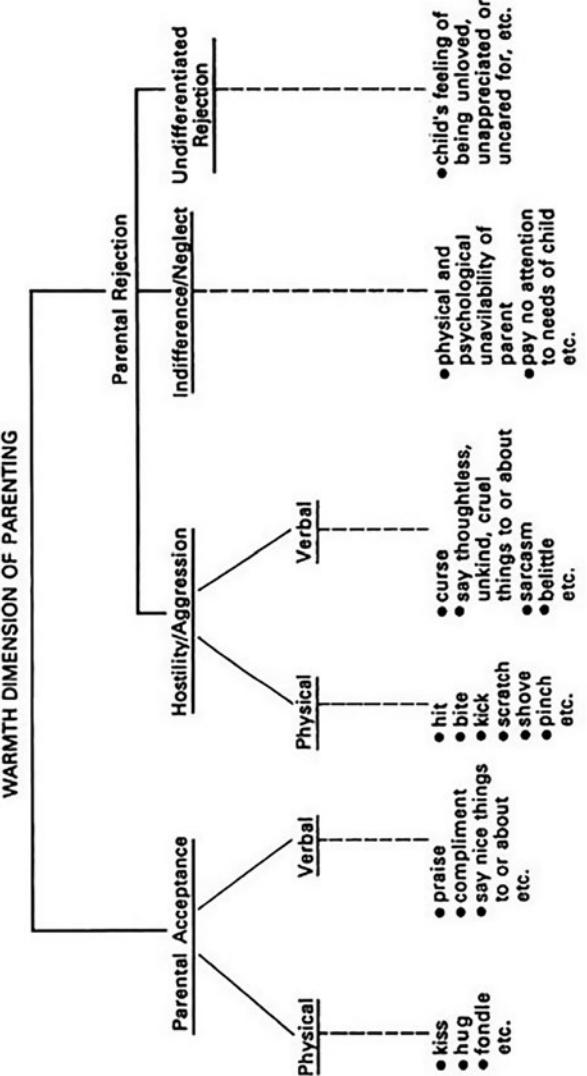
Fig. 9.1 Conceptual framework of principal parenting concepts in parental acceptance–rejection theory
From Rohner 1986; with kind permission of Sage.
Ammerman et al. 1986; Azar and Twentyman 1986; Patterson 1986; Augoustinos 1987; Browne and Saqi 1987; Kaufman and Zigler 1987).
Behaviours
- 1 Abusers value power and use high rates of physical punishment and expressed negative emotion as a means of control. Disputes are usually evaluated as power struggles which the parent must win by the use of coercive power.
- 2 They use low rates of positive reinforcement and engage in fewer mutually reinforcing exchanges.
- 3 They stimulate and interact with the child signifi cantly less than non-abusers.
- 4 They use high rates of inappropriate interference in the child’s behaviour and inappropriate soothing behaviour (e.g. children may be hit or rejected to enforce “non-crying”).
- 5 They are less likely to reason with the child.
- 6 They are less likely to empathise and/or to try to take the child’s perspective.
- 7 They use low rates of physical contact or are unpredictable and excessive in their contact.
Personality
- 1 There is a minority of abusers who demonstrate low IQ. Since abuse can cause brain damage (Ammerman et al. 1986), and certainly have deleterious effects on intellectual development, it is unknown how far these two factors interact (i.e. IQ with history of abuse).
- 2 A number of studies suggest that various personality dimensions including low self-esteem, neuroticism, increased hostility, poor impulse control and low frustration tolerance are higher in abusive parents. However, many pathological groups show low self-esteem and neuroticism but do not abuse their children. Hence, the personality dispositions of hostility, impulse control and frustration tolerance are probably key characteristics of abusers.
- 3 They are often poor empathisers and are sometimes regarded as suffering from narcissistic and borderline diffi culties. This may lead to poor social skills in the ability to develop supportive systems. Their somewhat abrasive and withdrawing personalities tend to alienate them from others.
- 4 Abusers discuss problems, especially those of discipline with the child, less with others, especially the spouse.
Stress and psychophysiology
- 1 Abusers tend to show more ongoing stress (e.g. marital disharmony) and/or rapid sequences of stress leading to exhaustion.
- 2 They see themselves as less able to cope with stress.
- 3 Economic stresses may aggravate abusive tendencies.
- 4 They have more mental and physical health problems, and more negative life events.
- 5 They have less in the way of supportive networks and are often quite isolated. They often lack a close confi ding relationship.
- 6 They tend to show increased physiological responsiveness to an infant’s cry and take longer to habituate. This may be mediated by a cognitive evaluation in that abusers, under laboratory conditions, tend to evaluate an infant’s cry as more demanding, angry and irritating. It may also be that this increased physiological responsiveness relates to increased agonic arousal.
Cognitive characteristics
- 1 Abusers make more internal, stable and negative attributions of their children (i.e. they see their children as deliberately trying to annoy). They tend to project onto the child their own negative feelings.
- 2 They regard their children as diffi cult (to care for).
- 3 They use the child’s behaviour to confi rm (or disconfi rm) their self-image. Compliance is mistaken as love. Patterson (1986, p.85) puts it this way: “It is our clinical impression that many mothers reject a child because they believe the child’s behavior signals the mother is a failure.”
- 4 Abusers have unrealistic expectations of the developmental competencies and abilities of their children and are therefore prone to disappointment and frustration at their children’s behaviour.
Other findings
The other major fi nding is that abusive parents often have a history of abuse. However, the link is not straightforward. Looking at the intergenerational transmission rates, Kaufman and Zigler (1987, p.190) in a review of the data, suggest the following:
. . . the best estimate of the rate of intergenerational transmission appears to be 30% plus or minus 5%. This suggests that approximately one-third of all individuals who were physically abused, sexually abused or extremely neglected will subject their offspring to one of these forms of maltreatment, while the remaining two-thirds will provide adequate care for their children.
In a study of British families by Browne and his colleagues it was found that approximately 7% of families with a newborn infant had a high number of “predisposing factors for child abuse”. However, at follow-up, only about 6% of these high-risk families did actually abuse their children within the fi rst 24 months of delivery. Hence, what fi nally leads to abuse relates to a complex set of interacting factors (Browne and Saqi 1987).
Patterson (1986) researched maternal rejection and child aggressiveness using an interactional approach. The characteristics of rejecting parents were the following:
- 1 Parents were very unclear how to discipline their children. They punished for insignifi cant transgressions whereas serious transgressions such as stealing went unpunished. Also, threats were carried through unpredictably.
- 2 There were very low rates of positive reinforcement, especially of physical contact, touching and hugging.
- 3 There were high levels of coersive, aversive interactions.
Patterson (1986, p.88) says:
Why are mothers of problem children more likely to start confl icts even when the child is behaving? Our clinical experience in treating these families suggested that what they choose to classify as deviant was different from the classifi cation schemes employed by normal mothers. They choose to view trivial instances of transgressions as worthy of a full scale scolding. In this formulation, scolding and threatening is not viewed as an exemplar of effective discipline because these parents almost invariably forgot to follow through their threat to punish . . . We suspected, but have never tested the idea, that rejecting mothers are more likely to have such highly inclusive categories for classifying deviant child behavior. We also suspected that the rejecting parents, with their overly inclusive categories for deviant behavior, have overly exclusive categories for prosocial behaviors. The latter would be commensurate with reduced likelihoods for the use of positive reinforcement.
Browne and Saqi (1987) have used an experimental paradigm involving close observation of interactive sequences between an infant and mother. Compared to non-abusive parents, abusive parents were found to interrupt the routine sequences with coercive, non-interactive behaviour, such as adjusting the infant’s posture or clothing. There was little opportunity for reciprocal interactions between the parent and the child in these kinds of episodes.
Children from aggressive backgrounds come to expect aggressive encounters to be the rule. Hence, in school settings, these children are more likely to attribute hostile intent to neutral behaviour from their peers (Patterson 1986). Their interactional style is therefore agonistic and defensive. In other words, these children tend to engage in agonic, rather than hedonic, styles of interaction from an early age. In consequence they elicit more aggression and withdrawal from their peers and facilitate and elicit less co-operative and affi liative behaviours from others. In addition to increased aggressiveness with both peers and teachers, abused children show a greater tendency towards dysphoric affect, have limited attention spans, cognitive impairment and hyperactivity (Ammerman et al. 1986; Azar and Twentyman 1986; Browne and Saqi 1987).
As yet, the differences between physical abusers and neglecters is still to be fully articulated by research (Rohner 1986). However, preliminary evidence suggests that they often coexist and that the greater the degree of neglect, the greater the probability that more serious mental disorder exists in the parent. Hence, this kind of care-giving disorder can be seen to represent the interaction of a number of complex factors including: (1) previous history of abuse; (2) unrealistic expectations; (3) various personality characteristics such as low frustration tolerance, high hostility and low impulse control; and (4) a low frequency of positive reinforcing interactions.
Sexual abuse
Sexual abuse is often associated with physical abuse. Females suffer more sexual abuse than males in a ratio of four or fi ve to one. Adult surveys suggest abuse rates in the order of 10–15%. However, Alter-Reid et al. (1986, p.255) in a major review quote research by Russell:
Russell’s study (1983) is the most important adult retrospective incidence study to date because it included a random household sample of 930 adult women, intensively trained female interviewers, and a carefully designed and standard interview schedule. Analysis of Russell’s data revealed that 38% of these women had had at least one unwanted sexual experience involving actual physical contact with an adult prior to the age of 18; 28% had one such experience prior to the age of 14. Only 8% of these cases were ever reported to the police. The overwhelming majority of perpetrators were known to their victims.
Different studies will often come up with different epidemiological statistics since much depends on the defi nition of sexual abuse. The defi nition of sexual abuse ranges from genital touching through full intercourse to anal rape.
As many have now argued, Freud probably did us a great disservice by replacing his seduction theory with a fantasy theory, although where fact and fi ction end is a debatable and controversial point. Nevertheless, in our culture sexual abuse is alarmingly prevalent.
The characteristics of sexual abusers remain elusive. However, in a major review of current evidence and theory, Finklehor and his associates (1986, pp.117–118) suggest the following:
. . . . The review suggests that 1) the best experimental research had been directed towards establishing that sexual abusers do show an unusual pattern of sexual arousal toward children, although no substantial theory yet exists about why this is so; 2) a number of studies have concurred that molesters are blocked in their social and heterosexual relationships; 3) alcohol is well established as a disinhibiting factor that plays a role in a great many sexual abuse offenses; 4) at least one study gives support to the “emotional congruence” idea that children, because of their lack of dominance, have some special meaning for pedophiles; and 5) there is evidence that many sexual abusers were themselves victims of abuse when they were children.
Finklehor goes on to analyse the reasons why these are relevant factors and how they have come to prominence in the sexual life of the abuser. At the present time there is little cross-cultural data to tell us how culturally aberrant this behaviour is. The masculine sexualisation of emotional needs may play a role, as may the striving for dominance noted in most Western cultures. Finklehor addresses these issues and considers aspects related to gender variation in abusers.
The effects of sexual abuse can be severe and long lasting. There is often a pathological collusion based on fear and resulting in a tense secrecy, guilt and shame for the victim. There can be excessive possessiveness and jealousy on the part of the father towards the daughter, with various disturbances in relationships with siblings and peers. Depression and low self-esteem are also very common. Alter-Reid et al. (1986, p.260) quote research by Herman and Hirschman. The victims of father incest show the following characteristics: “1) feelings of isolation; 2) negative self-identities; 3) fantasies of power over men; 4) depression; 5) diffi culties in forming trusting relationships; 6) anger toward women; and 7) fears of being inadequate mothers.”
More recently, Jacobson and Richardson (1987) took complete histories of 100 psychiatric inpatients. Diagnosis included affective disorders (32%), psychotic disorders (29%), personality and substance abuse (17%) and various other forms of neurosis including anorexia (22%). They investigated four types of abuse: physical abuse as a child, physical abuse as an adult, sexual abuse as a child and sexual abuse as an adult. Their fi ndings revealed that 81% had experienced one form of abuse and 60% had experienced two or more kinds of abuse. In conclusion to their study they say this:
In addition to establishing high prevalence rates the data obtained provide several kinds of evidence that assault experiences are relevant to current psychiatric treatment. Many patients had experienced assault within a few months before hospitalisation. Substantial guilt and shame had been associated with the assault and for some patients still remained. Patients often reported that the assault continued to have an effect on their current functioning, and a signifi cant minority carried physical scars as reminders of the assault. For some, the assaults had remained secret from family and friends and also from previous therapists.
(p.911; italics added) 2
Jacobson and Richardson (1987) and Alter-Reid et al. (1986) emphasise the importance of investigating these areas of history in standard psychiatric assessment. It is exceedingly important that therapists should be educated in good counselling and listening skills. Therapists who are unable to develop an empathic relationship in which trust is prominent, and prefer techniques to people, may miss essential sources of information. In my clinical experience, discussion of sexual and physical abuse often does not manifest until the patient has a degree of trust in the therapist and unless the therapist cues it, i.e. gives permission and encourages examination of this area of the patient’s life. Patients that are particularly prone to shame often show serious distortions in their early life in the domains of physical and sexual abuse. In my view, the current American vogue for engaging “shame attacking exercises” (i.e. walking down the street pulling a banana behind one) are way off line except perhaps for marginally shy people. These exercises do not get at the rage behind the shame (see Chapter 11 ).
We should also note that in rapists and other serious violent and sexual offences a great majority of offenders reveal histories of being physically and often sexually abused. Hence, abuse does not only result in serious risk of mental disorder for abused individuals, but can have serious consequences to those who come into contact with them.
Identity abuse
There is an area of abuse which I call “identity abuse” that is rarely considered as a separate phenomenon. This is not to say that psychotherapists have not been aware of it, for indeed they have. In terms of its presentation, it does not manifest until later in childhood, usually adolescence. Indeed, most of adolescence psychotherapy is concerned with issues of the struggle for an individual personal identity, and the presence of identity abuse in the home (Macadam, personal communication). Identity abuse relates to the confl ict between the child’s and an adult’s value systems. These parents do not necessarily physically or sexually abuse their children and in some senses may be deemed as quite caring. However, it is a superfi cial caring, lacking any recognition of the individuality and separateness of the child. They can also be overprotective and guilt inducing of the child’s move to greater autonomy and peer group loyalty. The child is seen as an extension of the parental self, to be moulded and modelled in the image that the parent has for the child. In one sense, we may view this as an effort to gain sociocultural fi tness. In these families there are usually high expectations of how the child should be. The parents subtly but perpetually push the child in certain directions, even to the point of choosing their careers.
In therapy at the moment, I have at least ten cases of people who have followed careers because they were unable to counter their parents’ demands. Two patients went to medical school. Both hated it. One dropped out and found solace in alcohol. The other became a very unhappy and stressed doctor. Yet another patient read law rather than history even though temperamentally, history would probably have suited her better. Another patient got married due to parental insistence that women do not follow careers. Yet another patient acquired the A-Levels to go to university, but his father insisted that he stayed within the working-class framework. And so the cases go on and on.
All these individuals suffer various degrees of dysphoria, feeling that they have taken a serious wrong turn in life. They feel resentful and lost. Of course, these compliant behaviours over careers were not isolated events; much of the upbringing was dominated by needs for compliance. In a large percentage of these cases, physical abuse of varying degrees form was present. For example, one patient revealed how her mother would frequently take the hairbrush to her, pulling her upstairs, laying her on the bed and repeatedly and consistently beating her. She said, “The beatings just went on and on and on.” She felt that many of her efforts to become autonomous met with nothing but rows until she felt forced to back down. Father, who was mostly absent, would side with mother for the sake of a quiet life.
In some cultures, compliance to parental designed lifestyles is the norm. Maybe, if this is the culturally accepted way, then one never thinks that a choice is possible and therefore never comes to believe that things could be any different from the way they are. I remember some time ago watching a television documentary on arranged marriages in India. While some women seem to accept this, others do not, especially if their marriages turn out to be unhappy. There is of course, no guarantee that freedom leads to happiness, but the degree to which the life of one person is controlled and dictated by another must be a cause for thought at least.
Adult–adult relationships
The most serious forms of care-giving disorders relate to child–parent interactions. This is because so much of the child’s development is shaped by these early experiences. Moreover, the child is considerably less powerful than an adult. However, if we broaden our focus a little, then many forms of adult relationships can be seen to be centred on nurturance and attachment. There are many theories of adult love and of how love develops and changes over the lifetime of a relationship (Sternberg 1986). There are also many types of love, e.g. sexual, friendly, dependent, possessive and so on. Adult love does not involve the dependency of childhood, nor do lovers need to mediate in the same way as they would with a child. Nevertheless, degrees of mediation still occur. As a general focus for discussion, it seems relevant to consider some forms of adult relationship as marred by an inability to care, nurture, love, and develop positive affectional attachment bonds. To a considerable degree, these problems probably refl ect as much a diffi culty of co-operation as they do nurturance. But intimate relations grow in part, at least, by the amount of adult nurturance that takes place in the relationship even if there is a good deal of reciprocality involved. In this short section, we will look at the way relationships that might ideally foster nurturance and co-operation, sadly, often become competitive and agonic.
There have been a number of studies examining what makes for unhappy and happy marriages. Various factors such as similarity of partners in various domains, strategies for confl ict resolution, shared goals and aspirations, are important. A particularly interesting approach has been to look at the physiological interactions of couples during interaction. Levenson and Gottman (1985) have shown that physiological arousal, measured during a couple’s interactions, was highly predictive of marital satisfaction three years later, the best predictor being heart rate (a measure of sympathetic arousal). These data may suggest that unhappy marriages operate predominantly through defence system processing. Levenson and Gottman suggest that the interactional style of unhappy marriages may be destructive, defeating and dismal, leading to negative expectations. In contrast, happy marriages are marked by optimism and pleasure. Such an approach also bears some overlap with the important work on high and low expressed emotion families (Tarrier et al. 1979).
The defence system controls particular patterns of attention and cognitiveaffective processing. In unhappy marriage the attention focusses on threat and need for defensive (protective) action, and disagreement is an arena for dominance fi ghting. In happy marriages, however, the attachment and hedonic systems mediating safety are more prevalent and in consequence, these individuals may be more attentive to and more capable of sending reassurance signals and encouraging mutually reinforcing, open and positive interactions. It is not too surprising that these differences should show up in physiology since many people, at a behavioural level, may try to mask their defensiveness especially when on public display (e.g. in front of experimenters). Also, it will be recalled that physiology can be a better predictor of stress than behaviour in some contexts (Coe et al. 1985).
When nurturance fails, the usual reason is that the relationship has become focussed on agonic and defence modes. Some marriages are marked by confl ict resolution that involves a good deal of downing or labelling of the other, or of inhibiting the expressions of grievances and sulking and withdrawing as a way of punishing. The switch to the agonic mode shifts attention to negative aspects of the other and increases arousal. Although yet to be proved, it probably also reduces positive expectations. While these interactions may never erupt into serious violence, power struggles for control and recognition are prevalent. The structure of these relationships ensures that anger, disappointment, status attacking and efforts to control the other are the norm. This reduces the probability of co-operative and nurturant styles evolving and may have detrimental effects on the development of the adults in the relationship. Sometimes, one individual can personalise the problems in a marriage or signifi cant relationship, and regards the other’s put downs and attacks as justifi ed criticism to an incompetent or unlovable self. This increases the power distortion in the marriage, making one more likely to dominate and the other more likely to submit. This style is seen repeatedly in psychiatric clinics.
As for children, so for adults. Neglect and identity abuse (using the other as an object of gratifi cation for various needs) are probably more common than we appreciate. In some cultures identity abuse is ubiquitous. It is institutionalised into the very fabric of social life and women are very much subject to the patriarchal order. The division of labour and the socially enforced role of child rearing, perhaps over very many years, are also examples. At the individual level, neglect and identity abuse are most common in men who use their wives as stress absorbers (this is especially true for Type A’s – Price 1982) or dedicate themselves to a career as a way to avoid intimacy. Just as for regulator mothers, these men (and women) can fi nd enforced togetherness a source of stress. Individuals may also have problems with the expression of caring and nurturant feelings when in close physical proximity, e.g. non-sexual hugging, touching, stroking, listening, empathising, etc. They may not recognise the stage of development that their spouse is at or take much interest in fostering growth if they do. They may have diffi culty in acting as a confi dant, especially if this ignites unwanted identifi cations of weakness or vulnerability. Some expect special dispensations or favours (often sexual) as a kind of recognition for all the hard work at the offi ce, or as a way of boosting self-esteem. Men who are engaged in competitive pursuits in careers to increase resource-holding potential and public status may be particularly prone to this.
All of the above factors are probably dimensionally related in terms of severity and prevalence and there may also be state and trait differences. Relationships may start of loving and nurturing but become progressively more agonic as careers develop, differences in goals and aspirations become manifest and children are born. There may be simple strategies for overcoming these diffi culties such as making special time for the relationship or sitting down with a third party (e.g. therapist), to air grievances and agree on plans and goals for the future. Sometimes relationships have just slipped into agonic modes without either party truly recognising what has happened. If the desires for nurturant and affectional bonding and close proximity can be rekindled, then problems may abate and insight may be gained. The success of any relationship therapy of this form depends crucially on the ability to help a nurturing relationship.
Sometimes however, the problems in relationships relate to more serious shifts into agonic modes and represent more serious forms of abuse. Physical abuse is not limited to parent–child relationships. Spouse abuse is also a major problem. People tend not to admit to spouse abuse because of stigma. Rates of abuse vary according to study, but could be as high as 25%; this fi gure increasing in populations of divorced women. There has been interest in factors which relate to both male and female characteristics of abuse. Some suggest that women may contribute, cause or even be addicted to abuse and get caught in repetitive cycles of abuse (Pizzey and Shapiro 1982). However, this view is unlikely for the vast majority, even though abuse should be looked at in interactional terms. Andrews and Brown (1988) suggests that teenage marriage, premarital pregnancy and an early history of parental neglect tend to be associated with physical abuse. Parental neglect may predispose some women to marry early to seek love and to deny problems (i.e. defensive exclusion). These women may be more prone to selecting partners who are superfi cially dominant but who are not able to nurture. Staying in an abusive relationship may relate to mental health factors such as depression or anxiety which make it diffi cult for the individual to summon the courage to leave, economic factors or fears of leaving the husband, e.g. threats of murder or disfi gurement.
Abusive men tend to be dependent, possessive, jealous and controlling. Alcohol is often involved as a disinhibiting factor. These men may also engage in impressive courtship displays to impress the female of their attentions (Andrew and Brown 1988). In all animal species, courtship is important, but in these men it can be excessive (though superfi cial) and the female is often taken in by it. Women can either be dazzled by these displays, sexually aroused or get involved and then be fearful of backing out. In many cases, men who persistently abuse are personality disordered, having a low tolerance for frustration and are hostile prone. Sometimes the advent of pregnancy and a new baby can take attention away from the male and can light up narcissistic injuries which were covered while he was getting the full attention of his spouse or lover. This begins a vicious circle of demands, withdrawal (by wife) and more demands.
Women who are not also themselves narcissistically damaged, may be aware of this possibility. Others however, can become rejecting, withdrawing or hostile to the male’s increased desires for attention with the arrival of the new baby. The new baby may act as the new object to focus loving attention on. The relationship then shifts into a triangular competitive one. Men who have used sex as a way to boost self-esteem are especially prone to diffi culty when a spouse loses sexual interest during or after pregnancy. The child is then seen as a competitor rather than as an object in need of nurturance. The wife is seen as choosing to nurture another individual rather than the vulnerable male.
In summary then, various forms of abuse ranging from mild to severe, including identity abuse, neglect and physical abuse can be present in many close relationships. At the present time, we do not know the prevalence of sexual abuse in marriages. In all of these cases, it is the switch to an agonic mode of interaction which spells trouble. In this mode, the other is not seen as someone to be understood, nurtured and reassured, but rather someone whose demands and behaviours must be controlled with the use of coercive power. This power can be used actively as in hostile, downing or other status and identity attacking exercises, or passively as in withdrawing, rejecting and not acknowledging. As a society, the most persistent accusation that can be made of us is that we do not know how to care for each other (Smail 1987). Our failure to nurture each other lies at the root of many of our human miseries.
Concluding comments
Care-giving disorders represent a major failure in attachment and hedonic systems. The interaction between the child and the parent becomes one of agonistic encounters. There is low empathy, low positive interactions, especially in proximity behaviours, and major elements of distortion of dominance and breeding behaviour. The reason why the attachment and hedonic systems become inhibited is an area for research. However, previous history of abuse, having no internalised model of self or role relationships to co-ordinate the attachment and hedonic systems seem to be important. It is extremely rare to fi nd abusers who do not have low self-esteem. Nevertheless, it must be remembered that about two-thirds of previously abused children do not go on to abuse their own offspring (Kaufman and Zigler 1987). Even when risk factors are present, a large majority of people do not abuse (Browne and Saqi 1987). Maybe a genetic component is present such that the evolved capacity for attachment and hedonic activities is weakly represented or activated in the CNS; and/or agonistic propensities are highly amplifi ed. The genetic relationship (e.g. step-parent) is also important. The effects of abuse and neglect have serious consequences (Rohner 1986).
In this short chapter then, we have reviewed some of the evidence pertaining to various forms of neglect and abuse. As a general classifi cation we have referred to these as disorders of care giving; that is, they represent a failure of people to be able to nurture (here, we use Fogel et al.’s 1986 defi nition). The ability to nurture is evolution’s most precious gift to humans. But like all gifts it is easily lost, atrophied or wasted. In all problems where there is a consistent failure to nurture, we fi nd the inhibition of friendly love and compassion and the need to engage the world as if in a struggle to defend against demands and accusations. There is a regression to use evaluative competencies evolved for ranking behaviour to be recruited into attachment contexts.
In this sense, an arena of relating which could, ideally, lead to nurturance and growth, leads instead to confl ictual, agonic interactions. We are thrown back in time, as a kind of phylogenetic regression, where the attachment and hedonic modes were yet to evolve. Others are not persons to be understood, loved, grown, care for, developed, protected or mediated for, but rather are objects of power, gratifi ers or takers whose behaviour must be controlled. The psychobiological consequences are related to the activation of the defence mode in all parties sharing these styles of relationship. The psychobiological changes help to lock attentive and coping styles into defensive strategies. This leads to a vicious amplifying cycle of defensive activity. Love, after all, is not a mystical something that someone is lucky enough to buy, inherit or is God given. It a creation of the most phylogenetically advanced possibilities of humankind which is actualised in relationships. In some cases, a key problem with nurturing relates to excessive dependency on the admiring attention of another, be it child or spouse. Any behaviour that threatens this fragile sense of self is aggressively rebuffed for the person feels defenceless to it. Few may be truly able to nurture others until they are able to nurture themselves. As we have said, when it comes to adult–adult relationships, much of the nurturance and hedonic behaviour has an important element of reciprocality about it. This leads us directly to co-operation – the subject of our next chapter.
Notes
- 1 In 1978, a religious cult-leader from California, James Jones, led a band of followers to Guyana. This move was almost certainly as a result of federal investigation for fraud. Jones was a charismatic leader, who at the height of the investigation persuaded over 800 people to engage in mass suicide. Parents fed their children poison so that they might die with them. (I am grateful to Dennis Trent for this point.)
- 2 In regard to current physical abuse, the authors point out that being slapped, shoved and threatened by a husband, or watching him slam his fi st through a wall when angry were not included as a major assault. Even though these researchers recognise that these events have powerful effects on self-esteem, they point out that the prevalence rates would have been even higher had such non-major assaults been included.
Co-operation
The importance of human co-operativeness
Of all the social behaviours which have evolved in humans, the capacity for cooperative action is of profound importance. Many of the innate information processing competencies, which make available the capacity to learn social rules, are probably related to the evolution of co-operation. These social rules, once learned, make possible forms of relationships that give humans the unique capacity to link in complex communicational networks that may loosely be labelled as “culture”. The evolved motivational and evaluative mechanisms which make co-operation possible serve to provide the basis of moral values and behaviours which keep egotistical–competitive behaviours in check. Some have suggested that a spur to co-operation arose from the ice age which rendered the environment more hostile. Tool use, digging for roots, hunting, shelter preparation and so on were more effective when carried out co-operatively.
In Chapter 2 it was suggested that co-operation evolved from the benefi ts bestowed to species who became capable of joint, co-ordinated action to secure a goal. Co-operation is therefore an evolved capability for the modifi cation of individualistic competitiveness. There are, of course, many kinds of co-operative behaviour in Nature. For example, various species of insects have evolved highly co-operative lifestyles, are able to work jointly on projects with the division of labour (e.g. leaf-cutting ants) and are able to share and communicate knowledge advantageous to the group (e.g. bees are capable of signalling to other members the direction and distance of pollen from the hive). Mostly, this form of co-operative enterprise has been explained in terms of inclusive fi tness (Crook 1980). In humans however, the phylogenetic path can be traced to species (reptiles) that were individualistically competitive, territorial and where each member was more or less capable of reproducing, provided access to reproductive opportunities could be acquired.
Although the same forces of selection apply, human co-operativeness is a re-invention of a relational style of some advantage but of a different order than insect co-operativeness. It involves high-level schemata, probably located in paleo- and neomammalian brain structures. Hence, among the most salient differences between insect and human co-operativeness is the degree to which human co-operativeness is under the control of motivational and cognitive processes and the way recent evolution has acted on this in a big way. However, cooperation has to be accommodated within a CNS structure which also allows for extensive egocentric and hostile competitiveness.
Human co-operativeness undoubtedly draws in and utilises various mechanisms related to care giving and care eliciting (i.e. the attachment systems). This manifests as liking, friendship and friendly love. (In Leary’s 1957 model this concerns the love–hate dimension.) The main focus of co-operativeness in this chapter however, is its relationship to, and inhibition of, individualistic competitiveness. This is not to deny in any way the importance of attachment systems operating between non kin (friendly love). However, this kind of relating is more of a blend of two biosocial goals (attachment and co-operation). Our concern here is more to think of co-operation in relation to power-competition.
Individualistic competitiveness is concerned with spacing, separating and differentiating one member from another such that one member extracts an individual advantage or control over another. It is concerned with a vertical hierarchical organisation of relationships. Co-operativeness, on the other hand, is concerned with linking, joining, acting together and minimising differences between individual members. This is concerned with a more horizontal organisation of relationships. In the human context, co-operative enterprise rests on bestowing value and status to others but without the use of power. It will be recalled that Foa (see page 66) suggested that the essential qualities of human behaviour concern the degree to which love and status are conferred or denied to self and others. This is one of the factors that links co-operativeness with competitiveness, i.e. through the bestowing of status. In other words, bestowing value and status, a recognition of rights, abilities and achievements are involved here, but in the co-operative mode this occurs without any signifi cant coercive interaction. The more an individual tries to force a bestowing/recognition of status, the more competitive the action. Many social signals exist to communicate co-operative (friendly) relationships. These are primarily “no threat” and reassurance signals (smiling, shaking hands, etc.; Eibl-Eibesfeldt 1980).
An individual seeking co-operative goals may not wish to have power over others or to lead them necessarily, but does wish to be viewed as someone with something to offer and share with others in terms of skills, knowledge or competency, i.e. to be of value to others, or in William James’ terms “appreciated”. In Leary’s (1957) model, these aspects would be classed as friendly–dominant. A sense of appreciation increases social attention-holding potential.
The central dialectic between competitiveness and co-operativeness has been outlined by a pop star who recently put the dilemma this way. He started out wanting to be one of the boys; to belong to a group; to be part of a team; to fi nd a sense of belonging. He wrote his songs, he said, to share with others something of himself; to feel accepted and part of a group. But as he became more successful, he found that the status that he acquired separated him from others and achieved the opposite of his conscious intentions. At times, he felt so depressed by the sense of isolation that success had brought him that he often considered giving up his pop star status altogether. Unlike competitiveness then, too much “distinguishing” status (vertical difference) can threaten a separation and spacing and a breakdown in the capacity to link and join together with others.
This dilemma is represented in many walks of life. Wolfe et al. (1986) have called this kind of dilemma “getting along” versus “getting ahead”. Individuals whose motivational systems are more attuned to linking functions may have diffi culties when it comes to the donning of roles of authority and status if this in some way threatens unwanted interpersonal separations or confl ict (McClelland 1985). Such individuals may fear behaving with authority for fear of losing their sense of belonging or approval and invoking envy or power plays in others. Co-operation is based, to some degree, on mutual respect of each participating member in the relationship and reducing dominance differences. The key to co-operation, therefore, is sharing, communication and the capacity to learn social rules for organising role expectations in relationships. Furthermore, it relates to a special class of social attention. The co-operative person wishes to be “attended to” as one member of a team, i.e. wishes to be appreciated. But he does not wish to attract attention related to rank differences. Therefore, as his status rises, he may try to raise the status of others or downgrade his own, or try to avoid dominance disputes. This is often a diffi cult balance to strike. McClelland (1985) would suggest the general motive as (social) confl ict-avoidance, which captures its essential aspect. But to this must be added the need for affi liation as he points out. Hence, co-operation represents: (1) the desire to valued and appreciated; and (2) a task-oriented aspect related to affi liation by joint action, be this hunting or scientifi c debate or just having a good time. In chimpanzee society it has recently been shown that the main form of social organisation is one of mutual dependence (Power 1988). There is little in the way of rigid dominance hierarchies and females may mate with many different males (Bailey 1987). The main group often splits into smaller groups for foraging and on return there is much greeting behaviour (hugging, display) which appears to be mutually reinforcing. In other words chimpanzee society is basically co-operative and affectionate. Social roles are particularly important (Power 1988). Only if the group is interfered with in some way, disrupting their foraging behaviours, is their regression to more hostile forms of dominance behaviours (Power 1986). Females however tend to avoid aggressive males.
In all cultures, periods of “get togethers”, be these parties, religious or other rituals, working on common goals from hunter-gathering societies to making a landing on the moon, are key features of co-operative endeavour. Within these fabrics of social life, tradition, the pooling and sharing of ideas, the sense of belonging and of continuity from one generation to another make up a cultural history. Individuals who are able to function in this manner gain enormously for they can learn and adapt coping and problem-solving skills not only from their own experience but also from the experience of others. The more individuals can know about others – their thoughts, feelings and knowledge – the more advantaged they may become. One of the most important requirements for such activity is a good means of communication. Hence the importance of language which probably evolved from gestures and various displays and alarm calls (see Chapter 14 ). Of course, not all knowledge passed from one generation to another is useful or accurate or refl ects the common needs of the time.
Therefore, to some degree, the capacity to compete and create new styles of relating must enter from one generation to another in order for each generation to avoid becoming mere replicas of the preceding generation. This dialectic is a complex one. A fi nal point on co-operation should be made here. Looking at evolution in broad terms it seems to me that co-operators will always win out over those species that are primarily individualistic in their strategies. Humans are the dominant species of the world (reducing the survival and existence of many other life forms) because we are co-operators par excellence. We can store information for our meaning-making that is derived not only from members of our own group or generation, but from many groups and generations. We may split the atom and live on other worlds because our intellectual abilities are designed to learn from others. Our philosophical and scientifi c meaning-making represents the distilled knowledge of countless millions of people now long dead. No other species can remotely match our competencies in this regard. Despite the apparent (personal) attractiveness of individualistic pursuit that served reptilian inclusive fi tness, we might remember it is Nature’s gift of co-operation that has made us what we are and we would do well to remember this in our egotistic pursuits. Our ability for love and compassion, our ability to value others are not God given, but are the inevitable consequence of evolution, for co-operators will always in the end be advantaged over species of individualists.
Evolution
In considering the issues of co-operation two central questions arise. First, by what route have humans acquired the superordinate capacity for sharing and cooperation? Second, what implications are there to be drawn regarding the evolution of evaluative and motivational systems which underlie these behavioural dispositions?
The (in)capacity to co-operate and share with others lies at the heart of many psychological diffi culties. These include thwarted efforts to see oneself as valued, appreciated and accepted as part of a group or a relationship, tendencies to be overly competitive (dominant, autocratic) or submissive in co-operative contexts and/or tendencies towards fears of deception, dishonesty and exploitation by one’s fellow. Indeed, Marx’s critique of capitalist society rests on the issue that the (co-operative) division of labour has simply provided an exploitative opportunity for the bourgeoisie – the owners of capital.
The evolution of co-operative behaviour can be traced via the avenues that have led to altruism. As already discussed, sociobiologists have proposed two forms of altruism – kin and reciprocal. Kin altruism relates to helping and caring behaviour between genetically related others. Trivers (1971) however, formulated the idea that altruistic acts could have evolved between non-genetically related individuals when donors might acquire some benefi t at a future date via reciprocation. The type of example usually quoted here involves the reciprocal behaviour of grooming. There may be some places on the body where various parasites might only be removed by another group member. Individuals that were capable of grooming each other would therefore be advantaged over those that were not. However, it is always possible that an individual might “cheat” and fail to reciprocate a grooming act. 1 The theory posits that forms of memory evolved allowing for the detection of cheating, i.e. a non-reciprocator would be remembered and would not be groomed in the future. This idea has become an interesting theory of social transaction (Crook 1980; Smith 1983; Wenegrat 1984; Dawkins 1986). Indeed, many theories of social relationship are based on various ideas about the equity and reciprocation of social transactions (Brown 1986). It is also the case of course that various forms of reciprocation and co-operation take place between species, e.g. certain species of fi sh feed on the parasites of larger fi sh, the tick bird of North Africa feeds on the ticks of buffaloes, fl owers rely on insects to pollenate them, and so on.
In humans reciprocation is an important part of sharing. Reciprocal altruism provides some useful hypotheses regarding the possible phylogenetic development of cognitive evaluative systems. These cognitive systems may be important in various forms of social interaction and forms of psychopathology. Basically, reciprocation is believed to operate on a tit-for-tat basis such that individuals are prepared to help to some degree, probably as the fi rst response (Dawkins 1986), provided that reciprocation occurs, but not to help at some future date if reciprocation does not. Human acts of helping, however, are controlled via many cognitive factors such as attributions and assessment of the status of the object of helping (N. Eisenberg 1986; Brewin 1988).
Crook (1980, pp.176–177) has articulated the sociobiological suggestions by proposing that a number of functional systems evolved out of the survival advantages bestowed by reciprocal altruism. These are:
- 1 The system is established by the offering of some service to a stranger by a donor. To behave in this way is to proffer friendship. Children, in fact, seem to respond to strangers rather than familiars with approaches of this type.
- 2 Friendship is established when a recipient responds to a donor with reciprocation. This happens when a liking by the donor is reciprocated by a liking of the donor by the partner, who responds in an expectant, friendly manner . . .
- 3 Once friendship is established it is possible for one partner to exploit the “goodwill” of the other, by cheating on his obligations. A compensatory motivational system involves a monitoring of returns so that, under certain conditions, an indignation at the absence of expected reciprocations will appear. This indignation, which lies at the root of concepts of fair play, and social obligation will prevent the exploited altruist from continuing to perform altruistic acts. In so far as the indignation is aggressive, it threatens the
cheater with the loss of a friend and the reduction of aid. 2 In extreme cases, the cheater may also expect an attack and injury.
- 4 The cheater, before or after being the recipient of indignation, is likely to experience the dissonance between his behaviour and that of his willing friend as guilt. Guilt has to do with a person’s self evaluation, whereas if an individual’s behaviour becomes publicly known and judged he may also experience shame.
- 5 In either case, a way to restore the status quo ante is to offer reparation which may well have to exceed in benefi t the costs of former cheating.
- 6 The cost benefi t analysis of these implicitly contractual relationships seems justifi ed from social psychological studies reviewed by Trivers. In general, it seems that the greater the need state of the recipient, the greater the probability of his reciprocation. The greater the cost to the donor, the greater the gratitude and sense of obligation of the recipient.
- 7 The giving of an altruistic act and the forgiving of cheating will be related to experiences of sympathy 3 which imply a degree of comprehension of another’s condition.
From this it can be seen that there have evolved key cognitive systems for evaluating co-operative enterprise. This highlights again the inherent confl ict between co-operation and competitiveness. Important issues are: (1) the evolution and evaluation of deception and cheating in both self and others; (2) the evaluation of guilt and shame in self and others; (3) the issue of reparation and redemption – a powerful theme in human culture, especially in religious history; and (4) sympathy/empathy as a motivational base for helping, reciprocation and forgiveness. The way these relate to psychopathology is the basis of our next chapter.
Another evolutionary route to co-operation may come from the evolution of play (see pages 21–24). Some individuals enjoy co-operative effort, be it science, intellectual debate, exploration and so on as a kind of adult “play”. These activities are enjoyable and motivating in part because of the affi liative characteristics of these endeavours. Furthermore, it is from childhood play behaviours that the rules governing co-operative behaviour are learnt. This may also explain why friendship is often an aspect of co-operative behaviour.
We will leave our evolutionary train of thought for the time being and engage in a more detailed examination of some of the mechanisms and processes which facilitate co-operative and supportive behaviour. Specifi cally, we consider how it is that in co-operative relationships, there is an inhibition of power competitiveness, in preference to mutual status-enhancing exchanges.
Issues in co-operative relationships
Co-operative behaviour involves, amongst other things, supportive relationships which serve to maintain and enhance self-esteem in participating members. There is some evidence that non-kin (rather than kin) relations are looked to for self-esteem in adults (Cutrona 1986). This suggests that in some forms of relating there is an inhibition of individualistic competitiveness, point scoring and exploitativeness, in preference to mutually reinforcing exchanges which minimise status differentials and hostile exchange. In co-operative relations, individuals surrender egotistic desire in favour of creating safety, sending signals of reassurance. Chance (1984, 1988) calls this form of relating “hedonic”. Hence, a major issue is why people would not take advantage of friends; why should we support each other’s self-esteem when there may be clear opportunities to gain a sense of superiority?
There are, of course, many answers to this. One is simply attachment and love. An emotional bond to another reduces desires to exploit the other. Alternatively, it may not be in our best interests to see our friend “go under”. Another possibility relates to issues outlined by Crook (1980). This is to do with issues of reciprocation, e.g. “If I support (the status of) my friend now, I can count of his assistance (status support) in the future.” Ethological work suggests that the formation of alliances allows primates to behave more assertively than might be the case without such alliances. Allies seem to increase the RHP in the members of the alliance. The removal of one member of an alliance can signifi cantly reduce the dominance and challenging behaviour of the animal remaining (i.e. reduce RHP) (Crook 1980). Such data point to the immense value of “making safe(r)” (by having access to an ally) the environment which facilitates explorative and autonomous action. Confi dence, as any team member will tell you, is essentially tied up with social support and approval of one’s team mates.
One way of distinguishing between supportive, status-enhancing as opposed to status-reducing relationships is by a distinction between egotistical and nonegotistical motivation (Lynn and Oldenquist 1986). This approach is useful in regard to the solving of social dilemmas. Major dilemmas for humankind exist in terms of pollution, economic growth and population. 4 But more work is necessary to understand the basis of non-egotistic interaction in individual relations. Lynn and Oldenquist suggest three forms of non-egotistical motivation. These are:
- 1 Altruism: which relates to helping behaviour and involves the affects of sympathy and empathy.
- 2 Group-egotistical: which involves desire to serve a social group and to limit individualistic competitiveness within the group; to surrender egotistic ambition in favour of the achievements of the group.
- 3 Moral motives: which relate to the obeyance of moral codes based on the recognition of rights and an internalised system of justice and fairness.
These three aspects probably co-relate in that altruism may be higher towards individuals of the same (identifi ed) group. Furthermore, groups tend to derive and articulate their own system of ethics over time (e.g. psychological, legal and medical professions, etc., and have their own ethical and disciplinary committees). Ethics are centred on the issue of non-exploitation. One may go so far as to suggest that the issue of exploitation is central to any theory of ethics and morality. As we shall see in Chapter 13 , narcissistic individuals are noted for their tendency to be highly exploitative of others.
The moral self
The development of moral codes of social interaction is uniquely human. Justice does not exist in the natural world; it is a creation of the human mind and imposed by a system of corporate laws. The human concern with fair play and non-exploitation acts as an inhibitory system to hostile (power) competitiveness. But fair play depends on the recognition of status and rights of others and the recognition of the importance of rules above the pursuit of egoistic ambition. 5 Humans appear to be biologically disposed to gain insight into these aspects and to monitor behaviour accordingly. In some situations, breaking the rules is experienced as personally aversive (guilt). This suggests there is an internal control system for monitoring transgressions.
The development of moral standards and values by which one will navigate and evaluate one’s action in relation to others refl ects a number of complex processes. These systems of rules provide the “oughts” and “ought nots” of social moral action. To break these rules may be experienced as guilt and also as a loss of a sense of goodness about oneself (Kagan 1984). However, for this to occur, these rules are in some sense tied to personal identity rather than being simply imposed by an institution and mimicked by participating members. It is the degree to which the adoption of moral rules becomes central to one’s personal identity that determines whether they will be consistently followed in the absence of some external agent.
Development of the moral self
There are a number of developmental theories which describe the stages by which a child acquires an adult moral evaluative system (see Bee 1985 for a comprehensive overview). As is often the case with a new science, theories of moral development have been presented as competing hypotheses rather than complementary. Gibbs and Schnell (1985) have pointed out, for example, that the developmental cognitive-based theories of Piaget and also Kohlberg are often contrasted with the socialisation and emotion-motive theories (e.g. Hoffman). However, just as the whole debate between cognition and emotion is dissolving into a richer understanding of complex interactional processes (Leventhal and Scherer 1987), so theorists of moral development are beginning to understand the interactions between emotive and cognitive contributions to a moral sense of self. Moral constructions are obtained by the development and unfolding capability of children which is interpenetrated and shaped by social experience and energised (amplifi ed) by the recruitment of affect. It is the motivational and emotional (i.e. limbic) involvement in moral beliefs that co-ordinates them into an integral part of a personal identity. Without the emotive–cognitive link, moral rules may be known but rarely acted on.
The stage reached in moral development determines the degree to which individuals are able to construe their actions in relation to others (Bee 1985). Kegan (1982) for example, has argued that many theories of psychopathology, such as personality disorder and so on, would be better conceptualised in moral developmental terms rather than as issues of disorder. Unless one is able to conceptualise others as separate individuals with different histories, needs, feelings and ideas, then the mode of interpersonal appraisal can remain essentially egocentric (McAdam 1986). There is something about the cognitive theory of personalisation which looks remarkably like adolescent egocentricity.
The best known nosology of moral thinking is that of Kohlberg and his colleagues. These theorists suggest six stages can be summarised as follows.
Preconventional Morality
- Stage 1: The child decides right from wrong on the basis of reinforcement and punishment (usually dispensed by parents).
- Stage 2: The child begins to formulate rules about reinforcement practices of others. The essential quality of the rules is what results in positive rewards. Issues of fairness and equity of exchange also become important.
Conventional Morality
- Stage 3: Group identity becomes important (e.g. family and peer). Rules for moral action become articulated into expectations that others and self have of social behaviour. Maintaining a good image of self becomes important, and trust, reciprocality (reciprocal altruism?) and loyalty are prominent. To individuals not identifi ed as part of the group, behaviour may be hostile and exploitative, especially if this is reinforced by the group.
- Stage 4: There is a shift of focus to identifi cation with society at large. The importance of contribution, obeying group rules, the rule of law become important elements in construction of the moral self.
Post Conventional Morality
- Stage 5: Increasing awareness of utilitarian philosophy and the relative nature of social values. Some values become focussed on the rights bestowed to others – freedom, liberty, the right to life.
- Stage 6: The sense of moral action is highly internalised. Personal conscience becomes the dominant decider of moral action.
(Adapted from Bee 1985)
This nosology has been extensively criticised and Kohlberg et al. (1983) have recently responded. It would be inappropriate to become embroiled with these debates here. However, concerns have been raised as to the cultural universality of these stages and the degree to which knowledge guides action (Snarey 1985). Even though an individual may publicly claim adherence to (say) Stage 4 ideas, this does not mean they will be followed. Some years ago, it will be recalled, the President of the United States, having sworn to uphold his country’s constitution (which encapsulates various Stage 4 ideals) was nevertheless impeached for what were considered to be grave violations of American Constitutional Law. Jung noted long ago that what an individual professes to believe in public may be quite different from how he behaves in private. The moralist can be a tyrant to his close family.
Those who are genuinely acclaimed to be highly moral also seem to have two other qualities: (1) a robust sense of self-esteem; and (2) a recognised sense of gentleness often (although not always) associated with good humour. These individuals are quick to forgive and are noted for their compassion. This involves an affective component to moral action. These are hedonic qualities. In other words, those who act as they think (given a high level of moral development) are probably those who are predominantly friendly-dominant. Proneness to hostile forms of confl ict resolution probably does not go well with high moral interpersonal action. Hence, we must distinguish intimate-personal forms of moral conduct from social and public forms. When individuals become aware of a signifi cant discordance between these two domains then dissonance occurs, resulting in guilt. Sometimes this alone can be the reason for seeking psychotherapy.
Some have suggested that much of our current thinking on morality is related to a masculine obsession with justice, fairness and fears of exploitation (i.e. a co-operative–power competitive dialectic). Gilligan (1982) has suggested that there are other forms of moral construction which contribute to a sense of “good self”. These relate not to issues or fairness but to issues of care giving. These concern emotional dilemmas of what another person needs in order to grow (Kohlberg et al. 1983). Although this form of moral issue may be more socialised in women and women may be more biologically disposed to it, it probably relates to traits of femininity rather than gender (Kohlberg et al. 1983). Great caution should be exercised in ascribing trait variation to gender variation (Hare-Mustin and Marecek 1988).
Whatever our growing understanding of the essentials of moral and ethical behaviour turns out to be, we would be advised not to ignore the role of status threat, needs for power and hostility proneness. These may have a greater bearing on actual behaviour even in the presence of articulated moral beliefs. If we can solve these issues then greater moral behaviour towards our fellow humans might follow. I recall some years ago watching a television debate on ethics, where one of the contributors was extremely offensive. This fellow appeared to have no insight into the fact that his personal behaviour violated every premise he was proposing (see concluding comments of this chapter for Foucault’s depiction of the polemicist). In the intimate and personal domain, moral action is controlled by affects, and these in turn are probably signifi cantly infl uenced by attributional styles, especially those attributions relating to status threat and status differentials.
Empathy, sympathy and morality
Sympathy and empathy were compared in Chapter 8 . Like moral stage theories (Bee 1985), there are many empathy stage theories. These have been well reviewed by Goldstein and Michaels (1985). Just as the child can come to recognise itself (e.g. in a mirror) and become self aware, so he can also become aware of others. This other awareness is not just of a physical separation and distinction, but awareness of similarity or differences of a subjective, non-observable self; a self that feels. What may begin as projection becomes refi ned by the recognition that individuals do not always think, feel or behave the same way as oneself. The capacity for the recognition of the other as distinct is probably far more complex than we realise and far more vulnerable to projection. How often have “do-gooders” fallen victim to this.
According to Hoffman (as discussed in Goldstein and Michaels 1985) there are a number of levels of empathic development. These levels refl ect an increasing capacity for self–other differentiation. At the fi rst level the child may cry because another child is crying. The child makes no distinction between the distress occurring to him or to the other. The second level, called egocentric empathy, occurs when the child can distinguish between physical self and physical other but does not differentiate at the subjective level of thoughts and feelings. At the third level (probably around the ages of 2–3 years) the child becomes more attentive to cues which indicate that the subjective experiences between himself and others may vary. Gradually, with the development of language and new cognitive abilities, the act of contemplating another’s situation can arouse empathic mediated affect. There also develops the capacity to gain insight into the plight of groups with desires to alleviate distress by sympathy and compassionate action. It has to be said however, that simply because an individual acquires or obtains a skill, this does not automatically mean that the individual will use that talent or skill in every context. Many factors including context, attributional processes and so on will interact to determine how individuals actually react in various social situations (N. Eisenberg 1986). There is no reason to assume that an individual will operate at his most empathic or sympathetic level. Indeed, this may be one of the sources of guilt in that one may behave exploitatively under stress or challenge, and in one’s quieter moments one refl ects on and considers this a rather undesirable aspect of self.
It is probable that sympathy (which is a quickly aroused help-giving response) and empathy (which is more refl ective) at some stage begin to blend together to form the basis of more accurate evaluation and compassion. When parents enable a child to understand the distress the child may cause another, they may also reinforce caring behaviour. In this way, a child learns that he is of value to others; he can be an agent of goodness and approval. The child can take pleasure and acquire status and prestige through helping and caring. However, there can be a confl ict in prestige seeking, for example, men who are highly identifi ed with masculine traits are fearful of acting compassionately and emotionally lest this detracts from their masculine status (Tice and Baumiester 1986).
Morality and foresight
To a large extent the altruistic aspect of morality has been studied reactively; that is, studying people’s reactions to care eliciting. However, human empathy and morality are more productive when used predictively and preventatively. Humans excel at what Piaget called “formal operational thought” which involves the ability to manipulate ideas and concepts, as well as events, in one’s imagination. We are able to think about things that we have never seen or which have not yet happened. We can organise ideas systematically and think deductively. From this, allied with an empathic, sympathetic orientation to one’s fellows, humans can plan for better futures in a better world. Hence, morality, sympathy and empathy are far more than the alleviation of immediate distress or the avoidance of exploitation, and relate to the predisposition to create better futures. Personal experience can be very important, as in the case of parents who set up action groups or trusts to advance research in diseases that may have claimed one of their children. No doubt, some of our visions of a better future are misplaced and deeply misguided (Berman 1986) and some may be little more than attempts to win prestige (Hill 1984). Yet humans have deep-seated desires to be of value to others (appreciated); to play a part and to contribute to their social domains. Of all the rehabilitative programmes for petty (and not so petty) criminals, harnessing this capacity has proved of immense value. To learn that one is an agent of value and has something to contribute which is valued by others can be enormously benefi cial in overcoming deep senses of alienation, hatred and envy. It may be that our genes are selfi sh (Dawkins 1976); and it may also be that the wish to leave some contribution after our death, to leave the world a better place than we found it is a defence against death anxiety (Yalom 1980). Be this as it may, the fact is that humans are deeply committed to contribute to the welfare of others and the development of human social culture. And it seems to me there is generally a great preference to do this co-operatively rather than individually. Moreover, reductionist arguments do not really do justice to the enormous potential that fl ows out of motivational systems serving inclusive fi tness (Fox 1986). Humans are able to act co-operatively; to be able to feel valuable as a member of a social group. Indeed, the loss of a sense of value to others is one route to despair and the sense of being a burden to others and having nothing to contribute a source which may hasten death (Gilbert 1984).
Overview
As Bee (1985) brings out so clearly, morality is above all concerned with social relationships. It is through morality and the cognitive and emotional mediators of moral behaviour that the constraints to aggressive and egotistic competition exist. In so far as evolution has given rise to progressively more complex social modes of interaction, a moral evaluative capacity which unfolds with age and is shaped by socialisation, seems part of this evolution. Beginning with obeyance to authority and ending with the existential recognition of the human ability to create justice and meaning, the various stages of moral development provide the medium by which a person will come to evaluate himself as an agent of goodness in his social domain. What is good or the “right thing to do”, depends on the level of complexity and insight of cognitive refl ective processes. This is not to say that the emotional core of moral reasoning which amplifi es and energises behaviour, loses its signifi cance. Rather, it changes in relationship to a growing cognitive complexity. Whereas the young child may feel guilty if he disobeys his parents or authority, the adult may feel guilty if he does not disobey. Morality becomes progressively individuated and less controlled by fears of sanction; it becomes more infl uenced by self-constructed recognition of goodness and fairness. At the heart of such constructions rest the central concerns of avoiding exploitation or doing harm to others in preference for the provision of oneself as an agent in the pursuit of common goals. Kagan (1984, pp.152–153) sums up many of these debates eloquently. He says:
Morality will always be a critical human concern because humans want to believe there is a more and a less virtuous outcome in a situation of choice and therefore insist on criteria for action. The fact that two-year-olds are concerned with the correctness or the incorrectness of action implies the primacy of this theme. Humans are driven to invent moral criteria, as newly hatched turtles move towards water and moths towards light. The conditions for moral virtue in moral society – the state that one seeks to attain in order to reassure oneself of one’s goodness – include pleasure, wealth, fame, power, autonomy, mastery, nurturance, kindness, love, honesty, work, sincerity and belief in one’s freedom. Each is a construction built over time, though traceable to universal affects. The relative prominence of each of these values is not an inevitable product of the human genome, but stems rather from the capacity for empathy with another’s distress, shame and guilt over violating standards and preparedness to inhibit actions that provoke disapproval. These are not inconsistent views. The young child is prepared by his biology to become attached to his parents; yet western culture insists that he eventually develop autonomy and independence from them and be able to cope with distress in their absence – qualities that not only require subjugation of the earlier natural disposition but also ones that are probably not biologically inevitable. The moral sense of children is highly canalized because of a capacity for evaluation and the experience of certain emotions but the surface ethics of a specifi c community are built from a web of social facts embedded in folk theory. Although humans do not seem to be specifi cally programmed for a particular profi le of moral missions, they are prepared to invent and believe in some ethical mission . . . 6
Hence, we have come a kind of full circle which began with the nature of nonexploitative relations and posing the question of how it is that co-operativeness involves a preparedness to enhance status in others. We have argued that evolution has provided for the ability to have insight into another (empathy), to have innate desires to reduce suffering (sympathy, altruism) and to construct a view of self which seeks to individuate, but in harmony with one’s fellows in so far as one can feel guilt-free and aware that one has earned the label of good self. Here then, in addition to any transactional view based on reciprocal evaluation, is an internalised evaluative system capable of reaching out beyond the personal to establish a code of ethics and moral imperatives within the culturally prescribed rules of social relationships. These are archetypal themes.
Co-operation and personality
Altruism and morality are important mediators of co-operative behaviour and refl ect the activation and articulation of various construct systems for evaluative self–other interactions. Rushton et al. (1986) suggest that altruistic and aggressive tendencies may relate to inherited individual differences. In their study of 573 adult twin pairs, they found that altruism tended to increase and aggressiveness decrease with age; and at each age women had higher scores on altruism and lower scores on aggressiveness than men. Hence, personality characteristics are important. McClelland (1985) has proposed that need for affi liation is a primary motive. Those scoring high on this motive do seem to wish to avoid confl ict, but are not necessarily more co-operative and may, at times, be quite passive. Need for affi liation probably relates to co-operation but it is unclear exactly how. Moreover, need for affi liation may be contaminated by the avoidance of rejection and loneliness motives and may not refl ect a more positive prosocial desire to contribute and be part of a supportive network. Indeed, early measures of need for affi liation were biased towards measures of rejection and loneliness. There may be a confounding of friendly-dominance with friendly-submission (Leary 1957) in this area of research. Self-esteem, which may relate to the dominance–submission dimension, probably interacts with affi liative needs. In Beck’s (1983) distinction of sociotropic and autonomy types the same problem exists in that the avoidance of loneliness and rejection, and need for approval, cannot be separated from a more positive orientation of enjoying being with others. In other words, people may co-operate with others for both positive and negative reasons. Morality based on co-operative endeavour should be separated from motives of submission (i.e. compliance) and avoidance of rejection.
It may be that co-operation is related to extraversion in that co-operators enjoy working and being with others. There is some evidence that in regard to wellbeing, extraversion is associated with positive affect and neuroticism with negative affect. Recently, Emmons and Diener (1986) looked at two separate factors of extraversion: sociability and impulsivity, in regard to life satisfaction and positive and negative affect. Sociability, but not impulsivity, was strongly associated with life satisfaction and positive affect, whereas impulsivity was more associated with negative affect. These authors discuss other work showing a consistent relationship between social activity, social contact and social interest with various measures of wellbeing and life satisfaction (see also Argyle 1987).
There is increasing evidence to suggest that wellbeing relates very much to social dispositions; those that are able to get on with others, support them and be supported seem to fare better. This may support the ethological work of Chance (1980, 1988) and highlights the fact that the hedonic mode increases wellbeing. For those interested in health psychology the factors that foster hedonic social modes would be of great interest. Our prediction would be that defensive arousal is reduced by these kinds of interactions.
In view of the psychobiological suggestions of Chapters 4 and 5 , we can speculate that co-operators tend to operate in the “safety-go” modes. They show interest in others and do not activate defensive patterns via competitive and status-attacking, nor do they activate this mode in themselves. As discussed in Chapters 12 , cooperators, when operating in leadership roles, tend to be prosocial leaders. Unlike Type A’s and narcissists (see Chapter 13 ) they do not see life as a struggle but rather as a joint enterprise of possibilities. They may get into trouble when confronted by egotistical status seekers interested in scoring points because this activates their own defensive psychobiological patterns. However, they rarely initiate status attacks unless under threat. Neurotics, on the other hand, are always on the defensive. They are hypersensitive to status attacks to which they respond either submissively or aggressively. According to Leary’s model and Orford’s (1986) reinterpretation, this will activate status behaviours in others, which when hostile will tend to reinforce putdowns by others and a sense of inferiority. This pattern of social interaction sets up a vicious circle which activates more defensive psychobiological activity and behaviour.
To sum up then, it would seem that over the course of social evolution, change has occurred which has shifted motivational systems away from isolated, and aggressive social styles to positive interactional styles. Those who are able to live in this domain, by creating safety in themselves and others, tend to be happier and more satisfi ed with life. Those who remain egotistic and hostile or who are on the defensive are less happy and more prone to disorder. We can still be egotistical and believe in our own importance but this does not mean that we should exploit others, attack their status or expect our status to be attacked. Neither need we label ourselves in unfriendly ways (e.g. self downing). I believe the Buddhists call such an approach “loving kindness” which should be directed towards both self and others. Evolution therefore, points out clearly the road we humans should try to tread.
Co-operation and friendship
Given that sociability (a hallmark of the hedonic mode) relates to wellbeing and positive affect, then the relationship of friends to co-operation and the function of friends is important. Here, our interest is less with the strong, affectionate attachments related to intimacy and more with the domains of personal and social relations. There is now little doubt that both siblings and peers can be of immense importance to the development of the child (Bee 1985; McConville 1985; Dunn 1988). Hartup (1986, p.16) in a fi ne edited volume, puts it this way.
Child–child relationships appear to have long-term consequences, too. Poor peer relations in childhood are characteristic of children “at risk” for emotional and behavioral disturbances in adolescence and adulthood. Early childhood assessments may not be strong predictors, but individual differences during middle childhood are correlated with subsequent adjustment. Negative reputations and social rejection among third–fourth graders predict poor mental health and psychosexual diffi culties; beginning in early adolescence, irritability, aggressiveness and negativistic behaviors are characteristic of preschizophrenic individuals. Similar comments can be made about poor peer relations and crime.
It is now recognised that child popularity refl ects the capacity to show many prosocial behaviours (Bee 1985). In fact, Argyle (1983) has built on Leary’s (1957) basic model and suggests that it is elements in the quadrant of friendly dominance that appear most effective in relationship formation. These have the characteristics of initiating action, advising, directing, leading and co-ordinating. Again, his work highlights the importance of both dominant and friendly altruism (non-status attacking) that make for good relationships.
In a recent study, Zahn-Waxler et al. (1984) investigated the social behaviour of children with a manic depressive parent. Although this study only contained seven male children, in comparison with ten female and ten male controls, their data remain useful. The children were observed at home and subsequently (one year later) under laboratory conditions involving various manipulations of social events (e.g. adults simulating arguments and distress, etc.). They found the following (p.119):
By age 2, children with a bipolar parent sometimes showed a lack of resilience and diffi culty engaging in give and take in interpersonal interactions. They had problems dealing with hostile impulses: 1) they were sometimes inappropriately aggressive, hitting or grabbing from an unfamiliar adult, whereas control children tended to assume a more realistically cautionary or co-operative stance; 2) following separation from their mothers they became particularly likely to aggress against their playmates; and 3) they were somewhat more inclined to respond to peer aggression with passivity.
These children showed disturbances both in aggressiveness and in co-operative behaviours. It is as if the early balance between co-operation and aggressiveness (or hedonic and agonic) was shifted in favour of the latter in these children. They were also less likely to use their parent as a mediator of distress. They tended to be preoccupied with distress following the simulations with more intense emotional reactions. It is as if these children do not have good prosocial coping repertoires to call upon under conditions of social stress. One may speculate that if a child knows how to console and feels valuable as a caring agent, then this will serve as a good coping response under conditions of social stress. Zahn-Waxler et al. (1984) also point out that because an individual (parent) has been pharmacologically restored to a reasonable mood state it does not automatically follow that other aspects of social behaviour will fall into place. Gardner’s views (1988) are pertinent to this problem because overcoming a depression would not automatically imply a healthy return to nurturant and child-responsive states. 7
Aggression and popularity
The idea that it is aggressiveness alone that decides unpopularity within a group needs to be treated cautiously. Much may depend on how aggression is used, in what context, its predictability, its form (physical versus verbal) and so on. Aggressive individuals may also be capable of showing many prosocial aspects. In times of stress aggressive individuals may be sought out as the protectors of the group.
Wright et al. (1986) review and discuss the literature on social status in small groups. Generally, there is agreement that competent, prosocial, co-operative behaviour promotes acceptance and popularity while hostile behaviour works against acceptance. However, they suggest that aggression “appears not to predict social status as consistently as one might expect.” (p.524) They suggest that rejection might relate more to the distinctiveness between the person and group. They note several mechanisms which seem to underlie the relationship of status acceptance in the dimension of similarity and attraction. These include: (1) shared attitudes and beliefs providing consensual validation and consistency of cognitions; and (2) common interests and goals. Hence, group characteristics signifi cantly affect the acceptance of any given individual traits.
These results suggest that unpopularity is related to group (contextual) characteristics. In groups of few aggressive children, aggressive children were likely to be unpopular. However, in groups consisting of many aggressive children, withdrawn children were likely to be unpopular. Thus, distinctiveness as defi ned by group context signifi cantly infl uences status within small groups.
Overall, prosocial contacts such as initiating contacts, helping others and effective communications correlate with high acceptance and status. These may be universal prerequisites of popularity, an assumption underlying most social skills based therapies. However, even here context may play a role since Wright et al. (1986) note earlier work of Gottman et al., that positive verbal communication is less predictive of popularity in working-class children than in middle-class children. The assumption of universals therefore requires a cautious view. However, there is general acceptance that aggression and withdrawal are probably the most unpopular combination. Aggressive children who also tend to isolate themselves make the poorest social adjustments.
These issues throw up some interesting clinical problems. To be prized and highly valued is often sought by low self-esteem individuals (especially in fantasy). Indeed, to have a functional use – to be of value – is a common theme for many people. Some are often disappointed to discover that far from the hoped for response, they are just as likely to provoke envy, resentment and hostility and refusal to acknowledge talent if talent is seen as a distinctive quality within the group or relationship. One of the main factors that seems to make a difference is whether talent is primarily for intra-group or inter-group advantage.
Women, for example, may fi nd their spouses belittling and humiliating of their newly discovered talents if their spouses feel threatened by the development of such competence and self-confi dence. For example, it is not unknown for patients to return after a weekend leave from hospital more depressed following rows at home. Interestingly, aggressive encounters may increase as a patient gets better. There comes a time when individuals can outgrow their group and must confront the inevitable need for separation and distinctiveness. Those who are unable to cope with envy and loss may be trapped in maintaining relationships with individuals who can no longer relate to them as the people they have become. The growth of competency can, via envy, become a source of status attack. The patient may relapse with the tendency to respond to this envy and confl ict with submission.
Styles of relating
Those who have the best adaptations to friendship systems are probably those who can both make and break them. If one cannot disengage from a set of relationships that are no longer supportive then problems may ensue. Indeed, as suggested elsewhere (Klinger 1977; Gilbert 1984), it is almost as important to have the skills to disengage appropriately from potentially damaging relationships as it is to have the skills to appropriately engage helpful ones. Sometimes disengagement need not be dramatic and it may be possible for relationships merely to drift into becoming more distant. This is far more diffi cult in work situations where the context of work does not allow spacing that might quell discordance (and of course marriages where many economic needs are intertwined in the relationship).
Various forms of relating exist which seem to function according to the interpersonal spacings and control desired by the participants. These relate to the intimate, personal, social and public domains. Hartup (1986, p.17) has reviewed studies which suggest the following classifi cation. Children seem to relate to each other in fi ve possible ways:
1 Intimate friends – children who have intimate friends with whom they pursue negotiations, actions and shared interests either to the exclusion of others (subtype 1) or supplemented by other, non-intimate (subtype 2);
216 Co-operation
- 2 Partners – children who move back and forth from social networks to alliances with one or two other children and who expect involvement with one another but not on an intimate basis;
- 3 Mates – children who are members of a manifold social network and who either have high (subtype 1) or low (subtype 2) social power;
- 4 Ramblers – children who oscillate between solitary activities and social participation without establishing enduring relationships and who are either accepted (subtype 1) or rejected (subtype 2);
- 5 Isolates – children who have very few interactive partners.
Although this typology is not universally applicable, it does predict certain aspects of the child’s socioemotional development.
For adults, Weiss (1986) has outlined six possible forms of what he calls “social bonds”. These are: (1) attachment based on the development of affection and related to Bowlby’s idea of attachment systems; (2) affi liation derived from the sharing of interests, mutuality of feelings, affection and respect; (3) nurturance which relates to a sense of commitment and investment of responsibility for someone; (4) collaboration which relates to the relationship based on shared commitment to achieve a goal; (5) persisting alliance which, again, is strongly associated with feelings of obligation to help the other and is related particularly to kinship ties; and (6) help obtaining which relates to relationships in which someone is perceived to be more knowledgeable and wiser and is looked to as a mediator or source of guidance.
We can see that co-operative relationships are multifaceted and have different functions. The review here is by no means exhaustive. Beyond this however, we need to look at what actually happens in relationships, in the transaction between two individuals. When we understand this more clearly, we are in a position to see how the dynamics of a transaction may be affected by various cognitive and emotional diffi culties that any individual taking part in the transaction may have.
Transaction in interpersonal relationships
So far we have considered how the evolution of co-operation may have given rise to a predisposition to morality and empathy. We looked further at the dynamics of this together with a moral (goodness) sense of self, personality, the importance of sociability and the nature of personal relationships/friendships. However, various blocks to the fl ow of relating may occur for all kinds of reasons which relate to guilt, fear of revealing the potential for deception, exploitation and so on. These concerns bring us back to evolution and psychobiological questions. All these factors tend to disrupt hedonic activity and switch the person into defence and agonic modes. In order to prepare the way for the next chapter we need to examine in a little more detail what actually occurs in co-operative relations.
Teaching
There is some controversy over whether animals, apart from humans, are actually capable of teaching (O’Hara 1985). Animals can certainly model skills but there may be no real capacity to instruct the learner. In humans however, teaching is far more than modelling and in fact, teachers may instruct others in things that they cannot actually do themselves. The focus here is very much on what the learner does. There appears to be a cognitive ability in humans to be able to observe learners, spot problems and modify feedback to the learner in novel ways to advance his or her competency. This ability to creatively pinpoint specifi c areas of defi cit in a learner, and to provide feedback relevant to overcoming the learner’s diffi culties, is of major signifi cance. We may regard this as evolution for the provision of instruction.
Some may argue that such a capacity arises from the amplifi cation of care giving and nurturance. That is, the carer is able to perceive specifi c problems and diffi culties in the care elicitor. I would not, in general, disagree with this point. However, a lot of teaching in human societies is provided for by institutions and certainly in adult life one tends to seek out individuals who are known to have specifi c skills rather than those to whom one is genetically or emotionally related. There is no need for any “attachment” between teacher and learner, although it is probably true that a liking for each other facilitates learning and trust. It is possible that the learner may come to be better than the teacher and in this sense the teacher would appear to be giving a competitive advantage to the learner. It may be, therefore, that teaching is in itself self rewarding to some degree. Children can increase their sense of self-esteem by being able to teach others; it increases their SAHP. On the other hand, the more two individuals are in confl ict or in direct competition, the less likely they are to be motivated to teach each other.
There are also many examples of where, to be able to share an activity with another, some degree of instruction must take place to bring the participants up to comparable skills. Humans, it seems to me, have innate predispositions and desires to pass on skills.
However, in care eliciting the individual tends to use the mediator to control the environment on his behalf. This is not the case for teaching, for teaching involves enabling the learner to do things for himself and, in effect, to make the teacher redundant. The primary role of teacher/learner relationships is therefore to provide information and feedback useful to task-oriented skills and not to provide care as such (although safety creating is involved). If teachers wandered too far into a caring role the learner might fail to learn. The evolution of teaching is probably one of the least considered elements of human social behaviour. Therapists will train for years in order to be able to develop skills which enable them to pinpoint diffi culties in their patients. This information is then used to provide feedback and to structure learning experience for the patient so that they may overcome their own diffi culties.
Revealing
This relates to teaching but there need not be any interest or attempt to modify the behaviour of the other as in teaching. Revealing involves the sharing of some internalised source of information for making some motive, skill, belief system, or experience more obvious to another. The reasons for personal revelations are complex and can involve confessions, wishes for redemption or efforts to help another gain insight into a particular diffi culty. There is increasing evidence that those people who are unable to communicate and reveal aversive personal experiences are more at risk of psychological distress (Brewin and Furnham 1986; Pennebaker and Becall 1986). Revealing, therefore, is another form by which a perceived interpersonal distance can be reduced so that two or more individuals become more linked. For example, revealing that one had a similar reaction to some life event may help to dispel a sense of difference between one person and another – a prominent feature of group psychotherapy (Kennedy and McKenzie 1986). Revealing is, of course, open to deception and distortion. Individuals may choose not to reveal or to reveal falsely. Revealing, therefore, is an act of communication where information which was not previously known is shared between two or more people; the purpose of (true) revealing is to reduce interpersonal distance.
The therapist–patient relationship is, in its very nature, a relationship based on revealing and communicating. In this interaction the patient seeks to tell another “his story”. During this telling, the therapist acts as a focus for the communicating. As the story develops, images, memories, feelings and ideas begin to occur within both patient and therapist. The therapist prompts the blocks: “Can you tell me what you are thinking or feeling now; can you explain that; how do you feel when you remember that incident?” The therapist facilitates what is essentially an increased capability for conscious articulation of inner experiences by encouraging revealing and acknowledging. These become the source for refl ection and cognitive–emotive understanding, made possible by the need to reveal and communicate. Key aspects of the self, perhaps never before articulated or even known, are struggled with. It is not an ego that mediates these communications, but a self-construct system that seeks to defend against the possibility of attack from outside (humiliation and abandonment).
Individuals can learn to reveal to themselves through writing about their feelings and insights into particular painful experiences (see Chapter 14 ). Hence, revealing can also occur at an intrapersonal level. We may choose not to reveal to ourselves if it is too threatening to our persona and sense of control and self-identity.
Complementarity
Complementarity is more common and involves working together and joint action but where each individual engages on a different behaviour. In this context actions go on simultaneously and what one individual does is not dependent on a reciprocal relationship with another. This is by far the most important form of cooperation and one which has made humans unique among animals. For example, in preparing to land a man on the moon, many individuals with many different skills and talents agreed to put these talents at the disposal of a group goal. The focus here is not on teaching or revealing (although these may be involved to a signifi cant degree) but on motivations to affi liate with and work jointly with other individuals; sharing values, plans, ambitions and tasks. The concern here is to act within a social fabric, becoming a thread among many such that what could not be achieved alone can be achieved by the many.
The archetypal activity here is probably one of joint exploration and development, to go beyond what has gone before and to improve on individual action. At root, this involves the division of labour and the capacity for each individual to behave differently yet meaningfully within a pattern of social actions. These enterprises provide people with a sense of belonging and value. This value derives not from gaining or being an agent of care or by having power over others in a strict sense, but by being part of something greater than oneself. Each individual complements another so that each has something to offer the whole. The recognition that what is offered is valued and appreciated by the participating members and acknowledged by all is probably an ideal that some, at least, search for. To belong in this way, to have a place in a pattern of actions, is a powerful counterweight to abandonment and isolation. Religious practice offers a powerful medium through which individuals can experience the sense of belonging which emerges through the joint pursuit of the common goal (worship of God, ritual and so on). Indeed, in meditative practice, the experience that is sought is one of belonging – being part of a universal sense of being or consciousness (Coxhead 1985).
Alliance formation
Alliance formation shares many of the aspects of sharing – both reciprocality and complementarity – but usually the goal is more clearly defi ned as a socially competitive one. People usually form alliances to defeat a common enemy, not to explore or develop human potential. Although some individuals may well have been motivated to land on the moon to gain advantage over the Russians, it is also true that many individuals engaged in this endeavour simply because it was a challenge and gave them a sense of belonging to an endeavour of lifting the potential abilities of human kind. On the other hand, armies and “ganging up” qualities tend to dominate alliance formation. We tend to speak of desires to form alliances when confronted by a competitive situation. Loyalty and requirements for reciprocation seem paramount here and governments speak of “loyalty to one’s allies” with the expectation that one good turn deserves another. Alliance formation is not generally about teaching or revealing, although of course, armies and allies may exchange information, technology and so on. Alliance formation is really co-operation in the service of competitiveness and power over others. It may be close to what Lynn and Oldenquist (1986) call the group-egotistical motive. Alliance formation is common in primates. For example, some male primates may form dyads to help one member take over the harem of a dominant third male (Crook 1980).
War, i.e. groups of individuals forming alliances to kill and destroy other groups of individuals of the same species, is extremely uncommon in mammalian species unless their social structures have been artifi cially changed (Power 1986).
Competitive constraint
This kind of co-operative endeavour differs signifi cantly from all the others. This relates to an individual’s recognition that to exploit a position to the full may result in reciprocation that is not in the individual’s best interests. The typical example here is of land use. If all individuals exploit a piece of land to their competitive fullest, then the land would quickly become exhausted. In consequence, individuals form contracts with each other in which all agree to limit the degree of exploitation of a resource to avoid its exhaustion. This co-operative action seems most effective when each individual has direct access to the environmental resource and information. When this is not the case, considerable exploitation can take place. Nowhere is this more serious than in the current mad exploitation of planetary resources by certain multinational fi rms involved in the stripping of the tropical rain forests. When competitive power is great, competitive constraint is weak. Under these conditions, competitive constraint may only be enforced by a system of rules, penalties and punishments for exploitation of resources, i.e. the use of “law”. In third world countries, who need the resources of multinationals, these penalties are unlikely to be applied.
Helping
“Helping” is a favoured term in the literature on altruism and co-operation. Yet it is important to recognise that helping may actually involve many different forms of co-operative behaviour. People may behave altruistically by, for example, teaching others, sharing with others (both in terms of reciprocality or complementarity), or they may agree to form alliances and risk their own safety or they may attempt to care for others in a fairly straightforward manner. Some people may help for reciprocal reasons or because they have an internalised reward and self-evaluated system based on caring, moral beliefs or because they happen to be in a good mood. Attributions are also major factors in helping behaviour (N. Eisenberg 1986). Helping behaviour, therefore, although an essential ingredient of many forms of co-operative behaviour, is actually made up of a number of complex aspects. Helping behaviour seems to depend on attributional and contextual processes and dispositional aspects.
Concluding comments: co-operating versus competing
It is to be stressed that the six loose divisions presented in the previous section are in no way comprehensive. However, the key to co-operative endeavour is joining and coming together; that is, linking as opposed to separating, differentiating and spacing. It is unlikely that pure forms of co-operation ever exist in the real world. Moreover, hostile (status attacking) behaviour represents the most usual reason for co-operative combinations of people to break up and fragment. Various psychotherapists recognise the importance of helping patients to reveal, acknowledge and articulate (re-evaluate) problematic aspects of themselves without attacking their status. This is sometimes quite diffi cult. Horowitz and Vitkus (1986) give some excellent examples in this regard.
Within systems of co-operative enterprise some seem more motivated to maintain the “togetherness”, i.e. the linking and cohesion of the group, than do others. For some on the other hand, minor shifts of power within a co-operative venture or relationship can trigger spacing and differentiating behaviours and, in some cases, extreme non-co-operativeness, hostility and withdrawal. Cooperativeness allows for the most salient emergent properties of human culture, but it must be stressed that this is always to do with an issue of balancing. The social context also plays a most important role. Many problems exist for individuals because industrial production methods are aimed at profi t rather than serving human co-operative needs, e.g. for developed roles, control, sense of value, etc. (Cooper 1986).
Both Chance (1980, 1984, 1988) and Crook (1980) have suggested that cooperativeness has been the spur to human intelligence. Also, co-operation will evolve faster on the basis of good means of communication. But equally, co-operation cannot evolve unless power behaviour is reduced. As we have seen, Chance (1980, 1984, 1988) argued that there has evolved an interactive style called the hedonic mode. This mode involves safety signals, given as reassurance gestures such that participants are free to engage in tasks without fear of attack. Contact in this mode is pleasurable and reinforcing. Liberating attention from concern with defensive spacings and the need to be constantly self-protective, individuals are free to use cognitive and problem-solving abilities directed to outside tasks. They are also (probably) more able to operate in the higher moral realms. Leary’s (1957) model has also looked at the dimension of love–hate and how dominance–submission interacts with this. Put simply then, co-operation involves status that is bestowed by others, not based on hate or hostility. Love liberates and frees individuals from continually checking their “attackability”; it enables the individual to link with others, develop his potential and learn with and from others.
We should note that in many relationships there is a serious confusion between (power) competition and co-operation. In some marriages one partner (usually the male) tries to control his wife with hostile dominance. He may undermine her confi dence in various ways, limit her access to friends and other males, or employment opportunities, or he may be verbally and physically abusive (see Chapter 9 ). If she then becomes depressed as a result of this forced subordinacy, he may then attack and undermine her even more because she loses interest in her appearance and sex, becomes apathetic and disinterested in him, the housework or the children. Now his attacks are for failed co-operation! He has fallen foul of the trap that you cannot inspire co-operation or love without valuing the person with whom you are trying to develop a reciprocal relationship. This simple but profoundly important error is made time after time in all kinds of relationship and in all kinds of context. Limited subordinacy may provoke fearful compliance, but after a certain point the individual becomes too depressed or angry to co-operate because they have been knocked (sometimes literally) into a yielding state.
The essential tension between co-operativeness and competitiveness exists at many levels. Foucault gives an excellent insight into this when speaking of the way in which humans pursue dialogue to share and communicate in the pursuit of truth. There is no doubt that one’s personal reasoning and logic may be put at the disposal of the group, to share its pleasure and disappointments, or, it can be recruited not for the development of understanding but to beat “the other” into submission. When asked why he did not engage in polemics, Foucault (1984, pp.381–382) had this to say:
In the serious play of questions and answers, in the work of reciprocal elucidation, the rights of each person are in some sense immanent in the discussion. They depend only on the dialogue situation. The person asking the questions is merely exercising the right that has been given him; to remain unconvinced, to perceive a contradiction, to require more information, to emphasise different postulates, to point out faulty reasoning, etc. As for the person answering the questions, he too exercises a right that does not go beyond the discussion itself; by the logic of his own discourse he is tied to what he has said earlier, and by the acceptance of dialogue he is tied to the questioning of the other. Questions and answers depend on a game – a game that is at once pleasant and diffi cult – in which each of the two partners takes pains to use only the rights given him by the other and by the accepted from of the dialogue.
The polemicist, on the other hand, proceeds encased in privileges that he possesses in advance and will never agree to question. On principle, he possesses rights authorizing him to wage war and making that struggle a just undertaking; the person he confronts is not a partner in the search for truth, but an adversary, an enemy who is wrong, who is harmful and whose very existence constitutes a threat. For him then, the game does not consist of recognizing this person as a subject having the right to speak, but of abolishing him as an interlocutor, from possible dialogue; and his fi nal objective will be, not to come as close as possible to a diffi cult truth, but to bring about the triumph of the just cause he has been manifestly upholding from the beginning. The polemicist relies on a legitimacy that his adversary is by defi nition denied.
The above captures the essential ingredients of co-operativeness in the pursuit of truth and understanding, and how this can so easily become entangled with power struggles. In any science, we must struggle with our need to disagree without being disagreeable. Disagreement is the fuel of science, to be welcomed as an opportunity for discourse. Far too many scientists are polemicists, who gaining prestige, perhaps by gifted intelligence, see it as their right not to persuade others but to subdue, disarm or make them submit.
Be it in therapy or at scientifi c conferences, each must be allowed the right to doubt, to say “I don’t know; I’m not sure.” When we fi nd ways to allow for and live with this uncertainty, humans will have allowed the new evolutionary adaptions to triumph over the old. Science then becomes the touchstone to understanding, not to be hijacked by fl ame-throwing polemicists.
Notes
- 1 The problem with grooming as an example, however, is that in many mammals grooming has come to represent a behaviour with many different functions. Grooming involves aspects of affectional bonding and is status linked.
- 2 It also threatens the cheater with making a friend into a hostile competitor. Hence, again the essential balance between co-operation and competition can be seen.
- 3 In Chapter 8, however, sympathy was not perceived as a form of forgiveness and a better term might be compassion.
- 4 When I was studying economics some twenty years ago, it was commonly believed that these three factors needed signifi cant control. Control of only two would result in the third factor getting out of hand to such a degree that control of the other two would be eventually lost. The loss of ozone, and depletion of the rain forests seem to bear this out although more urgently.
- 5 This dynamic was brilliantly portrayed in Tom Stoppard’s play “Professional Foul”.
- 6 It is from such aspects that religions have their great appeal and offer humans their greatest danger. Religious war depends on a capacity to persuade those who fi ght that what they do is morally good and just. For this, there must be an appeal to (and threat from) some higher authority who ordains what is good, right or just.
- 7 More research needs to be done on the way in which the pharmacological control of mood affects social behaviour. It may be that in some case antidepressants do indeed relieve disturbed mood but may also make parents less responsive to distress signals or incapable of empathising with their children. Most physicians would probably argue
that a non-depressed mother will always be more responsive than a depressed mother. Be this as it may, more work needs to be done on the interaction between antidepressants and a whole range of social behaviours. For example, Lyons et al. (1985) suggest that tricyclic antidepressants affect instrumental and activity-related behaviours but not social or interpersonal behaviours in depressed patients. Changes in social behaviour may be secondary to the changes in instrumental and activity-related behaviours. Hence, this area of research demands careful attention, especially in our treatment of depressed mothers.
Co-operation
At the centre of co-operative relationships is the issue of reciprocation. That is, individuals develop supportive, co-operative relationships by maintaining some awareness of give and take (i.e. equity, Brown 1986). Co-operative relationships can break down if individuals perceive others as exploiting them or if they perceive themselves as being unable to give to the relationship in an equitable way. Co-operation may recruit interpersonal modes relating to the evolution of attachment systems (e.g. liking and loving), especially since in small humanoid groups some genetic relations exist between most members. Co-operation also probably evolved because of the benefi ts it bestowed over hostile dominance. Finally, cooperation increases social attention holding between participants, which in turn, increases resource holding potential.
The self-evaluations involved in co-operation will therefore refl ect this dynamic in that they centre on self-worth and status, and give rise to human needs to feel appreciated and valued by others. However, in co-operative relationships, based as they are on linking with others, status and worth are defi ned not by power but by altruism and contribution (Hill 1984). In co-operative relationships therefore, status is defi ned on the one hand by an ability to contribute, to have something to offer and share and so on; and on the other hand, by the preparedness to inhibit status-attacks, exploitation, hostility and to act supportively. These two dimensions, contribution and aggressive inhibition, are major facets of supportive, cooperative relationships.
In this chapter, we will look at guilt from the angle of reciprocation and examine what this entails. The preservation of status is central to co-operation. Indeed, in many non-human species, large differences in status tend to mitigate against the establishment of a co-operative relationship. A perceived loss of status in humans can inhibit many forms of help seeking (see Fisher et al. 1982). Furthermore, as in competitive relationships, the co-operative individual attempts to maintain status in the eyes of the other(s).
In linking with others, individuals may evaluate that aspects of themselves or their past histories need to be concealed in order to maintain status in the eyes of the other, to avoid status-attack and rejection. This suggests that deception can be recruited intentionally into co-operative relationships. In important ways, individuals monitor their intents, thoughts, feelings, actions and past experiences to avoid revealing that which might result in status-attack, rejection or abandonment from the other(s), although non-verbal slippage can occur. The more intimately a person desires to link with others, and to evaluate himself as authentic in his relationships, the more problematic such deceptions and concealments may become. Needless to say, if the motivation is power-competitive, then concealment need not produce the same sense of isolation and alienation.
In this chapter, we examine some of these issues. These aspects can be seen as blocks to relating, or to a sense of authenticity (to use an existential term). Moreover, the more individuals become involved in deceptions and guilt, the more neurotic and avoidant their behaviour. In this sense, they are caught in an approach–avoidance confl ict (desiring to link with others yet fearing being rejected by others). We should note, however, that there is a difference between privacy and deception. I may choose to keep aspects of my personal life or experiences private, not because I fear revelation, but because I desire to own these in a positive personal sense. Privacy, therefore, refers to something that is positively owned; concealment and deception refers to that which is fearfully hidden. It should also be noted that the context of a relationship may make some forms of revelation inappropriate. Having given this brief overview, we will now proceed to explore deception, guilt and shame. We begin the journey with an analysis of deception.
Deception
The analysis of deception is of major importance to our understanding of how people link themselves together to form relationships. Deception is associated with many psychological concepts such as guilt, loyalty and trust. Moreover, the issues of whether people are conscious or unconscious of whether they are deceiving themselves or others has long been an area of interest to psychoanalytic writers. Fingarette (1969) has provided a classic philosophic-analytical text on self deception. Dorpat (1985) has also written an analytical account of deception. In the preface to Dawkins’s (1976) book The Selfi sh Gene, Trivers says this:
. . . If (as Dawkins argues) deceit is fundamental to animal communication then there must be strong selection to spot deception and this ought, in turn, to select for a degree of self deception, rendering some facts and motives unconscious so as not to betray – by the subtle science of self knowledge – the deception being practiced. Thus, the conventional view that natural selection favours nervous systems which produce even more accurate images of the world must be a very naive view of mental evolution.
(p.viii)
To a great extent, Dawkins’s book is about the evolution of deception. Information processing structures may have evolved from reciprocal altruism to detect and avoid being deceived. The capacity to deceive and detect deception is a very old capacity. Animals can be lured to their deaths with the falsifi cation of scents and colours while others may attempt to escape death by camoufl age or feigning death. Others, the cuckoo for example, may exploit the reproductive capacity of other species. Direct competitive contests, especially those that are highly ritualised, may be won by a successful deception. Humans have designed particular games (e.g. poker) where a successful deception may be positively most rewarding. Players of gambling games take pride in their capacity to “give nothing away” by posture or expression. (Unfortunately, during my student days a running fl ush always produced in me a wide grin or a tendency to fall off my chair.) In competitive situations, such as job interviews, the trick is to sell oneself even if the boundary between honesty and deception is blurred. Hence, in situations where individuals are attempting to space and differentiate themselves or to exploit others for some reason, the evaluation of performing a successful deception may be a source of pride. However, an evaluation of deception for someone who is attempting to link up with others can be most unpleasant. Whether deception is evaluated positively or negatively is determined by the purpose to which it has been put. It is therefore the motivational and evaluative basis of deception which takes us beyond the sociobiological view.
In this short section, we will not enter into complex territory of whether deception is conscious or not, its relationship to repression and denial (Fingarette 1969; Russell 1978; Dorpat 1985) or health issues (Goleman 1987). Rather, we will focus on individuals’ perceptions of their own (known) deceptions. Here, we take a cognitive behavioural approach to one aspect of deception. This aspect concerns the evaluation that a person is consistently involved in deception of his fellows and suffers a loss of sense of authenticity in his interpersonal behaviour. The most common description of this kind of problem is presented by those individuals who complain, “I am a fake; my life is a façade; it is all a performance – a mere acting of parts; I am simply going through the motions of life.” This diffi culty can be looked at in a number of ways. For example, it could be related to Winnicott’s idea of the “false self”. Or, it could be looked at as a diffi culty in integrating the darker side of the personality; that is, a persona–shadow confl ict, in Jungian terms, or it could be regarded as an existential crisis (Yalom 1980; Fromm 1984).
From a cognitive point of view, we can return to Beck’s (1976) discovery of automatic self-evaluative thoughts. While working with a client he discovered that she was verbally engaged in relating sexual material, but simultaneously experienced strong anxiety aroused by a self-monitoring system. Her self-monitoring led her to believe that possibly Beck found her boring, and desired to terminate the therapy. (These kinds of problems lead some patients to “produce” symptoms and problems in order to maintain the caring interest of the therapist.) The use of deception fl ows directly out of this possible dichotomy between the ability to engage one set of behaviours while having a different stream of self-monitoring thoughts going on at the same time. Individuals may well have acquired a set of social skills, roles or behavioural routines which they can put on display for public observation (persona), but at another level they experience a discordance between what they are doing or saying and what they are feeling. 1
In order to link up with others, there is usually some relational defi nition of the roles each of the participants will take on. Let us assume that an individual desires to link with others in a way that would involve being loved. As he grows he may gradually learn which behaviours bring this about. Ferster (1973) has given a conditioning theory of the inhibition of anger which is relevant here. He suggests that in the young child the expression of hostile behaviours or atavistic rage may come to invoke hostility and withholding of love from another, e.g. a parent. (Ferster, of course, speaks in terms of positive reinforcement, not love.) The activation of anger may then become a conditioned stimulus signalling a reduction in linking responses from others. Under these conditions, the individual may become motivated to deceive the other(s) of any felt hostility on his part. He deceives the other(s) in order to remain linked with the other(s), i.e. not be rejected or overpowered.
It may be that early conditioning of this kind operates to inhibit motor outfl ows from evaluations picked up in sensory-motor channels. It may be that somehow sensory-motor patterns that would normally lead to the expression of an anger or anxiety response become inhibited before reaching consciousness. If this were to continue for any length of time during development, the individual would lose vital opportunities for turning activistic rage responses into mature assertive responses. Many therapists would see this aspect as important to successful therapy for some patients, and it links with the importance of transference.
Equally, an individual may have a set of beliefs about negative consequences of expressing a (spontaneous) feeling state. This may lead to problems in the capacity to reveal certain affective responses to another. What these affects may actually be would depend upon the learning history. For some individuals, it may be anger; for others it may be sadness and dysphoria; yet for others it may be anxiety or sexual.
Deceptions and cognitions
Deception of the form we are interested in here relates principally to the issue of not revealing an inner state (i.e. memory, attitudes, appraisals, current feelings, etc.) to another. At the cognitive or articulated level, some of the reasons people give for not revealing to others are the following:
- 1 People will think I’m horrid, selfi sh, nasty.
- 2 People will think I’m boring or lazy.
- 3 People will think I’m crazy or silly.
- 4 People will think I’m weak or odd.
Young (1986) gives an excellent account of some of these beliefs and how they inhibit friendship formation. All of these and other such evaluations have one thing in common. That is, they are perceived to lead to the outcome that others will distance, separate, withdraw, lose interest, exclude or isolate the person from the relationship so that there is a breakdown in the capacity to link and increase social attention holding. 2 There are two sources of evaluation which cause problems. First, what would others think if I revealed “this” about myself. Second, what do I think about myself because I’m having this set of affects or experiences. Deception then relates to the issue of the failure to reveal and this can have most serious consequences. Although we are discussing deception and revealing at a conscious level, it remains possible that avoidance mechanisms operate to make deception unconscious. This is implied by Trivers (1976) and many analysts. In Leary’s model this would come from the realm of the “not me”. The problem with this view, which may well be correct, is how to test it. Nevertheless, selfdeception (Fingarette 1969) is an interesting research problem.
An individual may recognise that he may be privately feeling and thinking quite differently from his public observable self (Gilbert and Trower 1990). When this becomes a serious discordance, a perception of inner isolation, entrapment and abandonment may set in with great fears of being found out. Sometimes, sadly, the chosen solution to this dilemma is to try even harder to link up with others by playing the expected role even though one’s heart is no longer in it. As these people often fi nd, no matter how loud the applause for the act, in the end it doesn’t seem to do the trick; they feel as alone as ever. Another way of thinking about these issues would be as a form of cognitive dissonance which itself would produce unpleasant affects. As mentioned, unless the desire is competitive or exploitative, that is to differentiate and separate self from others, then deception is usually experienced as aversive. It reduces the capacity for authentic linking and relating with others and gives the individual a sense of being set apart. It probably also feeds the defensive systems, leading the individual to resist, hide or gain control so that he cannot be found out, attacked or humiliated.
Some evidence
Recently Brewin and Furnham (1986) have started to tackle this area from the angle of attribution theory. They have shown that attributional style is, in part, related to the expectation of social outcomes. Self blame may commence as an interpersonal tactic to invoke sympathy and caring responses from others to a perceived misdemeanour. Some families may deliberately reinforce this manoeuvre to force the child to accept responsibility for the parents’ own bad behaviour (Bowlby 1980; Gilbert 1984). Hence, individuals evaluate their inner subjective experience (thoughts, affects) accordingly to: (1) appropriateness or inappropriateness – via their own self-evaluative and moral codes, e.g. how they think they ought to or should feel and think; (2) whether these would be similar, i.e. shared or different from others’; and (3) whether revealing would induce interest, sympathy or help, or distancing, downing and isolating responses from others.
Since co-operation is about linking, negative evaluation of these would act to inhibit the act of revelation. As a result, the individual would either invest more in their social role or engage in a form of social withdrawal. As Brewin and Furnham point out, depressive-prone individuals appear to be so worried that their experiences are unusual and would invoke scorn that they do not reveal and therefore do not receive consensus validation or social feedback on their experience. In consequence, they tend to feel more isolated and different, setting up a vicious circle. Envy towards others who do not seem so burdened further fuels the sense of difference and scorn-worthiness. 3
From a different perspective, Pennebaker and O’Heeron (1984) and Pennebaker and Becall (1986) have argued that failure to reveal (and this might be called “hanging on to a pathological secret”) involves physiological cost. They regard the act of not revealing as requiring a need for inhibition. Pennebaker and Becall (1986) found that college students who have been unable to reveal and discuss childhood traumas (e.g. sexual or physical abuse, loss of a parent and so on) had more health problems than those with similar experiences who had been able to disclose them.
These psychobiological ideas of Pennebaker (1988) and colleagues are of great interest because recognising that failure to reveal involves physiological effects helps us to understand the links between trauma, revealing (sharing) and psychosomatic disorder. Furthermore, I would suggest that this inhibition relates to a sensitising of the defensive system. As a patient once said of her abortion: “I always felt slightly on the defensive with men. I thought that if they found out, they would see me for what I am. In close relationships I was always ready to take fl ight and couldn’t let people get too close. I thought I would therefore have to remain alone forever” – hence, her depression.
Overview
It has been increasingly recognised that revealing and sharing traumatic experiences with fellow sufferers is a powerful therapeutic process. We are only just beginning to realise why this is so. The need for other people’s understanding is powerful and has effects on the evaluation of one’s social attention holding. This gives rise to the desire to be with like-others as in self-help groups. There is an implicit recognition that “fellow sufferers” will be more supportive and less rejecting. There are, of course, other aspects to the act of revealing than simply the facilitation of linking with others. Pennebaker and Becall’s (1986) research shows that revealing to oneself by writing about one’s experiences both at a cognitive and affective level seems to have benefi cial effects. It may be that via revealing, not only are individuals able to experience a closing of the distance between themselves and others, but it also provides the opportunity for assimilation and acceptance to be worked out to the traumatic incident. Furthermore, because individuals begin to evaluate themselves as different from others, and less like “spies in a potentially hostile world”, there is a change in the activity and arousability of the defence system; acknowledging and accepting things in oneself makes them somehow safer.
The reader will note that I have wandered rather loosely over a number of different domains that should be separated. These are:
- 1 Keeping secret ongoing affective experiences, be these anger, envy, hatred, depression or anxiety or aversive thoughts.
- 2 Keeping secret some past episode in a person’s life such as sexual abuse. These are actions against the person for which the person feels some sense of responsibility even though there is little or no evidence. In a recent case of an adult lady who had been badly abused by her father, part of the reason she kept away from men was because she felt there was something about her that had caused it to happen. Similar diffi culties occur for the victims of rape and muggings.
- 3 Keeping secret some specifi c actions by the individual himself in the past. These actions are evaluated negatively and include theft, sexual promiscuity, abortion and so on. Again, for these patients, being able to reveal and work through – that is, allow acceptance of past diffi culties – can be a source of great benefi t.
In all these examples, these are acts of deception, not denial, since the patient is only too painfully aware of the secret he is carrying. A fourth type of deception which is very common is the deception of competency. As noted earlier, people may be able to sell themselves at a job interview and then suffer greatly because they feel they have deceived their interviewers (and maybe themselves) and will not be able to perform in the role as they promised. This fear can also be present in close relationships, e.g. the patient who says, “I deceived my wife about how good I am.” Here, it is not the revelation of affects that is feared but the discovery of incompetency. People may struggle for many years, even acquiring signifi cant popular recognition yet still fear being discovered as a fake or revealing themselves as such. It may be as Beck (1967) claimed, that individuals carry around with them latent schemata of incompetency or inferiority or unlovability which somehow never get modifi ed but only inhibited by success. For Leary (1957), these are schemata at Level III operating in the preconscious. When individuals suffer losses or defeats these latent schemata are reactivated. In many cases, this activation is one of degree rather than kind since the individual may have been struggling against an inner belief of incompetency for some time.
In my clinical experience there seem to be a number of reasons why individuals are not able to modify their incompetency beliefs. First, as children these individuals may have had genuine pride in achievements only to fi nd that it was degraded by some signifi cant other at a later date. Over time, they learned not to trust in their achievements because these could be knocked down at any time. Under these kinds of conditions of failure, the individual is prone to say, “Well, this is all I could have expected of myself.” Second, individuals may actually come to despise their competency and have a kind of love–hate relationship with it. They may see it as a block between themselves and others especially at the level of intimate or close relationships. A successful writer who had serious depressive problems actually hated his success and would sometimes talk of it as the “other him”. His suicidal thoughts were often to kill off “Mr Successful” who somehow, he believed, was a cheat; he had been able to deceive others of his competency, but not himself. He wanted to be free of him so that he could relate to the world anew, yet he feared revealing his inner pain, hostility and despair to others. He also thought others were either stupid or uncaring for being taken in by him.
Many kinds of deceptions, used for the purpose of trying to avoid isolation, rejection, status-attack and so on, can produce problems with trust, since, “If I am deceiving others, then maybe others are deceiving me; if I feel angry with others then maybe they feel (secretly) angry with me.”
Finally, it is easy to note how deception links with the concepts of shame and guilt (to be discussed shortly). It is because deception (keeping secret some affect, intent, past episode or whatever) is experienced as aversive and involves inhibition, that the straightforward sociobiological account of human behaviour is insuffi cient. To understand humans we need to understand the intermediary and modifying processes of the motivational and cognitive systems. As mentioned at the beginning of this section, the affect we experience from deception (maintaining secrets) depends explicitly on the purpose to which it is being put. Individuals who are attempting to reach out, to link with and form relationships with others can be greatly troubled by inner experiences that they cannot reveal. The fear is of a breakdown in that very linking they so desperately wish to secure. In this presentation, I have navigated around many of the complexities of deception as it relates to the issues of repression and so on. For those interested in more analytical views and the relationship between unconscious deception and repression see Dorpat (1985).
Being deceived
In straightforward acts of reciprocation, especially between unfamiliar others, the affects aroused by the detection of cheating and deception range from indignation to aggressive hostility (Crook 1980). 4 Anger may be recruited into these kinds of situations as in other situations in an effort to coerce the other into the desired behaviour. To a signifi cant degree the extent of threat of an aversive response to non-reciprocation or deception is important in social transactions. In a sense, this forms a very powerful social rule in social encounter, and many cultures clearly use this rule. The problem for humans is that we tend to link and separate from each other in complex ways. Some individuals may have secret agendas (which are not explicitly stated in the relationship) about what is expected from the relationship. For example, the idea that a spouse should always be supportive when his or her partner is in dispute with a child or in public can lead to confl ict. The partner, on the other hand, may believe that fi rmness and judging the issues on merit is the order of the day. Under such conditions these different rules of reciprocating support within a relationship can produce confl ict unless explicitly stated and understood by both parties. Hence, the preparedness to judge interactions as reciprocating or not will depend on the individual’s evaluations and agendas of the relationship.
The second issue is how individuals actually detect and evaluate deception. It is recognised that deception is more diffi cult to detect if: (1) it is delivered in a friendly manner; and (2) it is delivered with an implication of need. Abused children, for example, may be less able to detect when they are being exploited if requests are made in a friendly and supportive manner. Non-verbal communication in the delivery of a message or request goes a long way to facilitating the capacity to exploit others. A well known American television presenter was found to have more individuals watching and believing his broadcasts than those of any other presenter. On being asked what he believed to be the reason for his success, he is reported to have said, “Honesty – if you can fake that you’ve got it made!”.
The way individuals seek to detect cheating is of major signifi cance and nonverbal communication may be a key. Moreover we have already considered the issue that those who are predisposed to separate themselves from others are more likely to read deception in the actions of others. Paranoid types, for example, tend to have a lot of diffi culty with trust and will evaluate minor lapses as major deceptions hiding malevolent intent. Individuals clearly differ in their preparedness to trust others. Are some individuals more astute than others or do they come to relationships with a different set of evaluations gained from past experience or genetic difference? Here again, more research is required.
The third issue is concerned with what happens when a deception is discovered. How is the individual to react? Does the individual make allowances for the deception or does he attack the deceiver? As discussed in Chapter 10 , the nature of co-operation involves different domains of linking (e.g. revealing, sharing, alliance formation, competitive constraint). Hence, individuals can feel cheated in different domains. For example, the reaction to a cheat in revealing may produce different effects to the discovery of a cheat in competitive constraint.
Explaining deception(s)
There are many social arenas wherein deception can interfere with efforts to relate with others. An individual’s reaction to, and explanation of, them may be different. For example, reaction to being deceived may depend on the degree to which one needs something from the deceiver. The degree of perceived need will therefore have a signifi cant effect on the affects aroused by being let down (e.g. Brown et al. 1986). Hence, the strength of the desire for linking, based on an evaluation of need, plays an important role in the consequent affects. When individuals discover or believe that they have been deceived, let down or not reciprocated in some way then the response will not only relate to an evaluation of need but to explanations of the deception.
In traditional attribution theory, there are three dimensions which could be used to explain a deception: (1) internal–external; (2) stable–unstable; and (3) specifi c– global. 5 In general, people may attribute a deception to either dispositional factors or personality factors. For example, I may explain a deception or failure to reciprocate in terms of the environmental context which may have limited the capacity for reciprocation in a colleague. On the other hand, I might decide that he is simply a rotter. The degree of anger directed at the other would therefore relate to some interaction between need evaluation and attribution. But, as Brewin (1985) also points out, the evaluation of how I will cope with a negative event (in this case a deception) may play a part in how I explain it. The other way a deception could be explained is with self-referent explanation, i.e. I may review the basis of the non-reciprocation and say, “Well, it must have been I who did something wrong.” The usual explanation here is that one was not good enough, did not try hard enough so that reciprocation failed to occur because of one’s own lack or inadequacies of some kind.
In one of the few experiments of its kind, Haley and Strickland (1986) examined the effects of interpersonal betrayal and co-operation on self-evaluation of depressives. This study suffers from the fact that the subjects were students and that there was no close relationship between the experimental subjects. Nevertheless, the data is of interest. Using a variant of the Prisoner’s Dilemma Game, they found that depressed subjects who experienced interpersonal betrayal tended to be more critical of their performance on a subsequent task than non-depressed subjects who had experienced a co-operative interaction. Also, in the betrayal situation, depressed subjects tended to behave more aggressively towards the partner than did non-depressed betrayal subjects. Haley and Strickland suggest that depressed subjects were more critical of their own personality characteristics than were non-depressed subjects regardless of the experimental manipulation.
The issue of why depressed subjects tend to be more aggressive to betrayal requires further research and highlights again the interaction between hostility and depression. Why would individuals choose to blame themselves under these conditions? Consider for example, the depressed lady who has discovered that her husband is having an affair and who says in therapy, “It must have been my fault because I’m not attractive enough for him.” There are a number of explanations for this phenomenon.
The fi rst relates to what Bowlby calls “defensive exclusion”. This explanation would suggest that during early life the child develops an attributional style due to the parents’ labelling processes, i.e. the parents teach the child to blame him or herself for diffi culties in the child–parent relationship. As Bowlby (1980, p.71) says: “On threat of not being loved or even being abandoned a child is led to understand that he is not supposed to notice his parents’ adverse treatment of him, or if he does, he should regard it as being no more than the justifi able reaction of a wronged parent to his (the child’s) bad behaviour.” As a result of this learning there is a tendency to “defensively exclude” negative information about the parent(s). They become beyond reproach. If this style of information processing continues into adult life the person not only may be prone to make poor choices of partners but may also have diffi culties in dealing with deception. In these cases anger and ambivalence and efforts to bring the offending partner to heel are not easily worked through since the explanation for deception rests with the deceived and not the deceiver.
The second explanation may be that individuals can actually be quite angry at their own ability to have been “taken in” or quite angry at their own level of need. Hence, their focus is not so much on the deception but on allowing themselves to have been deceived and being unable to do anything about it. In this sense, they may feel helpless. Complaints like: “I should never have allowed myself to get into this situation”, or “I should never have allowed myself to be so dependent on X”, and so on, can be the manifest cognitions. At this level the person is struggling for control. The reader will also note the issue about the expression of anger. If indeed anger is the affect that is normally aroused following the detection of deception, then individuals who fear abandonment and loss, or in whom anger has become a conditioned stimulus to the loss of positive reinforcement, may have signifi cant diffi culty in engaging assertive responses to deception or let-downs (failed reciprocation).
To the religious-minded it may not have gone unnoticed that many individuals appear to try to form co-operative relationships with God. When mishaps occur individuals can become quite angry with God because they see this as a kind of “cheating on the deal”. Clearly, here again there is an interaction between need and attribution. Some individuals may explain misfortune in terms of God’s punishment or as a test, whereas other individuals become angry with God and see him as a deceiver and will exercise their ultimate punishment of God by refusing to believe in him, i.e. to withdraw from the relationship.
Guilt
Although the experience of guilt is usually aversive (i.e. people try to avoid it), guilt plays a major role in linking behaviour for it provides one motivational basis for the avoidance of exploitative responses. This in turn links guilt with moral constructions of the self. In this brief section, we shall explore briefl y a number of areas and attempt to link ideas rather than provide a comprehensive overview.
We begin the journey by returning to Crook’s (1980) seven points regarding reciprocal altruism. Guilt, it will be recalled, was posited as an internalised monitoring system which enabled individuals to track giving and taking and to become motivated to effect some kind of balance; i.e. avoid being exploiters. In so far as Crook relates guilt to reciprocal altruism, and in so far as reciprocal altruism was supposed to have evolved as altruism between non-kin related individuals, then we have something of a paradox. Guilt should be more easily aroused in transactions between non-related persons, whereas I think the reverse is probably true. Failure to reciprocate to close kin, where there exist strong attachments, would seem to me more likely to arouse the strongest guilt. Indeed, the arenas where guilt is prevalent is in child–parent and affectionate relationships.
It seems to me that one of the dimensions that relates to guilt (as indeed Crook implies) is the strength of linking; i.e. friendship and love. 6 The other relates to moral constructions of the self. The more one likes–loves another, the more strongly one may be motivated to reciprocate, play one’s part to the full and not (be seen to) exploit the other. In other words, guilt may be seen as a phenomenon which helps to facilitate linking and non-exploitative behaviour. Most attributional studies do not discriminate between kin-related (attachment-based relationships) and non-kin related relationships.
Guilt may operate via some internalised comparator system akin to the expectation of non-reward (e.g. the withdrawal of love, friendship, etc.) or punishment, producing aversive experiences. The kind of comparator system involved here may look something like Gray’s (1982) BIS mechanism (see Chapter 4 ). Perhaps, frontal cortical mechanisms monitor ongoing thoughts, feelings and behaviours and relay them somewhere for matching according to their reward or punishment worthiness. Pathological guilt can often have elements of obsessional rumination and checking. Gray regards checking as a central aspect of the BIS. I am unable to take this hypothesis very far, but it did occur to me how far antidepressants might exert an impact on guilt feedback systems by altering this checking and repetition of guilty thoughts, memories, etc. Pathological guilt may decline with successful antidepressant treatment or indeed psychotherapy; could this be a common focus of the two types of therapy? Drugs may work on the BIS in such a way that various thoughts or memories no longer produce aversive arousal. Psychotherapy, on the other hand, may help to change the input to the BIS by helping to reduce self-downing, develop new insights and acceptance of various aspects of the self.
Guilt can only be experienced for social objects and in social roles. If I forget to put oil in my car, I don’t expect the car to be upset about this. Hence, I am unlikely (as far as the car in concerned) to feel guilt. If however, I were to forget to feed my dog then depending on the strength of my attachment to the dog and my moral beliefs, I might feel very guilty. Guilt is therefore often tied up with some evaluation of having caused pain or suffering. Guilt is also often related to having “failed” to do something, falling short of a standard or expectation.
Guilt and entitlements
The second point about guilt is that it relates solely to a self-evaluative system. It seems especially connected to self-reward and self-punishment. In pathological cases, guilt becomes closely linked with a sense of “deserve”; allowing oneself to have good things on the one hand, and to a sense of punishment (“I deserve to die”) on the other. Guilt can arise from feeling one has not “earned” a certain entitlement, with fear that others may detect this. In fact, it would be diffi cult to think of guilt separately from self-evaluations concerning rewards and punishments. Therefore, I tend to think of guilt as mediating a self-evaluative system servicing “entitlements”. Presumably, entitlements relate to some evaluation of resourceholding potential. When individuals feel guilty there tends to be a change in the balance of self-allowed entitlements. These entitlements may be coded either as material resources or positive self-statements. This may be evolutionarily adaptive to the extent that individuals who evaluate that they cannot reciprocate or have fallen short of the mark will tend to downgrade their appraisal of entitlements and hence, request less from relationships. This would obviously have an effect on assertive requests. Individuals who perceive that what they have to offer others may not be very valuable or useful may be more guilt prone over making assertive requests. This may be due to concerns of not being able to reciprocate, or when being called on to reciprocate, being found to be defi cient.
I believe this kind of dynamic is far more common than is presently acknowledged. People’s evaluations of what they have to “offer” others in a relationship seems to be a concern of many. It may be that such diffi culties arise from early relationships where a child’s lovability is determined by what they do, how helpful (e.g. to parents) or successful they are. The desire to be useful to others and, if not, feeling less entitled than others, appears amplifi ed in cultures which emphasise competitiveness. It is also a very common theme in depression.
Guilt and justification
Guilt is a cognitive-emotional state that can only be evoked by our own evaluations. Hence, it is impossible for someone else to make us feel guilty (shame). For example, we may not feel particularly guilty about an act until someone persuades us that we have acted wrongly. If we do not agree then although we may fear retribution we may not necessarily experience guilt. Instead, we might switch into a state of justifi cation. We might say that justifi cation can occur, in part, as a public display in the face of an attempt to induce guilt in us by another. We may complain and say, “Look, your criticism of my behaviour is just not fair”, etc.
It is also possible that justifi cation can occur as an internal dialogue when we attempt to justify things to ourselves. Hence, justifi cation is often (although not always) related to fairness and rights. Justifi cation is therefore sometimes an attempt to counteract guilt. It is energising and often assertive – even aggressive. Justifi cation appears to arouse those affects that inhibit guilt. When individuals begin to doubt their own stories of justifi cation, more affect may be required to avoid the aversive experience of guilt breaking through.
It would, of course, be wrong to see all assertive justifi cations as guilt avoidant. One may speculate, however, how individuals who doubt their own value to others or who are unsure of their own standards of behaviour, may use justifi cation to help avoid their doubt being perceived. To confront that may lead them to expect less from others. In some narcissistic individuals, one sometimes sees strong efforts at justifi cation. There can be various (aggressive) complaints of the unfairness of other people’s behaviour towards them. Often this can relate to appraisals of not being appreciated. Behind many (but not all) is a self-evaluative system which is rather unsure of entitlement. The need to justify in part relates to the desire to feel entitled. Justifi cation can therefore relate to the issues of deception on the one hand and blaming others on the other.
Guilt and morality
There has been controversy regarding the relationship between self-referrant attributions, self-esteem and depression. Generally, researchers suggest that causal attributions should be separated from attributions related to moral codes. It is the latter that show most consistent relations to self-esteem and depression. Brewin (1986) gives an excellent airing of these controversies. Shaver and Drown (1986) also provide an important discussion of the complex interactions between perceptions of causality, responsibility and self-blame. They point out, for example, that responsibility does not always lead to self blame. Also, of particular interest is their comment (Shaver and Drown 1986, p.701): “What makes self-blame so interesting is that although a perceiver might forgive a person who offered such an excuse, the self-blamer does not accept his or her own inability to change underlying personal dispositions as a valid reason to withhold self-punishment.” These authors suggest that self-attribution should distinguish between blame worthiness, responsibility and causality. A distinction should also be made in terms of harm occurring to self (e.g. rape, accidents) and harm occurring to others. Some forms of self-attribution refl ect needs to maintain a sense of personal control. The events that individuals are likely to feel guilty about will therefore refl ect aspects of a moral construction of self and desires for personal control. At the present time guilt researchers do not make the important distinction between guilt and shame, and also how guilt affects entitlements. Guilt may also be used as a submissive gesture. By expressing (revealing) guilt an individual hopes to inhibit punishment from the other. Guilt can therefore be feigned.
Guilt can only be activated by self-evaluation and therefore it links directly with morality. More importantly however, it links up with the manner in which individuals design their behavioural repertoires and develop attitudes about how they ought to think, feel or behave. Having this system of internalised social rules for thinking, feeling and action, the individual is then able to evaluate to what degree his actual thoughts, feelings and actions deviate from those of the “shoulds”.
Guilt may be a mediating process which motivates the individual to try to track and maintain his actual behaviours with his “shoulds” and “oughts”. Individuals who speak in “ought” or “should” terms seem to be offering ideas about what is expected of them (by others and themselves), i.e. what the individual is expected to do in order to maintain a fl ow of positive reinforcement from others. With internalisation this becomes a set of expectations of what the person expects of himself, i.e. his moral construction of self (deviation from which causes guilt to re-direct behaviours towards repair, downgrade entitlements and avoid similar transgressions in the future).
Existential guilt
The existential approach to guilt distinguishes between actual/real and fantasised or distorted (neurotic) guilt. Further, although not original to the existentialists, guilt can arise from failing to do something as well as actually doing something immoral. However, the concept of existential guilt goes beyond present cognitive approaches. Existential guilt relates to negative self-evaluation to live up to one’s potential. It is a kind of self-condemnation for lack of courage in life (Tillich 1977).
Just as we have evolved construct systems to judge others (e.g. as friendly, hostile, nurturant, etc.) so with a conscious self-monitoring capability (Beck 1967), we can evaluate ourselves in the same way (see Chapter 14 ). Self-evaluation can be a personal judge and jury. In a sense, existential guilt relates to a perceived failure to have nurtured ourselves; to have failed to do those things necessary for the self to grow, individuate and fl ourish. Yalom (1980, p.280) discusses the case of a depressed woman who, when asked how she would imagine herself if close to death, replied: “Regret, for wasting my life; for never knowing what I could have been.”
This kind of dysphoric guilt relates to having allowed fear to get the better of one; for enduring a relationship(s) rather than trying to cope alone; fear of acting assertively and being put down; fear of taking risks and change, and fear of living freely, autonomously and responsibly. This kind of guilt Yalom relates to complex levels of knowing. Yet it also refl ects a life in confl ict; a division between the dominant versus the submissive self; the autonomous versus the sociotropic self; or of allowing oneself to be burdened by a false sense of altruism or morality. It would seem to me harsh to label this as guilt rather than regret. In cognitive psychotherapy we would tend to look at the fear, the catastophising, with every effort to reduce the self-labelling. We would try to allow there to be regret without guilt. The root of existential guilt seems to be a non-acceptance of self as it is. Furthermore, this self-actualising approach is very culture bound. It tends to stress individuation in a way that other cultures do not, fostering the view that personal growth is perhaps the most important thing to achieve. Unless balanced within a overall existential philosophy, which Yalom outlines beautifully, overcoming existential guilt could be little more than the pursuit of egoism. Nevertheless, existential guilt “rings true” to the extent that it is an echo of an inner struggle not only to individuate but also to contribute and to be part of something greater than oneself.
The existentialists draw on a long history of philosophy and the concept of existential guilt, as an idea, is not original to them. By way of an aside, I have an interest in ancient forms of psychological theorising – the manner in which cultures would depict human relationships in psychological terms. In my amateur understanding of ancient psychological systems such as the Tarot, Egyptian mythology and Runes, one thing has struck me (as it did Jung) – that these systems saw life as a journey, a series of stages, trials and progressions. The Tarot and Runic systems (as indeed many other mythic systems) use a symbolic language that depicts the human being in different types of relationship and encountering different types of obstacles and trials. Although these symbols have been debased to fortune telling, originally they were designed for meditations and refl ections. The Runes especially, portray the story of the Warrior in search of Enlightenment. This is a very old story refl ected in many myths and symbolic psychologies over many centuries. In all these myths it is pointed out the danger of clinging to the safe, the failure to take life on and the loss of self as a consequence. It is no surprise, therefore, that existential philosophy fl ourished as a kind of pinnacle of this tradition in a war-torn Europe – a Europe of misery which needed to rebuild itself and overcome the traumata that had befallen it. The desire for freedom and overcoming the trials of suffering should be seen against this backdrop. Within the existential view is a philosophic echo which rings over many, many centuries.
Guilt and culture
Historically and cross-culturally evidence suggests that societies vary in the guilt and shame proneness of their members. Murphy (1978) presents a fascinating discussion of this area. He points out that until about the sixteenth century, clinical descriptions of depression and melancholia more often than not, did not include guilt as a symptom. Moreover, cross-culturally there seem to be considerable variations in the prevalence of guilt in depressive disorders (Murphy 1978; Marsella 1980). Murphy provides some possible explanations for this. He suggests that guilt is more likely to arise in cultures which emphasise individual differences, self-control, predictability and responsibility for pain and pleasure. These cultures also separate mind from body and demote the importance of others and external events as causes of unhappiness and depression. This is a central argument of the social constructionists. In this sense loss becomes one’s own fault and suggests some defi cit on one’s own part. In our culture, more than any other perhaps, therapists seem to stress the importance of loving and valuing oneself. This could, of course, lead to egotism but providing it did not also involve the exploitation of others it might work, but it is not very stable and could backfi re, especially in socially limiting conditions. Maybe we would be better served by considering self-acceptance over self-love (i.e. the avoidance of self-labelling) or Kierkegaard’s view that we should help people to become more fully aware so that they can more freely “choose themselves.”
Guilt and redemption
Guilt is usually associated with efforts to repair, to make amends, seek redemption of sins, and so on. There is considerable debate over how far altruistic acts refl ect efforts to maintain positive emotions in situations where some responsibility might lie at one’s door (N. Eisenberg 1986 offers an excellent discussion of many of these issues). There is evidence that guilt increases helping behaviour. The funny thing about this, of course, is that most people would prefer to think that help was given freely and for genuine reasons, whatever these may be. There are probably rather few individuals who would be happy receiving helpful acts if their donor (perhaps honestly) revealed: “Of course, I’m only doing this to avoid feeling guilty.” Much depends on the context and the closeness of the relationship.
Psychologists have paid very little attention to the issue of redemption. Yet in many of the great literary works (William Blake for example) the issues of alienation/isolation and redemption go hand in hand. In religious writing, forgiveness and the seeking of redemption have also been prominent concerns. Confession, a signifi cant act of revealing, has long been viewed to be therapeutic in some cases. Jung (1984) in his classic text Modern Man in Search of a Soul provided an interesting discussion of these aspects. He believed that the revealing of a pathological secret was one of the aims of psychotherapy.
Catholic confession is part of western religious tradition and relates to a felt need to remove a sense of isolation for perceived wrong doing/thinking/feeling. Redemption is an important aspect to many psychological diffi culties and links with the importance of revealing, social validation and a belief in our acceptability in the eyes of others. The perception of transgression and of being different from others in a negative sense probably reduces a person’s sense of social attention and resource-holding potential. One carries an idea in one’s mind that if others “knew” about those secret aspects of one’s self then they would not socially approve of one. However, in seeking redemption a change takes place such that the individual feels worthy again, able to hold his head up and be part of the group that he relates to. The person feels “cleansed”. This shift probably lies behind the emotive experience of born-again Christians. Their talk of rebirth relates to a new construction of oneself and one’s social relations where there has been a massive input of social attention holding. The essential feature of redemption is forgiveness and rejoining. (It might also be noted that “cleansing” is an important ritual in the Hindu religion.)
Religious educators sometimes stress the importance of repayment (doing good works or submitting to God’s will) and are not averse to using the various sadistic threats to ensure this (e.g. hell, not being chosen for Heaven, being passed over, reduced status or being reborn as a rabbit). Possibly, certain forms of religious experience based on the revelation of sin and allowing “the Lord to accept one” resonate with important aspects of our biological nature. The essential feature of redemption is reparation, usually of a relationship with a real or fantasy fi gure where, within this relationship, social attention holding potential is increased. We often like to think that these concerns are specifi cally human and that they refl ect a spiritual dimension. Although I believe in a spiritual dimension to life, I doubt that this is one.
Consequently, although humans certainly can become preoccupied with issues of sin and redemption, sometimes manufactured by punitive rearing, religious or social contexts, their unique humanness is doubtful. Rather, they relate to the evolution of group living. This came home to me forcefully, when reading Goodall (1975, p.144):
Perhaps the most dramatic illustration of the chimpanzee’s need for physical contact is after he has been threatened or attacked by a superior, particularly when a young adolescent male has been victimised by a high-ranking adult male. Once Figan, aged about 10 years, was badly pounded by the alpha male (Goliath at the time). Screaming and tense, Figan began cautiously approaching his aggressor who sat with his hair still bristling. Every so often, the desire to fl ee seemed almost to overcome the adolescent’s desire for contact and he turned, as though to retreat. But each time he went on again until eventually he was crouched, fl at on the ground in front of Goliath. And there he stayed, still screaming, until Goliath, in response to his submission, began to pat him gently on the back – on and on until the screaming gradually subsided and Figan sat up and moved away quite calmly. Such incidents are common and almost always the aggressor responds to the submissive gestures of the subordinate with a touch, a pat or even an embrace. Occasionally, if a young male is not reassured in this way in response to his submission, he may actually fl y into a tantrum, hitting the ground and screaming so intensely that he almost chokes.
The above is not only an example of what Chance (1984, 1988) has called reverted escape (i.e. return to the source of threat), but we also see an effort to renegotiate the nature of the relationship. In other words, Figan elicited from Goliath reassurance behaviour. Could this not be the prototype for our need for redemption and forgiveness, a way of realigning the relationship between two people? It would seem sad that so many seek forgiveness from a God who can neither stroke, embrace or reassure.
Overview
When we take a cursory look at guilt, we can see that it is made up of many complex processes. On the one hand it may well be associated with linking and related to the strength of an attachment between two or more people, while on the other hand, guilt relates to an evaluation of transgressing moral codes. Guilt, when used as an inhibitor of desire seems tenuous as an agent of change. Cultures vary in regard to their guilt inducements.
Some depressives can feel guilty about being depressed. The basis of this guilt is that they feel that because they are depressed they are unable to give to their relationships what they feel they should or ought. Therefore, the loss of energy they feel as a result of being depressed fuels a sense of guilt and evaluation of being “inadequate”. (This leads to an evaluation of less entitlement and expectation of further loss.) Again, this relates very clearly to what they feel they should or ought to be able to do. In other cultures depressions are explained not in a self-referent way focussing on the guilt, but in relationship to the loss of spirit or some other metaphysical factor. The treatment is therefore usually social rather than individual.
The relationship of guilt to shame
As we have seen, the capacity for guilt arises from awareness of a social self; that is: “I can harm, hurt and let others down.” Crook (1980) suggests that if this is perceived as being made public then shame is felt. This is a useful distinction because people may be prepared to admit to guilt, but shame relates to a different domain. Guilt relates to evaluations of reciprocation and moral issues; shame relates to power-dominance evaluations. Guilt tends to mobilise efforts to repair and make amends; shame tends to mobilise avoidance (submission). Guilt and shame can coexist as in the case of a transgression which may lead to expectations of status attack (humiliation) and for which redemption is sought. If shame is powerfully aroused in individuals, they may fear making efforts to make amends even if they wish to; e.g. saying “sorry” may provoke an associated affect to shame, i.e. embarrassment, or lead to the perception of being weaker for having apologised.
Guilt arises from a self-evaluative process – “how I judge myself”, whereas shame arises from a social evaluation – “how I think others see me”. In a sense, a distinction could be made between self-esteem and social-esteem. Mollon (1984), in a fascinating paper on shame, captures this distinction with a quote from Sartre:
To “see oneself blushing” and to “feel oneself sweating”, etc., are inaccurate expressions which the shy person uses to describe his state; what he really means is that he is physically and constantly conscious of his body, not as it is for him but as it is for the Other. This constant uneasiness which the apprehension of my body’s alienation as irredeemable can determine . . . a pathological fear of blushing; these are nothing but a horrifi ed metaphysical apprehension of the existence of my body for the Other. We often say that the shy man is “embarrassed by his own body”. Actually, this is incorrect; I cannot be embarrassed by my own body as I exist in it. It is my body as it is for the Other which embarrasses me.
(As quoted by Mollon 1984, p.212)
Essentially, from an evolutionary point of view, shame is about power and dominance confl icts in a way that guilt is not. The concerns and fears of shame centre on issues of defeat, intrusion, encroachment, injury and ultimately destruction to the self. The guilty need not feel defeated or encroached upon. Shame then, is a kind of angry submission in a power struggle; the other is evaluated as more powerful and capable of revealing and taking advantage of weakness. To some degree, shame also clearly relates to the issues of deception. Individuals may fear revealing those parts of themselves they feel ashamed about if, in so doing, they make themselves vulnerable to attack (and hence either lose or have low resourceholding potential).
There is a further personal amplifi cation which I would wish to offer. At my boarding school, one of the masters would often cane, sometimes with requests to the boys to drop their pants. He was known to be rather “cane happy”. My experiences of these canings were deeply humiliating and even revealing this memory now causes some embarrassment. There was, of course, absolutely nothing one could do. One was totally helpless, but this kind of enforced practice of submission was always accompanied by intense anger and sometimes dysphoria. Luckily for me, I had a peer group which shared and revealed personal experiences of these kinds of events such that they could even become actions of bravado, i.e. increase social attention holding potential among one’s peers. One would engage in group fantasies of revenge, and if I recall correctly someone did put sugar in his petrol tank once. Revenge is not noted in those who feel guilty.
Subsequently, I pondered on how others, for whom these kinds of events might have occurred in a family setting where there existed no peer group, would have coped. I do believe abuse and physical overpowering has been overlooked in the studies of shame (Jacobson and Richardson 1987). I agree with the analysts however, that one of the issues here is very much to do with desires to destroy and overpower the perpetrator of crimes against the self. To put it another way, shame relates to the submissive pole of competitive selfschemata. It is, in a sense, to do with the issues of how we put on public display physical characteristics of ourselves (see Mollon 1984 for a discussion of sexual shame). A history of physical violence and humiliation seems to be noted in some shame-prone individuals.
Lewis (1986, p.329) has articulated some possible distinctions between guilt and shame. She says: “I use ‘shame’ to refer to a family of affective-cognitive states in which embarrassment, mortifi cation, humiliation, feeling ridiculed, chagrin, disgrace and shyness are among the variants. ‘Guilt’ is a family of affective-cognitive states that share the themes of responsibility, fault, obligation and blame for specifi c events.” Lewis points out that not only personal transgressions (deviating from how one evaluates how one should or ought to have thought, felt or behaved) but also defeats and disappointments can activate shame. Guilt, however, is entirely related to personal transgression. In Lewis’s view, guilt is always about moral issues whereas shame is not. The distinctions she offers up are extremely useful and may be summarised as follows:
- 1 In shame the physiological arousal invokes blushing, sweating and tears whereas this is less so for guilt. (In my view the physiological arousal is related to both anxiety – to do with being overpowered – and also the physiological shifts that take place in the activation of submissiveness.)
- 2 Shame evokes a sense of helplessness, as if paralysed and impeded in movement. Shame is about the self – about the “I”, whereas guilt does not involve the same sense of helplessness and is about things done or undone in the world or to others.
- 3 Shame evokes, and is related to, rage and fury (humiliated fury I would label as hostile submission as in Leary’s model of 1957) which at the same time may be perceived as inappropriate. It is experienced as threatening in so far as if it became known it would result in estrangement and loss of the signifi cant other. Hence, in my view, it is more commonly associated with deception and desire to hide the self or experiences that the self is having. Because of this, these experiences can be held in a state of inhibition which makes them diffi cult to communicate. This can cause some diffi culties in psychotherapy. Guilt, on the other hand, relates far less to aggressive emotions and desires for revenge but rather to regret and remorse with desires for reparation. In therapy patients will often talk a great deal about the things they feel guilty
about in an effort to seek forgiveness and redemption. This is not the case for things that shame them.
4 In shame, the other is perceived as a source of scorn, contempt or attack and at the same time is viewed as being fully intact but threatening a separating, abandoning or overpowering response. In guilt, the other is perceived as injured, needful, suffering and hurt. In other words, shame and guilt relate to different ways of viewing the other.
Lewis captures these distinctions in a very useful table which is presented in Table 11.1 . Recently, analysts have noted that Freud talked more about guilt than shame. However, as Mollon and Parry (1984) point out, it is likely that shame is the prominent social emotion in certain kinds of depression. Shame involves, as we have seen, a sense of helplessness and being overpowered by others and an inability, for various reasons, to use one’s own power and assertiveness and aggression in the world. The relationship of shame to depression and, indeed, other disorders such as social anxiety (Gilbert and Trower 1990; Trower and Gilbert 1989) and paranoia is still at the dawn of its research. If we are able to relate these kinds of affects to differences between competitive and co-operative dynamics then I think progress can be made, not only in terms of relating them to certain patterns of brain function but also in terms of understanding their
| Shame Experiences | ||
|---|---|---|
| Self (Unable) | Other | |
| Object of scorn, ridicule, small, humiliation | The source of scorn, contempt ridicule | |
| Paralysed, helpless, passive | Laughing, rejecting, powerful, active | |
| Aware of noxious body stimuli, rage, blushing, sweating, tears |
Adult | |
| Functioning poorly, going blank, desires to escape, hide, conceal |
Functioning well, competent, strong | |
| Self in focal awareness, heightened attention to self |
Also in focal awareness | |
| Guilt Experiences | ||
| Self (Able) | Other | |
| The source of hurt, let down, failure, regret, remorse |
Injured, needful, hurt | |
| Intact, capable | Injured | |
| Adult responsibility | Dependent (by implication) but may not be the agent of expressed guilt |
| Table 11.1 A Comparison of Shame and Guilt | |
|---|---|
| ——————————————– | – |
Adapted from Lewis (1986)
communicative (postural and facial) and psychobiological response patterns. I am of the view that the trick is to make the distinction between the co-operative and the competitive self-schemata.
These considerations would also lead us to deeper understandings of the inhibition of assertiveness in some depressive states. Forrest and Hokanson (1975) have shown that depressed patients tend to respond to environmental and interpersonal stresses, i.e. aggressive responses to others, with a tendency for selfpunitive and non-assertive counter-responses. They regard this as a form of masochism. It would seem the case however, that individuals may inhibit their assertive responses: (1) because they do not wish to behave like the aggressor; (2) because they are fearful of invoking an overpowering counter attack; and (3) because they are attempting to inhibit the aggressiveness of the other by offering a friendly response, i.e. “I am no threat to you”. The degree to which shame may be involved in these kinds of assertion inhibitions remains to be researched. It is unlikely that shame or guilt is involved in them all. However, it may be that one of the affective patterns that depression invokes is related to assertiveness inhibition (Gilbert 1984).
Some evidence
In two recent studies, Wicker et al. (1983) asked 152 students to recall personal experiences of shame and guilt, and rate them according to a number of characteristics and attributes. Many similarities, especially in relation to pain, tension and arousal were found between guilt and shame. However, there were also some signifi cant differences:
- 1 There was a strong agreement that shame was “the more incapacitating and overpowering emotion.”
- 2 Shame related more to feelngs of inferiority, submissiveness and being smaller.
- 3 Shame was associated with a sense of weakness, encouraging hiding rather than (as for guilt) reparation.
- 4 Shame produces more confusion over how to act appropriately.
- 5 Shame involved greater self-focus (e.g. physical sensations) and self-consciousness.
- 6 Shame produced a greater sense of being under scrutiny.
- 7 Shame invoked more anger with a greater desire to punish others, compete and/or hide with desires for revenge.
- 8 Guilt was more likely to be linked with moral and ethical evaluations.
However, shame did not last longer than guilt. Furthermore, there was a tendency for both to fuse and co-exist. Overall, there is some evidence that shame should be considered as related to hostile–dominance–submission or statusattacking and humiliation. This involves the perception of self as powerless in potentially hostile encounters. Guilt, however, relates to a different form of self-worth and status evaluation (derived from evolved co-operative evaluations) involving an internal monitoring system to avoid transgression. Shame can invoke hostility, whereas guilt can be a response to having used hostility (inappropriately). This may offer further evidence for the distinction of self-esteem based on power (relating to competitiveness) and reciprocal altruism (relating to co-operativeness). Again, I think it useful to ponder the evolutionary relatedness of competition and co-operation.
Belief systems derived from co-operation and reciprocal altruism
Many theorists have suggested that vulnerability to psychopathology can be classifi ed in two ways: (1) vulnerability relating to needs for attachment and nurturant fi gures (see Chapter 7 ); and (2) vulnerability relating to needs for power, autonomy or specialness (see Chapter 13 ). However, it has been suggested that in addition to these concerns individuals relate together in terms of co-operation. Consequently, it is useful to articulate some of the issues relating to morality (and its development), the role of altruism as a source of personal evaluation and the global judgements of self in terms of good or bad. Many psychotherapists have been interested in the moral struggles of their patients and indeed, morality (distinguishing right from wrong) was a central concern for Freud. Others such as Gilligan (1982), Kegan (1982) and Ryle (1982) have been more specifi c on how moral struggles are often the key to the suffering self. More recently, Glantz (1987) has indicated how beliefs about reciprocality can dominate the patient– therapist dialogue.
Blatt et al.’s (1982) concept of a self-critical vulnerability to depression may come closest to the idea of a moral self, but this theory confounds narcissistic (power) concerns with moral ones. In Beck’s (1983) discussion of the patterns of symptoms associated with the sociotropic versus autonomous modes, there is, interestingly, no mention of guilt. He does suggest that the autonomous mode tends to be more self-critical, but this seems to relate more to anger with the self for having failed to achieve. However, as Brewin (1986) points out, we must distinguish attributions of causality from those of morality. For example, I may blame myself for not having passed an examination but this seems to be of a different order to blaming myself for having been aggressive to someone, not helping or having let them down; or sexual infi delity, dishonesty or desires to reduce support to someone because they have become a burden. In these latter cases, the issues relate to a perception of personal rights and entitlements, and guilt will act to reduce feelings of entitlement.
Let us therefore suggest that some self-evaluative systems evolved from reciprocal altruism and provide novel ways of evaluating the self in relationship to others. These modes of evaluation occur because of our ability to evaluate ourselves as moral agents, capable of evaluating right and wrong (Kagan 1984) and desiring to be seen as an agent of value to others from which we may obtain prestige (Hill 1984), i.e. increase social attention-holding potential. In reality, the co-operative mode does not function distinctly from the attachment or competitive mode. However, for the sake of argument, I would like to present a pattern of beliefs that may relate the co-operative and reciprocal altruistic way of relating to others. What then are the characteristic beliefs that are related to the co-operative mode? As a preliminary endeavour we can outline the following basic characteristics of the co-operative mode. Because this chapter is concerned with suffering they are presented in their moral negative form.
- 1 Relationships (sociability) are central to personal meaning, but these need not be intimate or nurturant as in the sociotropic type, although these individuals may seek close relationships and have high fears of rejection and abandonment.
- 2 Co-operators do not see life as a struggle for power or autonomy over others (as may Type A’s). Rather they try to earn prestige and self-esteem by being of value to others. They have high needs to feel involved and of use, capable of contributing and being seen as having status as a contributor. There is a focus on what the self has to offer with, at times, a need to be needed to feel secure. This may imply that co-operation somehow blends with care-giving schemata.
- 3 Co-operators tend to worry about burdening others, being a nuisance, outstaying their welcome, i.e. fears of exploiting or taking too much from a relationship; they think very much in terms of entitlements and evaluate relationships in terms of reciprocal interactions.
- 4 They tend to monitor self-value by perceptions of reliability, trustworthiness and equal give and take. They have diffi culty (like the autonomous type) with unconditional receiving; will try to pay for help and tend to feel obligated if help is given unconditionally; and worry about burdening the therapist or being unreasonably aggressive or demanding.
- 5 They tend to evaluate self in terms of good or bad in a moral sense.
- 6 The co-operative mode is more confl ict-ridden and moral dilemma-prone than the sociotropic and competitive modes. They are more likely to come from or to gravitate to moralistic religions.
- 7 Co-operators ruminate on transgressions and guilt; seek redemption, look to therapist to cleanse “sin” rather than for love.
- 8 They judge behaviour in “ought” and “should” terms, again with a focus on moral correctness in relationships. There can be more questioning of moral problems in the world. There can also be more concern with duty (e.g. to family and friends). The more a sense of duty dominates intimate relationships, the less spontaneous and pleasurable such relationships are likely to be.
- 9 They may come from family backgrounds where affectionate displays have been low and there has been little in the way of recognition. The family has been “hot” on duty. These individuals tend not to show the aggressive
grandiosity of the narcissistic personality but do appear to have high needs to seek esteem and recognition and can be highly achievement oriented. But what they seek here is appreciation rather than (hostile) power or dominance. These individuals do not wish to control social attention by fear.
- 10 They often dislike argument and assertiveness, preferring a friendly “talk it through” way of dealing with confl ict. They fear being misunderstood or egotistical and selfi sh, and tend to conceal aggressive feelings (like the sociotropic type). However, they enjoy debates with someone they feel will not be damaged by their “power”.
- 11 They can be aggressive on behalf of the underdog or cause which may act as a morally acceptable cover for aggressive, dominance behaviour.
- 12 At times they can show sharp withdrawal from a relationship which involves being let down, or if present in a sociotropic type, may make many allowances for another’s bad behaviour.
- 13 They may gravitate to the helping professions and like to be in a position where it is possible to give to others and be in control via altruism. They take pride in doing more than the minimum required. Achievement is judged more by being of value to others, with a focus on social helping, rather than in personal achievements. However, if there are strong autonomous needs in the personality, these individuals also seek to rise to high status in their profession.
It must be emphasised that the co-operative mode is not independent of other modes (attachment or competitive) of being in the world. The more disordered a person’s personality, the less moral and reciprocal altruistic themes are likely to be present in the belief system. These beliefs tend to go with a certain stage in moral development (Kegan 1982).
I would stress, therefore, that these beliefs rarely exist separately from other modes, but they represent a different domain of self-evaluation which is linked with both intra- and interpersonal evaluations. When individuals who have highly articulated moral beliefs get depressed, they tend to focus on their badness (whereas sociotropics focus on their lack of love and lost object, and competitive individuals focus on their inferiority) and on rejection and living as being cast out for not being “good enough”. Of course, in reality all of these themes are more like a cake mix than anything else; they mingle together. But like cake mixtures, some will vary in one direction or another.
Overview
According to Kegan (1982), the manner by which the linking and distancing dynamic is carried out, refl ects a relationship between a child’s stage of development of (moral) competency and the environmental responses to the changing social patterns that are emerging in the child. The role of the environment is to foster and nurture the child in accordance with the requirements of the child – a dynamic of holding and letting go. With time, the self and the environment become increasing differentiated yet also integrated. Kegan’s book is an elegant attempt to pull these central concerns together. The idea that in order to understand another it is necessary to understand the stage of personal evolution that the person is at, the characteristic way that self and other are conceptualised and perceived, is important. We cannot assume that simply because a person has reached maturity in years, they will automatically have the most complex capabilities of self–other differentiation that are potentially possible in humans. The style that individuals use to construe themselves, others and the interrelationship of each, represents a developmental process. Within these dynamic processes, evolutionary biosocial goals are being defi ned, refi ned and articulated. What begins as a personal search for autonomy and status may become interpenetrated with a recognition of the autonomy and status of others, which may either be threatening to us or become the source of fundamental human rights.
This leads us back to Leary’s (1957) theory of adjustment level and potential reasons for why certain states of adjustment are chosen. It also links with Beck’s notions of self–other schemata (see Chapter 4 ). The interaction between self– other schemata (me as positive, others as negative, or vice versa) represents not only a current state of construction, but points to a personal history of relationships which have shaped cognitive affective development. 8
More research is needed on how moral constructions of self, derived from the capability to evaluate self as a reciprocal agent, interpenetrate attachment and competitive aspects of a personality. How are both of these needs modifi ed by developmental and moral changes? At present this remains unclear but, as indicated, behind a system of morality which organises an individual’s relationships with the world, one may fi nd a different set of power and/or attachment needs. Sometimes altruistic actions are a way to another’s affections, sometimes they are a way to control others for power purposes.
Concluding comments
The last two chapters have attempted to advance the idea that the evolution of co-operative behaviour (possibly related to reciprocal altruism) has introduced important modifi cations to both attachment and power (dominance) behaviour. Chance (1988) has called this the hedonic mode. This in turn is refl ected in human patterns of social organisation and individual, internal moral-self construct systems. Our increased prosocial competencies allow us to understand others as separate human beings, to learn from them, to be reassured by them and to give and to gain confi dence in relationship to them. We also develop a sense of self which provides us with an internalised sense of value and entitlement. These capabilities depend on the capacity to “get close” to others in order to work co-operatively and this in turn is only possible with substantial changes in power relationships. Our capacity to deal with close proximity may well relate to the degree of safety we felt in our early care-eliciting stages of development (see Chapter 6 ).
Some theorists have examined the importance of adult–adult support and sense of belonging by developing our understanding of attachment relationships. Heard and Lake (1986) have pointed out that adults have different needs in regard to adult relationships. They make a distinction between supportive and companionable relationships. They suggest the following (p.431):
The goal of companionable interaction is reached whenever an individual construes from the emotive messages sent by companions, that they are taking interest in and showing appreciation of his contribution and the way he is making it; and at the same time, realise that the interest he is taking in the contribution of his companions is also appreciated.
Hence as we consistently argued in Chapter 10 , co-operation rests centrally on issues to do with sending and receiving signals confi rming a sense of value and appreciation. Just as the recognition of young and the inhibition of cannabalistic behaviour was a quantum leap forward in social evolution, so too this capacity to engage in co-operative relationships must be seen as equally important. When developed in relationship to morality and positive affect, at its extreme all people of the earth are seen as our brothers and sisters. Moreover, our compassion can also be spread to other non-human species. There are few individuals who are not touched, saddened and angered at the ritual slaughter of whales and other species.
In this book I have approached the issue of co-operation from a different direction to that of Heard and Lake (1986) but one which should be seen as complementary to, not in competition with the “attachment dynamic” approach. My approach has been to consider co-operation as related to the inhibition of power (hostile dominance). It is this aspect that is so profound in evolution and in no way can it be compared to the social co-operation of ants, few of whom can procreate and none can think of themselves as autonomous individuals. Regarding co-operation as an inner triumph over primitive hostile dominance behaviour, we are able to understand why status remains a central issue in our diffi culties in cooperating. In the co-operative domain, status and prestige (the capacity to create a positive image of self in the mind of the other) relate less to assertiveness or hostile strength and more to having value (Hill 1984) and being capable of creating a sense of status via appreciation. This in turn, relates to the ability to elicit interest and various forms of positive (“no threat”) attention from others. When this is not forthcoming the individual may be forced to obtain status and a sense of control and resource-holding potential in the world via more primitive (hostile dominance) tactics. In Chapter 13 we will examine Heinz Kohut’s ideas, especially his concept of the exhibitionist stage in child development, and suggest this as the forerunner to the capacity to feel an inner sense of value, to create in the mind of the other a positive image of self.
Co-operation in humans is an inclusive fi tness strategy which may be subject to genetic variation (Rushton et al. 1986). As such it can be argued that humans must be biologically motivated to co-operate. But, by recognising that the potential for power (hostile dominance) is not removed by co-operative tendencies but is inhibited, then it becomes possible to understand a number of things. First, the failure to internalise a sense of value can lead to an impoverishment of co-operative ability. Second, that in order to co-operate, the individual has to be sure that in getting close to the other(s), he does not at the same time open himself up to attack, ridicule, humiliation, hurt or injury from the other(s). The more unsure an individual is of his own sense of value and the less he trusts the other(s), the greater the recourse to deception.
Individuals therefore use deception, false revealing or hiding to protect the self from attack or status loss. However, the focus of attention in such situations is self-protection and can lead to problems in co-operating. We will recall that with self-focussed self-protective (e.g. agonic) behaviour, attention is directed away from creative exploration, which is a necessary condition for full co-operative enterprise, towards being on the lookout for potential threat and attack. All of these factors point to the very central issue of maintaining trust and status of both patient and therapist in the therapeutic relationship (Horowitz and Vitkus 1986). Co-operation and reciprocal altruism must also be controlled by internal mechanisms controlling exploitative and power behaviour. This relates to the potential for guilt, the loss of the sense of being good and desires to make reparations (Crook 1980). In psychopathological states, guilt seems to have become maladaptively amplifi ed leading to preoccupations with transgression which the individual feels unable to repair. This in turn relates to a sense of loss of value and sense of entitlement. Guilt and shame can become the spirals into depression especially in societies which stress self-control and achievement.
We drew attention to the fact that individuals develop moral schemata of themselves which act to guide interpersonal behaviour. These can give rise to problems in how individuals attempt to link and relate to or to separate from others. They provide a source of much confl ict. To be socially skilled one must be able to make and break relationships. In psychotherapy one hears many stories of people who found themselves drifting into marriages because they were unable to offend their parents or to cope with hurting their future spouses. Sometimes apparent moral stances can actually hide a good deal of hostile dominance striving, submissiveness or unmet needs to be loved. In psychotherapy, there is the opportunity, via trust, to get behind deceptions and encourage revelation and in this sense we may see how an individual is both attempting to maintain a good sense of self by following moral action yet at the some time is inhibiting a good deal of his own nature. Psychotherapy offers the opportunity and the arena for the individual to come to a new understanding of both himself and others and to develop a more compassionate view of the other as well as of himself.
Notes
1 In many cases of social anxiety patients believe that others can “see into them”. When not psychotic, this involves the evaluation that they cannot conceal how anxious they are; people can see them sweating, “acting funny” or whatever. In a job interview, for example, a person may become progressively more anxious if he feels he has lost his confi dence camoufl age and the interviewers can see him as a trembling unconfi dent individual. However, the signals that the anxious person believes are being picked up are external. If the person became more psychotic, these signals would also involve thoughts and feelings (mind reading, thought broadcasting). At root these anxieties relate to fears of being uncamoufl aged where the other “can see me”.
- 2 Such internalised critiques which attack status from within so to speak, probably activate the defence system. It readies the individual for possible attacks from outside.
- 3 Attributional style undoubtedly refl ects these kinds of evaluative processes. I remember well a depressive who consistently downed herself as a mother and blamed herself for her teenage daughter’s chaotic life style. This was extremely diffi cult to shift. After six months of therapy, she began to express more hostile feelings towards her daughter. As an off-the-cuff remark, I said to her once: “You know I think you have been angry with your daughter since the day you walked in here.” She paused and then looked at me intensely and said, “I guess that’s right but I would never have told you because then you would have thought what a horrible person I was.” Only when she had gained suffi cient trust (i.e. safety) with me was this interpretation possible. It turned out that she had, indeed, felt angry all along. The self-downing was actually about her anger and not the things she had or had not done for her daughter. She had a fear of revealing hostility in the belief that I would desert her on the spot and also because she herself regarded it as evidence of her poor mothering. I eventually concluded with her that she rarely believed her own self-downing (apart from that related to her anger) and that it was in fact a public performance on her part to facilitate an encouraging, caring and sympathetic response from me. It should be added that it was precisely her lack of fi rmness and assertiveness with her daughter that produced a number of her daughter’s problems. As therapy progressed, anger was accepted and she became more assertive and fi rm with her daughter, to which her daughter acted out more, which gave us both a troubling time. However, eventually her daughter settled down to the business of learning self-autonomy and separating from mother. I have had my doubts about the relevance of laboratory based studies of attribution to clinical depression ever since. I am often reminded of Nietzsche’s view that no one accuses himself without having a secret wish for vengeance.
- 4 It is fairly easy to apply these simple laws to power politics. One of the major issues in arms control relates to the detection of cheating with constant claims of deception and cheating by one side over the other. Complex secret service operations are aimed at detecting cheating. The more power oriented any particular group is, the more a perceived cheat may be experienced positively since it provides the justifi cation for invigorated competitive and power plays. These may be to build up one’s own armies or whatever. Any anger here seems related to competitive desires and not genuine disappointments in a failed linking endeavour. It follows therefore that those individuals who are more power oriented will tend to be more motivated towards the detection of cheating in a straightforward competitive way. This may lie at the route of diffi culties in forming alliances with old enemies. Unless the biosocial goal is genuinely one of linking then it may be very diffi cult to develop trust.
- 5 See Brewin (1985) for a detailed discussion of attribution theory in relation to depression, and also Brewin (1988).
- 6 In object relations theory, guilt arises from the depressive position when the child is able to recognise (fantasise) the effects of his own hostile impulses.
- 7 In fact, this may involve a subtle combination of guilt and shame to the extent that one needs to “overpower” the other with threats before they will accept a self-blaming explanation.
8 These relations are subtly represented in brain patterns of organisation with which trauma, drugs and other physical agents may interact. Unfortunately, we do not know how drugs may facilitate or hinder the developmental process. Clearly, high levels of disorganisation and affective arousal in the CNS may mitigate against change. The central focus of the individual will be towards internal control rather than towards learning about other people. It is one thing for a one-year-old to experience impulsivity in behavioural and affective states and quite another in the case of the adult. The one-year-old will have a level of development of the CNS which makes such impulsivity rather shallow, short lived and easily extinguished. But once the brain has grown to maturity the “power” in the system is considerably greater. The adult can never regress to the state of the child because biology will be forever changed by the state of growth.
Competition
Power and dominance are concerned with separating, differentiating and, to a degree, spacing functions. There are a number of different but related aspects to the social dynamics of power-competitiveness and the hierarchical organisation of interpersonal relations. Harper (1985, p.33) discriminates between power, dominance and status in the following way:
While power and dominance are undeniably highly overlapping phenomena, power does not necessarily imply dominance as in the case of the “Gentle Giant” or the “benevolent despot”. Power is generally considered the ability to infl uence others to do what one wants. Dominance, however, probably always involves some component manifestation of power, especially as it is based on the coercive, expert, legitimate, and referent aspects of power . . . Finally, status refers to the position assigned or accorded a person in a hierarchy by other members of that social organization. Again, while status, dominance, and power are all strongly correlated, there are exceptions such as in the instance of a titular king or queen who may have great status without any power or dominance except in perhaps a social sense. Thus, status is at least the appearance of power.
What Harper is describing here is a differentiation between what an individual may do to others (use power) and what others bestow on the individual. Status is therefore related to the image in the eye of the other ; a social recognition of some distinction of value between one individual and others. Status can be bestowed by tradition and pertain to some recognised position or (symbolic) role; and/or status can be bestowed by the recognition of talent, competency or skill, etc. In human culture, these two domains have resulted in the institutionalisation of status by function (e.g. doctors). They relate especially to the concept of authority and respect which are concepts closely aligned to status. Status can also be reduced via symbolic as well as actual means. In these cases we would speak in terms of stigma (Goffman 1968).
Status
To acquire the institutionalised symbols of status and authority, the individual must prove that he can perform the functions that society demands of him (e.g. by passing exams). Showing that he can perform these functions leads to the acquisition and social recognition of status (Goffman 1968; Argyle 1983). Once achieved, individuals may use their socially defi ned status either benevolently or with hostility. Indeed, as discussed later, the bestowing of status via symbolic means or role designation (the donning of a uniform) can lead individuals who may not have previously shown excessive dominance behaviour to behave exploitatively or, indeed, sadistically.
Individuals may aspire to don the symbolic mantle of status from within which they then feel safe to use power. The use of power may or may not have been involved in the acquisition of status. The bestowing of status, especially when institutionalised, provides defensive safeguards for the use of power, e.g. the tacit knowledge of belonging to the same group, etc., who will work together to protect their own interests. This often involves protecting individuals whose status is defi ned according to the function that the group share. It is commonly recognised that groups of this form are strongly oriented to control their own disciplinary actions over members. Status in humans, therefore, is closely tied up with social roles and functions.
Status and altruism
Hill (1984) provided an interesting discussion on the relationship between altruism and status which aptly captures the social domain of recognition and positive social attention holding. This bears centrally on the aspect of sociocultural prestige. In the summary of his paper he puts this view succinctly:
Sociocultural fi tness is defi ned in terms of contribution to the concept pool mediated through the ability of individuals to gain prestige and thus, to infl uence the concepts of their fellow group members. It arose from biological fi tness when the evolution of articulate speech enabled dominant individuals to infl uence the concepts of other group members, so that the attention paid to them, which had complemented their sexual dominance and hence, their superior biological fi tness, now promoted their sociocultural fi tness. The proximate mechanism through which sociocultural and biological evolution are related is the quest for prestige by individuals and this often keeps sociocultural evolution “on track” biologically.
It is concluded that individual rather than kin selection has been a major factor in the evolution of much human altruism since individuals need to be well integrated with their group if their biological fi tness is not to suffer, and altruistic behaviour helps to achieve this by maintaining their prestige or increasing it, depending upon the relevant role expectations.
(p.17; italics added)
This excellent article analyses many of the domains of altruistic behaviour in the light of personal sociocultural fi tness. It provides a link for the important relation between bestowed status and the capacity to infl uence the behaviour, thoughts and affects of one’s fellows via altruism (e.g. to acquire leadership and increase social attention-holding potential). The essential ingredient here is contribution to the concept pool but this depends on providing something that others appear to be in need of. The role of status as a powerful infl uence involving the ability to control the thoughts, ideas and experiences of others was noted some time ago. For example, Ellenberger (1970) points out that it was extremely unusual for servants to be able to hypnotise their masters, but the reverse was common. However, this may relate more to dominance than altruism.
Hill (1984) introduces the important idea that prestige is gained by directing the attention of others. This is very close to the concept of social attention-holding potential (SAHP). In Chapter 3 I argued that this was related to resource-holding potential. In humans then, the ability to exert control over the behaviour of others requires fi rst that their attention is directed to you and then, via various signals, you can engage following states, or what Gardner (1988) calls alpha reciprocal states (see pages 56–59). These can have powerful effects on the problem-solving orientation of followers. Just as dominant animals tend to inhibit certain individual explorative acts in subordinates, so having high SAHP can infl uence how others construct their social worlds. The Jones Town massacre (see page 182, note 1) is a terrifying example of SAHP used negatively. Ghandi is a positive example. Patients tend to adopt the explanations of their therapists. Indeed, many believe that having patients change their explanatory schemata is a key to successful therapy.
Another reason why status may be highly sought is for hiding aspects of the self. I recall talking to a very obsessional patient about why he needed to succeed in academic life. His answer was this. Sir Isaac Newton acted as judge for the Royal Mint. If people were caught forging, he was extremely punitive, even having the offenders hanged. Yet no one remembers this or is interested because he is so well thought of in other areas that it never seemed relevant. Everyone regards him with admiration when in fact he was rather cruel. (I don’t know if this is true but the explanation is most interesting.) My patient had actually had many hostile diffi culties and when his father had died, he recalls having lain in bed in terror, thinking his father could see him from heaven and knew all his son’s evil thoughts. Achievement was the road to redemption. To be redeemed is to be forgiven and regain SAHP.
To those who take on leadership roles, there is always a danger that they will become overidentifi ed with their function, i.e. lost in the myth of the group’s projected need. This is a moral issue for therapists (London 1986).
Greatness is a transitory experience. It is never constant. It depends in part upon the myth-making imagination of humankind. The person who experiences greatness must have a feeling for the myth he is in. He must refl ect what is projected upon him. And he must have a strong sense of the sardonic. The sardonic is all that permits him to move within himself. Without this quality, even occasional greatness will destroy a man.
(From Dune, by F. Herbert 1978)
In more down-to-earth terms it is not good to take oneself too seriously. Being caught in the myth of the expert tends to lead to arrogance and a failure to listen to or acknowledge others. When a therapist was once called an “expert” on human problems he responded “Well, ‘x’ is an unknown quantity, and ‘spurt’ is a drip under pressure.”
Status and leadership
We now consider the close links between status and leadership. Crook (1986) provides an interesting evolutionary analysis of leadership. He points out that leaders may be chosen if they are perceived to have certain skills or are capable of performing certain functions advantageous to the group. In other words, leaders are chosen according to the purpose to which they can be put. Sometimes this may be no more than offering a structured, stable hierarchy which is known to reduce aggressive behaviour. In humans, status is also related to function and as such, related to context.
The delegation of power and control is complex. Husbands who say they are autocratic at work, but “allow” their wives to make decisions at home are still behaving autocratically. “Allowing” leaves no doubt as to who is actually in control. Thus we should distinguish the concepts of leadership, respect and authority. All relate to infl uence, but authority is usually invested with power.
In Chapter 10 we discussed the role of status support as being central to friendship and co-operative behaviour. There are however, a number of other aspects to status which are central to human relationships. The fi rst of these pertains to the relationship between respect and status. Status and leadership functions may be bestowed freely and with genuine pleasure as to a benign teacher (Einstein), or for what we perceive to be wisdom. Status can be confi rmed for altruistic acts and lifestyles. Jesus is possibly an archetypal fi gure in this regard. It was of course a hallmark of Jesus’ life up to and including the crucifi xion to refuse to use “power” to exploit others and cause them suffering in any physical sense. Many were disappointed in Jesus’ unwarlike role as the Messiah and some never accepted him. Hence, status tends to be bestowed if it provides the populace with something they feel they are in need of, be this a philosophy of life, deeper wisdom, a better way to relate to one’s fellows, entry into heaven or whatever. 1 Once bestowed, leadership status tends to provoke following and/or modelling behaviour in others.
Power and dominance
In the last section, we discussed primarily the issue of status as something that is bestowed. In this section we will switch attention to more individualistic (egocentric) power and dominance concerns. In part, dominance refers to the consequences of the use of power. Power and dominance are related to hostility, fear and coercion – what Chance (1984) calls the agonic mode. For Price (1988) this kind of dominance behaviour relates to the activation of more primitive social forms derived from ritualistic agonistic behaviour (see Chapter 3 ). Hence, dominance may be obtained by fear: the tyrant or archetypal bully. Whether one would wish to say that such individuals do have status is a debatable point. In these relationships, the attention of others is directed towards avoidance of injury or humiliation. These relate to Leary’s description of hostile dominance.
Power leaders
Power leaders tend to operate in the hostile domain (Leary 1957). Their primary concern is egocentric, egotistical, self-protective and power oriented. They also tend to be more oriented to direct expressions of resource-holding potential (e.g. sexual and economic) than prosocial leaders. In their social interactions, they activate defensive patterns in others (which we may speculatively suggest involve septo-hippocampal systems). The social attention of others is on the avoidance of attack, humiliation and ridicule. For extreme cases, Chance (1984) outlines four main characteristic interpersonal patterns that manifest in these interactions:
- 1 Dominant aggressors: These individuals get their own way by behaving aggressively. As children, these types fi ght often and social attention is focussed on the most aggressive person. They offer little help or much in the way of reassurance behaviour. Any appeasement is probably submissive gestures from others. In children, one fi nds little co-operation at the heart of their groups. When overpowered they may become isolated and the object of humiliation themselves.
- 2 Dominated aggressors: These individuals shift between isolation and aggressive encounters. Presumably, they are strong enough to exert some power over some individuals but not strong enough to become top rank. Speculatively, one of the archetypal forms would be that of the “henchman”, the assassin or sadist who masks sadistic behaviour behind following orders.
- 3 Dominated frightened: These individuals (especially as children) are characterised by a high frequency of crying and demonstrating features of isolation and appeasement with offerings to more aggressive, dominant individuals. These types may have problems of anxious attachment. The focus is to try to signal to power leaders “no threat” and submission.
- 4 Dominated isolated: These individuals are characterised by long periods of isolation which can last for years. In clinical terms they may be depressed or schizoid. Their interpersonal appraisal systems are highly attuned to threat and its avoidance. Withdrawn, isolated children tend to be the most unpopular especially if they are also aggressive. States of isolation may relate to Gardner’s (1988) depiction of omega states. In Gardner’s view the more schizoid personality relates to an outgroup omega state.
As in Leary’s (1957) model, these styles are highly localised on the hostile dimension which interacts with dominance and submission. Individuals who are dominated may stay within the group but at the same time try to make efforts to avoid attack by submission and appeasement (with increased braced readiness). Others may become more isolated trying to reduce threat by leaving the group. Why these different styles have become articulated within a person’s interpersonal repertoire remains an open question. Maybe genetic or constitutional factors play a role (Rushton et al. 1986), or there may be a developmental arrest (Kegan 1982) such that some children are very limited in their capacity to engage in social interaction in prosocial and co-operative ways because they lack sympathy, empathy and moral development. Maybe parental abuse may constitute a serious source of such personality distortion.
It should be remembered that we are not talking about categories here but dimensions. Some individuals may not display overt aggression but may use language and labelling with symbolic attacks, e.g. “You’re silly”, or “You’re an arsehole”, etc. Humour can also be recruited for egotistic and power-related designs. The power person gains his advantage over others by his potential for humiliation (sometimes via humour) and the capacity to hook up, however mildly, sensory-motor patterns underlying submissiveness. In a public arena humour used in this fashion will evoke such patterns (e.g. looking away, gaze avoidance, embarrassment and so on). In normal contexts, however, hostile dominance does not always invoke hostile submission (Orford 1986). In fact, if status is at stake, hostile dominance may elicit hostile dominance. Nevertheless, social context may play a major role. One may not wish to react to hostile dominance with hostility in a public arena in case this affects one’s persona (Baumeister 1982). Institutional power hierarchies can also make it diffi cult for dominance to be directed upwards, e.g. a junior doctor being ridiculed in front of others. Be this as it may, we can see that status and/or authority need to be clearly separated from power and dominance. It is the focus of attention and the activation of safety or defensive systems within an interpersonal framework that are the criteria for making such a distinction. When defensive interactions are the group style then members will be cognitively attuned to cues (CS’s) predicting punishment, i.e. there is a sensitisation in the septal hippocampal systems and this may also relate to increased cortisol found to be higher in group members in which power displays are prominent (Chance 1984).
Dominance and recognition
Dominance is dependent on social recognition. Serious problems may emerge when an individual attempts to dominate another and use power over the other which is not accepted/recognised (Price 1988). Under these conditions, serious fi ghting may ensue. For example, in many animals, scent marking of territory provides important signals of dominance position. This is often carried out by urinating and defecating. Such scent marking facilitates the recognition of status. Dr Diane Bell of the University of East Anglia recently told me of how during one particular experiment, a dominant male rabbit was removed from its group. During its absence a new male rose to top rank and scent marked. On its return the originally dominant animal, though still the physically stronger was hounded and viciously attacked to the point of death. Without its scent (pheromones) present in the environment it was not recognised as the dominant animal. Furthermore, the animal seemed unable to defend itself adequately or behave as an alpha male in territory not marked by its own scent; it seemed to have lost confi dence in itself. Hence, Bell believes that scent marking may have allowed for a kind of “confi dence fi eld” which facilitated the expression of dominance behaviour as well as serving as a stimulus for the recognition by other animals of dominance and possibly inhibiting their own alpha behaviours when this signal is present.
Power and sadism
The way humans use power and the signals of power to dominate others can be taken to horrifi c extremes. A recent television documentary (14.1.86) on torture highlighted the processes involved in becoming a torturer. First, there is idealism and a wish to belong to a power elite. This is fuelled by exaggerations of personal power and efforts to manipulate hatred towards the opposing forces, often with many paranoid elements. These are held in place by one’s own fear about what would happen to one if one did not comply. All these are deliberate efforts to disabuse the would-be torturer of any developed sense of morality and to block sympathy and compassion by dehumanising the victim, i.e. rendering him of very low status. In these situations the use of urination and excrement is sometimes associated with these appalling acts (hence note the issue of biological signals).
In interview, many torturers admitted that the goal of torture was not just the extraction of information but to humiliate and reduce the status of the victim: “to make the victim the lowest of the low”; “to break his or her spirit”; “to psychologically destroy them by acts of outstanding power”; “to show the victim that he or she counts for nothing”. Torturers also revealed that there was humour and pleasure in these actions for at least some of them.
Give somebody a role and all things are possible. Dominance can always be used to humiliate. More worrying perhaps is that it is not necessary to undergo any particular process of sensitisation before humans can be induced to commit cruel, dehumanising acts. In the 1960s a series of major experiments by Milgram (1974) demonstrated just how easy it is to get individuals to deliver serious and painful electric shocks to confederates. The main motive here seemed to be a desire to obey authority and to comply, even if this caused distress to the perpetrator himself. Milgram noted that very few of the subjects in his experiments directed a moral rebuke to the experimenter requesting the delivery of these (supposedly) dangerous and painful electric shocks to the victim.
In another experiment, Zimbardo simulated a prison environment with students arbitrarily assigned to either prisoner or warder roles. Within a fairly short time the donning of these roles resulted in behaviours that were not far short of the torturer’s mentality. Sabini and Silver (1982) have picked out some telling aspects of Zimbardo’s work:
The guards could be characterised as falling into one of three groups. There were the tough but fair guards whose orders where always within the prescribed rules of prison operation. Then, there were several guards who were the good guys, according to the prisoners, who felt genuinely sorry for the prisoners, who did little favours for them and never punished them. And fi nally, about a third of the guards were extremely hostile, arbitrary, inventive in their forms of degradation and humiliation and appeared to thoroughly enjoy the power they wielded when they put on the guards uniform and stepped out into the yard big stick in hand.
(Zimbardo 1971, p.14 as quoted by Sabini and Silver 1982) 3
These issues have been well discussed by Sabini and Silver (1982) and will not be taken further here. However, it should be noted that they regard these issues as basically moral ones. This is in accord with our discussion of co-operation. Suffi ce it to say that power dominance provides a great potential for evil, but nevertheless, we must not lose sight of the underlying biological aspects of these kinds of situation. Torture, in a sense, is a creative effort to humiliate another, taking to extremes the induction of fear through power. Maybe the sadistic guards had a way of signalling assertive behaviours which the good guards felt unable to compete with or to override. Indeed, work on dominance suggests the presence of powerful non-verbal signals which can infl uence social behaviour but in the absence of full conscious awareness (Dovidio and Ellyson 1985). If this is so, then perhaps a clearer analysis of the intercommunicative styles between the submissive and the dominant would be useful. Remember the old saying “all it takes for evil men to prosper is for good men to do nothing.”
What is certainly morally reprehensible is that fact that many armies throughout the world will deliberately use tactics to inhibit moral reproach in subordinate soldiers. A recent BBC documentary called “Haunted Heroes” interviewed individuals who had been sent on special missions to Vietnam. The training involved extreme forms of degradation, beatings and the use of special techniques to mobilise hate. Many of the subjects of this indoctrination were unable to reintegrate themselves into American society on their return and received some abuse. Although our great capacity for plasticity, fl exibility and creativity can be used in the service of co-operation and love, it also has a shadow side. We cannot escape the fact that the most phylogenetically regressive tendencies can also be summoned up and creatively exploited (see Bailey 1987 for development of this thesis).
Functions of leaders for followers
For there to be leaders there must also be followers and a full evolutionary analysis requires consideration of the inclusive fi tness benefi ts gained by both followers and leaders (Barash 1977; Crook 1986; Gardner 1988). “Acts of following” are complex and occur for many reasons. Involved are issues of recognition of status, authority or power. Acts of following involve following advice, instruction, modelling, etc., right through to preparedness to sacrifi ce oneself to danger and death, or to kill others (as in war).
However, the predisposition to follow casts a serious shadow as Milgram’s (1974) work on obedience shows. Following tends to inhibit an individual’s own capacity for reasoning and acting morally (Sabini and Silver 1982; Kennedy and McKenzie 1986). This evolutionary adaptation born from group living may, in the end, cost us dearly for we go to war in our tens of thousands, often out of loyalty to our group and leaders (Dixon and Lucas 1982). In similar numbers we work on the weapons that can destroy us all. Even our logic is quite bizarre. For example, during the Falklands confl ict, one minister said that we must send a task force to the South Pacifi c to show the enemy that force does not pay. Taken logically this can only mean that we should have been defeated (to prove to the other side that force is indeed useless).
It is unlikely that individuals are prepared to follow another unless the other is seen to have some dominant position. When this is socially confi rmed and agreed, all kinds of psychological benefi ts may be bestowed from following. Here I will not distinguish between following prosocial versus power leaders, but the context should be clear for each point taken up.
- 1 By supporting status and authority fi gures in the present, one can hope that one day one’s turn will come, or at least, that one’s genetic relatives (one’s kin) will, at some date in the future, be at a point of high status with the associated biological and sociocultural benefi ts. Hence, one may comply now in order for oneself or one’s kin to have power later. Kegan (1982) for example, notes how low-ranking children often become the more aggressive individuals when a new child appears to take up the role of low ranker.
- 2 Co-operating with status and authority fi gures who appear to have power may be useful in order to form helpful alliances. These may be used for one’s own protection at some point later. For example, Crook 1980 (pp.125–126) argues that: “An animal that has attained high rank is commonly used for social support by others in distress and especially as a refuge when an individual is under attack. Furthermore, since hierarchies may be structured more by avoidance than assertion, the dominant animal tends to participate less in these interactions but when he does so it is with considerable effect.”
- 3 Various institutions and professional hierarchies have vested interests in maintaining their hierarchies (“the old boy network”). As noted before, the promise of being able to don the mantle of status by joining some functional group enables people to have a degree of security about their social presentations that they may not otherwise have. Indeed, they may suffer quite distinct social anxieties yet behave assertively, even aggressively, when the signals are operative in their environment to sanction their dominant acts.
- 4 Since it is the case that in some primate groups dominant animals tend to avoid subordinates (Crook 1980), then by supporting dominant others one may reduce the risk of being injured, humiliated, ignored and/or excluded. Doing what parents want avoids punishment and loss of love. Doing what God wants avoids ending up outside the gates and taking the lift to the basement. Following can also be an act designed to evoke love and appreciation.
- 5 Another reward for supporting status fi gures or a status hierarchy may be derived from the power of association. By complying with dominant others
or those who have status, one can bathe in the glory of their success which one may not feel able to achieve oneself. Glory by association is a complex issue and relates to group dynamics. The efforts of parents to help their children to aspire to obtain status may be seen in this light, i.e. parents encourage (threaten) children to follow certain pathways; the child gains prestige which refl ects positively on the parents. What the parents regard as prestigious the children are encouraged to pursue – even if this is in confl ict with the child’s real desires (hence identity abuse).
- 6 An important advantage of allowing oneself to be controlled by status fi gures is that it removes the problems of moral confl ict. Conforming to the values of others relieves one of the responsibilities of one’s own sense of morality and of deciding what is right and wrong. “If the Queen believes x than I can believe x without troubling myself with the moral dilemmas involved.” This was often the case for Milgram’s (1974) subjects (see Sabini and Silver 1982). Status fi gures can be sought out to provide knowledge which will reduce individual moral dilemmas. Status fi gures (including therapists) may be sought out to provide certainty, reduce doubt and resolve powerful moral confl icts. Yet, it may be just these kinds of confl icts which promise to be rewarded with growth – if they are struggled with.
- 7 If one acknowledges that one’s superiors may actually have superior knowledge, talent or strength then in times of stress one may actually be able to shift the burden of responsibility on to them by care eliciting. In other words, status fi gures may be sought out to shift responsibility for things which should be personal. A typical example of this is the use of doctors. It is only recently that we have been encouraged to take more responsibility for our own health and illness prevention. Hence, conformity and allowing oneself to be led has many psychological appeals. The passivity inducement in some medical practices, be these for childbirth or whatever, attests to the way dominance and status can inhibit individual coping efforts.
- 8 Finally, one may conform to authority and status because one evaluates something of value that will be of personal benefi t, i.e. the sports person agrees to his training being worked out by someone else (coach). It is important at this level that collaboration is the basis of conformity. It is here that all good therapists use their status. It is where the therapists says, “I will put my skills at your disposal.” Out of this interactive style grows the capacity to challenge ideas and beliefs. As Beck (personal communication) points out, if the collaborative empirical approach is lost then every effort should be made to regain it.
Following others can lead to inhibition of one’s own individual problem-solving or moral capabilities. For example, dominant animals tend to make many of the main decisions of the group, e.g. direction to explore. This tendency for creative and autonomous problem solving to be deferred to another of higher status is well noted in psychotherapy groups (Kennedy and McKenzie 1986). For educators who wish to train people to think for themselves the use of status needs to be handled cautiously, to encourage creative individual ideas which can be exchanged without invoking defensive power or status protection interactions. This involves the way a teacher handles challenge to his ideas and theories. This dialectic is well articulated by Foucault (1984) (see Chapter 10 ).
Submission
Submission should not be confused with the more positive prosocial acts of following where one willingly bestows status on another and then follows and complies. Such acts are based on co-operative collaboration. However, following a threat, an animal may escape and fl ee for a time but not completely out of the safety of the group and may need to return to the group some time later. This involves returning to the source of the threat. Chance (1988) calls this reverted escape.
Submissiveness allows for the capacity for groups to exist based on rank. Submission allows low ranks to remain within a social unit while at the same time being able to express a socially communicative state which may reduce the potential for injury and attack. Mitchell and Maple (1984) suggest that submission is characterised by the following behaviours: withdrawal-fl ight, crouch, scream, gaze-avoidance, repetitive-peaking, ceasing ongoing activity under challenge and a preparedness to give way. These behaviours are not learned but are unconditioned responses to social events and signals. They are part of the innate social repertoire of higher social animals. As such they are conditionable to selective stimuli in such a way that the sensory-motor patterns mediating submissive displays can become highly activated in some contexts.
These relationships have also been well studied by social skills theorists (Trower et al. 1978; Argyle and Trower 1979; Argyle 1983). Human submissive behaviours are mediated via gaze, body posture, proximity behaviours, voice tone and volume, clarity, type and speed of messages, silences and so on. Buss and Craik (1986) have listed a number of what they call submissive acts (eighteen in all). For example, “I agreed I was wrong, even though I wasn’t”; “I accepted verbal abuse without defending myself”; “I was not able to tell a friend I was angry with her”. Some of Buss and Craik’s acts refl ect not only submissiveness but compliance. All these signals and acts refl ect a particular cautiousness to the offering of threat signals or failing to send appeasement signals (e.g. frequent thanks for small favours).
However, some submissive responses are aversively arousing to a dominant individual (e.g. silences). Giving a lecture to a group and getting no “feedback” can be interpreted negatively. Hence, humans have an innate preference to fi ll the gaps (Trower, personal communication). Those who are locked into agonic modes may not be able to use friendship signals (remember dominance and love–hate are separate dimensions). This refl ects the issue of attributing intent (see Chapter 3 ). Some of my patients say, “He may act friendly but he still thinks I’m a fool”; “others are only friendly if they can get something out of you”; “people cover up their true feelings”. Hence, these patients are unable to adapt to friendship signals because they are “at the ready” to change, fi ght or avoid and submit should there be a switch from friendship to hostility. The fact that they may be partly responsible for this switch may go unnoticed. They tend to be low on trust and locked into self-defensive attentional styles.
For these patients, having them gather evidence of whether they are liked or not rarely works because they often do not believe the data they get: “people lie”. Hence, they go on paying attention to selected elements of their social discourse. Often, these problems relate to projection of their own negative view of themselves onto others and progress cannot be made until their own view of themselves changes. That is, when they stop self-deceiving, downing and lying, they are more able to believe that others may be friendly too.
Submission and shame
One of the factors which will inhibit the requirement to submit to others is trust. The greater the degree of trust between two or more people, the less dominance or submissiveness becomes necessary and the less one fears revealing or allowing aspects of oneself to be observed by another. The behavioural and sensory-motor patterns (or PSALICs) that have evolved to make submission possible are those that are articulated and activated in states of shame. In severe cases of shame, one will see the same behaviours an individual manifests in submission, i.e. strong desires to escape/withdraw (i.e. not reveal or explore further), gaze-avoidance, crouch (a tendency curl up the body and look down) and peaking (rapid shifts of looking to the therapist and then away again) and increased aversive arousal. Other aspects include the experience of being “frozen to the spot”, the mind going blank, disorientation and so on. There may also be a cessation of activity as in the sudden ending of a dialogue between therapist and patient. The central focus is on the negative image of self that is created in the mind of the other. (Recall the discussion of shame in Chapter 11 .)
It should also be recalled that submission involves an effort to reduce potential physical injury, i.e. it is self-protective. In some theories of psychopathology, this function is seen as important in so far as shame involves a patient’s withdrawal into himself which is seen as an ego-protective act (Mollon and Parry 1984). Hence, the two domains that impose on shame are: (1) a focus on the physical self; and (2) the other as a source of attack or symbolic attack (humiliation).
Shame and the internal dialogue
Because shame relates primarily to submissiveness and not reciprocal altruism, the internal dialogue of some patients with shame problems tends to be hostile, and in the extreme, sadistic. One can only ponder why some patients have sadistic power–submissive dialogues with themselves and against themselves, even to the point of self-injury. Hence, we must distinguish two rather different types of internal self downing (these may relate to distinctions between behavioural versus characterological self-blame, Brewin 1988): (1) one which focusses attention and cognitive evaluations on social rules (reciprocal altruism) to avoid exploitation of others, cheating, relating to morality and so on; and (2) one that focusses attention on a more primitive social rank and of being in an inferior position. This theme is captured in a patient’s description of a therapeutic event. The patient was asked to go into detail on images of an episode of social anxiety. The patient says:
. . . As I described the incident, he probed for images and feelings and helped me relive the experience. The palms of my hands became sweaty and I became aware of a choking sensation in my throat. I experienced that alltoo-familiar feeling of panic and desperation that so often left me paralysed. I had this image of myself as this pathetic little creature, worthy only of contempt . . . I was able to verbalise some painful self-critical thoughts related to that image . . . For the fi rst time I had a profound and clear sense of what I was essentially doing to myself.
(From Greenberg and Safran 1987, pp.5–6; italics added)
Another form of submissive dialogue, which appears more conscious, was given by a depressed suicidal woman (Firestone 1985, p.443):
. . . I tell myself things like “Just be quiet. Don’t say anything. Don’t bother people with what you have to say. Just stop talking. Shut up. Just don’t say anything, okay? Just don’t bother me okay? I don’t want to hear anything from you”.
Both examples highlight the fact that the submissive routine can be fuelled from within. Price (1988) calls this an internal referee. Importantly the individual attacks him/herself in the role of a hostile dominant. If you ask people to write down their internal dialogues they will often use the pronoun “you” as if talking to, or being spoken to by, some other person (as in the preceding example).
The internal dialogue need not be verbal and not fully conscious, but its impact can be devastating. In other words we can treat ourselves as objects and bring to bear our socially developed constructs which can be used to develop an internal relationship. 4 Furthermore, it is not unusual to fi nd that individuals who have these kinds of dialogues with themselves tend to project them. That is, they react to others as if others thought of them the way they think about themselves. The nature of the internal dialogue is examined in more detail in Chapter 14 .
There is one further speculation which I would like to share. Consider the internal dialogue of the two people described above. Now it has been suggested that paranoia is a defence against depression (Zigler and Glick 1988), and that paranoid people have low self-esteem (low RHP). My speculation is this: Suppose that low self-esteem not only increases the sense of vulnerability to others, but also tends to activate a hostile internal dialogue similar in form to that described above. Suppose also that the person is not able to locate the origins of this dialogue as coming from within himself. Would that be the position of the paranoid state? Such a view may be similar to the object relations theorists who see the paranoid-schizoid position as an earlier defence to the depressive position. At this point this intriguing question must be left for further research.
Overview
Shame relates to submission and the innate schemata regulating ritualistic agonistic behaviour. The behaviours of the shamed, embarrassed and socially anxious bear comparison with those animals exhibiting low status and yielding signals (Gilbert and Trower 1990; Trower and Gilbert 1989).
Attention is self-protective to withdraw and avoid injury. However, we may also come to evaluate ourselves with internal evaluative systems designed by evolution for social use but directed at the self as an object. We can literally torture ourselves. These pathologies are often serious, especially if they involve self-injury. These represent severe disturbances in construct systems controlling dominance evaluation (e.g. related to inferior–superior evaluations). Like some immune diseases, these aggressive evaluative styles (designed to fi ght for dominance) do not seem to recognise the self as its own. They attack the self in the manner of a dominant reptile attacking another which has encroached on its territory.
The psychobiology of status, power and dominance
We have noted many times now that most social species, including humans, show a marked predisposition to organise themselves into rank order. In this chapter we have proposed that ranking constitutes an innate predisposition for the construction of social interactions. Humans can have status bestowed on them, or they can attempt to dominate others by the use of power. Hence, humans inherit construct systems (archetypes) which endow them to attend and respond to social events in terms of ranking (Leary 1957; Argyle 1983; Price 1988). These construct systems are presumably coupled up with sensory-motor patterns which form the core of PSALICs relevant to the construction of rank (Gardner 1988).
The psychobiology of ranking behaviour is immensely complex and still not well understood. It relates to many interacting factors such as previous history of success or defeat, context, species strain, age and so on. Many different neurotransmitters are involved and many interactions occur in the acquisition, maintenance or loss of rank. Changes in NA, DA, 5-HT and ACh are just some of the many neurotransmitters that have been shown to play a role in dominancerelevant behaviours. Our examination here is very brief but will touch on some central issues thrown up by psychobiological research.
Weiss et al. (1982) report some interesting work of Salman (1980) on the relation between status and tyrosine hydroxylase. Salman found that there were important negative correlations between tyrosine hydroxylase and the dominant position of rats in an open colony. The highest correlation was found in the locus coeruleus (the locus correlus is in the R-complex) but lower correlations were also found for other brain areas (hypothalamus amygdala, frontal cortex, substantia nigra, straitum and olfactory tubercule). The biological changes associated with induced helplessness also appear to inhibit dominance behaviour (Seligman 1975). Fighting in rats is one response that may reduce the effects of induced helplessness procedures (Anisman 1978). Such data give limited evidence to the overlap between helplessness and the evolution of the yielding subroutine.
Haber et al. (1981) examined the effects of amphetamine (which increases catecholamine turnover) on the social behaviour of rhesus monkeys. They found amphetamine increases arousal and hypervigilance to social animals. However, the behavioural effects were directly opposite between dominant and subordinate animals. Dominants increased in threat, chase and attack behaviour whereas subordinates increased in various submissive gestures (fear grimace, turning away, etc.). These behaviours were the result of drug effects rather than subordinates submitting more because dominants were challenging more. This data confi rms Price and Sloman’s (1987) view that changes in hostility in depression represent dominance relationships. Furthermore, it is known that the effects of this drug have variable effects in human depressive states (Silberman et al. 1981; Gilbert 1984).
The second fi nding was that all drug animals increased their time in proximity to their closest associate, but not other group members. Maybe this was an effort to increase or stabilise their RHP. Hence, increases in catecholamines result in heightened arousal and distorted attention to threat and danger (i.e. activate agonic systems). Additionally, there is activation of coping responses which are subject to social dominance on the one hand, and to perceptions of a safe other (close associate) on the other. Presumably, any naturally occurring stress which activates the catecholamine system (Anisman 1978) would tend to produce similar effects. Haber et al. (1981) sight their data in regard to a model of paranoid states.
In a different paradigm, Raleigh et al. (1984) examined the relationship between plasma 5-HT and social status in vervet monkeys. There remains some controversy as to the relationship between blood 5-HT and CNS 5-HT activity. Nevertheless, their fi ndings are of interest. In dominant males, blood levels of 5-HT were higher than in other males, in one case being twice as high. Research has shown that 5-HT blood levels are reasonably stable over time as long as the social hierarchy is stable. However, these researchers report that removing the dominant male with or without visual access to the group, resulted in major decreases in blood 5-HT levels, in some cases falling to levels similar to those in subordinate animals. The details of this complex biological process is less relevant here than the fi nding that social and environmental events had such major effect on 5-HT. This research suggests that blood levels of 5-HT are state dependent consequences of active occupation of the dominant male position. The hypothesis that some depressions are related to disturbances in 5-HT and that some depressions are related to defeat and low status (Price and Sloman 1987) suggests an interesting link. Moreover, the biological changes noted may not be primary causal agents of the disorder but responses to social environmental events or perceived changes in social status and evaluations of RHP. When the world chess champion loses a game, he says: ” . . . usually, I win. If I win a tournament or match, or the world championship there is great celebration . . . If I lose, it is very bad. I can’t eat, can’t sleep and I must understand why this has happened . . . but I never blame my coaches or anyone else because I know it is my fault. Maybe I say to myself some bad words.” (Gary Kasparov 1986)
We see, at least in this case, the change of state invoked by defeat and with it the release of a hostile internal dialogue. Changes in 5-HT would appear to alter response facilitation and this has been labelled the “impulsive hypothesis of 5-HT” (see Soubrie 1986). Low 5-HT in the context of a dominance or high power-seeking personality may provide some of the conditions for the expression of hostile dominance behaviour (Mandell 1979). On the other hand, low 5-HT in those more sensitive to avoidance of attack (subordinates) may show hostile submission.
Endocrinology
The endocrinology of dominance–submission has been reviewed by Henry and Stephens (1977), Leshner (1978) and Price (1982). In general terms, ACTH levels tend to be higher in subordinate animals compared to those occupying higher social ranks (see also Chapter 5 ). Changes in ACTH may be quite variable under conditions of challenge but rise following defeat. Previous history would seem to exert an effect on the HPAC system. Sassenrath (as quoted by Henry and Stephens 1977) found that infants weaned under conditions which produced increased cortisol responses showed an increased tendency towards submissiveness later in life, whereas lower cortisol infants showed the reverse. Hence, early exposure to social events which produce heightened cortisol activity may have long-term effects on the prominence of social avoidance learning and the preparedness to act submissively under confederate challenge (see Henry and Stephens 1977 for a further review).
Leshner (1978) has distinguished aggressiveness and avoidance of attack and points out that these may be independently related. ACTH may affect aggressiveness along with androgens, but corticosterone seems more involved in the avoidance of attack. He says (p.88) “. . . . because in intact animals ACTH and corticoid levels ordinarily co-vary, changes in pituitary–adrenal activity affect both aggressiveness and avoidance tendencies, and they do so in opposite directions. However,. . . . these two behaviours are controlled by different hormones.” Leshner suggests that a detailed consideration of the pattern of hormonal responses to dominance and status defeat reveals that aggressiveness and submission are not opposite ends of a continuum; each can be manipulated separately. This may support Leary’s (1957) idea of two dimensions, one for dominance and one for hostility. It would be interesting to know if hostile depressives can be distinguished from non-hostile types in terms of their hormone profi les.
The fi ndings from endocrinology are extremely relevant to the study of psychopathology. Take for example Cochrane and Neilson’s (1977) fi nding that endogenous depressives tend to show a more specifi c inhibition of aggressiveness than reactive depressives. What springs to mind is that these patients may be more affected by the avoidance of attack. This may be mirrored in their higher cortisol responses and early escape from dexamethasone (see Chapter 5 ). Such tendencies may be more associated with self blaming rather than other blaming but only if the level of aggressiveness is high. It would follow therefore, that such patients have high levels of aggressiveness but that these are under inhibitory control, or are directed at the self (see Gilbert 1984 for an alternative to psychoanalytic concepts of anger turned in). There is evidence that depressives are generally more punitive (Blackburn 1974).
One hypothesis here is that some depressions and personality disorders may manifest through psychobiological pathways involved in status defeat (Price and Sloman 1987). Under these conditions, individuals may show high profi les of avoidance of attack behaviour but not necessarily reductions in aggressiveness or hostility. Indeed, depressives often show increased hostility to subordinates, e.g. children or spouses. This increased irritability to children and spouses may be a source of negative self-evaluation setting up a vicious circle. This may also offer clues as to why, for some, aggressive acting out is sometimes serious, especially in those patients who make violent suicidal attempts. These, on the evidence available, seem related to 5-HT reduction (van Praag 1986). At the present time, the relationship between biological changes relating to dominance and loss of status (defeat, loss of social control) and how these might release hostility which may also be inhibited (avoidance of attack) or directed at subordinates or treating the self as if it were a subordinate, needs further research. All I have been able to do is point the reader to some tantalising clues. Somewhere in this area is the source of shame and depression and hostility directed at the self, either in dialogue form, or with a knife.
Overview
Psychobiology offers important clues for further research. To exploit this, we need to pay particular attention to the psychobiology and evolution of group-living animals who organise themselves into ranks. These ranking organisations have important effects on individual biological processes according to the social position an animal occupies. Furthermore, to enable ranking to be evolutionarily viable, there must be innate information-processing systems which co-ordinate the psychobiological states and behaviours of group-living animals (e.g. evaluation of relative RHP). As therapists, it is these innate information-processing systems we wish to understand more clearly: how they work; how they are projected; how they are directed against the self; how they are involved in shame, depression, social phobia, etc.; and most important, how we can view them for what they are – evolutionarily primitive responses which the individual has somehow fallen back on (Bailey 1987). Here lies the opportunity to deactivate them. Maybe an internal sense of value, or prestige which relates to inner models of social attention-holding potential (gained in youth) is the key. If this can be put into long-term memory, perhaps from therapy, then the individual may individuate and come to organise himself in ways that are evolutionarily more advanced and lead to a happier, more self-accepting life. To put the matter simply, “models of self” operate within psychobiological systems controlling evolutionary strategies and archetypes.
Gender: status, dominance and power
Darwin noted that there are important gender differences in sexual competitive tactics. Male-to-male competition is often direct competition in many species involving threat, challenge and attack or submission displays (Buss 1987). MacLean (1985) has outlined precise postural coding to these behavioural displays in the lizard. Complex signalling mechanisms have evolved to ritualise challenge and submission and much power and dominance behaviour is concerned with sophisticated processes of signalling intent, competency, retreat and submission. Females also form status hierarchies though these tend to be along kinship networks and are less aggressive. Dominant females tend to have more offspring and to commence breeding earlier. Subordinates appear to have inhibitions to their physiological breeding capacity which may relate to the stress involved in actually being in a subordinate position (Shively 1985). Males and females vary as to the personal qualities that bring status (e.g. strength versus beauty) (Argyle and Trower 1979; Sadalla et al. 1987; Buss 1988).
It has often been thought that male dominance hierarchies are determined purely by inter-male agonistic behaviours, but in a fascinating paper on primate ranks, Shively (1985) has pointed out that it is far more complicated. In the fi rst place, in any sexually reproductive encounter, half of the participants are female (not so strange when you think about it!). Recent research suggests that females control the sexual access of males and this may not always be in strict relationship to male rank. Indeed, one of the predictive factors related to the subsequent rank of a male is the interest and activity shown by females. Shively notes research that has attempted to identify the parentage of offspring using biological markers. In a two-year study it was found that primate males that produced the most offspring in the second year of the study were actually lower-ranking males of the fi rst year but became higher ranking in the second year. Such data may suggest: “that changes in rank position may typically follow rather than precede reproductive success”. Males who were to go on and assume a dominant position in the future sired more offspring early in their careers. In fact, a number of studies indicate that although the number of offspring is indeed related to rank, it would appear that rank may follow reproductive success. In chimpanzees females allow copulation with many males (Bailey 1987) .
It is now believed that males and females operate via different inclusive fi tness strategies (Barash 1977; Buss and Barnes 1986; Sadalla et al. 1987). Sociobiologists argue that human males are more concerned with beauty and breeding capacity and females with the masculine capability to provide for offspring (e.g. economic status). This is mirrored in many courtships and marriages throughout the world. Furthermore, in most human groups, marriage and mate selection take place before the male has achieved sociocultural dominance. His “potential” is often an important guide rather than his current social status. How might a female evaluate status potential? In a series of experiments, Sadalla et al. (1987) investigated sexual attractiveness of high and low dominance targets. Subjects were asked to watch interactions between two people (played by actors) and evaluate a number of characteristics of the target actor. In the high dominance scene, the target actor enters a room, sits close to another actor, takes a up a relaxed and open posture (leaning slightly backwards), engages in gestures with low rates of head nodding. In the low dominance scene, the actor selects a chair further away from the other, leans forward with head bowed (hence presumably giving less eye contact) and allows the other actor to engage in longer communications.
Results suggest that dominance enhances sexual attractiveness ratings of males but has little effect for females. However, the authors note other studies that suggest that high dominance in females can reduce ratings of attributes such as likeability (but this may depend on who does the rating for such qualities). It will be recalled that Leary (1957) regarded dominance and hostility as independent dimensions. Sadalla et al. (1987) found that varying the characteristics of aggression and domineering, did not positively correlate with sexual attractiveness but tended to reduce ratings of likeability and desirability as a spouse.
It may be therefore, that in primates, females pay more attention and allow greater sexual access to those males who exhibit certain classes of dominant behaviour. However, dominance and aggressiveness must be distinguished because in chimpanzees females tend to shun aggressive males and prefer the friendly dominant (Chance, personal communication). Dominance behaviours may suggest to the female that the male has a good chance of rising in the dominance hierarchy. This extra attention given by females may increase the dominance behaviour of males via confi dence. In humans however, other characteristics such as proneness to aggression, trustworthiness, etc., would also be important to the desirability rating of a spouse. Nevertheless, from a purely sexual point of view, attractiveness in men would seem to be linked to dominance behaviour. It may be that those subject to spouse abuse are less discerning in their choices (possibly because of neglect and hostility in early life) and confuse sexual desirability with lovability, and hostility with dominance behaviour. Hence, they may fail to exclude dominant partners who are also hostile prone.
It is only men who rape and prostitution for heterosexuals is demanded by men far more than by women. Moreover, prostitutes can sometimes be asked to engage in activities which refl ect power and dominance issues, e.g. sadomasochism (Janus et al. 1977). The degree to which internalised status or self-esteem is related to sexual activity and the type of sexual activity requires further research. Clinically, one frequently fi nds women who complain that men use sex as a kind of relaxation, to overcome the strains of the day and can become quite grumpy, even depressed, if access is refused. That is, women see these men as using sex for personal reasons and seem to intuit that this is something to do with the male’s self-esteem and status. Women, on the other hand, may be looking for a more committed form of interaction which involves not necessarily true concern for the partner but certainly a commitment from them. Females appear more likely to fall victim to a loss of sexual interest when sex is construed as a pleasure to be given or withheld. The evolution of sexuality (including orgasm) is also of interest because this relates to the kind of action that is necessary to achieve a satisfactory sexual life (Scott-Brown and Scott-Fordham 1987; Wilson 1987).
The cognitive evaluation of the meaning of sex is important here. Anger and power diffi culties in a relationship may lead men to demand more sex and women to refuse more (although the reverse also occurs and probably relates to the dominance relations between them). Loss of sexual desire in females can sometimes be interpreted as hostility by men. However, more research is needed before such a view could be accepted. Another area requiring research is in regard to sexual behaviour, personal identity and self-esteem. Person (1980) offers an interesting airing of some of these issues from a psychoanalytic perspective. However, sexual behaviour may refl ect attitudes that are infl uenced by biological (inclusive fi tness), cultural and social learning factors. The sexualisation of emotional needs seems more common for men than women, which may relate to the biological aspect of gaining access, which in turn relates to inclusive fi tness. Gaining access (or exerting control over female sexuality) seems more related to self-esteem (or status) for men than for women. An historical analysis of literature reveals how often women have been regarded as sexual objects who must be controlled by the male to gain status and power (Aers 1988).
The interaction between the genders, both in terms of gender-typic and specifi c sexual behaviour, and the effects on the self-esteem of each remains an untapped research area. Medieval knights would joust for a lady’s favour or wear her colours into a contest. The mythic theme of the hero striding to conquest to win the hand in marriage of the king’s daughter is another variant on this theme. Jungian therapists believe that the hero’s journey, inspired by desire for a female (search for the anima) is an archetypal theme at the heart of love, chivalry and masculine individuation. More down to earth, I certainly recall that as an adolescent, prestige in the eyes of one’s peers could be won by dating desirable females. Such encounters were the subject of bravado, jokes and envy. Greenfi eld (1983) has written a fascinating analytic account of the role men play in the psychological development of females. She points out that different types of female–male relationship are essential at different points in the life cycle to enable females to individuate. A more clearly researched area is the role marriage plays in the selfesteem of men (Type A’s; Price 1982). It would seem that Type A’s use their wives as stress absorbers and view them as subordinates. Other work has shown that there can be a major ego collapse in high-status men when diffi culties or losses occur in their marriage (Bird et al. 1983).
Sexuality in particular, and male–female relationships in general, can be used in different ways for different reasons by different people. Some like to have a fl ow of partners, others a stable relationship. For some, sexual behaviour is a major theme of self-esteem and security while for others this is less so. Sex can be used to dominate others, or by withholding access, to punish. Sex can be evaluated as a yardstick of masculinity/femininity or as a component of one’s lovability/ desirability. Self-esteem can be related to many and varied evaluations of self as a desirable (sexual) object. The sexual body can be used to attract or to compete. Anorexics, for example, are highly sexually competitive with other women (e.g. take pride in their thin shape and ability to diet), but are much less interested in actual genital sex. Sexual desire may increase under stress, especially in males, as a way to boost self-esteem or security, or it can decrease.
The above is only a brief outline of the human variants of sexuality. My main concern has been to engage the reader in consideration of the interactional nature of sexuality and how it relates to biosocial goals of power-dominance, self-esteem and other psychological processes (see Efron 1985 for a detailed discussion). Of special interest is the relationship of male dominance behaviour to the female propensity to allow or disallow access.
Gender differences and competition
The study of gender differences in social competition is often confused with issues of aggressiveness. However, aggression is only one of the many tactics employed in the pursuit of competitive advantage or status. Females may be as competitive as males in certain contexts but may be socialised into the use of different tactics. Some evidence suggests that men are more egotistical in their dominance acts and view these as more positive traits. Women are more prosocial in their dominance acts, using helpful rather than self-serving acts, and view egotistical traits negatively (Buss 1981). Nicholson (1984) has reviewed much of the current work on gender differences including that relating to aggression and dominance. Social factors are, in general, immensely important for determining the expression of dominant acts. It may be that males more easily learn or are more readily reinforced for egotistical behaviour than females. The biosocial interactions are complex.
Brinkerhoff and Booth (1984) have proposed a number of issues that need to be addressed in this area. These include: (1) whether males are more stressed in dominance encounters than females; (2) whether males engage in more dominant encounters than females; (3) whether high dominant males exhibit more stress than low dominant individuals; (4) whether awareness of threat to status makes a difference to the profi le of responses; and (5) whether there are gender differences in various response profi les following winning and losing. Their research suggests that for males, recognition of status threat is more stressful than when status threat is unrecognised. Women who recognised status threat were less stressed than men. Same-gender dominance encounters are generally more stressful than opposite-gender encounters for both men and women. In same-gender encounters, men did not signifi cantly differ from women in their tendency to engage dominance behaviour. Hence, in understanding dominance behaviour, gender differences do seem important and, interestingly, women can be just as competitive and dominant when acting with other women as men can when acting with other men. A great deal may depend on whom is competing with whom (male–male, female–female or male–female), for what (territory, food, protection, status) and in what context. Moreover, the degree to which females and males exhibit physical signals of challenge and aggression may differ. An important aspect of this relates to issues of power. It has been suggested that many differences in male–female behaviour are actually related to the social contexts of power. A thought-provoking paper on this is Hare-Mustin and Marecek (1988).
There are many other factors which determine the way in which dominance and competitiveness are expressed. For example, factors such as the stability of the relationship in which confl ict takes place together with the familiarity the participants have with each other may play a signifi cant role. The presence of a social audience introduces the desire “not to lose face” or alternatively to avoid being seen as aggressive. Parents may deal with a child’s diffi cult behaviour in public with patience, only to beat them when they get home. Competitiveness and dominance behaviours with strangers may follow different rules than competitiveness and dominance with familiars. Institutions may prescribe rules for dominance behaviours allowing some individuals to “pull rank”. In some contexts, e.g. in sport, there may be a fair degree of “hyping up” before competitive acts take place. Some individuals may be more and others less aggressive with friends than strangers, and context and the pre-competitive state (mood, state of physiological arousal or efforts to make up for past grievances) will all have an effect on competitive behaviour. Those incompetent at competing in public and social arenas may try to be so in intimate and personal arenas, e.g. meek at work, a tyrant at home. Outcomes of dominance encounters will also effect fantasies (e.g. for revenge, to be a hero, etc.)
The second issue related to gender differences and competitiveness, concerns the so-called feminine and masculine personality. Brown (1986) gives a very good review of these studies in his chapter entitled “The androgynous personality”. Generally speaking, it has often been assumed that feminine and masculine characteristics are opposite ends of a single dimension. Brown points out that among the factors of temperament that have been labelled as masculine are: independent, assertive, and dominant instrumentality. The factors associated with femininity include interpersonal sensitivity, compassion and warmth. However, research suggests that these two factors tend to be independently related rather than representing dimensions of a continuum. Indeed, it is possible for individuals to have both high masculine and high feminine traits, hence the concept of the androgynous personality. Moreover, if we were to take a Jungian stance, the integration of the anima (female characteristics of the male personality) and the animus (male characteristics of the female personality) is a necessary integration for full maturity. An essential issue is the capacity to switch behaviours appropriate to context. Although masculine and feminine traits may be independent, cognitive evaluations may be invoked such that feminine trait behaviours are seen to confl ict with a masculine persona (and vice versa).
The way individuals identify with the cultural stereotypes of their own sex and the implication for this in terms of behaviour has been examined in many studies. To take but one example, Tice and Baumeister (1985) suggest that individuals who identify with high masculine traits are less likely to offer help to an individual who appears to be in diffi culty. (In this experiment it was a member of a group apparently having a choking fi t and calling for help.) They suggest that masculine subjects may fear embarrassment and loss of poise and that the maintenance of status (the image they wish to create in the eyes of others) may be a powerful inhibitor of certain kinds of behaviour. Such studies do not allow us insight into whether individuals would wish to help were it not for fear of loss of status. Such effects would be crucial to understanding pathology. Individuals who would like to be more compassionate, understanding and helpful to others but who feel constrained in maintaining an identifi ed role may be under more stress than individuals who do not feel such constraint. Such evaluations create dilemmas and confl icts (Baumeister 1982; Ryle 1982).
Gender schemata and pathology
The last point raises the question of the relationship between gender schemata and pathology. Here, I would only wish to offer some rather general clinical observations. The fi rst observation is that gender identity is moulded in childhood and this can have both positive and negative effects. The attitude towards sexual feelings, the exploration of sex for the self and the avoidance of demonstrating genderrelated traits can be important factors in pathology. In one particular female case, her attitudes to her own femininity were confused. She had been brought up with a rather weak, manipulative and controlling mother fi gure. She tended to view women rather negatively as somewhat whingeing and controlling people. In a desperate effort not to be remotely like mother, she had chosen to close down all identifi cation with her femininity, became asexual, competitive and ambitious and would never allow herself to show feelings of need. Such feelings she regarded as being “awfully female”. In consequence, there were many negative attitudes and dislikes to herself as a woman. In cognitive psychotherapy, it was necessary to explore some of the positive functions of femininity, and to help reduce the confl ict between being successful and being a woman. She had often thought she should have been a male.
In another case, a male who had grown up without a father had developed stereotyped ideas about the power, assertiveness and control of men. On the one hand, he believed that he should himself be assertive and powerful, yet on the other, he had a fear of physical injury and saw himself as quite unmasculine. During therapy it emerged that he had a dislike of men and tended to overidentify with what he regarded as feminine qualities. However, this tended to lead him into positions where he was unable to mobilise his own assertiveness in work situations and could not cope with his own aggressive and destructive feelings of anger. When he had such feelings, he would tend to evaluate himself as bad (like the men he disliked) and would feel like crying. Again, psychotherapy needed to examine the basis for his negative attitudes to his masculine self. It became clear that these arose because father had left the family when he was six months old. Subsequently, mother had blamed father for all kinds of diffi culties and had frequently warned him not to turn out like his “old man”. As a result, he had been unable to integrate his own fairly assertive and competitive side to his personality. He was, in fact, a highly talented man but in a world where he needed to assert and defend himself, he felt quite unable to manifest his talents with confi dence (fear of being like the “old man” – the unlovable one). Under constraint and challenge, instead of getting up and fi ghting for his rights he would revert to complaints (“why couldn’t these rotten men understand his needs”), have fantasies of revenge and power over other men, and would spend long periods of time justifying his fantasies (i.e. “they are rotten”). (See also Hare-Mustin and Marecek 1988 for a discussion of gender issues in therapy.)
This brief scenario points to the fact that cognitive psychotherapies will sometimes need to examine gender schema-related diffi culties. These involve the way individuals evaluate their own gender, their own capacity for anger, assertion and aggression, the relationship between masculinity and femininity and the demonstration of feeling and so on. Individuals who attempt to design for themselves public presentations fall into the trap of making much of themselves into a shadow. They may either overidentify with gender stereotypes, or be in rebellion against their gender.
Competition and sibling rivalry
The embryos within the tiger sand shark compete within the mother’s womb until only one is left. In some species of heron, parents will only feed the young if they lie within the ring of the nest. Some chicks compete by trying to push a sibling beyond the ring ensuring that it remains unfed. The runt of many litters do not usually survive unless the mother makes special access available. Humans do not normally take things to this extreme, but nevertheless, sibling rivalry is a signifi cant source of family friction. Not only competing between themselves but competing for parental attention can be source of many family disputes. Adler (1938) was one of the fi rst to highlight the importance of sibling rivalry on the subsequent development of the child. He suggested that sibling competition was for parental attention, and dependent on these experiences, a child could grow to have signifi cant power needs or to retreat in the face of competitive endeavour. MacLean (1985) suggested that play was a signifi cant adaptation, which helped to reduce serious fi ghting in infants who shared the same nest and mother. Play provides the arena to learn social co-operative rules. Parents can help to reduce competitiveness between siblings by making “special time” available to each one.
In this chapter, it has been argued that status, power and dominance are about control of the attention of others. As children grow, they become increasingly more concerned with the issues of resource sharing. They are particularly concerned with who gets what and issues of fairness, at least as far as treatment of themselves is concerned (egocentricity). Competitive behaviour relates to context. For example, when our fi rst born started school, she would often return in a more competitive mode. Whether this was due to her recent peer group interactions, fatigue or the fact that she needed to make an impact because her younger brother had been at home with Mum all day is unknown. At the weekends they were far more likely to play co-operatively if left to themselves. Research suggests that maternal style may be an important factor in sibling aggression. For example, a high degree of interference in sibling contests can lead to high levels of aggression. However, parents who help fi rst-born children focus on the needs and feelings of the second born tend to promote a more friendly style (Dunn and Munn 1986; Weiss 1986). The tendency for a parent to overprotect or side with the younger child can reinforce more aggressive competitive behaviour. Sensitive parent handling can help children to become more empathic and aware of the separateness and needs of others.
In clinical practice one often hears stories of just how powerful sibling competition has been in shaping self-esteem. Some appear to develop a sense of inferiority because they perceived that a sibling was more favoured. Some develop high achievement or power needs for similar reasons, or because they were the favoured child and have tried to competitively live up to these expectations. Some children may have had their aggressive, competitive behaviour reinforced by pampering leading to the spoilt, narcissistic individual. The way people cognitively explain to themselves any difference in parental favouring is important. Sometimes these explanations are gender linked, e.g. “my parents did not want a boy/girl”; “I was a disappointment to my parents because while my brother (sister) was good at sport or school, I was not”; “my sister (brother) was favoured because she was prettier than I”. These set up powerful attitudes which mediate the appraisal of the ability to infl uence positive social attention from others.
Sometimes people feel resentful because they believe different rules have been applied to their brothers and sisters, e.g. “I was the fi rst born and had a diffi cult time getting to be allowed to wear makeup while my younger sister had a much easier time of it.” Such individuals may come to construe life as a personal struggle and are more likely to feel envious of those who appear to have an easier time. It is also probable that young children do not accurately remember how they were treated when they were at the age of a younger sibling. They may perceive a mismatch to the standards and expectations applied to them and those applied to younger siblings. Favouring of a child in terms of parental investment may occur because the child is ill or requires extra attention. Overall, there are many ways a child could come to see him/herself as more or less favoured by his parents. The explanations of these differences (e.g. gender, talent, physical beauty, autonomy and so on) may lay down powerful schemata for evaluating self in relationship to others in terms of the sources of personal value, shame or inferiority proneness. (See especially Plomin and Daniels 1987.)
As a clinical example, a patient complained that her mother had often pointed out what a diffi cult child she had been in relation to her sister. My patient presented as a rather ambitious and autonomous lady and it had been true (she thought) that she had not taken to limits well. The parents on the other hand were (from her perspective) very controlling. The younger sister was far more passive and accepting of this control, which the parents labelled as being more loving. My patient continually ran into attitudinal confl icts that to be more autonomous was to be less lovable. In her efforts to balance her autonomy with parental approval, she had got to university but had agreed to read a subject of her parents’ choice rather than her own. Because she knew she had cheated herself she was always unhappy at this. To escape her parents’ control she had made a poor marriage by joining with someone who appeared to be controllable (passive) but she was quite unhappy. This spouse rarely argued with her but at the same time was prone to sulk and be very isolate and secretive. When friction arose in the marriage she would interpret this as due to her autonomy causing unlovability and subsequently became very depressed.
There are a number of other very important factors which bear on sibling relations. Unfortunately, space constraints only allow the briefest of outlines.
- 1 Sibling death can signifi cantly reduce the kind of attention given to surviving siblings. Research shows that it is not so much so the death itself but rather, how the parents respond to it and the surviving children that may cause subsequent diffi culties. If we stay with an evolutionary analysis, then a switch in attention (either too little or becoming overprotective) may invoke various dynamics of sibling rivalry. Psychoanalysts have emphasised the possibility for hostility to be aroused by loss of attention following the death of a sibling. This hostility may appear in fantasy and also become the source of guilt and shame.
- 2 The syndrome of the replacement child. Stillbirth or infant death which is not worked through can lead to desires to have replacement children. These children may grow up with a sense of living as a replacement and have chronic diffi culties with self-esteem, identity and authenticity. In our circle, we know a couple who lost a daughter at three months and then went on to have two sons. The mother openly discussed that each time she got pregnant she hoped
for a daughter and was disappointed by a son. Children may try to live up to the fantasies and expectations of how the sibling would have been had they survived.
3 The accidental birth. That children are often informed they were “accidents” is known to cause serious diffi culties in some cases. Of special interest is the child born when siblings are into advanced childhood. How these children experience and cope with the dynamics of sibling rivalry is unknown apart from clinical anecdotes. In one of my own cases, a patient had siblings ten years older than she and grew up to believe that only she was the proper caretaker for her parents. She would actively attempt to stop her siblings from taking much interest in her elderly parents and see herself as something of a martyr and berate her siblings for taking little interest in their parents.
In Chapter 3 , we showed that in cognitive therapy it is useful to gain insight into a patient’s schemata of self and others. Exploring the sibling relationships, the presence of deaths in the family and child order often throws up very valuable information. Such an investigation should be carried out routinely. Confl ict, however, is only part of sibling relationships. A very interesting account of the mixtures of aspects to, and importance of siblings is given in McConville’ book, Sisters (1985).
Overview
An individual with siblings carries important models of him or herself as a member of a family. This experience of sibling interaction and also the perceived treatment of the child by the parents in comparison to the siblings set the ground for important self and social referent schemata. (For further, more detailed discussion of these issues see the very useful Hartup 1986; McConville 1985; Plomin and Daniels 1987; Dunn 1988). Kohut (1977) has discussed the importance of positive mirroring (the admiring responses of the parent) towards the child’s exhibitionist behaviours. These, I believe, act to internalise status-controlling models of the self by providing the child with an internalised sense of his or her own social attention-holding potential (see Chapters 4 and 13 ). Sibling rivalry may signifi cantly affect this internalisation of social attention-holding potential. This results in an increased tendency to use primitive status control systems rather than having an internal sense of value and appreciation of others.
Concluding comments
We began this chapter by considering the distinctions between status, dominance and power. Status may be bestowed by others in which case it tends to invoke friendly following and affi liative behaviour. These structures of social relationship are based on co-operative exploration and mutually reinforcing encounters. This represents the hedonic mode (Chance 1988). Hill (1984) has suggested that altruism can advance sociocultural fi tness via the accumulation of prestige. In the ideal world, social relationships would aim to maximise the individual prestige of all, providing an internalised sense of value and appreciation which would affect the sense of social attention-holding potential.
However, the hedonic mode of social interaction is a newcomer on the evolutionary stage and more primitive forms of dominance acquisition (i.e. strategies for securing competitive biosocial goals) exist (Bailey 1987). One may act as a potential agent of punishment and threat. Others obey because they are frightened to act otherwise, and if they do not, hostile interactions break out. This relates to the agonic mode. We also looked at the evolutionary aspects of submission. Submission is an innate strategy designed to avoid injury in the face of a more powerful other who is perceived as an agent of (potential) threat. The behavioural and psychobiological routines of submission can be triggered automatically by the evaluation of the potentially injurious other. Many forms of psychopathology relate to power–dominance–submission (or agonic) domains.
The psychobiological evidence suggests that 5-HT may be signifi cantly related to psychopathology, especially in so far as it disinhibits hostile forms of confl ict resolution. On the other hand, endocrinological research suggests that hostility may be high but inhibited by avoidance of attack. These dispositions relate to the evolution of dominance rank (Price and Sloman 1987). However, moral reasoning can also play a role in hostile inhibition. As yet, we know next to nothing of the psychobiological organisation of morality.
We then proceeded to explore the fascinating new work relating status and rank to male–female interactions. Females appear to exert powerful effects on male ranking and we need to explore in more detail how sexual behaviour in men and women is related to individual efforts to stabilise or enhance self-esteem. After all, sexual access is a form of social attention holding. I have not discussed the psychobiology of sexual behaviour although the biological changes associated with copulation may also have effects on status (esteem) regulation. Finally, we noted that competitive biosocial strategies take part in normal family life. These encounters may have a powerful infl uence on whether status and social attention-holding potential remain locked within primitive power strategies or become modifi ed by moral and altruistic pursuits (internalising a sense of appreciation).
There is a very little doubt that we, as human beings, hold the place we do by virtue of our co-operative abilities, yet we have not won the battle over hostile dominance, and it is these more primitive capacities that threaten us. Our co-operative side has allowed us to harness nuclear energy. Unfortunately, without better control of the agonic side of our mentality, we may have sown the seeds of our own destruction. If we believe that the bestowing of status in part protects against hostility, then in any confl ict resolution, these concerns should be paramount. This requires a recognition of the other and a preparedness to listen and develop dialogue. Many hostile disputes take place on religious as well as socio-economic grounds. Religion has the power it does for in many of its forms it is agonic, using threats, punishments and excommunications, or promises to invoke compliance and following. It cruelly plays on the most signifi cant fears of humans – death, loss of status and abandonment. This does not mean that life in the universe is unspiritual and purely materialistic (Wilber 1983a, b), only that currently, spiritual authority fi gures are often dangerous for it is through the agonic mode that obedience rather than individuation is sought and requested. As Jung suggested in his (rather obscure) “Answer to Job”, it is not God who has created man in his own image, but man who has created God in his own image. Humans understand God only as a refl ection of their own psychic structure and in this humans are constrained by the social relations and discourses that shape them.
But humans are born with a disposition to follow and comply. This relieves them of individual responsibility and its associated anxieties. We cannot undo what evolution has done, nor can we remove the defence or dominance systems, but we can learn to override or integrate them. This requires both individual action and social action. All enlightenment causes a change in our relations with authority. In psychotherapy, it is this change in both the inner and outer authority relations that are sought. Kohut (1977) has recognised something well known to those not embedded in analytic or medical orthodoxy. It is clear that analysis became a model for autocrats who neither knew nor understood what the dynamics of human nature were about (Eagle 1987). Yet, Jung had already highlighted many of Kohut’s (1977) concepts (Samuels 1985).
As I was fi nishing this chapter I noted a passage in van der Post’s (1976) refl ection on Jung. It highlights the immense value of a form of friendly dominance, i.e. acceptance and interest in the other. Jung’s approach is in contrast to the dispassionate and often aloof stance often taken by modern-day analysts. It demonstrates the importance of valuing the other and of giving social attention to the other. Jung was presented with a simple soul whose main problem was that her community had:
poured scorn on all her simple beliefs, ideas, customs and interests. Accordingly, he got her to talk to him at length about all the things she had enjoyed and loved as a child. As she talked, almost at once he saw a fl icker of interest glow. He found himself so excited by this quickening of the spirit of a despised self, that he joined in the singing of her nursery songs, and her renderings of simple mountain ballads. He even danced with her in his library, and at times, took her on his knee and rocked her in his arms, undeterred by any thought of how ridiculous, if not preposterous, would be the picture of him in the eyes of orthodox medical and psychiatric practitioners .
(van der Post 1976, p.59)
After a few days, the girl was restored to health never to relapse. When a local doctor asked how he achieved this miraculous outcome, van der Post says Jung replied, “I did nothing much, I listened to her fairy tales, danced with her a little, sang with her a little, took her on my knee a little, and the job was done.” But the local doctor never did believe him.
Notes
- 1 For those who followed Jesus, however, especially Paul, the essence of the message was far more power centred. Paul was an autocrat before his conversion on the road and was concerned with the punishment and ridicule of Christians as they existed within the Jewish framework. Even after his conversion, frankly, Paul’s personality remained autocratic. It was Paul’s version of Christianity that led to the Roman Catholic Church, which made for the development of power elites and demise of the gnostics. The moral in this perhaps is that one should always beware those who have sudden conversions that do not originate in learning and experiences of slow transformation. The messenger can become more important than the message.
- 2 Psychotherapy, like the religions, uses status to encourage development and change. It is necessary to enable the patient to stop avoiding the steps necessary for change. This is true for all psychotherapies. The difference between them lies in the learning experiences deemed necessary to facilitate change. On the other hand, pain for the sake of it (no pain, no gain) can easily become an excuse for sadistic exploitation of another’s distress. Psychotherapists can behave in very power-oriented ways. One patient told me of how another therapist had often made her feel backed into a corner and never seemed to be happy until she had been made to cry. The approach based on collaborative empiricism developed by Beck (Beck et al. 1979) she found a refreshing and encouraging approach that allowed her to engage and explore her distress without feeling that she was being placed in an inferior position. Indeed, exactly the same technique (e.g. inference chaining) can be viewed helpfully by one patient, but as quite overpowering by another. Prosocial therapists go at the speed of the patient, but keep an eye on the potential for a collusion of avoidance.
- 3 A colleague of mine, Mrs Lawrence, points out that the “big stick in hand” is a rather obvious phallic symbol when looked at psychoanalytically. Moreover, some research has highlighted the fact that some high-status men can demonstrate serious disturbances in sexuality in a sadomasochistic direction (Janus et al. 1977). Indeed, the relationship between sadomasochism, torture and sexual deviation needs further research.
- 4 My impression is that the internalised sadistic dialogue is part of the arousal of a hostile-dominance class of schema which are directed against the self. Like Jung, I suspect that intense activation of one aspect of the dimension also activates its opposing pole (i.e. the more the elements of power dominance behaviour are activated, the more also the submissive aspects are activated). This, to me, explains why many patients with shame problems also have compensatory fantasies of revenge, power, hate and so on. In fact, Jung suggested that in the unconscious of every conscious inferiority complex there lies a superiority complex and behind every conscious superiority complex there lies an unconscious inferiority complex. Hence, the autocrat fears humiliation though he may seek it sexually. The withdrawn submissive type may come to fear his own vengeful feelings and can evaluate these as evidence of how bad he is. As discussed elsewhere, these kinds of phenomena probably relate in a manner outlined by catastrophe theory (Gilbert 1984). It should not be forgotten that in any prison the most violent and sadistic murders have often been committed by the most quiet and withdrawn individuals.
Also, we should not forget the pathological disturbances of self attack. I always remember an experience I had as a nursing assistant some twenty years ago when I was asked to assign and book in a young man who was admitted for self-mutilation. During this admission he showed me multiple scars on arms, legs and neck. In discussion with him he admitted both shame and pride and that he oscillated between high levels of aggression and isolation. But one thing that has stayed with me was the idea he expressed that when he became tense or angry he felt that if he cut himself and could see blood fl owing he felt the world around him became safer; it reduced his tension. He felt less vulnerable. Could it be, I asked myself later, that this infl icting of a wound was an intuitive awareness that he could reduce attack by showing himself to be injured? Was this a kind of safety or submissive signal? That is, once he had attacked himself then he could expect no attacks from outside. Much more work needs to be done on the relationship between sadistic behaviours towards the self and how these may fl ow out of our innate propensities for power dominance.
Some psychopathologies of status, power and dominance
Theories of psychopathology
Few students refl ecting on the basis of human nature have not been impressed with the human “will to power” as Nietzsche called it. Similarity Price (personal communication) has suggested that we need a term for “up hierarchy motivation”, which refl ects motivational processes to increase RHP. Alfred Adler coined the terms inferiority and superiority complexes (Ellenberger 1970). Leary (1957) regarded dominance–submission as a central dimension of personality. More recently, McClelland (1985) has written extensively on the power motive as one of the primary human motives. In political philosophy, the issue of the relation between exploiting (master) and exploited (slave) has been a central issue for many centuries and was articulated so fully by Marx. Foucault (1984) has also analysed in depth, the issue of power and authority as social phenomena. Although Foucault has little interest in the issue of “human nature”, preferring a historical analysis of cultural structures, the tendency for social animals to exert power to acquire dominance and control over others is ubiquitous.
The evolution of communicative states designed specifi cally to signal power over others, which operate as signals of control, spacing and access to resources has been a prime mover in the evolution of social behaviour (Chance 1980, 1984, 1988; Crook 1980; Gardner 1988). These signalling control systems relate to the evolution of ritualistic agonistic behaviour (RAB) (Price and Sloman 1987; Price 1988). When individuals engage the world with heightened biosocial competitive needs, the innate information-processing systems serving RAB become important sources of an individual’s self-esteem and control of social behaviour. Importantly, in humans relative RHP is co-ordinated by complex social comparisons (Swallow and Kuiper 1988). The targets we select to compare ourselves with may either increase or decrease our sense of relative RHP (self-esteem). In fact it may be necessary to be more discriminatory in investigating how esteem is evaluated.
Although the evolution of attachment and co-operative enterprise has made it possible to move beyond primitive contests, i.e. status gain via altruism (Hill 1984), this has not removed the enormous power of evaluative systems relating to dominance and RAB to be attentive to rank, power and social aggression as central domains of control (Bailey 1987). These evaluating systems continue to be powerful organising structures within the human mind (Ellyson and Dovidio 1985). The more individuals fail (and are failed by others) to develop the prosocial options of human nature (secure attachment, co-operative, moral and empathic ability which gives rise to a sense of inner value and safety), the more active (or less inhibited and less modifi ed) may be the primitive hostile dominance options for sociocultural advance. In this chapter, I wish to propose that there is an underlying commonality that relates a number of apparently different disorders. These disorders all relate to particular sensitivity to dominance and RAB. They have been labelled in various ways such as narcissistic, special, dominant goal, Type A, self-critical, autonomous and so on. These are all related to the construct systems that are concerned with dominance control where the chosen defence behaviour is fi ght. In other words, status is gained or lost by competing with others and these individuals are acutely attentive and sensitive to these aspects.
We know that status has two aspects: (1) status as bestowed by others and derived from a sense of friendship and value; and (2) dominance as obtained by force. In relation to the fi rst, individuals tend to judge themselves by the status that is bestowed or refl ected back at them, e.g. “my value depends on my value to others, or how others see me, or the image I create in the eyes of others”. These are judged by friendship and other close proximity behaviours. This need not involve hostile tactics, but rather, when deliberately pursued can be most altruistic as in the search for prestige (Hill 1984). This sense of value is probably learned in childhood.
On the other hand, if no matter how one tries, it appears impossible to fi nd a willing bestower of status, or if one has experienced early relationships as essentially hostile, then power tactics may be the only strategy to protect against exclusion, loss of RHP, abandonment and possibly injury. Until an individual has accommodated himself to a social world, in which there will always be more powerful others, then a satisfactory adaptation may not take place.
The basic propositions therefore, can be outlined as follows:
- 1 Various forms of psychopathology are the result of dysfunctional amplifi cation of the construct systems evolved out of ranking PSALICs and RAB (the obtaining and maintaining of positive estimates of RHP).
- 2 The general perception of these individuals is that the world is populated with powerful others with whom one must either compete, struggle, fi ght or be forced to submit. These individuals must either engage in a struggle for control or be defeated or isolated.
- 3 RAB psychobiological defence systems are activated by these constructs (fi ght-submission-fl ight). In this sense, individuals function predominantly in defensive modes.
Having outlined the basic propositions, we will now examine a number of theories which highlight the importance of dominance evaluations in various theories of psychopathology. We should note that none of the theorists to be discussed present their views in terms of a theory of social (dominance) hierarchy. We begin our review with the existential approach.
Existential theories
The existentialist writer and psychotherapist, Yalom (1980), has distinguished two kinds of interpersonal styles for dealing with death anxiety. These are called “The Pursuit of the Ultimate Rescuer” and “The Pursuit of Specialness”. We met the former in Chapter 7 and our attention here is with the Pursuit of Specialness. The description aptly describes the interpersonal style. These individuals seek distinction with a dread of ordinariness. They may be low on empathy and expect to be treated as special. They tend, especially under stress, to view others as hostile. This gives rise to various defensive and coping styles throughout life which are refl ected in compulsive heroism, workaholism and narcissism. In each of these styles, aggressive (fi ght-defensive activation) may be mobilised to ensure that the individual can exert enough power over the social and non-social world to keep alive their sense of invulnerability.
The existential concern to relate psychopathology to defences against death anxiety is fair enough, but it is doubtful that our primate cousins seek dominance as a tactic to try to cheat death. That this may occur in humans refl ects the creative use that we can make of innate motives, but it does not explain such motives. Therefore, the existential approach is species specifi c and not easily incorporated into psychobiological theory. It is constructed on the meaning-making capabilities of humans. But there is no reason to assume that this meaning-making cannot be created from below (so to speak), recruiting phylogenetically old evaluative systems into the service of a conscious being, aware of his own death. Others (e.g. Hanly 1985) have also expressed reservations about the existential approach. Nevertheless, within the therapeutic relationship, the themes of freedom, meaning, isolation and death do present themselves in powerful ways.
The ego analytical approach
The ego analysts, Arieti and Bemporad (1980) have suggested three types of vulnerability to depression. These are dominant other, dominant goal and a more chronic form of personality diffi culty characterised by many taboos (e.g. on pleasure). We have discussed the dominant other mode in Chapter 7 . Here our attention is with the dominant goal types. Arieti and Bemporad outline the characteristics of these individuals in the following way:
These individuals invest their self-esteem in the achievement of some lofty goal and shun any other activities as possibly diverting them from this quest. Originally, achievement was rewarded by the parents, and so high marks for some outstanding performance was sought as a way to ensure support and acceptance. In time, the individual selects some fantastic goal for himself which he then pursues frantically, apparently for its own sake. However, closer scrutiny reveals that the achievement of this goal is burdened with surplus meaning. The individual believes that the goal will transform his life and, possibly, himself. Attaining his desired objective will mean that others will treat him in a special way or that he will fi nally be valued by others. Just as the “dominant other” type of depressive individual uses fantasies of the relationship to derive a feeling of worth, the “dominant goal” type of depressive individual obtains meaning and esteem from fantasies about obtaining his objective. Both types also use these fantasies to eschew ratifi cation or meaning from other activities in everyday life. In contrast to the “dominant other” type, this form of depressive personality is usually seclusive, arrogant and often obsessive. In addition, this form of personality organization is commonly found in men . . .
(p.1361; italics added)
Arieti and Bemporad discuss the developmental aspects of the dominant goal and dominant other types in the following way:
On reviewing the childhood of depressive adults one does not fi nd the disorganization of families of schizophrenic or psychopathic adults. Rather, the family structure may have been too stable, with little tolerance for individual deviation from an expected norm. One parent was usually dominant and the rest of the family accepted a submissive role.
(p.1364)
Note the use of the term “the submissive role” – the importance of being constantly confronted with powerful others to whom compliance is expected. This compliance may be enforced by threats of punishment or the withdrawal of approval or love. However, the role of submissiveness in children who go on to become pathology-prone requires more research. A retrospective study by McCranie and Buss (1984) suggests that control, submissiveness and inconsistent affection were high in the backgrounds of both dominant-other and dominant-goal types. However, dominant-goal types also experienced their parents as requiring more achievement and achievement was used to regulate self-esteem. It may also be that if a child experiences lack of control in his early care-giving relationships, as he grows he may fi nd that he can obtain control (e.g. direct the attention of signifi cant others including parents, teachers and peers) by accomplishment, be this academic, athletic or whatever. Since status is about the capacity to direct social attention towards the self, then this may be a good tactic. However, he may fi nd himself in signifi cant diffi culty when he is unable to interpose his achievements (role) between himself and another, e.g. during intimacy. The experience of intimacy may again arouse the fears of being controlled, abandoned, shamed or whatever.
Analytic formulations
Blatt et al. (1982) have also articulated differences in depressive vulnerability. These are labelled: (1) dependency; and (2) self-criticism. The vulnerability of dependency we noted in Chapter 7 and here we focus on the self-critical dimension. Blatt et al. regard self-criticism as a developmentally later onset of vulnerability and it is characterised by activities of self-rebuke and self-criticism for failure to live up to internalised standards. These individuals are marked by evaluations of inferiority (note the rank evaluation) and a sense of worthlessness (lack of status-value). Blatt et al. developed a questionnaire (The Depressive Experience Questionnaire) to tap into these underlying different styles. From this research they were able to identify self-critical types. A review of their clinical records (Blatt et al. 1982, p.120) revealed that individuals who are high on self criticism are characterised by:
social isolation, intense and self-critical involvement with work, professional and/or academic strivings, feelings of worthlessness and failure, a history of a very critical or idealised parent, obsessive and paranoid features, anxiety and agitation, acting out (sex, alcohol and aggression), fear of loss of control, childhood history of enuresis and bowel diffi culties and feelings of being a social failure. Members of this group made serious and violent suicide attempts and most often were diagnosed as “depressed with psychotic features”.
Blatt et al. also noted that individuals could be high on both dependency and self-criticism (see also Zuroff and Mongrain 1987). These researchers offer an important discussion of the relationship between psychologically based classifi cations and psychiatric nosology (e.g. Feighner and DSM III). They point out that psychiatric phenomenology lacks any consistent theory of etiology or functional meaning. In other words, our understanding of psychopathology cannot advance unless we go well beyond the phenomenological approach.
The cognitive approach
Beck has described two types of vulnerability which underlie depression (Beck 1983) and anxiety (Beck et al. 1985). These are social dependency, discussed in Chapter 7 , and individuality (autonomy). Beck regards autonomy as relating to a person’s desire to maintain a sense of independence, mobility, control over personal rights and freedom. This involves protection of his domain and defi ning his own boundaries. The salient characteristics of the autonomous mode are the following (Beck 1983, pp.273–274):
1 Has a set of internalized standards, goals, criteria for achievement and highly specifi c set of self-rewards or acceptable rewards from others. The standards and goals are different from and often higher than the conventionally accepted norms. This person must thus judge himself more stringently than he does other people.
- 2 Is less susceptible to external feedback than the socially dependent person; thus is less infl uenced by praise or criticism; by the same token is less subject to corrective infl uences and may proceed in counter productive ways – oblivious to the effects on his action on other people. 1
- 3 Is less sensitive to other people’s needs and wishes (although he may believe that he is aware of other people’s feelings and may care about them). Does not rate well on accurate empathy.
- 4 Is action-orientated, emphasizing DOING rather than THINKING.
- 5 Is less refl ective than the dependent type.
- 6 Is focussed on getting positive results and places less weight on possible negative consequences of actions.
- 7 Tends to be direct, decisive, and positive, often dogmatic and authoritarian.
- 8 When not depressed, has high level of self-confi dence and self-esteem.
- 9 Wants freedom to initiate action, dislikes being held back, blocked, or deterred from doing what he wants to do.
- 10 Strongly prefers that his options are open rather than making permanent commitment.
- 11 Adapts better than social dependent persons to situations or relationships in which there is a good deal of variability and/or ambiguity.
- 12 Dislikes externally imposed directives, deadlines, demands or pressures.
- 13 Most common “cause” for a rupture of interpersonal relations is a belief that he or she was trapped or forced to do something against his or her will.
- 14 Dislikes asking for help.
- 15 Self-esteem based on attributes that facilitate independence, action and versatility.
- 16 Unless has a serious physical illness, is less concerned than average about physical illness or death.
- 17 Judges own worth by success in fulfi lling specifi c role expectations (student, employer, employee, parent, child).
- 18 Obtains pleasure from “doing” and reaching goals.
(Reprinted with permission of Raven Press and A.T. Beck)
When the autonomous type becomes depressed he is more likely to be hostile, to respond to the constraint of hospitalisation with agitation, is more pessimistic about the capacity to be helped and is more concerned with personal ineffectiveness. More recently, Beck and his colleagues (1986) have developed a personality scale called the “Sociotropic and Autonomous Scale”. The development of questions (60 in all) on this scale, when subjected to factor analysis, has revealed three major factors pertaining to autonomy. These factors are labelled: (1) individualistic or autonomous achievement; (2) mobility/freedom from control by others; and (3) preference for solitude. Threats to any of the domains outlined above can result in anxiety (Beck et al. 1985).
Given the way we have discussed competitiveness in terms of status, power and dominance, it is diffi cult not to be intrigued by the possibility that the construct systems outlined by Beck are human adaptations to a primitive style which has as its root territorial control and dominance ranking. The freedom of territorial control may well have become amplifi ed and symbolised in many different domains by human adaptation. Nevertheless, the underlying dynamic seems to me to be one of competitiveness.
It will be noted that individuals using competitive schemata (or in Beck’s terms autonomous schemata) are particularly attentive both to the role of others as potential detractors from freedom and status and toward themselves as being able to maintain control and status.
At the present time however, research is equivocal on this issue. Although it has been found that sociotropy has a clear association with responses to life events (Robins and Block 1988) and depressive symptoms (Robins et al. 1989), the same has not been found for autonomy. In fact need for others and fears of displeasing others are both measured by the sociotropic aspect of this scale. However, fear of displeasing others may relate to a dominance–submissive dimension suggesting that sociotropy has both an attachment measure and submissive measure within it. (See the case of Mrs A and Mrs B on page 149.) Hence the relationship between autonomy and the dynamics of competitiveness require further research. This scale does make useful predictions of the benefi cial effects of coping styles in regard to life events (Reynolds and Gilbert 1991).
Summary
These four different ways of conceptualising vulnerability to psychopathology can all be seen to impinge on certain key issues. In my view, these key issues are to do with dominance, rank, control and freedom. In other words, they all load heavily on Leary’s (1957) depiction of the dominance–submission dimension. Having outlined some of the different theoretical approaches to status, power and dominance (although admittedly these theorists do not discuss the issues in this way) we can now look at some specifi c psychopathologies which refl ect the issues we have been discussing.
Type A personality
It would be inappropriate to engage detailed discussions of the classifi cation of Type A because the concept is still evolving and changing (Price 1982; Mathews 1982). The psychobiology is also more complex than originally thought (Herd 1984). Eysenck and Fulker (1983) suggest that many of the components of Type A behaviour patterns do appear to correlate together but not in a manner that justifi es categorical distinctions of personality type into Type A and Type B. Moreover, they believe that the Type A construct is not distinct from other personality attributes. Some components relate to the dimension of extraversion and some to the dimension of neuroticism. Hence, they believe that standard personality-measuring instruments can be better used to study these individuals. Certainly, having two or more dimensions of personality rather than one would seem advantageous. If one wanted to study the differences between Type A and (say) narcissistic personality disorder then this may be important. The distinction between Type A and its shading into personality disorder is confused and probably they are dimensionally related within the population rather than categorical. Research on Type A has fallen victim to much of the diffi culty in psychology, in that we have no generally accepted view on what the salient dimensions of human nature are. Type A behaviour has been the subject of a considerable amount of research. There is no doubt that this style activates the defensive systems as outlined in earlier chapters (Henry and Stephens 1977; Price 1982; Herd 1984).
Type A’s are seen to be preoccupied with the struggle for resources and status. Self-esteem regulation is through the success (or otherwise) of competitive endeavours. The perfectionistic obsessionality of some of these individuals can usually be traced to cognitively mediated beliefs that the person must perform to a point of being beyond attack and beyond rebuke. Whereas cognitive schemata of care elicitors are to avoid being “beyond help”, cognitive schemata of obsessional Type A’s are to be “beyond attack”. It is the perception of others as evaluators ready to compete, attack or reduce self-esteem (RHP) that makes the competitive schemata the most powerful inputs to self-esteem regulation. Some Type A’s also have considerable problems with trust, preferring to maintain control over situations even in the presence of a more skilful helper (Miller et al. 1985). Obsessionals showing Type A attributes are often preoccupied with who is trustworthy and who is not. Part of this relates to the tendency to see others as subordinates, or less able/competent.
There is considerable doubt over which components of Type A behaviour most confi rm risk of heart disease, but one piece of research suggests that it is anger directed at the self (Dembroski et al. 1985). The risk of depression in Type A’s is usually believed to operate through the process of vital exhaustion (Price 1982; Falger 1983). Appels and Mulder (1984) found that “imminent myocardial infarction” was over four times higher in subjects exhibiting syndromes of vital exhaustion and depression. Hence, certain types of depression and heart disease may show an important link in both biological and psychological factors. Analysts since Freud (1917) have regarded “anger-in” as a cause of depression. The problem here however, is that anger directed against the self, or anger with the self has been implicated in many forms of illness, both psychological and physical. Furthermore, we should make the distinction between someone who is angry with himself and someone who inhibits assertive behaviour. These two components may or may not correlate in some individuals. Anger with self and low assertive behaviour probably have quite different physical consequences. Anger with the self may be activating under certain circumstances, whereas inhibited assertive behaviour does not activate action in the same way. Inhibited assertiveness can be related to moral beliefs or relative dominance position.
Much Type A research seems to tap into concepts proposed by others. For example, needs for specialness (Yalom 1980), autonomy (Beck 1983), compulsive self-reliance (Bowlby 1980), self-criticism (Blatt et al. 1982), narcissistic personality and needs for power (McClelland 1985), and so on. Strangely however, McClelland (1985) mentions only one paper on the relationship between the power motive and Type A, which found no association between them. Price (1982) has presented a comprehensive overview of many avenues of work arising from Type A research and this will be used as a basis here. Her work is essentially a cognitive and social learning theory approach and makes a very valuable and brave attempt to integrate Type A research into mainstream psychological theory.
Personal beliefs of Type A’s
Price (1982) has outlined the following personal beliefs that characterise Type A individuals:
- 1 My sense of personal well-being (peace of mind) depends upon my being a worthwhile (lovable, respected) person;
- 2 My worth is not constant it fl uctuates;
- 3 My worth is determined by how I feel about myself;
- 4 How I feel about myself is determined primarily by what others think about me ( or what I think they think about me );
- 5 What others think of me is determined primarily by what they see me do (my achievements);
- 6 Therefore, in order to have a sense of personal well-being (peace of mind), I must achieve a lot, so that people will think well of me, so that I will feel good about myself. In short, my sense of self-esteem is a direct function of my observable, tangible accomplishments.
(p.67)
Price goes on to suggest that these formulated beliefs produce three basic propositions:
- 1 My worth is not constant, so my sense of well-being is always in jeopardy;
- 2 People, including myself, can add or take away from my worth;
- 3 Because everyone’s worth fl uctuates, at any given time, my worth is greater than that of some, and less than that of others.
(p.67)
A similar set of beliefs could characterise narcissistic disorders.
Characteristics of Type A
The fear of insuffi cient worth and the need to prove one-self by accomplishments is a prevailing hallmark of people labelled Type A. Furthermore, according to Price (1982) they believe that there is no universal moral principle and that all resources are scarce and therefore have to be struggled for. This lack of moral cognitive schemata may again point to lack of empathy and developmental arrests in moral thinking (Kegan 1982). There is increasing evidence that one of the most amplifi ed traits of the Type A person is interpersonal competitiveness (Yarnold and Grimm 1986). In other words Type A’s emphasise those biosocial strategies that evolved from intrasexual competition and involve high concerns with expressing RHP often through RAB (see pages 43–50). Because the pursuit of achievements is to prove self worth and acquire dominance there are many tactics especially designed to direct and control social attention and autonomy. The Type A behaviour pattern is believed to produce a number of components which include: (1) ambitiousness; (2) setting excessively high standards; (3) high driving behaviour; (4) competitiveness; (5) aggressiveness; (6) time urgency; (7) impatience and irritability; and (8) speech and motor behaviours mostly of an activated form (Price 1982). Powell and Friedman (1986) offer a more comprehensive listing (see Table 13.1 ) which appears very close to both neurotic extraverts and narcissistic personality disorder, although for personality disorder one should keep in mind the age at onset and chronicity (Rutter 1987b).
| Overt Behaviour | Hostility |
|---|---|
| Relives anger about past incidents | |
| Hypersensitivity to criticism | |
| Argues tenaciously to win small points | |
| Annoyance at trivial errors of others | |
| Defensiveness/rationalisations | |
| Strong opinions | |
| Challenges validity of statements of others | |
| Short-tempered | |
| Edginess | |
| Time urgency | |
| Interrupts others | |
| Poor listener | |
| Polyphasic behaviour, thoughts | |
| Rapid, accelerated speech |
Table 13.1 A Selected List of Common Type A Behaviours, Attitudes and Environmental Determinants Likely to Emerge in Group Members During Group Discussions
| Overt Behaviour | Hostility |
|---|---|
| Environmental Determinants |
Trivial situations which are uncontrollable, unexpected |
| Driving a car | |
| Waiting for someone who is late | |
| Waiting in a queue | |
| Interpersonal challenge | |
| People who talk too much with nothing to say | |
| Incompetent telephone operators, shop assistants, waitresses/ waiters, bank clerks |
|
| Engaged tone on the phone | |
| Ongoing struggle with family member, work associate | |
| Signs and Symptoms of Physiological Reactivity |
Tense body posture |
| Fast, jerky movements | |
| Repetitive movements: knees jiggling, fi nger tapping | |
| Expiratory sighing | |
| Tic-like grimaces | |
| Covert Attitudes and Beliefs |
Egocentrism: dominates conversations, interested in self only |
| Suspiciousness: distrusts others’ motives | |
| Competitive: belittles achievements of others, perceives other group members as adversaries |
|
| Resentment: harbours feelings of ill-will | |
| Prejudice: stereotyped generalisations about groups | |
| Deterministic world view: believes self to be a pawn of the environment rather than active determiner of fate |
|
| Short-term perspective: deals with problems from immediate consequences |
|
| Belief in inherent injustice: acts like the policeman of the world |
Source: Powell and Friedman (1986). Reprinted with kind permission J. Wiley and Sons Ltd.
Price (1982, p.97) suggests that Type A’s can be envious of other people’s accomplishments (“their gain my loss”): “. . . middle class Type A men may behave aggressively by attempting to diminish other persons’ achievements, undermine their confi dence, belittle their efforts, fi nd fl aws in their work, discredit their ideas, or deny them the attention or assistance they need in their work.” These people are also prone to envy and when these behaviours are directed at a spouse can lead to signifi cant depression in their spouses. Indeed, psychiatric hospitals and outpatient departments are full of women who recount that their husbands behave exactly in this manner to them. In other words, their relationships are marked by dominance–submissive interactions. Price also suggests that many of these behaviours, along with self-righteousness and self-justifi cation, are efforts to protect the self from potential injury (much as we discussed guilt and justifi cation, but here, justifi cation is to avoid shame). When Type A’s are blocked or need the help of others, far from this being a potentially pleasant opportunity for friendly co-operative enterprise, they feel resentful. Having errors pointed out to them is viewed as shameful rather than helpful.
Price discusses some (to date admittedly limited) data that the more extreme and pronounced Type A’s at least, are the result of demanding, aggressive mothering where fathers are absent or passive. There seems to have been a failure to acknowledge the child as an individual, autonomous person. However, these kinds of mothering styles are noted for many forms of psychopathology and we do not yet know what determines whether a child will go on to become a Type A (dominance striving) or more socially anxious.
Most therapists will confront the attitudes outlined by Price (1982) many times a day. They are often the central focus for therapeutic work. In cognitive psychotherapy they are seen in terms of “have to” and “must” forms of thinking: “I have to excell – I must never be a failure or ordinary”. However, it is useful to appreciate that these cognitive styles are embedded in deeply ingrained desires for superiority and control over the environment and interpersonal attention/approval/ admiration. The desire and display of grandiosity, believed to be a hallmark of the narcissist, is a natural response in centring self-value in achievement and social competitive endeavours. Status must be won “in the eyes of others” – the grandiosity of the narcissist is an effort to do just this.
This issue of the relationship between the beliefs outlined in the previous section and innate competitiveness, especially its relationship to RAB, is often missed in cognitive theory. This is important if we are to make links between psychotherapeutic theories and biological theories ( Chapters 4 and 5 ). The internal models of self that control Gray’s (1982) BIS are related to sensitivity to dominance cues and signals. Price (1982, p.68) also makes the following point: “Persons classifi ed as Type A appear to be very reluctant to abandon their belief that their self-worth fl uctuates, even though by doing so they could avoid a sense of low self-worth. The reluctance may occur because to abandon this belief would entail giving up their belief in their superiority over certain other people in their environment.” I would add that to give up this belief involves giving up the potential for superiority and also the fantasies of grandiosity! In terms of survival, the Type A’s motto is “I must win to survive; I cannot trust my survival to others.” This of course may be true of lower species and it is a sad refl ection that all the modifi cations to hostile competitive behaviour that evolution has facilitated (nursing, care eliciting, co-operation) remain dormant potentials for interpersonal relating. Maybe it is only in a caring empathic relationship that these potentials can be activated.
Therapeutic practice may be aided if the therapist has a conceptualisation of this thinking style as one that relates to competitiveness and status needs. It allows him or her to anticipate a number of potential therapeutic problems, especially the great reluctance individuals have in giving up this belief. The tendency in these clients may be to become impatient, angry, competitive, envious, resentful, etc., with the therapist or signifi cant others. This relates to the fact that these emotions are associated with the hostile dimension of interpersonal relating. Fears of shame and humiliation (loss of status) may produce diffi culties in the therapeutic alliance. Moreover, some individuals may become highly approval seeking of the therapist but this is different from what may occur in individuals whose primary problem is care eliciting. These individuals are seeking an “admiring” therapist, not a caring or protective one. Type A’s want prestige (admiration) rather than dependent care, even though during therapy, issues of caring and needs for intimacy usually appear as the patient begins to explore the reasons behind his competition. Indeed, Type A’s and high-status men may use work to avoid intimacy (Price 1982) but be signifi cantly injured if marital partners are lost (Bird et al. 1983).
Narcissistic personality disorder
Narcissistic personality disorder is a highly complex and controversial area of psychopathology (Russell 1985; Adler 1986). In this short discussion, we will only touch on a few elements in order to present a view that social competitiveness is the central diffi culty for narcissists. First, a look at how the disorder is classifi ed would be useful. The DSM III suggests the fi ve following criteria:
- 1 A grandiose sense of self-importance or uniqueness.
- 2 A preoccupation with fantasies of unlimited success, power, brilliance, beauty or ideal love.
- 3 Exhibitionism, the person requiring constant attention and admiration.
- 4 Cool indifference or marked feelings of rage, inferiority, shame, humiliation or emptiness in response to criticism or defeat.
- 5 At least two of the following characteristics of disturbances in interpersonal relationships: entitlement (expectation of special favours without assuming reciprocal responsibilities), interpersonal exploitativeness, relationships that characteristically alternate between the extremes of overidealisation and devaluation, and lack of empathy.
From analytical theorising, especially the work of Kernberg and Kohut, Adler (1986, pp.430–431) gives a succinct description of these patients:
These patients tend to be extremely self centred, often needing praise and constant recognition in order to feel momentarily good about themselves. Rather than feeling a sense of their own worth or value, they require repeated bolstering from the outside. In their relationships with people, they tend to be exploitative and insensitive to the feelings and needs of others. Their behaviour can be superfi cially charming on the one hand and arrogant on the other. They expect special privileges from those around them without giving anything in return, yet they can feel easily humiliated or shamed and respond with rage at what they perceive to be criticisms or failure of people to react in the way they wish. Some may alternate between letting people see their vulnerabilities and aloof distancing, while others maintain their arrogant exterior much more consistently. Many describe their inner world as empty and feel that they are “fakes”. Some also have frequent episodes of hypochondriacal symptoms. Many can elaborate active fantasies about magnifi cent success in love, sex, beauty, wealth or power. They often devalue people they have previously idolised and tend to “split”, i.e. see people as either all good or all bad, or alternate between these extremes.
Adler’s description highlights status evaluative and power-hostility components, the use of others for self-valuing purposes and a comparative lack in the functionings of the more prosocial aspects of human nature (empathy, moral thinking, care giving). Leary (1957) described this pattern also as narcissistic (see page 66). Kegan (1982) suggested that a lack of moral development can result in symptom presentations not dissimilar from those we might call personality disorder.
An individual may appreciate that he is not the most talented, assertive or charismatic of individuals in the world but may still be able to regulate self-esteem by deriving positive self-evaluations from other functions and social roles (e.g. as friendly, helpful, understanding and caring of others). A real advantage of this means that he can be more sensitive to the context of relationships. Those with narcissistic disorders, however, tend to turn all interpersonal relationships into a context of competitiveness; e.g. how does this person add to or subtract from my value, prestige and status?
Russell (1985) and Adler (1986) have published important reviews comparing the work of the analytical writers Kernberg and Kohut. Kahn (1985), in a superb paper, compared the work of Kohut and Rogers. Kohut is of special interest to cognitive therapists because his conceptualisation of selfobjects is potentially translatable into schema theory. Moreover, his developmental ideas promise exciting possibilities to understanding the origins of particular types of cognitive schemata. I will try to make a few elementary links between Kohut and cognitive theory here.
Developmental aspects
Kohut (1977, 1982) suggests that during development, the child passes through a stage of exhibiting a grandiose self. This grandiose self is presented to the parent (mediator) who feeds back to the child delight and pride in the child’s activities. This is referred to analytically as “mirroring”. Mirroring allows the child to internalise a conceptual/belief system of self as valued for performing/doing in the eyes of others. Kohut refers to the “gleam in the mother’s eye”. In my view, mirroring is about the control of attention, the capacity to direct positive (other) attention to the self (through the exhibition of talent, skill or physical attributes). This is the domain of status. Parents, in effect, are the earliest bestowers of status which becomes internalised as positive memories and expectations of self as an agent of prestige.
It is quite interesting to note that even in adulthood many individuals may have a slightly grandiose view of self in that they tend to see themselves more positively than others see them (Mischel et al. 1976; Lewinsohn et al. 1980). This is referred to as the “warm glow effect”. Hence, just as Bowlby points out that attachment and care eliciting are not necessarily pathological processes when present in adulthood, so some desire at least for self-valuing from others and the tendency to see oneself as slightly more positively than others see one are also not pathological.
The grandiosity of the child is expressed principally through exhibitionist behaviour. I remember well my own children’s delight at discovering and performing new activities with “Look at me, Daddy. Look at me!” My children, at least, could be quite angry if I did not look and admire. When we were teaching my children to play cricket, every good shot was immediately followed by a look in our (the parents’) direction to confi rm positive evaluation. Delight tended to follow our admiration of their behaviour. Just as care giving and care receiving in the mother/child interaction is a kind of dance between the two, the exhibitionism of the child and the parents’ admiration of the child’s talents is also a kind of dance. However, it is important to notice that the child is not using mediators to serve as caring or nurturing agents. In the exhibitionist stage the child targets behaviours at mediators for non-physical and non-nurturing caring reasons. The child is seeking confi rmation of self value through action and doing. The key to this is to make the link with status. The parent bestows status and self value to the child by admiration, pride, recognising the separateness and autonomy of the child. Hence, power and hostile status are in some way modifi ed by early experiences. Furthermore, this internalisation of value allows for co-operative development to proceed, because, as Chance (1988) points out, attention is directed away from (or liberated from) self-protective (agonic) styles towards prosocial (hedonic) interactive endeavours.
We should note that the sense by which children feel they can control the attention and admiration of their parents seems important to later achievement striving (or lack of it). The fi lm producer Michael Winner (1987) makes this interesting observation:
I don’t know how other people regard me. They probably think I’m rather thrusting. As a youngster, when I was doing this showbiz column, my mother would always make me feel very unappreciated. She’d ask me who I’d interviewed that week and I’d start to tell her about Louis Armstrong or Sophie Tucker. But before I could get any more out, she’d be telling me about her hand of poker the night before. Maybe it gave me this great ambition of push forward, to make people realise I exist.
It is also the case that exhibitionist behaviour is a major constituent of peer group relationships – at least it was when I was growing up. Preparedness to do “dares” earned much esteem. The parents’ function is not just to enhance self value but perhaps to facilitate confi dence to be assertive and exhibitionist with one’s peers. This may well facilitate a preparedness to show off and take leadership roles in peer group interactions. Furthermore, the caring behaviour a parent shows a child may be modelled by the child with his peers. This is reinforced by the fact that this behaviour may increase popularity. Be this as it may, the essential purpose of the parents’ support of the child’s exhibitionist behaviour may be to provide the child with knowledge about the positive outcomes of action in the world, i.e. confi dence. That is, the child becomes able to predict the social behaviour of others by observing parental response, especially to the “showing off” of certain competencies. For Kohut, successful navigation of this stage leads to competent assertiveness and ambition. Presumably, the child will also model the parents in this regard (see Kahn 1985).
The fact that it is exhibitionist behaviours that are crucial at this stage of development rather than care eliciting suggests that social attention tends to be directed towards the physical characteristics of the child in action. When things go badly between parent and child, the emotion that may be aroused is one of shame or incompetence. Here, the focus is on the attributes of the self in action (not moral behaviour which underlies guilt). Mollon and Parry (1984) have highlighted the role of shame in depressive disturbances which have high narcissistic vulnerabilities. The withdrawal and anger of these patients is seen as a protection against the experience of a vulnerable self and to protect against further injuries. Moreover, Mollon (1984) has highlighted the importance of shame as arising from negative appraisals of how the self is perceived in the eyes of others, especially the physical characteristics of the self.
Although those with narcissistic disorders have self-esteem focussed on needs for specialness power and the avoidance of shame, their latent schemata are of inferior self-attributes. This presents approach/avoidance confl icts. Status in the eyes of others is highly sought but with expectations that others will be humiliating rather than valuing because the self does not actually possess the qualities that others value. 2 Beck’s (1967) idea of latent cognitive schemata can be used here to see that there are basically two types of schemata operating. One involves self perceptions (I need to be strong, superior, dominant and must struggle to be so). Yet at the same time, there are expectations that signifi cant others may be more powerful, humiliating or uninterested. In other words, it is beliefs about others and not just beliefs about the self that must be dealt with in the therapeutic relationship. In an effort to defend against the hurt that might be infl icted by others, they are rendered subordinates. Unfortunately, others do not always concur with this role, invoking rage and increased agonistic behaviour in the narcissist. In guilt problems, these issues do not come up so much because it is the self-evaluative style that is primarily distorted. That is, the self is seen as powerful and feels guilty because it has harmed others.
In a way, it is not surprising that these patients often have serious sexual diffi culties. This, I suspect, is because the sexual activities of competitive schemata are innate and the individual seems to derive a sense of power and dominance through sexual behaviour. In other words, having rather few other attributes that can be utilised to substantiate self-esteem, the dimension of sexual behaviour plays a central role. Sexual exploitativeness is often linked to cognitive schemata of inferiority. Drugs, including alcohol, can be used to increase feelings of dominant control and counteract powerful feelings of inferiority and anxiety.
Other developmental theories
Kernberg is much more Freudian in his theory of the development of narcissism. He sees narcissism developing from the oral stage and related to parental abandonment and rejection. As a result, the child experiences envy and rage at the aggressively withheld source of gratifi cation. In consequence, the child withdraws into himself and comes to believe that only he can be relied on trusted and therefore loved. Karen Horney differed from Freud’s view of narcissism which Freud saw as self love (libido directed toward the self). Ellenberger (1970, p.640) puts her view succinctly. He says:
. . . . like Adler, she also departed from the traditional classifi cations of neuroses still adhered to by Freud. She knows of only one genuine neurosis with several types of development . . . the compliant (or submissive), and aggressive type guided by the will to power, and the withdrawing type. These neurotic types of development are traced back to specifi c childhood situations. As for the Oedipus complex, Karen Horney, exactly like Adler, admits that it sometimes exists but explains it as a type of development of an initially spoiled child. Narcissism, she explains not as self-love, as Freud does, but as self-admiration, that is admiration for an idealized picture of oneself.
Similarly, other writers such as Millon (1981) (as quoted by Emmons 1987) view narcissism not as the result of parental devaluation but rather as the consequence of overvaluation. The child is treated as special, deserving of much attention and led to believe that he or she is lovable and perfect. First-born and only children are particularly vulnerable to this kind of overvaluation. Hence, there would appear to be two possible sources of narcissism. One relates to underinvolvement and devaluation and the other relates to overvaluation and parental overinvolvement. In the latter theory, the parents may fuel the child’s narcissistic needs as a projection of their own. In other words, through the child’s grandiose behaviour the parents may benefi t from the child’s achievements. We need to be slightly cautious of this view of narcissism because children may be spoilt, but also overpowered by peer interactions. They may behave in an arrogant and aloof manner with peers which reduces the opportunities for learning about cooperative friendship. Being spoilt may involve rather little real love and little effort to help a child develop co-operatively. Children may model a parent’s sense of specialness (economic or religious, e.g. a “chosen” people), and again come to treat others as subordinates.
Narcissism has been a source of debate for many years. Russell (1985) offers a comparison of Kernberg’s and Kohut’s theory. Samuels (1985) offers a comparison between Kohut’s view and Jung’s view, and Kahn (1985) compares Kohut with Rogers. In my presentation, narcissism relates to the prominent organisation of primitive hostile–dominance innate mechanisms for self-defi ning and construction. That is, one is dealing with a person whose attentional structures are highly agonically controlled, with a focus on gaining and maintaining relative RHP by the exercise of hostile control over others.
Research on narcissism
Research on narcissism is still in its infancy. Many psychoanalytic speculations are still to be put to empirical validation. However, Emmons (1984, 1987) has presented some interesting data. First, some degree of positive self-evaluation is necessary and when part of a co-operative endeavour, forms the recognition of being of value. In other words, narcissism need not mean egocentric or conceited, but, “simply recognising one’s own contribution to positive outcomes without overtly exaggerating one’s accomplishments to others.” (Emmons 1987, p.16) Hence, a distinction between pathological and non-pathological forms of narcissism is important. Work with the narcissistic personality inventory (NPI) suggests a positive relationship between narcissism and Eysenck’s dimensions of extraversion and psychoticism. A factor analysis of the NPI suggested four separate factors labelled exploitativeness/entitlement, leadership/ authority, superiority/arrogance and self-absorption/self-admiration (Emmons 1984). Emmons (1987) suggests that it is primarily the factor of exploitativeness/entitlement that contributes to pathological forms of narcissism (i.e. a failure in care giving and co-operative competency). He suggests that this factor is related to “neuroticism, social anxiety, and interpersonal styles of aggressive/sadistic and distressful rebelliousness”. Other work has shown that this factor is negatively associated with empathy. Such data may again support the distinction between prosocial leadership and power leadership. Although as Adler (1986) points out, some narcissists can be superfi cially charming, under threat they may retreat to hostile (rage) tactics to get what they want. In other words, stress activates the defence system which reveals the high fi ght type coping response.
In general one of the common threads that comes through from many theoretical stances on narcissism is exploitativeness. Exploitativeness comes over time and again and was a characteristic of Leary’s (1957) description of the narcissistic adjustment style. This suggests developmental arrests which are most comprehensively described by Kegan (1982). He points out that narcissistic individuals are characterised by a failure in the development of moral thinking and empathic capabilities. To put this another way, individuals may have highly developed competitive goals but are not able to co-operate in any genuine sense. They cannot bestow status on others unless in doing so this benefi ts themselves. They have diffi culties with trust, they are poor empathisers, and above all their coping strategies are aimed at the protection of dominance. Lacking the capacity for altruistic behaviour, their dominance-seeking endeavours are nearly always based on power. What research there is therefore, suggests that it is not a grandiose self as such that causes the problem, but how the individual relates to others.
Possible relationships between Type A and narcissistic behaviour
There may be a number of elements of the cognitive style (value being determined by competency) that both Type A’s and narcissistic personalities share. Clearly however, there may be important differences between the two. As a speculative start to the discussion I would like to suggest the following differences:
- 1 Type A’s tend to have less disturbed family backgrounds. Usually, competitive behaviour has been positively reinforced or the individual is attempting to outcompete a sibling or parent. Those with narcissistic personalities on the other hand often show serious disturbances in their early life, often from broken homes and a lack of empathic and emotionally caring parents. Type A’s usually suggest their parents were caring to some degree.
- 2 Type A’s show more “addiction” to work and are able to plan and carry through goals to fulfi lment despite minor setbacks. There is a reasonable belief that they are competent and if anything, they are indeed arrogant and grandiose. They enjoy and cope with leadership and do not, unless or until major obstacles come along, devalue themselves. They are often quite successful. Those with narcissistic disorders however, may aspire to high goals but are less able to carry them off. They are easily demoralised and engage in more fantasy of achievement rather than engage in actualising long-term goals. They tend to give up easily and are less successful and engage in more signifi cant-other blaming and self-hating behaviours. Type A’s rarely “hate themselves” although they may see themselves as failures when depressed.
- 3 Because the parent/child relationship is less disturbed in Type A’s there is usually more moral and altruistic development. Hence, they tend to form therapeutic relationships more easily and are generally more able to work at emotional diffi culties. On the other hand, they may tend to end a therapeutic relationship rather early. Type A’s are less shame prone, although they may experience guilt. Those with narcissistic disorders on the other hand, are especially shame prone and have more diffi culties with long-term relationships; they are considered far more impulsive and act out. Acting out in Type A’s, if it occurs, tends to be socialised, whereas in personality disorders it may not be. In a sense, just as we would make a distinction between socialised and
unsocialised behavioural disorders, so we might be able to make a distinction between socialised competitiveness and unsocialised competitiveness.
- 4 Type A’s are able to cope with ambivalence more easily and have a fuller range of emotional expression. On the other hand, some believe that Type A’s suffer from alexiathymia: for example, as may the individual who raises his tone, bangs the table but denies that he is becoming angry.
- 5 Care-eliciting endeavours are also rather different. Type A’s focus more exclusively on the desire to maintain a strong self image and tend to see emotionality as signs of weakness. They would not risk emotional behaviours, impulsive or otherwise, if such behaviour constituted any threat to their status of themselves in being seen as weak. They often pride themselves on being emotionally in control. Those with narcissistic disorders, on the other hand, oscillate between grandiose efforts to demonstrate competency and control over emotions on the one hand and needs for others, infantile dependency, collapse and emotional acting out, on the other.
As suggested, these are only speculative comparisons which research would need to investigate. In any case, the distinctions between Type A behaviour and narcissistic behaviour probably exist in a number of dimensions. Moreover, given some current descriptions of Type A, these distinctions may represent a mild versus severe dimension of variation in narcissistic disorder.
Another comparison between Type A and personality disorder has been offered by Garamoni and Schwartz (1986). This paper is an important one for anyone working in this area. It points out the major overlaps between Type A and compulsive personality patterns. They note that unlike narcissistic people, control of emotion is paramount to both types, as are devotion–addiction to work and many other characteristics. Once again, however, I would suggest that all these problems refl ect, to differing degrees, issues pertaining to social ranking functions. As Price (1982) says, Type A’s see themselves in a struggle, a competition, and all efforts are made to win that contest.
The perfectionism noted for some narcissists, compulsives and Type A’s is understandable in that it puts them beyond rebuke and attack. In my clinical practice, the fear of leaving a “chink in the armour” through which they may be vulnerable to criticism or loss of (admiring) approval is a central concern. Order makes the world more controllable and predictable.
Concluding comments
Much suffering refl ects various disturbances in a person’s sense of autonomy, individuality and competitive competence. Some feel easily threatened by others and suffer various anxieties (Beck et al. 1985; Tuma and Maser 1985; Heimberg et al. 1987; Gilbert and Trower 1990; Trower and Gilbert 1989). Others feel they have lost and are losers (Beck 1976; Price and Sloman 1987; Gilbert unpublished). Others are caught in competitive dynamics and become confused in their (physical) self-identity (Orbach 1986). Yet others become paranoid or take to drugs of various kinds to try to increase their sense of self-worth. In this chapter we have not tried to separate out individual disorders, but have tried to look at underlying factors which many states of suffering have in common. All, in one way or another, feel a chronic sense of loss of safety and assurance in themselves as social beings and with their fellows.
This chapter has focussed on some of those disorders that appear to relate to a particular class of beliefs and evaluations. These attentional-evaluative mechanisms are deeply embedded in the dominance aspects of human nature. Attentional mechanisms and psychobiological processes are controlled by the various routines evolved to co-ordinate ritualistic agonistic behaviour. We investigated the idea that Type A’s see life as a struggle and self-esteem appears to be regulated by mechanisms in the brain controlling dominance and the evaluation of relative RHP. The personality is controlled by agonic defensive behaviour. Depression, if it occurs, relates to the activation of defeat or yielding subroutines of RAB. With the loss of incentives relating to competitive advantage there may be little in the way of other incentives to modify depressive states (e.g. friendship capability).
It is extremely common in my experience that many Type A’s and narcissistic individuals, especially those that have a modicum of success in life, are at the same time, intensely lonely. They may have many acquaintances but few if any people they can talk to about their intimate fears, worries, sadnesses and concerns. They show many of the blocks to co-operation discussed in Chapter 10 and are especially concerned with hiding and deceiving. If they do begin to discuss their more intimate fears, they may do so in such a defensive manner that in the absence of a trained listener, the depth of their need is missed. Sometimes others who share their social environment have come not to expect these aspects and hence they are not taken seriously. If these individuals are relating to sociotropic types, especially in marriage, the idea that the dominant other may have clay feet is fearful. Hence, the relationship produces a kind of collusion: “you keep your anxieties to yourself.” The sociotropic spouse can be guilt inducing of any intimate needs or fears that the more “dominant partner” may have.
Competitive type individuals need to be clear that the therapist is going to behave neither as a subordinate nor as an overpowering other. These patients can paradoxically end their therapy if they see their therapist as easily manipulated, shallow or incompetent. One patient put it this way: “it’s like playing squash. In order to develop your own skills and grow, you want to fi nd people who are as good as you – who neither beat you easily nor are overpowered by you.” In other words, during the early stages of therapy, therapists have to be able to “match” the patient almost as a kind of game, making sure that they are neither beaten nor overpowering. In other words, the therapist must ensure that he adjusts to the pace of the patient. In the analytic literature there is debate on how far therapists should be admiring of these patients. In my view, a certain degree of admiration in the form of valuing should be facilitated provided it can then point back to the need for the competitive struggle. Also, these patients need to begin a dialogue with people close to them outside of the therapy relationship (Powell and Friedman 1986). If this does not happen, then after a period of time the patient may start to use the therapy as a form of companionable relating but this is not transferred to the outside.
The central question to all of these kinds of diffi culties is this. Why have information processing systems and evaluative styles which are related primarily to ranking behaviour become so amplifi ed in the personality? I think the answer is that evolution has provided humans the capacity to acquire status (social attention-holding potential) that does not depend on power, but on altruism and friendship (Hill 1984; Heard and Lake 1986). That is, we can internalise a sense of our own value and our capacity for appreciation. However, in order for these to become capable of inhibiting more primitive RHP regulating systems, they need to be practised. When returning adult animals to the wild, there are always fears that the animal will not survive. Instinct for hunting, for example, is not enough. They have to be trained by exposure to adult models, i.e. many instincts need some form of modelling to become effective. Similarly, prosocial behaviours of humans require training and these occur through the long periods of dependency the child has with its mediators and early peers. Since parents and teachers are the fi rst models that the child engages during its development, they will model for the child a sense of the child’s status and values. In Kohut’s terms, this is the “gleam in the mother’s eyes”. These become internalised and coded in long-term memory. They relate to the exhibitionist stage and are encoded with affects related to the receiving of empathy, trust and pride, from another. This in turn activates the safety system and enables attention to be turned outwards (away from a focus on self-protective and self-defensive needs). As the child engages his peers, the greater the personal constructs are coded in safety systems, the more attention is directed to co-operative play, friendship formation and the greater the capacity for the development of morality and empathy. To state it briefl y then, there is a knock-on effect such that the safer a child feels with his early authority fi gures, the safer he is likely to feel with his peers, provided the authority fi gures have not overprotected the child. The safer he feels with his peers, the more practised he becomes in co-operative prosocial activities and the more reinforcing and pleasurable are such activities. These individuals are able to use companions in status-enhancing ways (Heard and Lake 1986). In this way, the more primitive information-processing mechanisms which are concerned with the gaining and losing of dominance via competitive fi ghting become inhibited and modifi ed.
On the other hand, the more defensive a child is with his peers, the more attention is regulated by the defence system. This in turn becomes encoded in longterm memory and has a number of effects on the structures of self-esteem:
- 1 It renders the individual more attentive to threat rather than friendship cues.
- 2 It renders the individual less practised in positive, enjoyable, hedonic, co-operative activity.
- 3 It renders the individual more prone to signal either dominance or submissive signals.
- 4 This in turn evokes more dominance behaviour from others (Leary 1957) which appears especially true for children (Kegan 1982).
The outcome is that without wishing to, these individuals may be less able to send friendship (as opposed to submissive) signals.
What Bowlby did for attachment behaviour, Kohut has done for competitive behaviour. Kohut, of course, does not talk in terms of evolutionary mechanisms in the way that we have here. However, my argument is that humans have the ability to internalise value via the appreciation and empathic recognition of their parents. They are able to translate this style of relating to their peers and so are able to inhibit and make redundant primitive competition for status. They are able to model empathic reasoning, internalise it and construct a sense of self which is based on status supporting rather than status attacking. This capacity is seen in very few other species (Chance 1988), and yet it is the key to human success and wellbeing. Those who come to therapy have either lost this internalised control (i.e. have very low self-esteem) or have never had it. The role of therapy is to help them renegotiate the world in such a way that they can begin to feel good about themselves as agents of value. It is most important to recognise that these concerns are not about care eliciting. The individual does not wish to fi nd a mediator who will look after him or indeed, necessarily love him. These concerns are to do with fi nding competency, fi nding appreciation and value, and being an agent of goodness in one’s own right.
Notes
- 1 For example, there may be a mismatch between level one and level two according to Leary’s (1957) system of different levels.
- 2 It is interesting to note that the use of the couch for severe personality disorders of this form is not recommended by Kohut. Kahn (1985) notes that these kinds of patients prefer face-to-face contact. It seems to me that the patients may need to read the emotional displays on the face of the therapist to acquire certain kinds of social knowledge. This may be in much the same way as my children’s good cricket shots were nearly always followed by “looking at” us (the parents). It might be remembered here that, as discussed in Chapter 6, in an ambiguous world, children will often look to their parents for cues as to what to do as, for example, with the crossing of the visual cliff.
Beyond the power of reason
Encapsulation
A major issue of current research taken up particularly by Ornstein, Howard Gardner and Fodor is the degree of “encapsulation” of these special purpose processing capabilities. That is, how open are they to background information lying outside their special processing concerns? For example, no matter how much one knows about the Ames room, the experience of this visual illusion is not altered. In this sense, the perceptual process is encapsulated from background information (Fodor 1985).
Leventhal (1984) (see also Greenberg and Safran 1987) suggests that the core elements of emotional experience are to be found in sensory-motor patterns (see page 31). These are shaped by experience into emotional schemata and cognitive schemata. As a rule of thumb affect plays an important role of encapsulation of information processing. For example, the greater the degree of aroused affect, the more diffi culty there is in using logical reasoning. In these situations, we may say people are responding at a “gut level”, and are not thinking clearly; we suggest a cooling-down period, and so on. An affect comes on line with particular styles of appraising and information processing (Zajonc 1980, 1984; Tomkins 1981) which are diffi cult to change so long as the affect remains highly aroused. Stress and strong affect disrupt higher centres leading to a regression to more primitive forms of response (e.g. fi ght/fl ight; Bailey 1987) and a failure in the inhibitory control of higher centres (e.g. logical reasoning).
A different approach is that of state-dependent learning and retrieval (Reus et al. 1979; Bower 1981; Teasdale 1983; Gilbert 1984). Here, the evidence suggests that what is learnt in one brain state is better recalled in that state. Sometimes this may be an emotional state or a state induced by drugs. (A famous example is of a character portrayed by Charlie Chaplin who only remembers a friend when he is drunk.) Different brain states are associated with different encoding and retrieval strategies (Reus et al. 1979; see also Iran-Nejad and Ortony 1984, for an innovative approach to these issues). In Chapter 5 , we examined how the pre-existing physical state of an organism had a major effect on the elicitation of responses to excitatory stimuli. Physical state is therefore also a key factor in encapsulation. Epstein (1982) does not use the term encapsulation, preferring to use ideas of preconscious processing. Nevertheless, he provides a good example of it in his discussion of refl ections of rapists:
. . . Both rapists said they felt badly about what they had done . . . They said that in their normal state of mind they could not comprehend how they could brutalize another human being, but they knew that they would do it again if they were in the same emotional state of frustration and anger that preceded the rapes.
(p.240)
. . . when asked if a more severe penalty for rape would have deterred him, one of the rapists said that considerations of punishment would have made no difference because, when he was in the state that led him to rape, nothing could stop him. He pointed out that after rape he wept and despised himself for having brutalized another human being, but before the rape, concern for the victim’s and even his own welfare never occurred to him.
(p.241)
However we may wish to formulate the issue of encapsulation, it is a crucial concept to our understanding of psychopathology (Bailey 1987). We do not yet understand why specifi c individual evaluative response options appear to become autonomously activated leading to rape, murder, depression, and so on. Delusions are also highly encapsulated belief systems which are virtually impossible to break in to. Furthermore, as Ornstein (1986) suggests, although we may try to teach patients different skills to overcome diffi culties, we are also engaged in helping people to evaluate events in a different way. In other words, we are trying to teach them how to switch out of one special type of appraisal and use another. However, this must involve working with the affect that encapsulates these evaluative competencies.
Cognitive therapists and rational emotive therapists, by and large, focus on logical reasoning and behavioural practice as the lever out of pathological states of mind. There is some evidence that this works best for people who, in their premorbid states, already demonstrate the talent for logical reasoning to overcome life’s diffi culties (Moorey 1987) and who can readily recognise the rationale of the cognitive approach. Psychoanalysts on the other hand, believe that the faculty of logical and moral reasoning should be suspended to allow unconscious evaluations and desires to come into consciousness and be integrated. In other words, they need to be projected onto the screen of consciousness. Hence the use of free association. Whereas cognitive psychotherapists are more interested in techniques to change dysfunctional thoughts, analysts are more interested in “revealing” to the patient the basis of his suffering. Gestalt therapists (Perls 1971) and affect therapists (Greenberg and Safran 1986) suggest that penetrating the meaning and images encoded within an affect is necessary for change. Jung believed in bringing into consciousness, attitudes and appraisals that are part of archetypal meaning making. For example, the hero archetype tends to appraise the self and the outside world in ways related to needs to excel in one way or another or to identify with some hero fi gure (idealising). Archetypes give rise to “complexes” (combinations of images and ideas bound together by affects). The more autonomous a complex, the more encapsulated it becomes from other possibilities of evaluation.
Whatever therapy appeals to us most, each therapy in its different ways is trying to decode the special purpose information processing systems that have taken charge of the psyche. In addition, there is an effort to open the person up to alternative ways of examine and evaluating himself and others. Put briefl y, we are all confronted by the problem of encapsulation in one form or another. Therapists differ greatly in their methods for the “de-encapsulation” of meaning making. Some stress action, while others stress insight. To my mind both are necessary to a greater or lesser degree depending on the individual. In many cases, one has to recruit affect (Greenberg and Safran 1987).
Innate knowing
The idea that humans are born with innate potentials for meaning making has always fascinated me. This has been a central idea in philosophical enquiry, traceable to Plato. Kant believed that meaning making is created by “things” conforming to pre-existent patterns within the mind. These pre-existent patterns for the construction of meaning he termed schemata. These are “procedures of imagination by which pre-existing categories of understanding are applied to incoming perceptions.” They are a set of “a priori principles, conceptions that are already in the mind: they inform us about what something means” (Goldstein 1985, p.164). This links us with concepts such as archetype (Jung followed Kant and Plato in his approach), and also with concepts such as symbols of representation. Our concern here is the degree to which innate meaning-making competencies are recruited into the social construction of the self and its experiences; the way individuals come to “know” both themselves and others.
The idea that each biosocial goal has a different, innate mentality, which involves a special way of appraising, evaluating, structuring and constructing role relationships is crucial. It provides us insight into prepared ways for self-organisation, self-evaluation and role enactments. The easiest way to highlight this aspect of the theory is by considering again the yielding subroutine of ritualistic, agonistic behaviour. When conspecifi cs are engaged in competing for resources, there is a continual monitoring of the strength of each against each. In other words, we see the operation of a very particular kind of appraisal system (see pages 43–47). At some point, one will evaluate that he is outpointed or overpowered and that to continue will result in serious injury. Interestingly enough, the more serious and pronounced the yielding subroutine, the more usual it is that at one time the defeated animal was a high-status animal (Price and Sloman 1987).
Whereas the defeated animal simply acts and biologically responds to defeat with yielding, the human subject may have conscious access to his own yielding. In other words, what is projected onto the screen of consciousness is a readout of the instructions contained in a biosocial mentality. The innate knowledge, or innate evaluative style, of the yielding subroutine are, “give up, you’ve lost; behave like a loser” (Price 1988). It is this information which gets sent into consciousness (i.e. “think like a loser”). Whereas the animal simply behaves submissively, the human subject thinks about himself submissively and judges himself as inferior, unable, weak, incompetent, etc. He appraises himself in terms of worth and (in)capability to achieve. The desire to achieve can be related to a more primitive desire to obtain resource-holding potential. As Ornstein (1986) makes clear, when such data come into consciousness, it is usually in very exaggerated form. Moreover, the conscious “thinking” of oneself in the role of the defeated, may act as an internal positive feedback mechanism which keeps the yielding subroutine switched on. Hence, our ability to think of ourselves as “losers” is a potential, given a priori. Furthermore, it has its own physiological state and control mechanisms. If a person becomes lost or stuck in the role of the “loser”, he may falsely identify with this (archetypal) state and way of being in the world. Apart from greater self-awareness of his state, it is little different from the defeated state of any animal. If our patient says, “this is the real me”, then the therapist’s job is to redirect attention to ask not: “is this the real me?”, but “is this all that I am (have been or can be)?” The yielding subroutine is indeed one symphony we can play – it is as real as that of the winner, lover, helper and so on.
I hope enough has been said here to provide some suggestions on the nature of innate social mentalities. Different mentalities will construe roles in different ways. To an outside observer, one may regard a person’s evaluative style (self as a failure) as illogical or irrational, but in my view it would be a great error to regard these simply as errors of reasoning. We may, in the simpler cases, use the talent of reasoning to override another mentality, but that is a different issue. Our rational or reasoning talent is of late phylogenetic origin whereas our yielding subroutine mentality is of a much earlier origin. Furthermore, reasoning is a talent not a biosocial goal or primary motive. It should also be considered that in some therapies such as rational emotive therapy, the therapist can rightly point out to a person that equating a behaviour (e.g. failing a certain task) with a personal label (“I am a failure”) is indeed erroneous. However, we must be careful not to mix our levels. The logic of the primitive yielding subroutine is, in fact, specifi cally designed to produce global changes to defeat. To a defeated animal, it is most important that it recognises its subordinate status and does not get ideas above its station. Hence, global self-labelling is not illogical to a primitive mentality; it was designed to do just that. Moreover, the biological state that is activated in yielding has a powerful effect on the evaluative style (Gilbert 1988a, b).
Sometimes, as Greenberg and Safran (1987) point out, people experience strong affect to certain situations, but do not have conscious or language access to the meaning or source of the mentality that is being used to produce that affect. You may recall the example used in Chapter 11 of the socially anxious person who got in touch with the images of his anxiety. He came up with the idea that, “I had the image of myself as this pathetic creature, worthy only of contempt.” (Greenberg and Safran 1987, p.6). By working with the affect, the patient came to articulate an aspect of his innate (archetypal) knowledge, a way of knowing and perceiving himself in a particular role – the role of the defeated or the omega. Only then could he refl ect on and deactivate the power of this archetypal mentality by bringing it into consciousness and thereby link it, or integrate it, with other mentalities.
Our mentalities therefore, are both personal and collective. The anti-predator defence system and yielding subroutine we share with most species; the despair over loss of a loved object with a few; and guilt and moral thinking we probably share with none. When we engage a depressive person, what is revealed is both something personal to the experience of that person, but also we observe a style of knowing and being in the world which stretches back millions of years, is present in various forms of life and which is brought into human consciousness. We are, in Jung’s terms, seeing an archetypal experience, be it biologically, psychologically or socially triggered and be it mild or severe.
What we see in psychopathology then, is the result of the use of a particular innate form of social mentality. The more encapsulated the mentality, the greater (usually) the pathology. Our mentalities may well have been shaped, developed, amplifi ed and modifi ed by cultural and learning experiences but their core meaning and appraisal process are given innately. Therefore, psychopathology in many ways represents a keyhole onto phylogenetic states of being. Through our psychopathology we have conscious access to a phylogenetic history.
Summary and cautions
We can summarise some of these points in the following way:
- 1 The human psyche is made up of different mentalities. These evolved to enable animals to become social actors in the social world. In other words, the human mind is innately equipped with social mentalities (e.g. PSALICs) which are role serving.
- 2 These mentalities and special-purpose appraisal systems have their own evaluative styles. Mentalities control attention and also provide knowledge about self–other interactions. According to the mentality an individual uses, he may be particularly attentive to cues signalling caring, co-operating, competing and so on. Moreover, he may use these mentalities to judge the degree to which he is himself successfully caring, care eliciting or competing.
- 3 These mentalities therefore, act as core referent points for self-knowledge. In other words, not only does each mentality evaluate the actions and intentions of others directed towards the self, but also evaluates the intentions and actions being directed outwards.
The self
The concept of the “personal self” has plagued philosophy and psychology for many centuries. In recent years there has been a rapid acceleration of interest in the notion of the self, especially in social psychology (e.g. Baumeister 1982; Goldstein 1985). Plato believed that there is a personal soul imprisoned within the body only to be released at death. In older philosophical traditions, especially those concerned with the place of God in human affairs, the personal self and the soul were never clearly separated and were often interchangeable concepts. Psychological suffering was seen as the soul’s transgression against the desires of God (Zilboorg and Henry 1941), i.e. a signifi cant “other”. This led to a long tradition of viewing mental distress as sin rather than illness and to the importance of atonement (a kind of suffering to cure suffering). Although illness may, in some respects, be seen as a preferable explanation to sin, it is not without its problems. Wriggling out of these confusions is no easy task, especially since humans appear to have great desires to seek redemption for personal suffering in terms of appeasement to some external “other”. Hence, psychotherapy has often been seen in the same arena as religious counselling (London 1986).
For our purposes however, the self is something that needs to be explained in evolutionary rather than mystical terms; something that emerges from the evolution of biological forms rather than being pre-existent or independent of them. This should not imply however, that transpersonal states of being or of mystical experiences do not exist or do not have profound importance to people’s lives (Wilber 1983a, b; Coxhead 1985), but only that human suffering relates solely to activity in evolved mental functions. Hence, we approach the issue of the self as the product of evolved properties of the psychobiological organisation of human beings.
The idea of a personal self is central to very many schools of psychological theorising. In the literature we have concepts such as self-actualisation, selfdetermination, self-organisation, self-schema, self-intention, self-effi cacy, agency, and so on. In a fascinating approach to self-knowledge, Neisser (1988) has illuminated fi ve types of self-knowledge. These are: (1) the ecological self, derived from time and place knowledge; (2) the interpersonal self, derived from the enactment of interactive, interpersonal behaviour; (3) the extended self, derived from internal memories and identifi cation with routines; (4) the private self, derived from recognition of distinctiveness/differences in the experiences of the self compared to others; (5) the conceptual self, derived from notions of a self concept which in part is a combination of the other forms of self-knowledge and in part formed from an appraisal of abilities, talents and aims/goals. From our perspective self-knowledge rests on major construct systems that are interactionally focussed. Each mentality we have discussed is role related. It seems impossible to consider the idea of a self concept which, at the same time, does not include any reference to others. Even if we consider the concept of autonomy or independence, we have also to ask the question: independent of whom or what? In other words, freedom to, also implies freedom from.
Self–other differentiation
The problem with concepts of a personal self is that this domain of debate covers a conglomerate of separate concepts and issues. In psychoanalytic theory it is believed that the baby emerges from a non-differentiated relationship and, via maturity and experience, begins to construct itself as a separate being. However, this does not seem to be a valid view (Horner 1985). Although a baby may have no separate self-awareness, this does not mean that it experiences a symbiotic relationship with his care givers. The capability to distinguish self from others is essential for the operation of social mentalities. Indeed, the human infant is biologically prepared to exhibit certain classes of behaviour given the presentation of various external stimuli (e.g. the smiling face of the mother – see Chapter 6 ). Hence, the baby comes into the world as a social being. Although animals may not have any coherent competencies for self-identifi cation (e.g. the ability to recognise themselves in a mirror), it is more than likely that they do recognise a difference, distinction and/or boundary between themselves and other conspecifi cs. Hence, one concern of the self relates to the competencies for self–other differentiation.
To put this another way, one aspect of self-appraisal lies in the capability to recognise boundaries between self and others. It lies with the perception of contrast and difference between self and others. In primitive animals it may be no more than this. For example, the subordinate is able to recognise the dominant and coordinate his actions appropriate to that relationship. This does not mean that the subordinate or the dominant have any coherent self-awareness. However, with the development for the capacity of empathy, not only is it possible to gain insight into the other, but one can gain insight into oneself. Having consciousness of this ability allows for the development of a social presentation of self. Importantly, empathy involves the capacity for understanding of both self and others (Goldstein and Michaels 1985). One aspect of the self therefore, relates to the complex domain of the differentiation of self from others which makes social interactions possible. Ryle (1982) has given a fascinating description of psychotherapeutic procedures based on this kind of issue. With increasingly sophisticated forms of conspecifi c relating, the domains and dimensions of differentiation and the appraisal systems necessary to co-ordinate social roles within those dimensions, also grew in complexity.
We can observe the importance of self–other differentiation and its role implications in religious behaviour. For some, the personal self should try to comprehend the intentions of God (decipher his or her messages via prophets or Popes or reading of the signs, e.g. the entrails of some unfortunate sheep). In this way, information is gained making it possible to enact a particular role or sequence of behaviours. From here grows the desire to enact (in thought, word and deed) the correct relationship with the “Commander”. Hence, the notion of Commandments, which are role scripts (not to steal from others or make off with their spouses, etc.). Unfortunately, the reading of “the signs” and the deciphering of God’s messages have often been no more than projections of power and dominance role mentalities.
Suffi ce it to say then, that self-differentiation has, as its origin, the enactment of the social role; the self and the other and the pattern of interaction between them. Because we can enact various roles, we can experience ourselves as different actors. We can experience ourselves as the winner, the defeated, the victim, the altruist, the care giver, and so on.
The dialogues of the self
The issue of self–other differentiation evolved from the capacity to enact different roles, or, as Gardner (1988) calls them, PSALICs. These roles predate language but form the basis for the acquisition of biological and sociocultural fi tness. With the development of language, symbolic thought and self-consciousness, extra dimensions to the construction and experience of self are immediately opened up. As many theorists have suggested self-consciousness, provides a kind of recursive process, a mirror within. We are able to observe ourselves as objects and enact a commentary on our thoughts, emotions and behaviours. We may praise or punish ourselves. We can re- run events in our minds and appraise them differently from the time at which they occurred; hence, we may experience different affects when recalling the event than those we experienced at the time of the event. We can anticipate events and we can play with a variety of possible outcomes, fearing some and hoping for others. Consciousness allows our different mentalities literally to talk to each other.
Many of these issues pertain to the development of the internal dialogue. Watkins (1986) has given an interesting refl ection on the developmental processes of what she called imaginal dialogues and compares and contrasts the work of Piaget, Vygotsky, Mead and object relation theorists. She makes the interesting point that consciousness also has access to creative intelligence and reasoning. In consciousness, we are able to create, around a skeleton of (archetypal) meaning making, variations on a theme. This is seen most clearly in the creative endeavours of the writer who allows different characters to form (in imagination) and engage them in interacting sequences. Dreams may also be seen as the enactment of fantasy roles. We may dream of ourselves as being loved, hated, inhibited, threatened, abandoned and so on. The dream is a fantasy play that we script, produce and act (Karle et al. 1980). The dream can be a cognitive-affective inner dialogue; an enacting of roles. In fact, the human power for improvisation and adapting of innate themes is profound.
For some, the inner dialogue is at the centre of the development and construction of the self. George Herbert Mead may well have been one of the fi rst to articulate how important the human ability for inner dialogue is. He says:
There is a fi eld, a sort of inner forum, in which we are the only spectators and the only actors. In that fi eld each one of us confers with himself. We carry on something of a drama. If a person retires to a secluded spot, and sits down and thinks, he talks to himself. He asks and answers questions. He develops his ideas and arranges and organises his ideas as he might in a conservation with someone else. He may prefer talking to himself to talking to somebody else.
(As quoted in Watkins 1986, p.19)
The idea of conferring requires us to examine within, to listen to various appraisals, or to receive messages and communications from within. This provides the potential for a high-level construction of meaning that seeks consistency. In my view, conferring involves the ability to throw up on the screen of consciousness alternative appraisals. These appraisals have an innate core of meaning but have also been developed by life’s experiences, rather as Jung’s analogy to the crystal (see page 37). The “voices” or appraisals of such dialogues are not passive and passionless but are active and often charged with affect (see Firestone 1986).
For Mead it was the assuming of roles that led to the emergence of self-consciousness (Farr 1980, 1987) and that at times, the assuming of these roles took place within the same person. As for Gardner (1988), so for Mead. Social roles create meaning via their intended effects on another. Mead, apparently ” . . . saw the origins of language in gesture” (Farr 1987, p.5) as does Gardner (1988). Mead believed that:
Mind emerges “naturally” out of the “conversation of gestures” and that this occurred phylogenetically, in the emergence of the species and occurs again, ontogenetically in the development of each individual. Mind arises through communication by a conversation of gestures in a social process or context of experience – not communication through Mind.
(Farr 1987, p.9)
At many points in our discussion, we see the interaction of many threads of human mental life. There is biological and sociocultural fi tness, the evolved emergence of roles or PSALICs, the archetypal appraisal systems necessary for co-ordinating these roles and their psychobiological responses, and there is the development of language from gesture and of consciousness which allows for different appraisal systems to speak and confer.
Farr (1980, 1987) makes a fascinating point that this conferring is often in language although visual conferring can occur (as in dreams). It may be that it is from this ability to inwardly confer allied with consciousness that a sense of self is constructed. Generally, when we confer with ourselves we listen to a kind of inner speech, but this speech is often not well coded in spoken linguistic form. Indeed, it is sometimes diffi cult to know what our different mentalities are “talking” about. To enable us to understand the inner speech, the inner appraisal systems arising from our innate meaning-making capacities, there has grown a whole psychotherapeutic movement called psychoanalysis. The psychoanalytical endeavour is focussed purely on listening and articulating. Image, affect and language are intertwined and many of our innate meaning-making processes are coded with affect (Greenberg and Safran 1987). Whatever therapy is applied, there is a need to suspend the moral mentalities and, at least for investigative purposes, the logical reasoning mentalities. It is as if in some cases the language of the moral mentality, concerned as it is with reciprocation, seeks to drown out all others. Consciousness requires the linguistic articulation of archetypal appraisals. In cognitive therapy this can sometimes be obtained by inference chaining. (An inference chain is a form of reasoning that looks like this: “If I fail my exams, others will think I’m stupid; people don’t like stupid people therefore they won’t like me. Therefore I shall always be disliked and not respected, etc.”)
The degree to which these archetypal appraisals are “deeply unconscious” is a source of debate. It may be that a person judges himself a failure (as a person) because of falling below some standard or perceives that, compared with others, he is not doing so well. Whatever techniques we may use to alleviate his suffering, we try to bring to his attention (usually via linguistic articulation and behavioural practice) that (in this example) the person is being tyrannised by a competitive mentality – a struggle for power, supremacy and control. That is, his suffering is related to being overly controlled by an archetypal theme of dominance and needs to control attention holding by the exhibition of competency.
Although therapies like Rational Emotive Therapy (RET) do not theorise in these terms, nevertheless, they pay special attention to the language a person uses. They are quick to pick up on dialogues such as “I must succeed; I demand to be respected; I must be loved.” In Mead’s terms these would be gestures and communications with the self. As long as the person is persuaded by such crude, absolute evaluations arising from a primitive mentality, then he will be prone to suffer. The difference between RET and the theory proposed here is that the energising power of the “musts” does not come from errors of reasoning (although at one level they are indeed errors in the use of reason) but comes from a kind of encapsulated appraisal system of primitive origin. That is, they are problems of goals and role constructions. The person who must succeed is driven by the will to power. The agonic states of being relate in turn to pre-human group living and territorial breeding strategies. As mentioned in Chapter 2 , the strength of a belief relates not to cortical processes but to limbic system activation (MacLean 1985).
In general, we can say that conferring with ourselves is a form of internalised interaction. In many cases these interactions involve feeding consciousness with different types of appraisal upon which the self constructs are developed. The appraisal systems, originally designed to function interpersonally, now come to function intrapersonally. Just as we can evaluate others as caring or hostile, so we can pass these judgements of ourselves.
The reader will be aware that I have put together different types of theory (e.g. structural, mentality, versus process, brain state). Structure and process models require more detail than we can offer here. For example, changes in brain state have a signifi cant impact on the recruitability of mentalities. At this point, however, enough has been said to introduce the salient ideas. Another problem is that we have given the impression that humans are very fragmented animals, where various mentalities confl ict and compete for control over action. To a large extent this is probably true and is mirrored in our literary fi ctions. However, the psyche is also a system and consequently has systemic properties. In the next part of this chapter we look briefl y at this aspect.
The development of the self
As the self grows, there is a gradual unfolding of competencies which allows the child to understand and enact increasingly complex species roles (Neisser 1988). The emergence of language, empathy, self-awareness and various memories of previously experienced roles, provide important components of the skills necessary to become a fully social being. Furthermore, as a result of these developments, the child becomes increasingly able to self confer, “as if in a role”, or to prescribe roles to others as in play. In psychoanalytic theory it is the internalisation of the acts directed towards the child (usually by the parent) that become internalised and the source of ego identity (Greenberg and Mitchell 1983). In other words, the child comes to confer with himself in the style of relations experienced in transaction with others.
In Freudian theory, an aspect of this relates to the development of the superego. Some analysts point out that the superego sounds remarkably like mother. The more critical and hostile a parent–child relationship, the more likely it is that the child will self confer in this manner and will also prescribe hostile roles to self and others (including play objects, e.g. dolls). Conversely, the more loving the relationship, the greater the degree of internalised nurturing and supportive self-conferring. In a sense there is an internalisation of agonic or hedonic gestures. The important issues are the degree to which defensive and agonic mentalities become the habitual style for self-conferring, role prescribing and self-understanding.
The child is not passive, waiting to internalise as if a tabula rasa. Rather, he is going through a process of continual inward transformation. For example, Rutter (1987a) points out that a three-year-old may be deterred from touching a forbidden object by appeals to the object’s fragility. But it is not until about age 5, that appeals to the fact that the object belongs to another will have any effect. In other words, until a certain age, the child is unable to construct himself in the role of a respecter of another’s property. Parents need to understand these developmental aspects to avoid using age-inappropriate controls and appeals. The ability to understand the nature of a role is therefore age related.
There are many developmental theories concerning the age relatedness of understanding different roles (Bee 1985). As the child grows, he becomes more able to distinguish himself from others and to relate in different domains. For example, trust versus mistrust, guilt, autonomy, intimacy and so on. Kegan (1982) suggests that what evolves over time is an increasing complexifi cation of self–other differentiations and ways of socially relating. This approach is called a developmental constructionist approach. Kegan believes that, over time, there emerge different constructions of the self. The self grows through transaction with the environment as it becomes capable of understanding different aspects of relationships. If the environment is nurturing and supportive of the change in self–other differentiation complexity and role enactments (as the child begins to act a more autonomous role, for example) then progress may be made. However, at each stage there is confl ict between moving on to a new self organisation which incorporates new competencies. This is because although something is gained from the new self-organisation, something is also lost. For example, as the child comes to give up idealising his parents, he may gain a greater sense of autonomy and equality. However, he loses the safety of that all-powerful other on whom he can rely and model himself and takes on increased personal responsibility. These responsibilities include moral choices.
In general, the development of the self moves through stages of change as new competencies and role understanding come into being. Recently, attention has been focussed on the fact that the construction of the self can be future directed. In imagination we construct ourselves in the way we would like to be in the future (Markus and Nurius 1986) and also the way we would not like to be (Ogilvie 1987). With insight and foresight, the child comes to develop aspirations and ideals for how a future self would be. These are modelled and derived from the cultural reinforcement practices. These become important incentives for the development of a future self and are very important in the organisation of social behaviour in the present (Markus and Nurius 1986) provided they are deemed real possibilities.
If we invest a lot in a future self, an ideal, this can be helpful or harmful. We may become locked into the pursuance of incentives which are age inappropriate. We do not allow a new self-identity to come through if it threatens our overinvested incentives and social identities. An example may be of a teenager who dreams of becoming a mathematician (perhaps to win parental approval). He invests in his studies and gets to university. In the second year however, he becomes progressively unable to study or sustain attention. He becomes restless and seeks psychological help. Only painfully does he discover that his childhood dream is no longer appropriate for him; that he fi nds mathematics boring and would much rather be out with girls, studying literature, playing cricket or travelling the world. What will it take for him to change and how will his signifi cant relationships support or punish this movement to change? The loss of a major incentive may not only invalidate a whole chain of related incentives (Klinger 1977) but may invalidate a construction of self. This is particularly noted with the loss of a loved object and can lead to the emergence of very different self–other role schemata (Horowitz et al. 1980).
In general then, we can say the following. As the psyche develops and unfolds, it engages a collective aspect (species specifi c) and a temperamental aspect (individual). In other words, I arrive in the world with specifi c potentials for being me. These potentials I largely share with others by virtue of being a human being and the temperamental characteristics which may be individual to me. But the process of becoming involves engaging a social world and learning about the meaning of my collective role possibilities and temperament attributes. The social relationships in which I fi nd myself do not “add on” to me, but actually penetrate into the structural dynamics of my biological form (Sroufe and Fleeson 1986). As I learn and grow, my nervous system changes. As Adolf Meyer suggested, every psychic change involves a physical change and vice versa (Rutter 1986). In the early stages of my development, I have very little choice about how the “me-ness” is to be educated and therefore little choice over how I will start to confer with myself. My various capabilities are modifi ed by interactions. With the growth of the ability to imagine, refl ect and anticipate, we may become more self organising in our structure of intents. Parental aspirations or commandments may be dropped or rebelled against; groups lose their appeal and new relationships are sought. Within these new relationships we will become changed. In other words, in regard to our personal selves there is also a selection of possible and potential selves; that is, possible and potential forms of role which, in their enactment, become the source for self-construction. 2
Similar ideas have been developed by Oatley and Bolton (1985). They also suggest that selfhood is rooted in social roles. Roles provide not only an identity but also provide for plans, goals, hopes, expectations, etc. If the successful enactment of a valued role is perceived to be impossible, or becomes invalidated by the inability or refusal of others to validate (reinforce) the role, i.e. bestow value on it, then depression may ensue. Vulnerability to depression can arise when the person perceives himself to have few possibilities for successful enactments, alternative roles that are limited to selfhood. In the view here we would suggest that it is via the successful enactment of social roles that a person gains sociocultural fi tness (and this is dependent on social reciprocality to a role) and hence social attention holding.
The self as an integrator
So far we have looked at the issues of self relating to: (1) self–other differentiation; (2) the development of the internal dialogue arising from a socially interactive life: and (3) the issue of unfolding competencies for role enactments which feed back onto (1) and (2). The construction of a personal self emerges out of our internal dialogues and role prescribing (to self and others) and this in turn rests on a seedbed of evolved species-specifi c social mentalities. Because of this we must be cautious of general terms such as self-effi cacy or self-control for these are related to specifi c attributes. An individual may have high self-effi cacy in, say, one-to-one caring, or believe himself to be of good moral fi bre, but may be all at sea when it comes to chairing a committee or taking on a leadership role. Indeed, acting with authority may confl ict with his view (role) of himself as caring.
At this point we can look at a different view of the self. This view is not primarily concerned with self–other differentiation but rather with integration. In this approach the self has a functional role rather than being a passive emergent property of mind. The author most strongly identifi ed with this view of the self is Jung. For Jung the self was a special kind of archetype, responsible for differentiating and integrating other archetypal potentials and thus, bringing into consciousness multiple possibilities for being.
Samuels (1985, p.91) suggests a working defi nition of the self as “the potential for integration of the total personality”. As Samuels makes clear, the concept of self is a key to Jung’s idea of individuation and personality. Individuation implies “becoming oneself” and accepting those parts of oneself which one may at fi rst dislike:
Jung refers to the “achievement of a greater personality” . . . by such integration, though he acknowledged that the integration of the Shadow, implying acceptance of rejected, repressed and as yet unlived aspects of oneself is painful, particularly when what is involved is the withdrawal of projections onto other people. The self becomes an image not only of a more complete person but also of the goal of life and in this context we can rightly speak of attaining or realising one self.
(Samuels 1985, p.102)
There are indeed many thinkers who see this integrating and “becoming” process as central to healthy functioning and adaptation (Graham 1986). This approach is mirrored most in the humanists such as Maslow and Rogers, the “self” psychologist Kohut and, of course, the existentialists. But what Jung tried to express is that the art of becoming involves the integration of forms of being that have their origin in pre-human life forms. It is this aspect which gives Jungian theory its psychobiological potential.
Some writers, such as Horowitz and Zilberg (1983), provide an illuminating discussion on how the self can regress to less differentiated states of being; that the organisation of self-schemata is not at the level of a supraordinate (integrative) organisation of different potentials, but becomes encapsulated by the activity of one mentality. The suggestion is that there are supraordinate schemata of the self which are capable of integrating a varied array of possible states of being (or mind). Their approach seems to me quite Jungian, but sadly Jung is never mentioned. Many of the states of mind they discuss could be regarded as kinds of psychobiological activations of (primitive) archetypal appraisal systems (mentalities) which come on line in a rather encapsulated form. In other words, a person can get locked into construing himself in only one role (e.g. the role of the defeated, the abandoned, etc.).
Jung, of course, went much further and suggested that the themes of integration had their own symbolic language, recognisable in dreams and fantasies and that the self needed to bring into consciousness archetypal potentials that were unconscious, i.e. to expand the awareness of a person’s varied potentials for being. He also believed that the self should come into its own during the second half of life. Returning to his religious and Platonic origins, the integration of the psyche represented for him a spiritual growth and set in motion the opportunity for the acquisition of deeper levels of meaning and meaning making. For Jung, this bringing together made more than the sum of the parts.
The mind as a system
When we begin to think of the concept of self in this way, we engage questions of structural cohesion and systems analysis. It may be possible to regard archetypes as forms of mentality, or potentials for the construction of social roles. These potential constructions involve innate knowing and evaluating which may or may not be conscious. They may also have their roots in sensory-motor patterns. However, when we come to consider the issue of integration, it is immediately apparent that this is a systems property.
Leaving aside for the moment the complications of conscious knowing, it is a fact that any system we care to think of has self-organisational properties. Atoms, molecules, universes, cells and frogs are all examples of self-organising systems (Bateson 1980; Jantsch 1980; Maturana 1983; Dell 1985; Schwartz and Wiggins 1986). These are all structural forms which represent different kinds of relationships between constituent elements. For example, the organisation of electrons, neutrons and protons make up a stable structure called an atom. Atoms vary in their form and stability according to the arrangement of these components. In other words, an atom is an identifi able, self-organising system (Jantsch 1980). Atoms themselves become the components of higher and more complex systems, namely molecules. Again, the structural cohesion of the molecule is determined by the relationship between the atoms, e.g. how they are bonded together; some molecules have tightly bonded atoms, others are less tightly bonded. A relationship between molecules brings about a new structural entity (system), e.g. hydrogen and oxygen bring about the entity of water. Water does not exist at the level of hydrogen or oxygen, but comes into existence from the structural cohesion (or relationship formed) between hydrogen and oxygen. Molecules can form relationships with other molecules to form compounds, and so the story goes on, creating ever more complex structures from systems (e.g. molecules) of systems (e.g. atoms). These structures themselves have greater complexity and properties than the systems from which they are created. Sperry (1986, pp.20–21) sums up the current opposition to deterministic and reductionist philosophies in the following way:
Opposed to this long dominant physicalist-behaviorist interpretation is the view which I here uphold and which has recently been gaining increased acceptance particularly in the behavioral sciences. It contends that the higher forces and laws of causation as seen, for example, in classical mechanics, in physiology, and in brain function and behavior, cannot be fully explained by the laws of quantum mechanics or by the mechanics or laws or any other ultimate physical force or fi eld. The higher entities and their causal properties and laws of interaction are conceived to be causal realities in their own right and not determined completely (though they are in part) by the causal laws and properties of their components. The larger, higher, more molar properties are perceived to be just as real, just as causal, and in many ways to be of more importance than are the more basic physical properties of their subsidiary components. In this view the fundamental forces of physics are only building blocks used in creating bigger, more competent entities and forces. The patterning of the building components (i.e. their arrangement in space and time) becomes a distinctive key factor in making things what they are, and is not determined solely by the properties of the parts themselves.
To attempt to explain an entity in terms of its parts and then the parts in terms of their parts and so on, results in an infi nite regress in which one is left at the end trying to explain everything in terms of next-to-nothing. At each step of the way critical patterned components of causality are lost and the explanation becomes less and less complete at each lower level.
In other words, what the newer sciences are suggesting to us is that the properties of the higher organisation of systems (structures) cannot be inferred from the lower, nor are they mere epiphenomena of the lower. If this was so, water would simply be an epiphenomenon of oxygen and hydrogen, and life would be an epiphenomenon of carbon, and carbon in turn would be an epiphenomenon of subatomic particles. Hence, not only do systems have self-organising properties, but systems can be derived from other systems (i.e. systems of systems). There is no special ingredient in a life form which cannot be found in the universe as a whole. What makes a life form distinctive is its pattern of organisation. The technical term for self-organisation is autopoiesis.
Autopoiesis depends on the suffi cient operation of contributing systems. For example, if you remove all the iron from the human body, you end up with a corpse. The other characteristic of systems is that they can change their forms. Descartes’ example was of a lump of wax. If you put a lump of wax by the fi re, it melts and becomes a liquid, but we would not say that it is a different wax (same wax, different form). Similarly, humans can be in different psychobiological states. Even though they may experience themselves as being different (in the extreme multiple personality disorder) it would be quite wrong to say they are different.
In general the self can be viewed as a supraordinate system of systems. It represents the sum of the interacting components of lower systems (mentalities). The self represents a pattern of organisation of component systems. When or if this pattern of organisation changes then so does the experience of the self. The greater the level of coherence in the self system (i.e. the more component mentalities interact and are structurally related), the more robust is the self. This is no different from, say, a good team, who are good because they play as a team rather than a set of competing individuals.
Humans have team members (social competencies) stretching back to the reptilian age. To progress and integrate we must become aware of these, listen to them, not hate or glorify them, set them in their context, be honest about our transgressions, learn from them and move on. In this way we are honest with ourselves and others and are freer to choose in the process of becoming and unfolding.
Psychotherapy implications
Freud believed that health was marked by the ability to love and to work. In psychotherapy this is a prominent concern. We can fear things which in reality are safe, we may compete when it may be better to co-operate, we may submit when it may be better to compete. We may fail to decode context accurately because of applying inappropriate generalisations and rules from previous situations, or because appropriate action appears to compromise our internal construction of self. This may arise because of major confl ict and distortion in the four forms of construct system that have been outlined in this book. For example, people may be overly concerned with their moral codes, be confused about when and how to compete and assert themselves, with the feeling that assertiveness violates some important component of their self-esteem. Alternatively, people may be dominated by their beliefs that they need proximity to supportive others. This may be to the detriment of their own capacity for independent action and may lead to submissiveness in confl ict situations and unexpressed anger. Yet others view the world as an essentially competitive exercise: “if you go down you go under”. Hence as Beck et al. (1979) suggest there may be an inappropriate and overinclusive set of social rules which are enacted relatively independently of social context.
Decoding context is also about deciding when and how to enact various classes of social behaviour. We must decode the closeness and nature of our interactions. It will be recalled that in Chapter 2 we made the distinction between intimate personal social and public domains. An individual who is assertive in the public domain may be at a disadvantage if he behaves in the same way to his intimates. He may believe that expressing affectionate feelings compromises his sense of being strong and independent, or even desirable to the opposite sex. One of my patients was inappropriately caring (in a motherly way) in her sexual relations and was prone to get involved with men with “broken wings”. These relationships were fraught and unhappy and when they broke up she usually blamed herself for failing to make enough allowances.
Whatever form a belief system takes, it carries implications for how a person typical constructs his sense of self and the type of roles he habitually enacts in the worldly. Leary (1957) called these “patterns of adjustment” (see pages 62–66). In other words, different archetypes are more or less prominent in the person’s conscious construction of the self. “I am the kind of person that believes, feels and does this” and “I am the kind of person who does not believe, feel or do that”.
This aspect is crucial to psychotherapy. Beck et al. (1979) suggest that the therapist can look at the advantages and disadvantages in holding a specifi c belief. In Jung’s terms we would direct the person’s attention to the shadow side of their beliefs by focussing on the disadvantages and the unseen snags and compromises that are sometimes inadvertently being made. For example, in always trying to be caring I may fail to be honest with myself or others or may express my grievances in a passive-aggressive way which may be more harmful. I may think I am behaving for the good of the other when in reality I am simply maintaining my own belief of what a caring person I am.
Resistance is not unusual if in changing belief, the person is also required to invalidate major aspects of his construction of himself and his role behaviours. As we saw in Chapter 13 , Type A’s are very reluctant to give up their competitive beliefs because this can invalidate their sense of (potential) superiority over others. Some people fail to act assertively not because they do not know how to, but because this seems to invalidate their view of themselves as kind, empathic people who do not cause harm. Hence, as Kegan (1982) makes clear, change involves not only gain but also loss; loss of our sense of being the person we are (were). Change also involves changing the identifi cations we may have with our role models. The kind of model we identify with when we were young may be different from that when we are older. Our diffi culty here is if those who share our personal domains do not also change. If, for example, my wife and friends identify with tough no-nonsense role models I may fi nd it diffi cult to change to a more compassionate construction of myself, i.e. I suffer a kind of cognitive dissonance in the process of my attempts to grow and individuate within a intimate/social domain that does not reinforce this role change. Marriages run into this problem quite frequently. Change may also mean changing the way we make our social comparisons (Swallow and Kuiper 1988).
Change is more than just adding onto, or getting better. In psychological therapy one must confront the fear of getting better and becoming different: will others like me? Will I like myself? Will God like me? Brewin (1988) gives the example of a tense man who knew it would be benefi cial to relax. However, he rarely practised relaxation. It was discovered that for him relaxation meant being lazy and slapdash and reminded him of a disliked father.
In helping people to embark on change, especially those with developmental/personality diffi culties, it is important to spend some time collecting autobiographical data. This involves reviewing relationships with parents, what was helpful and what they think was missing. The relationship with siblings is also important. Autobiographical data are used to derive hypotheses about the underlying schemata of self and others. Were relationships basically competitive, or hostile? Was there a poverty in the expression of affection? Was personal identity compromised, etc.? In a sense we review the typical social roles and enactments that have been part of that person’s life, and have contributed to the construction of self–other role models/schemata. At some point people need to see that childhood is over; they will never fi nd the all-loving mother/father. Sometimes a good history session results in insights that the person brings to the next session. In other words, we facilitate a structured review of the life history up to seeking therapy. Being able to understand where base schemata may have come from can facilitate the behavioural practice needed to engage change. In therapy I also discuss some of the ideas expressed in this book and explain that human nature is like the keys of a piano; it is diffi cult to play a good tune if you can only reach a limited number of keys. We are then in a position to consider what this person needs to develop; what is missing or is being avoided. This can be negotiated and behavioural practice planned.
Base schemata 3
Finally some comment should be made on the issue of base schemata. I do not think it helpful to have endless lists of base schemata. For me base schemata revolve around the four central biosocial concerns that have been covered in this book. The question is thus: on the (successful) enactment of which role(s) does a person locate his self-esteem and sense of value/worth? As discussed in Chapter 2 , brought down to basics this involves the habitual ways a person spaces/ distances/distinguishes himself from others and the habitual ways a person links/ assimilates himself with others.
In answer to these questions there seem to be repetitive, social themes that centre around the following issues.
Care-eliciting and attachment
Lovability, dependency, needs for proximity, fears of separation or the opposite; avoidance of closeness/dependency/help seeking. These are usually (but not always) relevant to the intimate domain of life ( Chapters 6 and 7 ). Social/emotional support (Brown and Harris 1978; Brown et al. 1986) is also an important aspect here.
Care-giving
Mediating for others, facilitating their growth, putting their needs fi rst, or its opposite, failing to do so ( Chapter 8 and 9 ). One should keep in mind here, with all these biosocial goals, the distinction between intimate, private, social, and public domains. So-called “do-gooders” for example may be energetic in pursuing a cause for the underdog but may have little capacity for intimate caring, e.g. they leave their children with others and rarely engage deep, intimate relationships. They may also distort the nature of reality, putting a rosy glow on things and the importance of their efforts. It is therefore debatable whether the hypernormal personality in Leary’s (1957) conception (see page 64) is developed on the love dimension.
Co-operating
Moral issues, working together and joint contribution, valuing and respecting others, sharing, trusting and revealing to others, or its opposite, failing or the avoidance of doing so ( Chapter 10 and 11 ). Again the closeness of the domain is important. Co-operative individuals in the social and public domains may act far from co-operatively in their intimate relations.
Competing
Asserting oneself, being independent, autonomous, taking leadership roles, or failing to do so ( Chapters 12 and 13 ). Again this is domain related. Individuals may be quite submissive at work or with those they see as more dominant but be aggressive or overcontrolling with their intimates, spouses and children.
We may exaggerate the importance of a biosocial goal/role in the construction of self and suppress the pursuit of other biosocial goals. We can develop a negative attitude to the enactment of a social role in specifi c domains. For example, the more important it is for me to be in control and be seen (and see myself) as dominant, the greater my diffi culty may be in listening to and seeing value in other people. The more I need to be seen (and see myself) as caring, the more diffi culty I may have in behaving competitively. These, as Ryle (1982) points out, are the source of our common dilemmas.
Therefore base schemata are rarely about individual goals and attitudes to them. Rather an exaggerated attitude to one has a knock-on effect on the others. Often there is an inverse relationship between the enactment of social roles; i.e. the more I engage in care eliciting, the less I am likely to act independently/assertively. We should not be surprised by this because the human mind evolved as a system that facilitated response variety according to context. Base schemata in my view should therefore be seen as patterns of attitudes relating to all the biosocial goals (amplifying the pursuit of some and suppressing others) rather than as individual attitudes. It is these patterns of attitudes (which represent the person’s organisation of their potential nature – archetypes) that forms the structural cohesion of the self. This may be called the “autopoietic preference” of the person. When these patterns of attitudes are seriously in confl ict, and are not context sensitive, there is the potential for this cohesion to fragment in the presence of affect and fantasy (Horowitz and Zilberg 1983). When this occurs the responses tend to be primitive in a phylogenetic sense.
Individuals can also be confused as to the strategies they should use to secure their goal. Some may threaten suicide to maintain threatened relationships, others may act in a hostile way to demand love or respect as if force alone will secure their goal. Dr Macadam has used the approach of biosocial goals to explore adolescents’ understanding of goal and strategy. She has found that adolescents in therapy are often confused about these. They may seek love by pursuing achievement and suffer when their efforts appear to fail. As with adults, there can be a failure in seeking validation for their beliefs, or the whole family is confused about role behaviour: “If you loved me you would/wouldn’t, etc.” (see also Bowlby 1980).
A typical confusion is related to the enactment of aggression. Some believe that these signals provoke respect rather than fearful compliance (i.e. this is a confusion between prosocial and power leadership; see Chapter 12 ). In fact many of the more subtle strategies of human life represent blends of biosocial goals. For example, assertiveness refl ects a blend of competitive and co-operative competence. We do not want the other to act as a subordinate but do wish to be acknowledged and understood. Blending may only be possible if various competence are understood. Blending may only be possible if various competencies are developed enough to be blended. In this example we would need to have some empathic understanding of the effects our aggression is likely to have on another and modify our responses accordingly.
Cognitive therapy (Beck 1967, 1976) and rational emotive therapy (Ellis and Grieger 1977) attempt to help people free themselves from the restrictions imposed by their own way of constructing their social roles and self-worth. It directs attention to what they think they must/should/ought or ought not, to do/feel/think. It attempts to change a person’s labelling of good of bad and the consequent implications people derive for their sense of self-esteem/worth. It encourages people to seek the evidence of their beliefs and to try different ways of behaviour. It encourages the pursuit of preferences rather than absolute musts and shoulds. And in regard to the more developmentally/personality disordered it encourages a re-evaluation of the meaning of past experiences of social enactments (e.g. if my mother didn’t love me it means I must be unlovable). For me these exercises are about developing archetypal potential, which is progressive, developing and integrating rather than regressive and disintegrating (Wilber 1982). It facilitates a greater appreciation of context and appropriate responding.
If I have any disagreement with cognitive psychotherapy it is this. There is a tendency in this approach to believe that humans can socially decontextualise themselves and bestow value on themselves almost irrespective of the social worlds they inhabit. Yet evolution has been a process of social adaptation that rewards successful social behaviour. In humans I believe that our evaluations of RHP have been changed by the evolution of our capacity for attachment, the hedonic mode, and the importance of gaining not only by biological fi tness, but also sociocultural fi tness. This concern I have labelled “social attention-holding potential”. In many forms of suffering a person not only seeks personal approval but also a sense of value and appreciation; that is, what they have to offer their social domains is of value to others. The evaluation of being a burden, or of no value/use to others is often a powerful theme in depression (Gilbert 1984). It is sociability and not non-social individualism which is associated with wellbeing (Argyle 1987), but again it is a matter of balance.
Consequently I am presently of the view that more work needs to be done on how people develop and internalise a sense of value; that what they have to offer is worthwhile. Indeed I would suggest that there is a difference between a personal and instrumental sense of worth, which we may derive from a non-social activity (e.g. a painting) and a social sense of what is worthwhile which is aimed at social attention holding. The latter but not necessarily the former gives the sense of personal belonging to (being a part of) a culture or way of life. The latter needs to be linked up with notions of the importance of sociocultural fi tness to human life.
It may be that for some people, we will need to radically rethink what we are hoping to achieve in psychotherapy. Outward-bound types of activity (Marsh et al. 1986) that facilitate the learning of mutual valuing and respect may be better arenas for this type of learning than many hours in individual psychotherapy. Helen Johnson (personal communication) has told me of some of the major changes in self-esteem and social functioning that can occur in mentally handicapped people following outward-bound courses. People may become dysphoric about their lifestyles not because they are incompetent but because they view it as essentially worthless in a social sense.
Other cultures seem to understand these issues better than we do and recognise the importance of stages of initiation, ritual and ceremony (joint enactments) and the social validation of a person as a socially valued entity. There may be serious limits to the application of our knowledge if we insist on limiting ourselves to individual work which does not at some time enable us to appreciate the importance of our sense of belonging to the social worlds that we inhabit. Hence we return to Freud’s view that health is about our ability to work and love, but with the proviso that this must be in the appropriate context.
Concluding comments
To summarise, we can say that the concept of the self is used to refer to very different issues. On the one hand there is the issue of self–other differentiation and the way individuals come to know themselves through social processes. On the other hand however, is the issue of self-becoming, the progressive unfolding and developing of competency, and the systemic properties of self-organisation. Central however, is the biological suffi ciency of a person to do this. Integration then is as much a biological feat as it is a psychological one. There are some biological states that aid integration because they facilitate exploration and change (e.g. safety and hedonic) and some which do not (defensive and agonic).
Given psychobiological suffi ciency, the human system will become organised at its most complex, if there is a suffi cient environment of freedom to allow it. This idea of the ability to “become organised at its most complex level” is central to many teleological positions. However, it is important to recognise that there is nothing mystical is this. The acorn will become the best oak tree it can be, given genetic suffi ciency and a nurturant environment. The acorn knows how to become itself in its own domain of existence (Maturana 1983). We might say the acorn becomes itself. The art of becoming is therefore the art of unfolding, complexifying and integrating – and in this order.
Biological systems change their form by virtue of the internal dynamic principles of development and via the modifi cations induced as are necessary to adapt to the local environment. Acorns and humans are no different here. Hence change represents a communication between internal and external processes. As is common in science, these two mechanisms (the internal, unfolding, integrating and the controlling, determining and acting upon) have been placed as polar opposites in an unprofi table debate. Goldstein (1985) has articulated these debates very well. He has shown how there have been different perspectives on change which have been the source of great discussion. On the one hand there are positivists who view humans as objects to whom an observational, scientifi c method can be applied. In this view, humans change their structural forms only by virtue of external events. These events represent causal agents, and are therefore open to manipulation and study. The way to remove suffering is via manipulation of external contingencies. In other words, humans are changed rather than being implicitly changing in themselves. The teleological position however, views human life as primarily subjective. It is a process of becoming and complexifying and one that humans carry forward in time intentions. Furthermore, these intentions change as a product of internal development and system complexifi cation and organisation. Suffering represents the inability to change in accordance with the internal dynamic organising principles of the person (Mahoney and Gabriel 1987). A person’s development is thwarted or distorted away from their epigenetic paths (i.e. the way they would grow given a suffi cient environment).
We cannot examine the long history of philosophical debates which underpin these rival positions. Suffi ce it to say here that they are false polarities. Humans do change over time, but the question is how. There is no reason to assume that change is always to the good or that the environment–persona interaction is not the crucial element. What we have tried to do throughout this book is to ponder the characteristics which have detrimental effects on the process of becoming oneself.
Notes
- 1 We use a mentality to pursue a goal. However, sometimes an individual may think he is using one mentality to pursue one goal (e.g. co-operative) while in fact he is using a competitive mentality but denies his competitive aims and desires.
- 2 Family therapy is about changing the patterns of interaction (role enactments), such that individuals within the family come to experience themselves and their interactions in different ways. Different aspects of their natures become the source of the family dialogue, and in this way each “self” is changed.
- 3 There is one further important base schema which we have not discussed in this book which concerns life/death (see Yalom 1980). This schema is often involved with other biosocial goals, e.g. I cannot survive alone, etc.
Conclusions and reflections
An overview
This book has tried to articulate some basic mechanisms of human nature. In this effort we have tried to avoid the error of brainlessness versus mindlessness (L. Eisenberg 1986). We have in effect tried to advance a psychobiology of mind that is consistent with evolutionary theory. Before offering some personal refl ections on the implications of an evolutionary approach to human beings, it may be useful to try to capture some of the essential points covered.
- 1 Evolution works as a process of natural selection. For both Darwin and Freud it was the selection of the individual via reproductive (sexual) success that was the prime mover. This concern is mirrored in Freud’s emphasis on libido (sexual energy) as the fuel of neurosis. Freudian theory is therefore a drive theory (Greenberg and Mitchell 1983).
- 2 Sociobiology, however, has pointed out that individual sexual success does not account for the evolution of altruistic behaviour (kin and reciprocal). From this arises the idea that there have evolved various competencies (e.g. to protect and nurture young, and co-operate) which, with their successful enactment, confer inclusive fi tness. This approach accords well with the ideas of Jung who pointed to the repetitive themes of our social life (to be mothered, to relate to peers, to form sexual relations, to become a parent, to grow old and die). Jung suggested that evolution gave rise to special-purpose processing competencies, called archetypes, which enabled humans to enact these roles by rendering such roles meaningful and motivating. However, experience is crucial in determining whether the enactment of these roles becomes positively reinforcing or is to be feared and inhibited.
- 3 Ethological theory has been concerned with the classifi cation of the roles that are enacted between conspecifi cs. These roles can be classifi ed in various ways, but here we have been particularly concerned with those that underlie ranking behaviour (and gave rise to particular forms of social defence) and those that underlie nurturant and co-operative behaviour. These different forms of social behaviour have been called agonic and hedonic, respectively.
It was suggested that we may represent the link between inclusive fi tness theory and the evolution of social roles with the concept of biosocial goals.
- 4 It was argued that biosocial goals cannot be pursued nor roles enacted, without there also being evaluative competencies that are responsible for making sense of the signals being emitted from target conspecifi cs and co-ordinating appropriate behaviour towards them. It is these evaluative competencies that link us to the concept of archetype, and the concepts derived from interpersonal, and cognitive-behavioural theories. Humans can formulate internal models of enactments (roles) they would like to enact in the future. These models guide behaviour in the present.
- 5 Ranking behaviour and the evaluative mechanisms that underpin it, remain crucial to understanding many forms of suffering. Ethological work has given rise to the idea that quite primitive animals are able to evaluate their relative resource-holding potential (dominance, RHP) and respond to other conspecifi cs on the basis of this evaluation. The importance of being able to evaluate RHP may form the core mechanisms in our need to have self-esteem. Furthermore, many forms of psychopathology can be regarded as the activation of innate defensive psychobiological routines that have evolved as responses to social threats (i.e. threats/losses to relative RHP and self-esteem).
- 6 Crucial to the enactment of any role, an animal must be able to evaluate if the signals it emits are likely to produce punishment or positive reinforcement. This leads us to the view that all the biosocial goals are embedded in a defence or safety system. These systems function for the control of different forms of psychobiological activity which are part and parcel of attentional control and evaluative competence. This moves us away from thinking of emotion, cognition and behaviour as if they function independently of each other. For example, if defensive arousal is high, the individual is attentionally focussed on the possibility of threat and injury in the social domain. The schemata (archetypes) that co-ordinate attention, evaluation, fantasy and response are those that evolved for rank ordering.
- 7 Unlike some theories of psychopathology that focus predominantly on the defence system, we have argued that a better understanding of distress comes from understanding the enormous importance of the safety system and the way we can make the world safe(r) for each other. By the sensitive use of the self, as a mediator/care giver to the child, the child’s psychobiological state operates predominantly in safety modes. The mother/care giver is trusted, closeness is rewarding and the child is able to explore the world in an essentially optimistic way. Subsequently other social beings (peers) become the source of interest, joint exploration and positive reinforcement. Consequently, the child’s unfolding competencies and social enactments that are reinforced are primarily those of late phylogenetic social options; namely attachment and hedonic. However, genetic/temperamental differences also play a role but the interaction between care giver and child remains an important factor in the child’s style of unfolding and development.
- 8 In the hedonic mode, which uses co-operative competencies and mentalities, prestige is gained via our ability to elicit positive social attention holding. In this mode the individual gains access to various reinforcing social opportunities by being seen as an agent of value. Display is now not of fi ghting ability or strength (RHP) as in more primitive species, but rather our displays are designed to elicit positive, bestowing responses from others; i.e. we desire to be appreciated. The exhibitionist stage provides opportunities for the development of internal representations of a positive self-image in that it provides memories of positive social attention holding to various enactments.
- 9 With this development, caring and empathic skills are incorporated into the manner by which the self comes to construct and know itself. We engage the social world optimistically, develop moral codes for conduct and are able to recognise that other people also need respect and appreciation. The source of our suffering now changes in such a way that we experience distress when our own actions appear to invalidate our caring and moral codes, or the behaviour of others is evaluated as evidence that we have no social value or the important roles that are the basis of our self-esteem have been invalidated.
- 10 So then, in brief, our capacity for love and compassion and our ability to make the world a better place, arise from an evolved system of competencies that proved to be more advantageous than those of individualistic, hostile dominance. Nevertheless, the earlier options are not removed by these newer experiments of evolution and can easily break through, leading to suffering. We may evaluate ourselves to be defeated or abandoned and in this way link our personal evaluations into those primitive systems that control ranking/ loss. There is, as articulated elsewhere (Gilbert 1984; Bailey 1987), a set of innate psychobiological response routines, which are part of our evolutionary heritage, that we can recruit to these evaluations.
- 11 Mind evolved in large part from the capacity to engage in patterned interactions (roles) of gestures. Out of this ability arose many of our human characteristics, including our ability to represent roles to ourselves and construct models of ourselves and others. We have also evolved an ability to enact an internal commentary on our own role behaviours. We can talk to ourselves in the language of the loved, the defeated, the victim, the dominant, etc. We can energise this dialogue by making these roles into musts: “I must succeed, I must be loved, I demand other people notice me, I cannot survive alone, I must never let others get one over on me, etc.” This type of dialogue facilitates a greater activation of primitive response options and increases the probability that roles are enacted with a greater recruitment of affect (e.g. anger, anxiety, depression).
- 12 Because there are a large variety of potential roles that might be enacted in any context, we may experience confl ict in exactly how to act. For example, we may wish to be assertive to someone but fear the loss of their future support, or we may think that to act out our fantasy/desire of being assertive/ aggressive would invalidate our model of ourselves as a kindly person who
does not cause another to suffer. Some individuals have very generalised rules for their role behaviour (i.e. “I must never display aggression”, “I must always be kind”, etc.) and have diffi culty in recognising the importance of context.
These then are some of the aspects of human nature that have been explored in this book. Once again I must drop any claim to this being a comprehensive analysis; it is more a sketch of what I see as the main themes of human life. Before closing I would like to take this opportunity to outline some personal concerns regarding an essential dialectic between ourselves as collective actors and our own sense of individuality. This is also necessary to avoid the evolutionary approach from being distorted in political discourse as has happened to sociobiology.
Personal reflections
We shall probably get nearest to the truth if we think of the conscious and the personal psyche as resting upon the broad basis of an inherited and universal disposition which is as such unconscious, and that our personal psyche bears the same relation to the collective psyche as the individual to society.
(From Jung 1971, p.155)
Human nature represents a mosaic of possibilities. However, this mosaic is shaped by the culture in which it unfolds and individuates. Culture is a complex concept and it is probably more meaningful to think in terms of a way of life. People identify with a way of life which represents a set of values and social rules. In any one individual there are different components and levels to a way of life. For example, people may identify on the basis of race, age, colour, ethnic history, religion, social and economic class, etc. These different ways of identifying with the varied components of culture make up a person’s way of life and also their sense of social self. It is our identifi cation with a way of life that enables us to derive a sense of self-esteem from judgements of social comparison, variation in our actual self, ideal self and undesired self and perception of control (Brewin 1988). In some religions, notions of personal control are reduced, for example. It is also our sense of attachment and identifi cation to our way of life that leads us to go to war or attempt to repress those whose way of life seems alien and threatening to our own because of its potential to invalidate that which we collectively value.
But whatever way of life we have come to value and identify with, a central question is the degree to which we are prepared to utilise the competitive and agonic possibilities to pursue and defend it. 1 Furthermore, behind the pursuit of a way of life lies a set of assumptions about what is collectively permissible to maintain it, including the right of defence to the point of threatening the world with nuclear war, or exploiting planetary resources that can only benefi t the few and may cause unknown suffering to future generations. Central to these pursuits is the assumption that access to resources is paramount; that is, we appear to strongly endorse a sense of entitlement. If we wish to increase the possibilities for our hedonic and co-operative mentalities, then we should be warned that there are serious obstacles, arising from our biological history, in tandem with economic values that we must learn to overcome. As a culture we must learn the hard lesson of recognising that there are serious limitations to our sense of entitlement. We must also recognise that it is not possible to use the dubious capitalistic concept that each must be facilitated to compete more effectively. Planetary resources simply could not sustain a global raising of standards to the most prosperous, even if free competition could indeed achieve this. We have already lost half the world’s tropical rain forests and pollution from industrial and agricultural production is a serious problem.
Culture
Many thinkers, from Marx onwards, have seen that some very serious problems can arise from the way a society organises its economic relations. Modern society bears little resemblance to the cultures of the hunter-gatherer in which a good deal of human evolution took place. The problems can be traced back to the growth and development of agriculture and the importance of surplus. The nomadic life of the hunter-gatherer evolved from a highly co-operative (primate) lifestyle where major accumulations of resources were rare, because no one person could signifi cantly outperform his colleagues. To survive required co-operation both instrumentally, and in the sharing (learning) of skills. Prosperity depended on joint effort and a recognition of mutual dependence.
With the development of agriculture and surplus, land again fell into personal ownership and surplus became a new way to gain and trade resource-holding potential/power. From this arose a new communication of power which advantaged those who tended to think in the more reptilian-like styles of possession and power. This reintroduced the possibility that biological advance (one can more easily support wives and offspring) and sociocultural advance could be obtained by what one individually owned and controlled. It was these new structures of social life, centred on who owned what, that set the stage for a return of the primitive ranking mentalities to fl ourish. Power was now less vested in wisdom and contribution but rather in ownership.
Groups developed into hierarchies of haves and have nots (or as one commentator has said, haves, have nots and have lots). Class structures evolved around the basic issue of ownership and resource control. Control over resources went with control over conspecifi cs. Consequently, various social commentators have seen the history of modern society as a history in the uses and abuses of (possessive) power.
Unfortunately a culture that regresses to the importance of the accumulative and the possessive is a culture whose surplus may grow to the point of indecency. One is put in mind here of the grain stores that are amassed in Europe while Africa starves. It is a culture that becomes hierarchically structured in terms of power and ownership. It therefore creates within itself the relations of envy, greed, power striving, fear and comparative deprivation. It is a culture which purposefully encourages its populace to think in terms of individual winners and losers, tougher and weaker, superior and inferior. It is a culture of self-interest, individuality and entitlement; of doing one’s own thing at almost any price. It is a culture that seeks freedom for some but fails to recognise that such freedom may only be gained by the exploitation of the many. It is a culture that sees its own salvation in the production of more surplus and turns people and nature into objects of gratifi cation. It is a culture that loses its sense of the mythical and sacred (Campbell 1985) and puts Nature to the rack. It is in effect a culture of primitive mentalities, where creative intelligence is recruited into the service of exploitation, a culture in the worship of narcissism (Lasch 1985) entrapped in its lack of caring (Smail 1987).
Children growing within such cultures are schooled in the surplus, accumulative mentalities. As Hardyment (1986) suggests, it is not that we pay too little attention to our children, but the wrong sort of attention ( Chapter 8 ). Men are locked into repetitive, time-structured occupations which preclude any signifi cant involvement with children (unlike hunter-gatherers). Women are trapped for very many years in the socially prescribed role to which they are supposed to be lovingly adapted, often existing in isolation. They too are trapped in the production of surplus by liberating men to the work process who, now hooked on the power and material resource holding, enter the furnace of production with increased zeal. Women may even reinforce the ambitions of their spouses as part compensation for emotional neglect. Through the prosperity of the husband the family may prosper economically. There may also be efforts to compensate their sense of emotional neglect by having more children.
All of us in our different ways are encapsulated in a time-structured world of our own making – when to get up, when to eat, when to go to bed, which days are available for social recreation, and so on. The day is highly institutionalised around our economic structures; school times, work times, shift times. Freedom to choose is minimal, for the production of surplus must go on. This kind of co-operation is more like insect societies than human. There is a failure to be clear about the dimensions of individual and collective control and responsibility (Sampson 1988). In our pursuit of things we lose sight of people. Many families do succeed in navigating these troubled waters and, in spite of everything, manage to provide loving, caring environments for their children and each other. Sadly, however, the epidemiology shows that many do not, and in any case, no statistic can reveal what a person’s potential was, be it for happiness/love/compassion or for creative endeavour. No doubt we will continue to shrug our shoulders and see the unfortunate casualties not in terms of people stranded in an unfi t culture, but as noble cultures having to put up with a growing number of unfi t persons. Despite our dedication to the culture of surplus, material resources are in fact only marginally related to happiness and wellbeing (Argyle 1987).
The social values of culture help to recruit and shape the kinds of mentalities and social roles that we all enact between ourselves. Consequently, they will shape our inner dialogues by which we will come to know and experience ourselves. This has been a central theme in an approach to psychology called social constructionism and contextualism (Sampson 1981, 1983, 1985, 1988; Gergen 1985). Sampson (1983) points out that personhood (as he calls it) is an essential dialectic between the individual and his culture. He puts it this way (p.145):
The reality of personhood cannot be grasped by either the extreme pole of individualism – in which the seemingly autonomous individual is the ontological reality or prime mover, nor the pole of collectivism – in which the individual is merely a mechanical copy of the underlying social order. There is an essentially dialectical interpenetration of the subject and object in which neither has full primacy.
Personhood arises from the interpenetration of the incorporated social world as it is, with innate structural forms and innate autopoietic preferences. These twin aspects are intermeshed and cannot be separated. Moreover, many of the predeterminates for social knowledge of self in relation to others are biologically prepared for. These are the social roles, or PSALICs, that evolution has designed. Even morality and altruism, long thought to be the product of cultural and reinforcement history, can now be seen as the activation and unfolding of innate predisposition in relation to culture (Kegan 1982; Kagan 1984).
Culture represents a superordinate system made up of other systems, i.e. people. Furthermore, any one individual is a component in the system of culture, constantly interacting, changing others and being changed. Mandler (1985, p.20) puts it this way:
What is behind us apparently is the view of people as passive systems receiving information from a fairly static environment, people whose future course of action is determined by the rewards dealt by an unexamined environment. Recent trends point to truly symbiotic models of the organism and its environment in which persons change as they change the social and physical environment in which they act and in which the situational changes in turn interact with individual action.
Towards the spiritual
Although culture plays so important a role in how we come to know and experience ourselves, it is vital that we should not see ourselves as constrained victims sentenced to enact repetitive scenes on the scripts of culture. Indeed, throughout history there have been powerful ideas and philosophies on how we may disengage ourselves from the entrapment of our possessive mentalities. Early Christianity and Buddhism stressed the idea that the roots of suffering lay in the acquisitive mentalities, for in their nature they set people against themselves and against each other. The desires to possessively own (lovers, status, worldly goods, etc.) give rise to attachments and cravings (Crook 1980). In effect these philosophies warn of the consequences of being dominated by resource holding and possessiveness.
Against this warning comes the concept of the spiritual quest; the pursuit of self-knowledge gained by looking within and coming to “know thyself”. This is called gnosis – knowledge via personal experience. Gnosis gives a deeper insight and understanding into the inner potentials of the self. But even here there is a danger. When encapsulated within certain forms of religious orthodoxy, these pursuits become elitist, with scorn and aloofness towards the less enlightened who are perceived to be the “unchosen”. Nevertheless, the most interesting aspect of these philosophies is the suggestion that at some point in the life cycle there is need for inner refl ection. These spiritual philosophies provide us the recognition that to progress through life on an unquestioning automatic pilot is to miss out on important opportunities for change and individuation. To compensate for this, many seek out alternative experiences, be these drug, hunger, exhaustion or meditation induced. Whether these procedures are integrating or wisdom inducing is a scientifi c question. Certainly for some they are quite dangerous and disintegrating (Wilber 1982).
Behind many of the ideas of “knowledge through experience” is the notion that consciousness has to be trained to attend to inner and outer realities in different ways. Consciousness cannot be relied on to provide gnosis without training (Deikman 1982). For example, McGhee (1988) has suggested the development of an attitude of what he calls mindfulness through meditative practice:
What raises a person out of their ignorance and unregeneracy depends upon bringing about the conditions under which their attention can be refocussed, so that the content of their imagination is renewed. The development of mindfulness brings about such a refocussing and sharpening of attention in those areas in which it is blurred. What, among other things the practice of meditation achieves, is a temporary cessation of thought itself, the silencing one might say of “the usual preoccupations of the conscious mind”.
Hence, the purpose of meditation is, in part, to reduce arousal, clear the screen of consciousness from all the usual chatter of the survival-related mentalities (“will I get the new job”; “was John getting at me in the meeting – I’ll teach him if he was”; “the children’s reports were not so good this term”; etc.), and allow consciousness to freewheel yet with focussed attention. This disengagement from habitual forms of construing the world does, for some people, seem to have very many benefi ts. On the other hand, I have met meditators who, to me, seem as agonic as anyone else, and unless an individual is prepared to confront the Shadow (his own potential for submissiveness, unkindness and evil) I doubt whether much progress can really be made.
The spiritual quest is therefore noted by its focus on the personal and the subjective constructions of reality. It looks particularly at the ways these may be altered by various forms of training and exercise. On the other hand, in older psychological systems the spiritual quest was seen to be one of a journey which requires the person to engage the world in particular ways. It is not a question of sitting and contemplating the breath, but rather an issue of engaging life. Failure to undertake the journey or to learn from it was believed to result in spiritual stagnation. Today we may feel uncomfortable with terms like spiritual stagnation but we might speak in terms of blocks to the development of self. That is, an individual who clings to safety and who avoids the challenge of life through fear or resentment can fi nd his psychobiological development restrained. Some remain preoccupied with past regret, disappointments or injustices or future fantasies of repair, revenge and disaster. They do not live in the now but in their yesterdays and tomorrows.
Although we can attempt, as we have throughout this book, to study mind objectively, for personal transformation there must be movement within our subjective domain. Reason by itself is not enough to furnish transformation. Rather we need insight into our must’s and demands, and those possessive, control-seeking mentalities of ourselves. Who or what do we trust?; What do we really want?; these are the basis of our subjective knowledge. Einstein was once asked if he thought we would ever understand the universe in purely physical terms. He is reported to have replied, “Well, we might, but this would be like trying to understand a Beethoven symphony in terms of the frequency distribution of the notes.” Hence there is objective and subjective knowledge, but it is in the subjective domain that personal transformation occurs. The art of individuation is not so mysterious but it does require training and effort; it requires a certain type of attention and orientation to one’s inner life.
These views are crucial to psychological practice. If it is true that personality does not change much over the life cycle (Costa and McCrae 1986) then this may mean that left to themselves most people will use repetitive forms of coping with life events because they don’t know any better. Change in the inner domain is not assured simply by growing older unless the person is specifi cally concerned to change. The same is true of physical health. Growing older does not mean becoming fi tter unless one makes the time and effort to promote fi tness. As psychologists we should be more vocal in this concern. Unfortunately, unless people are in some kind of distress they may prefer ignorance and prejudice to insight. This can have serious consequences not only for themselves but also for those that share their lives. If the power orientated obtain power then their own competitive and hostile mentalities may wreak terrible consequences on many (e.g. Hitler), for the rest of us remain essentially unconscious of what is going on. It is because we do not recognise our own competitiveness and sense of entitlement that we give our support to those that carry out these behaviours in our name. Jung (1971, p.158) put this point clearly:
It is, unfortunately, only too clear that if the individual is not truly regenerated in spirit, society cannot be either, for society is the sum total of individuals in need of redemption. I can therefore see it only as a delusion when the churches try – as apparently they do – to rope the individual into some social organization and reduce him to a condition of diminished responsibility, instead of raising him out of the torpid, mindless mass and making clear to him that he is the one important factor and that the salvation of the world consists in the salvation of the individual human soul.
Resistance to the organized mass can only be effected by the man who is as well organized in his individuality as the mass is itself.
In other words, although we can identify with a way of life our individuality must not be lost in it. When this happens we either gleefully go along with promoting our sense of being able to do anything we please, or we are silenced by our fear of sanction and scorn; i.e. we submit. It seems to me that genuine enlightenment, which is not derived simply from esoteric experiences or imitating parrot fashion some current (sub)cultural philosophy, always produces a change in the social roles that people enact. This involves a change in the construing of self and other. It is in a sense the growth of the moral person, derived from empathic knowing directed both inward and outward. Because (to a large degree) mind evolved from gesture and communication, and because our most phylogenetically advanced gestures are those facilitating co-operation, attachment and love, then enlightenment usually moves us in this direction. However, any religion or political philosophy which has its roots in personal, individual salvation, the promise of being chosen, honoured or special to the exclusion of others, is to my mind immediately suspect. This kind of individuality belongs with the reptiles.
In these matters, it seems therefore that any spiritual quest is a kind of ongoing, developing oscillation between an insight into oneself and the other. As the Buddhists say, “God understands himself through the eyes of the many.”
Enlightenment must be about valuing self and other and the enactment of roles that confer this. Without the other, valuing may become merely self-promotion, egocentric and exploitative; without valuing of the self it runs the risk of being mere submission. The future of the world is in our hands because our co-operative and intelligent abilities have enabled us to take it over. But to cope with this challenge we must fi nd out who or what we are and take responsibility for what nature has made us. A failure to use our creative intelligence in the service of evolution’s more recent adaptations may mean that this little experiment will burn itself out.
Not nature but the “genius of mankind” has knotted the hangman’s noose with which it can execute itself at any moment.
(From Jung 1971, p.156)
Note
1 At the time of going to press my video shop is stacked with fi lms exploring various themes of ritualistic, agonistic behaviour (Rambo, etc.). There is doubt about the role of television on aggressive behaviour, but we know still less about more gradual changes in attitudes to the fantasy acting out we observe. Currently in America, and in Britain to a lesser extent, current-affairs programmes are being scheduled which are purposefully designed to encourage ritualistic, agonistic behaviour, in word and affect, if not behaviour. These programmes often appear offensive to the individuals taking part. One might have hoped that this medium for providing role models would be concerned with the more diffi cult prosocial forms of confl ict resolution. However, the pursuit of money and ratings make such considerations rather secondary concerns. To refl ect life, as some claim, is I think to miss the point.
References
- Ader, R. & Cohen, N. (1984). Behavior and the immune system. In J. W. Gentry (ed.), Handbook of behavioral medicine. New York: The Guildford Press.
- Adler, A. (1938). Social interest: A challenge to mankind. London: Faber and Faber.
- Adler, G. (1986). Psychotherapy of the narcissistic personality disorder patient: Two contrasting approaches. American journal of psychiatry, 143, 430–436.
- Aers, D. (1988). Community gender and individual identity. London: Methuen.
- Ainsworth, M.D.S., Biehar, M.C., Waters, E. & Wall, S. (1978). Patterns of attachment: A psychological study of the strange situation. Hillsdale, N.J.: Lawrence Erlbaum Associates Inc.
- Akiskal, H.S. & McKinney, W.T. (1973). Psychiatry and pseudopsychiatry. Archives of general psychiatry, 28, 367–373.
- Akiskal, N.S., Rosenthal, T.L., Haykal, R.F. et al. (1980). Characterological depressions. Archives of general psychiatry, 37, 777–783.
- Alter-Reid, K., Gibbs, M.S., Lachenmeyer. J.R., Sigal, J. & Massoth, N.A. (1986). Sexual abuse of children: A review of empirical fi ndings. Clinical psychology review, 6, 249–266.
- Altman, J., Brunne, R.L. & Bayer, S.A. (1973). The hippocampus and behavioral maturation. Behavioral biology, 8, 557–596.
- Ammerman, R.T., Cassisi, J.E., Hersen, M. & Van Hassett, V.B. (1986). Consequences of physical abuse and neglect in children. Clinical psychology review, 6, 291–310.
- Anchin, J.C. & Kiesler, D.J. (1982). Interpersonal theory for personality and psychotherapy. In J.C. Anchin & D.J. Kiesler (eds.), Handbook of interpersonal psychotherapy. New York: Pergamon.
- Andrews, B. & Brown, G.W. (1988). Marital violence in the community: A biographical approach. British journal of psychiatry, 153, 305–312.
- Anisman, H. (1978). Neurochemical changes elicited by stress: Behavioral correllates. In H. Anisman & G. Bignami (eds.), Psychopharmacology of aversively motivated behavior. New York: Plenum Press.
- Anisman, H. & Zacharko, R.M. (1982). Depression: The predisposing infl uence of stress (plus commentary). Behavioral and brain sciences, 5, 89–137.
- Appels, S.A. & Mulder, P. (1984). Imminent myocardial infarction: A psychological study. Journal of human stress, Fall, 129–134.
- Arana, G.W., Baldessarini, R.J. & Ornsteen, M. (1985). The dexamethasone suppression test for diagnosis and prognosis in psychiatry. Archives of general psychiatry, 42, 1193–1204.
- Argyle, M. (1983). The psychology of interpersonal behaviour (4th edition). Harmondsworth: Penguin Books.
- Argyle, M. (1987). The psychology of happiness. London: Methuen.
- Argyle, M. & Trower, P. (1979). Person to person. London: Harper & Row.
- Arieti, S. & Bemoporad, J. (1980). The psychological organisation of depression. American journal of psychiatry, 137, 1360–1365.
- Asso, D. (1983). The real menstrual cycle. Chichester: Wiley.
- Augoustinos, M. (1987). Developmental effects of child abuse: Recent fi ndings. Child abuse and neglect, 11, 15–27.
- Azar, S.T. & Twentyman, C.T. (1986). Cognitive-behavior perspectives on the assessment and treatment of child abuse. In P.C. Kendall (ed.), Advances in cognitive–behavioral research and therapy, Vol 5. New York: Academic Press.
- Bailey, K. (1987). Human paleopsychology: Applications to aggression and pathological processess. Hillsdale, N.J.: Lawrence Erlbaum Associates Inc.
- Bandura, A. (1977). Social learning theory. Englewood Cliffs, N.J.: Prentice-Hall.
- Bandura, A. (1982). Self-effi cacy mechanism in human agency. American psychologist, 37, 122–147.
- Bandura, A., Taylor, B.C., Williams, S.L., Mefford, I.N. & Barchas J.D. (1985). Catecholamine secretion as a function of perceived coping self-effi cacy. Journal of consulting and clinical psychology, 53, 406–414.
- Barash, D.P. (1977). Sociobiology and behavior. London: Heinemann.
- Barsky, A.J. & Klerman, G.L. (1983). Overview: Hypochondriasis, bodily complaints, and somatic styles. American journal of psychiatry, 140, 273–283.
- Bateson, G. (1980). Mind and nature: A necessary unity. London: Fontana paperback.
- Baumeister, R.F. (1982). A self-presentational view of social phenomena. Psychological bulletin, 91, 3–26.
- Beck, A.T. (1967). Depression: Clinical, experimental and theoretical aspects. New York: Harper & Row.
- Beck, A.T. (1974a). The development of depression. In R.J. Friedman & M.M. Katz (eds.), The psychology of depression: Contemporary theory and research. New York: Winston Wiley.
- Beck, A.T. (1974b). Cognition, affect and psychopathology. In H. London & R.E. Nisbett (eds.), Thought and feeling. Chicago: Aldine Publishing Company.
- Beck, A.T. (1976). Cognitive therapy and the emotional disorders. New York: International Universities Press.
- Beck, A.T. (1983). Cognitive therapy of depression: New perspectives. In P.J. Clayton & J.E. Barrett (eds.), Treatment of depression: Old controversies and new approaches. New York: Raven Press.
- Beck, A.T. (1987). Cognitive models of depression. Journal of cognitive psychotherapy: An international quarterly, 1, 5–38.
- Beck, A.T., Rush, J.A., Shaw, B.F., & Emery, G. (1979). Cognitive therapy of depression. New York: J. Wiley.
- Beck, A.T., Emery, G. & Greenberg, R.L. (1985). Anxiety disorders and phobias: A cognitive approach. New York: Basic Books.
- Beck, A.T., Epstein, N. & Harrison, R.P. (1986). Development of the sociotropy– autonomy scale: A measure of personality factors in psychopathology. University of Pennsylvania.
- Beckmann, H., Holzmuller, B. & Fleckenstein, P. (1984). Clinical investigations into antidepressive mechanisms. Acta psychiatrica scandinavica, 70, 342–353.
- Bee, H. (1985). The developing child (4th edition). New York: Harper & Row.
- Beitman, B.D. (1987). The structure of individual psychotherapy. New York: Guildford Press.
- Berman, M. (1986). The cybernetic dream of the twenty-fi rst century. Journal of humanistic psychology, 26, 24–51.
- Bibring, E. (1953). The mechanism of depression. In P. Greenacre (ed.), Affective disorders. New York: International Universities Press.
- Bird, W.H., Martin, P.A. & Schuham, A. (1983). The marriage of the “collapsible” man of prominence. American journal of psychiatry, 140, 290–295.
- Birtchnell, J. (1988). Defi ning dependence. British journal of medical psychology, 61, 111–123.
- Blackburn, I.M. (1972). A psychometric study of unipolar and bipolar affective disorders. Unpublished PhD thesis: University of Edinburgh.
- Blackburn, I.M. (1974). The pattern of hostility in affective illness. British journal of psychiatry, 125, 141–145.
- Blatt, S.J. (1974). Levels of object representation in anaclitic and introjective depression. Psychoanalytic study of the child, 29, 107–157.
- Blatt, S.J., Quinlan, D.M. Chevron, E.S., McDonald, C. & Zuroff, D. (1982). Dependency and self criticism: Psychological dimensions of depression. Journal of consulting and clinical psychology, 50, 113–124.
- Boulton, M.G. (1983). On being a mother. London: Tavistock.
- Bower, G.H. (1981). Mood and memory. American psychologist, 36, 129–148.
- Bowlby, J. (1969). Attachment. Attachment and loss, Vol 1. London: Hogarth Press.
- Bowlby, J. (1973). Separation, anxiety and anger. Attachment and loss, Vol 2. London: Hogarth Press.
- Bowlby, J. (1977a). The making and breaking of affectional bonds: I. Aetiology and psychopathology in the light of attachment theory. British journal of psychiatry, 130, 201–210.
- Bowlby, J. (1977b). The making and breaking of affectional bonds: II. Some principles of psychotherapy. British journal of psychiatry, 130, 421–431.
- Bowlby, J. (1980). Loss: Sadness and depression. Attachment and loss, Vol 3. London: Hogarth Press.
- Bowlby, J. (1988). Developmental psychiatry comes of age. American journal of psychiatry, 145, 1–10.
- Bradbury, T.N. & Miller, G.A. (1985). Season of birth in schizophrenia: A review of evidence, methodology and etiology. Psychological bulletin, 98, 569–594.
- Breier, A., Charney, D.S., Heninger, G.R. (1986). Agoraphobia with panic attacks. Archives of general psychiatry, 43, 1029–1036.
- Brewin, C.R. (1985). Depression and causal attributions: What is their relation. Psychological bulletin, 98, 297–309.
- Brewin, C.R. (1986). Internal attribution and self-esteem in depression: A theoretical note. Cognitive therapy and research, 10, 469–475.
- Brewin, C. (1988). Cognitive foundations of clinical psychology. London: Lawrence Erlbaum Associates Ltd.
- Brewin, C.R. & Furnham, A. (1986). Attributional versus preattributional variables in self esteem and depression. Journal of personality and social psychology, 50, 1013–1020.
- Brinkerhoff, D.B. & Booth, A. (1984). Gender, dominance and stress. Journal of social and biological structures, 7, 159–177.
- Brown, G.W. & Harris, T. (1978). Social origins of depression. London: Tavistock.
- Brown, G.W., Andrews, B., Harris, T., Adler, Z. & Bridge, L. (1986). Social support, selfesteem and depression. Psychological medicine, 16, 813–831.
- Brown, R. (1986). Social psychology (2nd edition). New York: The Free Press (Macmillan Inc).
- Browne, K. & Saqi, S. (1987). Parent-child interaction in abusing families: its possible causes and consequences. In Maher (ed.), Child abuse: An educational perspective. Oxford: Blackwell.
- Buck, R. (1985). Prime theory: An integrated view of motivation and emotion. Psychological review, 92, 389–413.
- Bunge, R., Johnson, M. & Ross, D.C. (1978). Nature and nurture in development of the autonomic neuron. Science, 199, 1409–1416.
- Burbach, J. & Borduin, D.M. (1986). Parent-child relations and the etiology of depression: A review of methods and fi ndings. Clinical psychology review, 6, 133–154.
- Buss, D.M. (1981). Sex differences in the evaluation and performance of dominant acts. Journal of personality and social psychology, 40, 147–154.
- Buss, D.M. (1984). Evolutionary biology and personality: Toward a conception of human nature and individual differences. American psychologist, 39, 1134–1147.
- Buss, D.M. (1987). Sexual differences in human mate selection criteria: An evolutionary perspective. In C. Crawford, M. Smith & D. Krebs (eds.), Sociobiology and psychology: Ideas, issues, and applications. Hillsdale, N.J.: Lawrence Erlbaum Associates Inc.
- Buss, D.M. (1988). The evolution of human intrasexual competition: Tactics of mate attraction. Journal of personality and social psychology, 54, 616–628.
- Buss, D.M. & Barnes, M. (1986). Preferences in human mate selection. Journal of personality and social psychology, 50, 559–570.
- Buss, D.M. & Craik, K.H. (1986). Acts, dispositions and clinical assessment: The psychopathology of everyday conduct. Clinical psychology review, 6, 387–406.
- Campbell, J. (1985). Myths to live by. London: Paladin.
- Campos, J.J., Barrett, K.C., Lamb, M.E., Goldsmith, H.H. & Steinberg, C. (1983). Socioemotional development. In M.M. Haith & J.J. Campos (eds.), Handbook of child psychology, Vol 2: Infancy and psychobiology. New York: Wiley.
- Campos, J.J. & Barrett, K.C. (1984). A new understanding of emotions and their development. In C.E. Izard, J. Kagan & R.B. Zajonc (eds.), Emotions, cognition and behavior. Cambridge: Cambridge University Press.
- Capitanio, J.P., Weissenberg, M. & Reite, M. (1985). Biology of maternal behavior: Recent fi ndings and implications. In M. Reite & T. Field (eds.), The psychology of attachment and separation. New York: Academic Press.
- Carlton, P.L. (1969). Brain-acetylcholine and inhibition. In J.T. Tapp (ed.), Reinforcement and behavior. New York: Academic Press.
- Carroll, B.J., Feinberg, M., Gredon, J.F. et al. (1981). A specifi c laboratory test for the diagnosis of melancholia. Archives of general psychiatry, 38, 15–22.
- Carson, R.C. (1969). Interaction concepts of personality. London: Allen and Unwin.
- Caton, H. (1986). Sound and shoddy sociobiology. Behavioral and brain sciences, 9, 188–189.
- Chance, M. (1980). An ethological assessment of emotion. In R. Plutchik & H. Kellerman (eds.), Emotion: Theory, research and experience, Vol 1. New York: Academic Press.
- Chance, M.R.A. (1984). A biological systems synthesis of mentality revealing an underlying functional biomodality: Hedonic and agonic. Man-environment systems, 14, 143–157.
- Chance, M.R.A. (1986). The social formation of personality systems: The two mental modes and the identity of recursive mental processes. American journal of social psychiatry, 6, 199–203.
- Chance, M.R.A. (1988). A systems synthesis of mentality. (See also, Introduction: Synthesis of themes.) In M.R.A. Chance (ed.), Social fabrics of the mind. London: Lawrence Erlbaum Associates Ltd.
- Charlton, B.G., Leake, A., Wright, C., Griffi ths, H.W. & Ferrier, I.N. (1987). A combined study of cortisol, ACTH and dexamethasone concentrations in major depression. British journal of psychiatry, 150, 791–796.
- Checkley, S.A. (1978). A new distinction between the euphoric and anti depressant effects of methylamphetamine. British journal of psychiatry, 133, 416–423.
- Christie, J.E., Whalley, L.J., Dick, H., Blackwood, D.H.R., Blackburn, I.M. & Fink, G. (1986). Raised plasma cortisol concentrations are a feature of drug-free psychotics and are not specifi c to depression. British journal of psychiatry, 148, 58–67.
- Clark, D.M. (1986). A cognitive approach to panic. Behavior research and therapy, 24, 461–470.
- Clark, D.M., Salkovskis, P.M. & Chalkley, A.J. (1985). Respiratory control as a treatment for panic. Journal behavior therapy and experimental psychiatry, 16, 23–30.
- Cochrane, N. & Neilson, M. (1977). Depressive illness: The role of aggression further considered. Psychological medicine, 7, 283–288.
- Coe, C.L., Wiener, S.G., Rosenberg, L.T. & Levine, S. (1985). Endocrine and immune responses to separation and maternal loss in nonhuman primates. In M. Reite & T. Fields (eds.), The psychobiology of attachment and separation. New York: Academic Press.
- Collins, A., Eneroth, P., Landgren, B.M. (1985). Psychoneuroendocrine stress responses and mood as related to the menstrual cycle. Psychosomatic medicine, 47, 51–527.
- Conger, J.J. (1988). Hostages to fortune: Youth, values, and the public interest. American psychologist, 43, 291–300.
- Cooper, C. (1986). Job distress: Recent research and the emerging role of the clinical occupational psychologist. Bulletin of the British Psychological Society, 39, 325–331.
- Costa, P.T. & McCrae, R.R. (1986). Personality stability and its implications for clinical psychology. Clinical psychology review, 6, 407–424.
- Cotman, C.W. & McGaugh, J.L. (1980). Behavioral neuroscience: An introduction. New York: Academic Press.
- Coxhead, N. (1985). The relevance of bliss. London: Wildwood House Ltd.
- Crick, F.H.C. (1979). Thinking about the brain. Scientifi c American, 130–137.
- Crook, J.H. (1980). The evolution of human consciousness. Oxford: Oxford University Press.
- Crook, J.H. (1986). The evolution of leadership: A preliminary skirmish. In C.F. Graumann & S. Moscovici (eds.), Changing conceptions of leadership. New York: Springer Verlag.
- Cutrona, C.E. (1986). Objective determinants of perceived social support. Journal of personality and social psychology, 50, 349–355.
- Dahlstrom, A. & Fuxe, K. (1964). A method for the demonstration of monaminecontaining nerve fi bres in the central nervous system. Acta physiologica scandinavica, 60, 293–295.
- Dawkins, R. (1976). The selfi sh gene. Oxford: Oxford University Press.
- Dawkins, R. (1986). Co–operative evolution: The nice way to survive. The Listener, April 17th, p.10.
- de Coverley Veale, D.M.W. (1987). Exercise and mental health. Acta psychiatricia scandinavica, 76, 113–120.
- Deikman, A.J. (1982). The observing self: Mysticism and psychotherapy. Boston: Beacon Press.
- Dell, P.F. (1985). Understanding Bateson and Maturana: Toward a biological foundation for the social sciences. Journal of marital and family therapy, 11, 1–20.
- Dembroski, T.M., MacDougall, J.M., Williams, R.B. et al. (1985). Components of Type A, hostility and anger-in: Relationship to angiographic fi ndings. Psychosomatic medicine, 47, 219–233.
- DePaulo, B.M., Kenny, D.A., Hoover, C.W., Webb, W. & Oliver, P.V. (1987). Accuracy of person perceptions: Do people know what kinds of impressions they convey. Journal of personality and social psychology, 52, 303–315.
- Depue, R.A. & Monroe, S.M. (1978). Learned helplessness in the perspective of the depressive disorders: Conceptual and defi nitional issues. Journal of abnormal psychology, 87, 3–20.
- De Wet Vorster, D. (1987). Infant psychiatry: recent developments. Bulletin of the Royal College of Psychiatrists, 11, 160–162. (Also, Crying and non-crying babies: unpublished manuscript, Nuffi eld Clinic, Baring Street, Plymouth, England.)
- Dilsaver, S.C. (1986). Cholinergic mechanisms in affective disorder. Acta psychiatricia scandinavica, 74, 312–334.
- Dixon, N. (1981). Preconscious processing. Chichester: J. Wiley.
- Dixon, T. & Lucas, M. (1982). The human race. London: Thames–Methuen.
- Dolan, R.J., Calloway, S.P., Fonagy, P., De Souza, F.V. & Wakling, A. (1985). Life events, depression and hypothalmic-pituitary-adrenal axis function. British journal of psychiatry, 147, 429–433.
- Dorpat, T.L. (1985). Denial and defense in the therapeutic situation. New York: J. Aronson Inc.
- Dovidio, J.F. & Ellyson, S.L. (1985). Patterns of visual dominance behavior in humans. In S.L. Ellyson & J.F. Dovidio (eds.), Power, dominance and nonverbal behavior. New York: Springer Verlag.
- Dryden, W. (1985). Challenging but not overwhelming: A compromise in negotiating homework assignments. British journal of cognitive psychotherapy, 3, 77–82.
- Dryden, W. (1986). Therapist dilemas. London: Harper and Row.
- Duke, M.P. & Nowicki, S.J. (1982). A social learning theory analysis of interactional theory concepts and a multi–dimensional model of human interaction constellations. In J.C. Anchin & D.J. Kiesler (eds.), Handbook of interpersonal psychotherapy. New York: Pergamon.
- Dunn, J. (1988). Sibling infl uences on childhood development. Journal of child psychology and psychiatry, 29, 119–128.
- Dunn, J. & Munn, P. (1986). Sibling quarrels and maternal intervention: Individual differences in understanding aggression. Journal of child psychology and psychiatry, 27, 583–595.
- Eagle, M. (1987). Theoretical and clinical shifts in psychoanalysis. American journal of orthopsychiatry, 57, 175–185.
- Eastwood, M.R., Whitton, J.L., Kramer, P.A. & Peter, A.M. (1985). Infradian rhythms: A comparison of affective disorders and normal persons. Archives of general psychiatry, 42, 295–299.
- Efron, A. (1985). The sexual body: An interdisciplinary perspective. The journal of mind and behavior, Vol 6 (1 & 2), 1–314 (special issue).
- Egrise, D., Rubinstein, M., Schoutens, A. et al. (1986). Seasonal variation of platelet serotonin uptake and 3H–imipramine binding in normal and depressed patients. Biological psychiatry, 21, 283–292.
- Eibl-Eibesfeldt, I. (1980). Strategies of social interaction. In R. Plutchik & H. Kellerman (eds.), Emotion: Theory, research and experience, Vol 1. New York: Academic Press.
- Eisenberg, L. (1986). Mindlessness and brainlessness in psychiatry. British journal of psychiatry, 148, 497–508.
- Eisenberg, N. (1986). Altrustic emotion, cognition and behavior. Hillsdale, N.J.: Lawrence Erlbaum Associates Inc.
- Ellenberger, H.F. (1970). The discovery of the unconscious: The history and evolution of dynamic psychiatry. New York: Basic Books.
- Ellis, A. (1980). Psychotherapy and atheistic values: A response to A.E. Bergin’s “Psychotherapy and religious values”. Journal of consulting and clinical psychology, 48, 635–639.
- Ellis, A. & Grieger, R. (1977). Handbook of rational emotive therapy. New York: Springer.
- Ellyson, S.L. & Dovidio, J.F. (1985). Power, dominance and nonverbal behavior: Basic concepts and issues. In S.L. Ellyson & J.F. Dovidio (eds.), Power, dominance and nonverbal behavior. New York: Springer Verlag.
- Emmons, R.A. (1984). Factor analysis and construct validity of the narcissistic personality inventory. Journal of personality assessment, 48, 291–300.
- Emmons, R.A. (1987). Narcissism: Theory and measurement. Journal of personality and social psychology, 52, 11–17.
- Emmons, R.A. & Diener, E. (1986). Infl uence of impulsivity and sociability on subjective well-being. Journal of personality and social psychology, 50, 1211–1215.
- Engel, B.T. (1986). Psychosomatic medicine, behavioral medicine, just plain medicine. Psychosomatic medicine, 48, 466–479.
- Epstein, S. (1982). The unconscious, the preconscious and the self concept. In J. Suls & A.G. Greenwald (eds.), Psychological perspectives on the self. Hillsdale, N.J.: Lawrence Erlbaum Associates Inc.
- Erdelyi, M.H. (1985). Psychoanalysis: Freud’s cognitive psychology. New York: W.H. Freeman & Company.
- Evans, R.B. & Koelsch, W.A. (1985). Psychoanalysis arrives in America. American psychologist, August, 942–948.
- Eysenck, H.J. (1979). The conditioning model of neurosis. Behavioral and brain sciences, 2, 155–199.
- Eysenck, H. & Fulker, D. (1983). The components of Type A behavior and its genetic determinants. Personality and individual differences, 4, 499–505.
- Eysenck, M.W. (1988). Trait, anxiety and stress. In S. Fisher & J. Reason (eds.), Handbook of life stress cognition and health. Chichester: J. Wiley.
- Falger, P.R.J. (1983). Behavioral factors, life change, and the development of vital exhaustion and depression in myocardial infarction patients. International journal of behavioral development, 6, 405–425.
- Falger, P.R.J. (1984). Biographical analysis and heart disease. Paper presented at the inaugural European conference on behavioral development, Groningen, August.
- Farr, R. (1980). Homo socio-psychologicus. In A.J. Chapman & D.M. Jones (eds.), Models of man. Leicester: The British Psychological Society.
- Farr, R. (1987). The science of mental life. A social psychological perspective. Bulletin of the British Psychological Society, 40, 2–17.
- Fava, G.A., Keller, R., Lisansky, J. et al. (1986). Hostility and recovery from melancholia. Journal of nervous and mental disease, 174, 414–417.
- Ferster, C.B. (1973). A functional analysis of depression. American psychologist, 28, 857–870.
- Field, T. (1985). Attachment as psychobiological attunement: Being on the same wavelength. In M. Reite & T. Field (eds.), The psychobiology of attachment and separation. New York: Academic Press.
- Fingarette, H. (1969). Self deception. London: Routledge & Kegan Paul.
- Finkelhor, D. & associates (1986). A sourcebook on child sexual abuse. Beverly Hills: Sage.
- Firestone, R.W. (1986). The “inner” voice of suicide. Psychotherapy, 23, 439–444.
- Fisher, J.D., Nadler, A. & Whitcher-Alagna, S. (1982). Recipient reactions to aid. Psychological bulletin, 91, 27–54.
- Fisher, S. (1988). Leaving home: Homesickness and the psychological effects of change and transition. In S. Fisher & J. Reason (eds.) Handbook of life stress cognition and health. Chichester: Wiley.
- Fodor, J.A. (1985). Precis of the modularity of mind (plus peer commentary). Behavioral and brain sciences, 8, 1–42.
- Fogel, A., Melson, G.F. & Mistry, J. (1986). Conceptualizing the determinants of nurturance: A reassessment of sex differences. In A. Fogel & G.F. Melson (eds.), Origins of nurturance: Developmental, biological and cultural perspectives on caregiving. Hillsdale, N.J.: Lawrence Erlbaum Associates Inc.
- Forrest, M.S. & Hokanson, J.E. (1975). Depression and autonomic arousal reduction accompanying self-punitive behavior. Journal of abnormal psychology, 84, 346–357.
- Foucault, M. (1984). The Foucault reader (edited by P. Rabinow). Harmondsworth: Penguin Books.
- Fox, R. (1986). Fitness by any other name. Behavioral and brain sciences, 9, 192–193.
- Frank, J.D. (1974). Therapeutic components of psychotherapy. Journal of nervous and mental disease, 159, 325–342.
- Freud, S. (1917). Mourning and melancholia. In Complete psychological works: Standard ed., Vol 14. (Translated and edited by J. Strachey). London: Hogarth Press.
- Friedrich, W.N. & Wheeler, K.K. (1982). The abusing patient revisited: A decade of psychological research. Journal of nervous and mental disease, 170, 577–587.
- Frijda, N.H. (1988) The laws of emotion. American psychologist, 43, 349–358.
- Fromm, E. (1984). Fear of freedom. London: Ark Paperbacks.
- Fromm, E. (1985). The art of loving. London: Unwin Paperbacks.
- Garamoni, G.L. & Schwartz, R.M. (1986). Type A behavior pattern and compulsive personality: Toward a psychodynamic–behavioral integration. Clinical psychology review, 6, 311–336.
- Gardner, H. (1985). Frames of mind. London: Paladin.
- Gardner, R. (1982). Mechanisms in manic-depressive disorder, an evolutionary model. Archives of general psychiatry, 39, 1436–1441.
- Gardner, R. (1988). Psychiatric syndromes of infrastructures for intraspecifi c communication. In M.R.A. Chance (ed.), Social fabrics of the mind. London: Lawrence Erlbaum Associates Ltd.
- Gergen, K.J. (1985). The social constructionist movement in modern psychology. American psychologist, 40, 266–275.
- Gibbs, J.C. & Schnell, S.V. (1985). Moral development “versus” socialization: A critique. American psychologist, 40, 1071–1080.
- Gilbert, P. (1984). Depression: From psychology to brain state. London: Lawrence Erlbaum Associates Ltd.
- Gilbert, P. (1988a). Emotional disorders, brain state and psychological evolution. In W. Dryden & P. Trower (eds.), Developments in cognitive psychotherapy. London: Sage
- Gilbert, P. (1988b). Psychobiological interactions in depression. In S. Fisher, & J. Reason (eds.), Handbook of life stress, cognition and health. Chichester: J. Wiley.
- Gilbert, P. Hughes, W. & Dryden, W. (1988). The therapist as a crucial variable in psychotherapy. In W. Dryden & L. Sturling (eds). On becoming a psychotherapist. London: Rutledge.
- Gilbert, P. (unpublished). The evolution of depression and its cognitive, behavioural forms.
- Gilbert, P. and Trower, P. (1990). Social anxiety: Its evolution and manifestation. In Crozier, R. (ed). Shyness and embarrassment (pp. 144–177). Cambridge: Cambridge University Press.
- Giles, D.E. & Rush, J.A. (1982). Relationship of dysfunctional attitudes and dexamethasone response in endogenous and nonendogenous depression. Biological psychiatry, 17, 1303–1313.
- Gillie, O. (1981). Sex and cocaine: Freud’s pact with the devil. Sunday Times Weekly Review, 27th December, pp.33 & 35.
- Gilligan, C. (1982). In a different voice: Psychological theory and women’s development. Cambridge, Mass.: Harvard University Press.
- Gilmore, D. (1981). Internal responses to environmental stimuli. In D. Gilmore & B. Cook (eds.), Environmental factors in mammal reproduction. London: Macmillan.
- Gilmore, D. & Cook, B. (eds.) (1981). Environmental factors in mammal reproduction. London: Macmillan.
- Glantz, K. (1987). Reciprocality: A possible new focus for psychotherapy. Psychotherapy, 24, 20–24.
- Goffmann, E. (1968). Stigma: Notes on the management of a special identity. Harmondsworth: Penguin.
- Goldstein, A.P. & Michaels, G.Y. (1985). Empathy: development, training and consequences. Hillsdale, N.J.: Lawrence Erlbaum Associates Inc.
- Goldstein, H. (1985). Social learning and change: A cognitive approach to human services. London: Tavistock Publications.
- Goleman, D. (1987). Who are you kidding? Psychology today, 21, March, 24–30.
- Goodall, J.V. (1975). The chimpanzee. In J.V. Goodall (ed.), The quest for man. London: Phaidon Press.
- Gosling, J. (in press). The classifi cation of theory in psychology. A prerequisite for theoretical integration. Annals of theoretical psychology.
- Graham, H. (1986). The human face of psychology. Milton Keynes: Open University Press.
- Gray, J.A. (1971). The psychology of fear and stress. London: Weidenfeld & Nicolson.
- Gray, J.A. (1982). The neuropsychology of anxiety. Oxford: Oxford University Press.
- Gray, J.A. (1985). Issues in the neuropsychology of anxiety. In A.H. Tuma and J.D. Maser (eds.) Anxiety and the disorders of anxiety. Hillsdale, N.J.: Lawrence Erlbaum Associates Inc.
- Greenberg, J.R. & Mitchell, S.A. (1983). Object relations in psychoanalytic theory. Cambridge, Mass.: Harvard University Press.
- Greenberg, L.S. & Safran, J.D. (1984). Integrating affect and cognition. Cognitive therapy and research, 8, 559–578.
- Greenberg, L.S. & Safran, J.D. (1987). Emotion in psychotherapy. New York: The Guildford Press.
- Greenfi eld, B. (1983). The archetypal masculine: Its manifestation in the myth and its signifi cance for women. Journal of analytical psychology, 28, 33–50.
- Griez, E. & Van de Hout, M.A. (1983). Treatment of photophobia by exposure to CO2 induced anxiety symptoms. Journal of nervous and mental disease, 171, 506–508.
- Griez, E. & Van de Hout, M.A. (1986). CO2 inhalation in the treatment of panic attacks. Behavior research and therapy, 24, 145–150.
- Grof, S. (1985). Beyond the brain. Albany, N.Y.: University of New York Press.
- Guidano, U.F. & Liotti, G. (1983). Cognitive processes and emotional disorders. New York: Guildford Press.
- Gunderson, J.G. & Elliott, G.R. (1985). The interface between borderline personality disorder and affective disorder. American journal of psychiatry, 142, 277–288.
- Haber, S., Barchas, P.R. & and Barchas, J.D. (1981). A primate analogue of amphetamine induced behaviors in humans. Biological psychiatry, 16, 181–196.
- Haley, W.E. & Strickland, B.R. (1986). Interpersonal betrayal and co-operation: Effects on self-evaluation in depression. Journal of personality and social psychology, 50, 386–391.
- Hall, C.S. & Nordby, V.J. (1973) A primer of Jungian psychology. New York: Mentor.
- Hall, E.T. (1979). Proxemics. In S. Weitz (ed.), Nonverbal communication (2nd edition). New York: Oxford University Press.
- Hall, J.A. (1986). The Jungian experience: Analysis and individuation. Toronto: Inner City Books.
- Hallpike, C.R. (1984). The relevance of the theory of inclusive fi tness to human society. Journal of social and biological structures, 7, 131–144.
- Hanly, C. (1985). Logical and conceptual problems of existential psychiatry (including peer review). Journal of nervous and mental disease, 173, 263–277.
- Hardyment, C. (1986). Who brings up baby best? Sunday Times Colour Supplement, August 17th, pp.32–34.
- Hare-Mustin, R.T. and Marecek, J. (1988). The meaning of difference: Gender theory, postmodernism, and psychology. American psychologist, 43, 455–464.
- Harlow, H.F. & Mears, C. (1979). The human model: Primate perspectives. New York: Winston & Sons.
- Harper, R.C. (1985). Power, dominance and nonverbal behavior: An overview. In S.L. Ellyson & J.F. Dovidio (eds.), Power, dominance and non verbal behavior. New York: Springer-Verlag.
- Hartup, W.W. (1986). On relationships and development. In W.W. Hartup & Z. Rubin (eds.), Relationships and development. Hillsdale, N.J.: Lawrence Erlbaum Associates Inc.
- Hazan, C. & Shaver, P. (1987). Romantic love conceptualized as an attachment process. Journal of personality and social psychology, 52, 511–524.
- Heard, D.H. & Lake, B. (1986). The attachment dynamic in adult life. British journal of psychiatry, 149, 430–438.
- Heimberg, R.G., Dodge, C.S. & Becker, R.E. (1987). Social phobia. In L. Michelson & M.L. Ascher (eds.), Anxiety and stress disorder. New York: The Guildford Press.
- Hellhammer, D. (1983). Learned helplesness an animal model revisited. In J. Angst (ed.), The origins of depression: Current concepts and approaches. Berlin: Springer-Verlag.
- Henry, J.P. & Stephens, P.M. (1977). Stress, health and the social environment. New York: Springer-Verlag.
- Herd, J.A. (1984). Cardiovascular disease and hypertension. In W.D. Gentry (ed.), Handbook of behavioral medicine. New York: Guildford Press.
- Hesse, H. (1979). Refl ections (selected by V. Michels., trans. R. Manheim). London: Panther.
- Hill, D. (1968). Depression: Disease, reaction or posture? American journal of psychiatry, 125, 445–457.
- Hill, J. (1984). Human altruism and sociocultural fi tness. Journal of social and biological structures, 7, 17–35.
- Hinde, R.A. (1982). Ethology. London: Fontana Paperbacks.
- Hofer, M.A. (1981). The roots of human behavior. San Francisco: W.H. Freeman.
- Hofer, M.A. (1984). Relationships as regulators: A psychobiologic perspective on bereavement. Psychosomatic medicine, 46, 183–197.
- Horner, T.M. (1985). The psychic life of the young infant. American journal of orthopsychiatry, 55(3), 324–344.
- Horowitz, L.M. & Vitkus, J. (1986). The interpersonal basis of psychiatric symptoms. Clinical psychology review, 6, 443–470.
- Horowitz, M.J., Wilner, N., Marmar, C. & Krupnick, J. (1980). Pathological grief and the activation of latent self–images. American journal of psychiatry, 137, 1157–1162.
- Horowitz, M.J. & Zilberg, N. (1983). Regressive alterations of the self concept. American journal of psychiatry, 140, 284–289.
- Humphrey, N. (1986). The inner eye. London: Faber & Faber.
- Iran-Nejad, A. & Ortony A. (1984). A biofunctional model of disturbed mental content, mental structures, awareness and attention. Journal of mind and behavior, 5, 171–210.
- Iversen, L.L. (1979). The chemistry of the brain. Scientifi c American, September (241), 118–129.
- Izard, C.E., Kagan, J. & Zajonc, C.R.B. (eds.) (1984). Emotions, cognition and behavior. New York: Cambridge University Press.
- Jacobs, W.J. & Nadd, L. (1985). Status-induced recovery of fears and phobias. Psychological review, 92, 512–531.
- Jacobson, A. & Richardson, B. (1987). Assault experiences of 100 psychiatric inpatients: Evidence of the need for routine inquiry. American journal of psychiatry, 144, 908–913.
- Jantsch, E. (1980). The self–organizing universe: Scientifi c and human implications of the emerging paradigm of evoluntion. Oxford: Pergamon Press.
- Janus, S., Bess, B., Saltus, C. (1977). A sexual profi le of men in power. Englewood Cliffs, N.J.: Prentice-Hall Inc.
- Jung, C.G. (1971). The individual and the community. In Psychological refl ections: A new anthology of his writings 1905–1961 selected and edited by J. Jacobi. London: Routledge & Kegan Paul.
- Jung, C.G. (1972). Four archetypes. London: Routledge & Kegan Paul.
- Jung, C.G. (1984). Modern man in search of a soul. London: Ark Paperbacks. (Original edition 1933)
- Kagan, J. (1982). The emergence of self. Journal of child psychology and psychiatry, 23, 363–381.
- Kagan, J. (1984). The nature of the child. New York: Basic Books.
- Kahn, E. (1985). Heinz Kohut and Carl Rogers: A timely comparison. American psychologist, 40, 893–904.
- Kalin, N.H. & Dawson, G. (1986). Neuroendocrine dysfunction in depression: Hypothalmic– anterior pituitary systems. Trends in neurosciences, June, 261–266.
- Karasu, T.B. (1986). The specifi city versus nonsecifi city dilemma: Toward identifying therapeutic change agents. American journal of psychiatry, 143, 687–695.
- Karle, W., Corriere, R., Hart, J. & Woldenberg, L. (1980). The functional analysis of dreams. Journal of clinical psychology, 36, 5–78.
- Kasparov, G. (1986). A life in the day of Gary Kasparov. Sunday Times Colour Magazine, August 10th, p.50.
- Kaufman, J. & Zigler, E. (1987). Do abused children become abusive parents? American journal of orthopsychiatry, 57, 186–192.
- Kegan, R. (1982). The evolving self: Problem and process in human development. Cambridge, Mass.: Harvard University Press.
- Kellner, R. (1985). Functional somatic symptoms and hypochondriasis. Archives of general psychiatry, 42, 821–833.
- Kemper, T.D. (1984). Power, status and emotions: A sociological contribution to a psychological domain. In K.R. Scherer & P. Ekman (eds.), Approaches to emotion. Hillsdale, N.J.: Lawrence Erlbaum Associates Inc.
- Kendell, R.E. (1975). The role of diagnosis in psychiatry. London: Blackwell Scientifi c Publications.
- Kendell, R.E. (1976). The classifi cation of depression: A review of contemporary confusion. British journal of psychiatry, 129, 15–28.
- Kennedy, J.L. & McKenzie, K.R. (1986). Dominance hierarchies in psychotherapy groups. British journal of psychiatry, 148, 625–631.
- Kiesler, D.J. (1983). The 1982 interpersonal circle: A taxonomy for complementarity in human transactions. Psychological review, 90, 185–214.
- Klein, D.F. (1974). Endogenomorphic depression: A conceptual and terminological revision. Archives of general psychiatry, 31, 447–454.
- Klein, D.F. (1981). Anxiety reconceptualized. In D.F. Klein & J. Rabkin (eds.), Anxiety: New research and changing concepts. New York: Raven Press.
- Klinger, E. (1975). Consequences and commitment to and disengagement from incentives. Psychological review, 82, 1–24.
- Klinger, E. (1977). Meaning and void. Minneapolis: University of Minnesota Press.
- Klinger, G.W. (1985). Effects of differences in early social experiences on primate neurobiological–behavioral development. In M. Reite & T. Field (eds.), The psychology of attachment and separation. New York: Academic Press.
- Kohlberg, L., Levine, C. & Hewer, A. (1983). Moral stages: A current formulation and a response to critics. New York: Karger.
- Kohut, H. (1977). The restoration of the self. New York: International Universities Press.
- Kohut, H. (1982). Introspection, empathy and the semi-circle of mental health. International journal of psycho–analysis, 63, 395–407.
- Kostowski, W. (1980). Noradrenergic interactions among central neurotransmitters. In W.B. Essman (ed.), Neurotransmitters, receptors and drug action. Spectrum Publications Inc.
- Kottler, J.A. (1986). On being a therapist. San Francisco: Jossey–Bass.
- Kraemer, G.W. (1985). Effects in early social experiences on primate neurobiological behavioral development. In M. Reite and T. Field (eds.) The psychobiology of attachment and separation. New York: Academic Press.
- Kraemer, G.W. & McKinney, W.T. (1979). Interactions of pharmacological agents which alter biogenic amine metabolism and depression. Journal of affective disorders, 1, 33–54.
- Kripke, D.F., Risch, C.S. & Janowsky, D.S. (1983a). Lighting up depression. Psychopharmacology bulletin, 19, 526–530.
- Kripke, D.F., Risch, S.C. & Janowsky, D.S. (1983b). Bright white light alleviates depression. Psychiatry research, 10, 105–112.
- Lader, M.M. (1975). The psychophysiology of mental stress. London: Routledge & Kegan Paul.
- Lamb, M.E., Thompson, R.A., Gardner, W.P., Charnon, K.L. & Estes, D. (1984). Security of infantile attachment as assessed in the strange situation: Its study and biological interpretation (plus peer commentary). Behavioral and brain sciences, 7, 127–162.
- Lasch, C. (1985). The minimal self: Psyche troubles in troubled times. London: Picador.
- Lazarus, R. (1982). Thoughts on the relations between emotion and cognition. American psychologist, 37, 1019–1024.
- Leary, T. (1957). Interpersonal diagnosis of personality. New York: Ronald Press.
- Leshner, A.I. (1978). An introduction to behavioral endocrinology. New York: Oxford University Press.
- Leshner, A.I. (1979). Kinds of hormonal effects on behavior: A new view. Neuroscience and biobehavioral reviews, 3, 69–73.
- Levenson, R.W. & Gottman, J.M. (1985). Physiological and affective predictors of change in relationship satisfaction. Journal of personality and social psychology, 49, 85–94.
- Leventhal, H. (1984). A perceptual motor theory of emotion. In K.R. Scherer & P. Ekman (eds.), Approaches to emotion. Hillsdale, N.J.: Lawrence Erlbaum Associates Inc.
- Leventhal, H. & Scherer, K. (1987). The relationship of emotion to cognition: A functional approach to a semantic controversy. Cognition and emotion, 1, 3–28.
- Levine, S. & Coe, C.L. (1985). The use and abuse of cortisol as a measure of stress. In T.M. Field, P.M. McCabe & N. Schneideiman (eds.), Stress and coping. Hillsdale, N.J.: Lawrence Erlbaum Associates Inc.
- Lewinsohn, P.M., Mischel, W., Chaplin, W. & Barton, R. (1980). Social competence and depression: The role of illusory self-perceptions. Journal of abnormal psychology, 89, 203–212.
- Lewinsohn, P.M. & Rosenbaum, M. (1987). Recall of parental behavior by acute depressives, remitted depressives and non depressives. Journal of personality and social psychology, 52, 611–619.
- Lewis, C.S. (1961). A grief observed. London: Faber Paperbacks.
- Lewis, H.B. (1986). The role of shame in depression. In M. Rutter, C.E. Izard & P.B. Read (eds.), Depression in young people: Developmental and clinical perspectives. New York: Guildford Press.
- Lewy, A.J., Nurnberger, J.I., Wehr, T.A. et al. (1985). Super-sensitivity to light: Possible trait marker for manic-depressive illness. American journal of psychiatry, 142, 725–727.
- London, P. (1986). The modes and morals of psychotherapy (2nd edition). London: Hemisphere.
- Lynn, M. & Oldenquist, A. (1986). Egoistic and nonegoistic motives in social dilemmas. American psychologist, 41, 529–534.
- Lyons, J.S., Rosen, A.J. & Dysken, M.W. (1985). Behavioral effects of tricyclic drugs in depressed inpatients. Journal of consulting and clinical psychology, 53, 17–24.
- McAdam, E.K. (1986). Cognitive behaviour therapy and its application with adolescents. Journal of Adolescence, 9, 1–15.
- McCarley, R.W. & Hobson, A.J. (1977). The neurobiological origins of psychoanalytic dream theory. American journal of psychiatry, 134, 1211–1221.
- McClelland, D.C. (1985). Human motivation. Dallas: Scott, Foresman & Co.
McConville, B. (1985). Sisters: Love and confl ict within the lifelong bond. Pan paperbacks.
- McCranie, E.W. & Buss, J.D. (1984). Childhood family antecedents of dependency and self–criticism: Implications for depression. Journal of abnormal psychology, 93, 3–8.
- McCue, E.C. & McCue, P.A. (1984). Organic and hyperventilatory causes of anxiety-type symptoms. Behavioral therapy, 12, 308–317.
- McGhee, M. (1988). In praise of mindfulness. Religious studies, 24, 65–89.
- McGuire, M.T. & Essock–Vitale, S.M. (1981a). Psychiatric disorders in the context of evolutionary biology: A functional classifi cation of behavior. Journal of nervous and mental disease, 169, 672–686.
- McGuire, M.T., Essock-Vitale, S.M. & Polsky, R.H. (1981b). Psychiatric disorders in the context of evolutionary biology: An ethological model of behavioral changes associated with psychiatric disorders. Journal of nervous and mental disease, 169, 687–704.
- Mackie, J. (1982). Attachment theory: Its relevance to the therapeutic alliance. British journal of medical psychology, 54, 203–212.
- McKinney, W.T. (1977). Animal behavioral-biological models relevant to depressive and affective disorders in humans. In M.S. Schulterbrandt & A. Raskin (eds.), Depression in childhood: Diagnosis, treatment and conceptual models. New York: Raven Press.
- McKinney, W.T. (1985). Separation and depression; Biological markers. In M. Reite & T. Field (eds.), The psychobiology of attachment and separation. New York: Academic Press.
- MacLean, P. (1985). Brain evolution relating to family, play and the separation call. Archives of general psychiatry, 42, 405–417.
- McNally, R.J. (1987). Preparedness and phobias: A review. Psychological bulletin, 101, 283–303.
- McNeal, E.T. & Cimbolic, P. (1986). Antidepressants and biochemical theories of depression. Psychological bulletin, 99, 361–374.
- Mahoney, M.J. (1974). Cognition and behavior modifi cation. Cambridge, Mass.: Ballinger.
- Mahoney, M.J. (1984). Behaviorism, cognitivism and human change processes. In M.A. Reda & M.J. Mahoney (eds.), Cognitive psychotherapies: Recent developments in theory, research and practice. Cambridge, Mass.: Ballinger.
- Mahoney, M.J. & Gabriel, T.J. (1987). Psychotherapy and cognitive sciences: An evolving alliance. Journal of cognitive psychotherapy: An international quarterly, 1, 39–60.
- Mandell, A.J. (1979). On a mechanism for mood and personality changes of adult and later life: A psychobiological hypothesis. Journal of nervous and mental disease, 167, 457–466.
- Mandler, G. (1985). Cognitive psychology: An essay in cognitive science. Hillsdale, N.J.: Lawrence Erlbaum Associates Inc.
- Margraf, J., Ehlers, A. & Roth, W.T. (1986). Biological models of panic disorder and agoraphobia – A review. Behavior research and therapy, 24, 553–567.
- Margulies, A. (1984). Toward empathy: The uses of wonder. American journal of psychiatry, 141, 1025–1033.
- Markus, H. & Nurius, P. (1986). Possible selves. American psychologist, 41, 954–969.
- Marsella, A.J. (1980). Depressive experience and disorder across cultures. In, H.C. Triamdis and J.G. Draguns, Handbook of cross-culture psychology: Psychopathology, vol. VI. Boston, Mass.: Allyn and Bacon Inc.
- Marsh, H.W., Richards, G.E. & Barnes, J. (1986). Multidimensional self-concepts: The effects of participators in an outward bound program. Journal of personality and social psychology, 50, 195–204.
- Maslow, A. (1971). The further researches of human nature. New York: Viking.
- Mason, J.W. (1971). A re-evaluation of the concept of “non-specifying” in stress theory. Journal of psychiatric research, 8, 323–333.
- Mathews, K.A. (1982). Psychological perspectives on Type A behavior pattern. Psychological bulletin, 91, 293–323.
- Mathews, A. & Macleod, C. (1987). An information-processing approach to anxiety. Journal of cognitive psychotherapy, 1, 105–115.
- Maturana, H.R. (1983). The biological foundations of self consciousness and the physical domain of existence. Unpublished manuscript.
- Mendels, J. & Frazer, A. (1974). Brain biogenic amine depletion and mood. Archives of general psychiatry, 30, 447–451.
- Meyersburg, H.A. & Post, R.M. (1979). A holistic developmental view of neural and psychobiological processes: A neurobiologic–psychoanalytic integration. British journal of psychiatry, 135, 139–155.
- Michael, R.P. & Zumpe, D. (1981). Environmental infl uences on the sexual behavior of rhesus monkeys. In D. Gilmore & B. Cook (eds.), Environmental factors in mammal reproduction. London: Macmillan.
- Michael, R.P. & Zumpe, D. (1986). An annual rhythm in the battering of women. American journal of psychiatry, 143, 637–640.
- Milgram, S. (1974). Obedience to authority. New York: Harper & Row.
- Miller, S.M., Lack, E.R. & Asroff, S. (1985). Preference for control and the coronary-prone behavior pattern: “I’d rather do it myself”. Journal of personality and social psychology, 49, 492–499.
- Mineka, S. & Suomi, S.J. (1978). Social separation in monkeys. Psychological bulletin, 85, 1376–1400.
- Mischel, W., Ebbesen, E.B. & Zeiss, A. (1976). Determinants of selective memory about the self. Journal of consulting and clinical psychology, 44, 92–103.
- Mitchell, G. & Maple, T.L. (1985). Dominance in nonhuman primates. In S.L. Ellyson & J.F. Dovidio (eds.), Power, dominance and nonverbal behavior. New York: Springer Verlag.
- Mollon, P. (1984). Shame in relation to narcissistic disturbance. British journal of medical psychology, 57, 207–214.
- Mollon, P. & Parry, G. (1984). The fragile self: Narcissistic disturbance and the protective function of depression. British journal of medical psychology, 57, 137–145.
- Montagu, A. (1979). The skin, touch, and human development. In S. Weitz (ed.), Nonverbal communication (2nd edition). New York: Oxford University Press.
- Moorey, S. (1987). The use of cognitive-behavioral therapy with depressed adults. Paper presented at the Association for Psychological Therapies Conference on anxiety and depression. (Available from APT, PO Box 3, Thurnby, Leicester, England.)
- Morris, D. (1977/1978). Manwatching. London: Triad-Granada.
- Murphy, H.B.M. (1978). The advent of guilt feelings as a common depressive symptom: A historical comparison on two continents. Psychiatry, 41, 229–242.
- Neisser, U. (1967). Cognitive psychology. New York: Appleton-Century-Crofts.
- Neisser, U. (1976). Cognition and reality: Principles and implications of cognitive psychology. San Francisco: Freeman & Company.
- Neisser, U. (1988). Five kinds of self knowledge. Philosophical psychology, 1, 35–60.
- Nelson, J.C. & Mazure, C. (1985). Ruminative thinking: A distinctive sign of melancholia. Journal of affective disorders, 9, 41–46.
- Nicholson, J. (1984). Men and women: How different are they? Oxford: Oxford University Press.
- Noyes, R., Reich, J., Clancy, J. & O’Gorman, T.W. (1986). Reduction in hypochondrias with treatment of panic disorder. British journal of psychiatry, 149, 631–635.
- Oaker, G.M. (1988). Cognitive schema and the menstrual cycle. MSc project: University of Leicester.
- Oatley, K. & Bolton, W. (1985). A social-cognitive theory of depression in reaction to life events. Psychological review, 92, 372–388.
- Ogilvie, D.M. (1987). The undesired self: A neglected variable in personality research. Journal of personality and social psychology, 52, 379–385.
- O’Hara, M. (1985). Of myths and monkeys: A critical look at a theory of critical mass. Journal of humanistic psychology, 25, 61–78.
- Ohman, A. (1986). Face the beast and fear the face: Animal and social fears as prototypes for evolutionary analyses of emotion. Psychophysiology, 23, 123–144.
- Ohman, A., Dimberg, U. & Ost, L.G. (1985). Animal and social phobias: Biological constraints on learned fear responses. In S. Reiss & R.R. Bootzin (eds.), Theoretical issues in behavior therapy. Orlando, Fla: Academic Press.
- Olds, J. & Milner, P.M. (1954). Positive reinforcement produced by electrical stimulation of the septal area and other regions of rat brain. Journal of comparative and physiological psychology, 47, 419–427.
- Orbach, S. (1986). Hunger strike. London: Faber & Faber.
- Orford, J. (1986). The rules of interpersonal complementarity: Does hostility beget hostility and dominance, submission? Psychological review, 93, 365–377.
- Ornstein, R. (1986). Multimind: A new way of looking at human behavior. London: Macmillan.
- Panskepp, J., Siviy, S.M. & Normansell, L.A. (1985). Brain opioids and social emotions. In M. Reite & T. Field (eds.), The psychobiology of attachment and separation. New York: Academic Press.
- Parker, G.A. (1974). Assessment strategy and the evolution of fi ghter behaviour. Journal of theoretical biology, 47, 223–243.
- Parkes, C.M. (1986). Bereavement: Studies in grief in adult life (2nd edition). Harmondsworth: Penguin.
- Patterson, G.R. (1986). Maternal rejection. Determinant or product for deviant child behavior. In W.W. Hartup & Z. Rubin (eds.), Relationships and development. Hillsdale, N.J.: Lawrence Erlbaum Associates Inc.
- Paulhus, D.L. & Martin, C.L. (1987). The structure of personality capabilities. Journal of personality and social psychology, 52, 354–365.
- Perls, F.S. (1971). Gestalt therapy verbatim. New York: Bantam Books.
- Pennebaker, J.W. (1988). Confi ding traumatic experiences and health. In S. Fisher and J. Reason (eds.) Handbook of life, stress, cognition and health. Chichester: Wiley.
- Pennebaker, J.W. & O’Heeron, R.C. (1984). Confi ding in others and illness rates among spouses of suicide and accident-death victims. Journal of abnormal psychology, 93, 473–476.
- Pennebaker, J.W. & Becall, S.K. (1986). Confronting a traumatic event: Toward an understanding of inhibition and disease. Journal of abnormal psychology, 95, 274–287.
- Perris, C., Arrindell, W.A., Perris, H. et al. (1986). Perceived deprived parental rearing and depression. British journal of psychiatry, 148, 170–175.
- Person, E.S. (1980). Sexuality as the mainstay of identity: Psychoanalytic perspectives. Signs: Journal of women in culture and society, 5, 605–630.
- Peterson, L. (ed.) (1987). Infant attachment and psychopathology. Journal of consulting and clinical psychology, 55, 803–859.
- Petrovich, S.B. & Gewirtz, J.L. (1985). The attachment learning process and its relation to cultural and biological evolution: Proximate and ultimate causation. In M. Reite & T. Field (eds.), The psychobiology of attachment and separation. New York: Academic Press.
- Pizzey, E. & Shapiro, J. (1982). Prone to violence. London: Hamlyn.
- Plomin, R. & Daniels, D. (1987). Why are children in the same family so different from one another (plus peer commentary). Behavioral and brain sciences, 10, 1–59.
- Plotkin, H.C. & Odling-Smee, F.J. (1981). A multiple-level model of evolution and its implications for sociobiology. Behavioural and brain sciences, 4, 225–268.
- Plutchik, R. (1984). Emotions: A general psychoevolutionary theory. In K.R. Scherer & P. Ekman (eds.), Approaches to emotion. Hillsdale, N.J.: Lawrence Erlbaum Associates Inc.
- Powell, L.H. & Friedman, M. (1986). Alteration of Type A behaviour in coronary patients. In M.J. Christie & P.G. Mellett (eds.), The psychosomatic approach: Contemporary practice of whole-person care. London: J. Wiley.
- Power, M. (1986). The foraging adaptation of chimpanzees, and the recent behaviours of the provisioned apes in Gombe and Mahale national parks. Human evolution, 1, 251–265.
- Power, M. (1988). The cohesive foragers: Humans and chimpanzees. In M. Chance (ed.), Social fabrics of the mind. Hove: Lawrence Erlbaum Associates Ltd.
- Pribram, K.H. (1980). The biology of emotions and other feelings. In R. Plutchik & Kellerman (eds.), Emotion: Theory, research and experience, Vol 1. New York: Academic Press.
- Price, J.S. (1972). Genetic and phylogenetic aspects of mood variation. International journal of mental health, 1, 124–144.
- Price, J. (1988). Alternative channels for negotiating asymmetry in social relationships. In M.R.A. Chance (ed.), Social fabrics of the mind. London: Lawrence Erlbaum Associates Ltd.
- Price, J.S. & Sloman, L. (1987). Depression as yielding behavior: An animal model based on Schjelderup-Ebbe’s pecking order. Ethology and sociobiology, 8, 85–98.
- Price, V.A. (1982). Type A behavior pattern: A model for research and practice. New York: Academic Press.
- Rachman, S. (1978). Fear and courage. San Francisco: W.H. Freeman.
- Rachman, S. (1981). The primacy of affect: Some theoretical implications. Behavioral research and therapy, 19, 279–290.
- Rachman, S. (1984a). A reassessment of the “primacy of affect”. Cognitive therapy and research, 8, 579–584.
- Rachman, S. (1984b). Agoraphobia a safety-signal perspective. Behavior research and therapy, 22, 59–70.
- Rachman, S. & Hodgson, R. (1974). Synchrony and desynchrony in fear and avoidance. Behavioral therapy and research, 12, 311–318.
- Raleigh, M.J., McGuire, M.T., Brammer, G.L. & Yuwiler, A. (1984). Social and environmental infl uences on blood serotonin concentrations in monkeys. Archives of general psychiatry, 41, 405–410.
- Raphael-Leff, J. (1986). Facilitators and regulators: Conscious and unconscious processes in pregnancy and early motherhood. British journal of medical psychology, 59, 43–56.
- Rasmussen, K.L.R. & Reite, M. (1982). Loss-induced depression in an adult macaque monkey. American journal of psychiatry, 139, 679–681.
- Reiser, M. (1984). Mind, brain and behavior. New York: Basic Books.
- Reiss, S. McNally, R.J. (1985). Expectancy model of fear. In S. Reiss & R.R. Bootzin (eds.), Theoretical issues in behavior therapy. Orlando, Fla.: Academic Press.
- Reite, M., Shorte, R., Seiler, C. & Pauley, J.D. (1981). Attachment, loss and depression. Journal of child psychology and psychiatry, 22, 141–169.
- Reite, M. & Capitanio, J.P. (1985). On the nature of social separation and social attachment. In M. Reite & T. Field (eds.), The psychobiology of attachment and separation. New York: Academic Press.
- Reite, M. & Field, T. (eds.) (1985). The psychobiology of attachment and separation. New York: Academic Press.
- Rescorla, R.A. (1988). Pavlovian conditioning: It’s not what you think it is. American psychologist, 43, 151–160.
- Reus, V.I., Weingartner, H. & Post, R.M. (1979). Clinical implications of state-dependent learning. American journal of psychiatry, 136, 927–931.
- Reynolds, S. and Gilbert, P. (1991). Unemployment as a stressful life event: The interaction between vulnerability, protective factors and depression. Journal of counselling, 34, 76–84.
- Rippere, V. & Adams, N. (1982). Clinical ecology and why clinical psychology needs it. Bulletin of the British Psychological Society, 35, 151–152.
- Robins, C.J. and Block, P. (1988). Personal vulnerability, life events, and depressive symptoms: A test of a specifi c interactional model. Journal of personality and social psychology, 54, 847–853.
- Robins, C.J., Block, P. & Peselow, E.D. (1989). Relations of the sociotropic and autonomous personality characteristics to specifi c symptoms in depressed patients. Journal of abnormal psychology, 98, 86–88.
- Rohner, R.P. (1986). The warmth dimension: Foundations of parental acceptance-rejection theory. Beverly Hills: Sage.
- Rosenthal, N.E., Sack, D.A., Gillian, C.J. et al. (1984). Seasonal affective disorder: A description of the syndrome and preliminary fi ndings with light therapy. Archives of general psychiatry, 41, 72–79.
- Roth, J., Le Roith, D., Shiloach, J. et al. (1982). The evolutionary origins of hormones, neurotransmitters and other extra cellular chemical messengers. The New England journal of medicine, 306, 523–527.
- Roy, A., Pickar, D., Linnoila, M. & Potter, W.Z. (1985). Plasma norepinephrine level in affective disorder. Archives of general psychiatry, 42M, 1181–1185.
- Roy-Byrne, P., Uhde, T.W., Post, R.M. et al. (1986). The corticotropin-releasing hormone stimulation test in patients with panic disorder. American journal of psychiatry, 143, 896–899.
- Rozin, P., Millman, L. & Nemeroff, C. (1986). Operation of laws of sympathetic magic in disgust and other domains. Journal of personality and social psychology, 50, 703–721.
- Rozin, P. & Fallon, A.E. (1987). A perspective on disgust. Psychological review, 94, 23–41.
- Rubinow, D.R., Roy-Byrne, P., Hoban, C.M. et al. (1985). Exaggerated orthostatic responsivity of plasma norepinephrine in depression. Archives of general psychiatry, 42, 1186–1192.
- Rubinow, D.R., Roy-Byrne, P., Hoban, C.M. et al. (1986). Premenstrual mood changes: Characteristics patterns in women with and without premenstrual syndrome. Journal of affective disorders, 10, 85–90.
- Rudorfer, M.V., Ross, R.J., Linnoila, M. et al. (1985). Exaggerated orthostatic responsivity of plasms norepinephrine in depression. Archives of general psychiatry, 42, 1186–1192.
- Rushton, J.P., Fulker, D.W., Neale, M.C., Nias, D.K.B. & Eysenck, H.J. (1986). Altruism and aggression: The heritability of individual differences. Journal of personality and social psychology, 50, 1192–1198.
- Russell, G.A. (1985). Narcissism and narcissistic personality disorder: A comparison of the theories of Kernberg and Kohut. British journal of medical psychology, 58, 137–148.
- Russell, M.J. (1978). Saying, feeling and self-deception. Behaviorism, 6, 27–44.
- Rutter, M. (1986). Meyerian psychobiology, personality development and the role of life experiences. American journal of psychiatry, 143, 1077–1087.
- Rutter, M. (1987a). The role of cognition in child development. British journal of medical psychology, 60, 1–18.
- Rutter, M. (1987b). Temperament, personality and personality disorder. British journal of psychiatry, 150, 443–458.
- Ryle, A. (1982). Psychotherapy: A cognitive integration of theory and practice. London: Academic Press.
- Ryle, A. (1985). Cognitive theory, object relations and the self. British journal of medical psychology, 58, 1–7.
- Sabini, J. & Silver, M. (1982). The moralities of everyday life. New York: Oxford University Press.
- Sachar, E.J. (1967). Corticosteroids in depressive illness: A longitudinal study. Archives of general psychiatry, 17, 554–567.
- Sadalla, E.K., Kenrick, D.T. & Vershure, B. (1987). Dominance and heterosexual attraction. Journal of personality and social psychology, 52, 730–738.
- Sampson, E.E. (1981). Cognitive psychology as ideology. American psychologist, 36, 730–743.
- Sampson, E.E. (1983). Deconstructing psychology’s subject. The journal of mind and behavior, 4, 135–164.
- Sampson, E.E. (1985). The decentralization of identity: Toward a revised concept of personal and social order. American psychologist, 40, 1203–1211.
- Sampson, E.E. (1988). The debate in individualism: Indigenous psychologies of the individual and their role in personal and societal functioning. American psychologist, 43, 15–22.
- Samuels, A. (1985). Jung and the post-Jungians. London: Routledge & Kegan Paul.
- Schalling, D. (1986). The involvement of serotonergic mechanisms in anxiety and impulsivity in human. Behavioral and brain sciences, 9, 343–344.
- Scheff, T. (1985). The primacy of affect. American psychologist, 40, 849–850.
- Scherer, K.R. & Ekman, P. (eds.) (1984). Approaches to emotion. Hillsdale, N.J.: Lawrence Erlbaum Associates Inc.
- Schwartz, M.A. & Wiggins, O.P. (1986). Systems and the structuring of meaning; Contributions to a biopsyosocial medicine. American journal of psychiatry, 143, 1213–1221.
- Schweizer, E.E., Swenson, C.M. Winokur, A., Rickels, K. & Maislin, G. (1986). The dexamethasone suppression test in generalised anxiety disorder. British journal of psychiatry, 149, 320–322.
- Scott-Brown, M. & Scott-Fordham, A. (1987). Social role problems in sexual relationships: An introduction. In E. Karas (ed.), Current issues in clinical psychology, Vol 3. New York: Plenum.
- Seligman, M.E.P. (1975). Helplessness: On depression development and death. San Francisco: Freeman & Company.
- Shaver, K.G. & Drown, D. (1986). On causality, responsibility and self blame: A theoretical note. Journal of personality and social psychology, 50, 697–702.
- Shively, C. (1985). The evolution of dominance hierarchies in non human primates. In S.L. Ellyson & J.F. Dovidio (eds.), Power, dominance and non verbal behavior. New York: Springer-Verlag.
- Silberman, E.K., Reus, V.I., Jimerson, D.C. Lynott, A.M. & Post, R.M. (1981). Heterogeneity of amphetamine response in depressed patients. American journal of psychiatry, 138, 1302–1307.
- Simon, D.I. (1987). On change, catastrophe and therapy. Journal of family therapy, 9, 59–73.
- Simons, A.D., McGowan, C.R., Epstein, L.H. et al. (1985). Exercise as a treatment for depression: An update. Clinical psychology review, 5, 553–568.
- Sitaram, N., Nurnberger, J.I., Gershon, E.S. & Gillin, C.J. (1982). Cholinergic regulation of mood and REM sleep: Potential model and marker of vulnerability to affective disorder. American journal of psychiatry, 139, 571–576.
- Smail, D. (1987). Taking care: An alternative to therapy. London: J.M. Dent & Sons.
- Smith, P.K. (1983). Human sociobiology. In J. Nicholson, & B. Foss (eds.), Psychology survey No.4. Leicester: British Psychological Society.
- Snarey, J.R. (1985). Cross-cultural universality of social-moral development: A critical review of Kohlbergian research. Psychological bulletin, 97, 202–232.
- Soloman, E.P. & Davis, P.W. (1983). Human anatomy and physiology. Japan: CBS College Publishing.
- Soubrie, P. (1986). Reconciling the role of central serotonin neurons in human and animal behavior (plus peer commentary). Behavioral and brain sciences, 9, 319–363.
- Sperry, R.W. (1986). Science, values and survival. Journal of humanistic psychology, 26, 8–23.
- Spring, B., Chiodo, J. & Bowern, D.J. (1987). Carbohydrate, tryptophan and behavior: A methodological review. Psychological bulletin, 102, 234–256.
- Sroufe, A.L. & Rutter, M. (1984). The domain of developmental psychopathology. Child development, 55, 17–29.
- Sroufe, A.L. & Fleeson, J. (1986). Attachment and the construction of relationships. In W.W. Hartup & Z. Rubin (eds.), Relationships and development. Hillsdale, N.J.: Lawrence Erlbaum Associates Inc.
- Sternberg, R.J. (1986). A triangular theory of love. Psychological review, 93, 119–135.
- Stevens, A. (1982). Archetype: A natural history of the self. London: Routledge & Kegan Paul.
- Stokes, P. (1985). The neuroendocrinology of anxiety. In A.H. Tumas & J. Maser (eds.), Anxiety and the anxiety disorders. Hillside N.J.: Lawrence Erlbaum Associates Inc.
- Stout, A.L., Steege, J.F., Blazer, D.G. & George, L.K. (1986). Comparison of lifetime psychiatric diagnoses in a premenstrual syndrome clinic and community samples. Journal of nervous and mental disease, 174, 517–522.
- Swallow, S.R. & Kuiper, N.A. (1988). Social comparison and negative self-evaluations: An application to depression. Clinical psychology review, 8, 55–76.
- Tam, W.Y.K. Chan, M.Y. & Lee, P.H.K. (1985). The menstrual cycle and platelet 5-HT uptake. Psychosomatic medicine, 47, 352–362.
- Tarrier, N., Vaugn, C., Lader, M.H. & Leff, J.P. (1979). Bodily reactions to people and events in schizophrenics. Archives of general psychiatry, 36, 311–315.
- Teasdale, J.D. (1983). Negative thinking in depression: Cause, effect or reciprocal relationship. Advances in behavior research and therapy, 5, 3–25.
- Teasdale, J.D. & Dent, J. (1987). Cognitive vulnerability to depression: An investigation of two hypotheses. British journal of clinical psychology, 26, 113–126.
- Thompson, P.J. & Trimble, M.R. (1982). Non-MAOI antidepressant drugs and cognitive functions: A review. Psychological medicine, 12, 539–548.
- Tice, D.M. & Baumeister, R.F. (1985). Masculinity inhibits helping in emergencies: Personality does predict the bystander effect. Journal of personality and social psychology, 49, 420–428.
- Tillich, P. (1977). The courage to be. London: Fount Paperbacks.
- Tjosvold, S. (1985). Power and social context in superior-subordinate interaction. Organizational behavior and human decision processes, 35, 281–293.
- Tomkins, S.S. (1981). The quest for primary motives: Biography and autobiography. Journal of personality and social psychology, 41, 306–329.
- Trivers, R.L. (1971). The evolution of reciprocal altruism. Quarterly review of biology, 46, 35–37.
- Trivers, R.L. (1976). Foreword to R. Dawkins, The selfi sh gene. Oxford: Oxford University Press.
- Trivers, R. (1985). Interview. Omni, 7, 76.
- Tronick, E.Z., Winn, S. & Morelli, G.A. (1985). Multiple caretaking in the context of human evolution: Why don’t the Efe know the western prescription for childcare. In M. Reite & T. Field (eds.), The psychology of attachment and separation. New York: Academic Press.
- Trotter, R.J. (1987). The play’s the thing. Psychology today, January, 27–34.
- Trower, P., Bryant, B. & Argyle, M. (1978). Social skills and mental health. London: Methuen.
- Trower, P. & Gilbert, P. (1989) New theoretical conceptions of social phobias. Clinical psychology review, 9, 19–35.
- Tucker, D.M. (1981). Lateral brain function, emotion and conceptualization. Psychological bulletin, 89, 19–46.
- Tucker, D.M. & Williamson, P.A. (1984). Asymmetric neural control systems in human self-regulation. Psychological review, 91, 185–215.
- Tuma, A.H. & Maser, J.D. (eds.) (1985). Anxiety and anxiety disorders. Hillsdale, N.J.: Lawrence Erlbaum Associates Inc.
- Tyrer, P. (1986). Classifi cation of anxiety disorders: A critique of DSM III. Journal of affective disorders, 11, 99–104.
- Tyson, R.L. (1986). The roots of psychopathology and our theories of development. Journal of the American Academy of Child Psychiatry, 25, 12–22.
- van der Molen, G.M., Merkelbach, H. and van der Hout, M.A. (1988). The possible relation of the menstrual cycle to susceptibility to fear acquisition. Journal of behaviour therapy and experimental psychiatry, 19, 127–134.
- Van der Post, L. (1976). Jung and the story of our time. Harmondsworth: Penguin Books.
- van Praag, H.M. (1986). Biological suicide research: Outcome and limitations. Biological psychiatry, 21, 1305–1323.
- Vining, D.R. Jr (1986). Social versus reproductive success: The central theoretical problem of human sociobiology (plus peer commentary). Behavioral and brain sciences, 9, 167–216.
- Wachtel, P.L. (1977). Psychoanalysis and behavior therapy. New York: Basic Books.
- Warburton, D.M. (1975). Brain, behaviour and drugs. Chichester: J. Wiley & Sons.
- Watkins, M. (1986). Invisible guests: The development of imaginal dialogues. Hillsdale, N.J.: The Analytic Press and Lawrence Erlbaum Associates Inc.
- Wehr, T.A., Sack, D.A., Parry, B.L. & Rosenthal, N.E. (1985). Treatment of seasonal affective disorder with light in the evening. British journal of psychiatry, 147, 424–428.
- Wehr, T.A., Jacobson, F.M., Sack, D.A. et al. (1986). Phototherapy of seasonal affective disorder. Archives of general psychiatry, 43, 870–875.
- Weiner, B. (1972). Theories of motivation: From mechanism to cognition. Chicago: Rand McNally.
- Weiner, H. (1982). The prospects for psychosomatic medicine: Selected topics. Psychosomatic medicine, 44, 491–517.
- Weiner, H. (1985). The psychology and pathophysiology of anxiety and fear. In H.A. Tuma & J.D. Maser (eds.), Anxiety and anxiety disorders. Hillsdale, N.J.: Lawrence Erlbaum Associates Inc.
- Weisner, T.S. (1986). Implementing new relationship styles in American families. In W.W. Hartup & Z. Rubin (eds.), Relationships and development. Hillsdale, N.J.: Lawrence Erlbaum Associates Inc.
- Weiss, J.M., Glazer, H.I., Pohorecky, L.A., Bailey, W.H. & Schneider, L.H. (1979). Coping behavior and stress-induced behavioral depression; Studies of the role of brain catecholamines. In R.A. Depue (ed.), The psychobiology of the depressive disorders. New York: Academic Press.
- Weiss, J.M., Bailey, W.H., Goodman, P.A. et al. (1982). A model for neurochemical study of depression. In M.Y. Spiegelstein & A. Levy (eds.), Behavioral models and the analysis of drug action. Amsterdam: Elsevier.
- Weiss, J.M. & Simson, P.G. (1985). Neurochemical mechanisms underlying stress–induced depression. In T.M. Field, P.M. McCabe & N. Schniederman (eds.), Stress and coping. Hillsdale, N.J.: Lawrence Erlbaum Associates Inc.
- Weiss, M.L. & Mann, A.E. (1975). Human biology and behavior: An anthropological perspective. Boston: Little Brown.
- Weiss, R.S. (1986). Continuities and transformations in social relationships from childhood to adulthood. In W.W. Hartup & Z. Rubin (eds.), Relationships and development. Hillsdale, N.J.: Lawrence Erlbaum Associates Inc.
- Weissman, M.M., Klerman, G.L. & Paykel, E.S. (1971). Clinical evaluation of hostility in depression. American journal of psychiatry, 128, 261–266.
- Weitz, S. (1979). Proximity behaviors. In S. Weitz (ed.), Nonverbal communications (2nd edition), pp.277–292. New York: Oxford University Press.
- Wenegrat, B. (1984). Sociobiology and mental disorder: An new view. California: Addison-Wesley.
- Whybrow, P.C. (1984). Contributions for neuro-endocrinology. In K.R. Scherer & P. Ekman (eds.), Approaches to emotion. Hillsdale, N.J.: Lawrence Erlbaum Associates Inc.
- Whybrow, P.C., Akiskal, H.S. & McKinney, W.T. (1984). Mood disorders: Toward a new psychobiology. New York: Plenum Press.
- Whyte, L.L. (1960). The unconscious before Freud, New York: Basic Books.
- Wicker, F.W., Payne, G.C. & Morgan, R.D. (1983). Participant descriptions of guilt and shame. Motivation and emotion, 7, 25–39.
- Wilber, K. (1982). The pre/trans fallacy. Journal of humanistic psychology, 22, 5–43.
- Wilber, K. (1983a). Up from Eden. London: Routledge & Kegan Paul.
- Wilber, K. (1983b). A sociable God: Toward a new understanding of religion. London: New Science Library.
- Willner, P. (1985). Depression: A psychobiological synthesis. Chichester: J. Wiley.
- Wilson, G. (1987). Biological and social aspects of female sexual functioning. In E. Karas (ed.), Current issues in clinical psychology, Vol 3. New York: Plenum.
- Winner, M. (1987). A life in the day of. Sunday Times Colour Supplement, August 9th, p.98.
- Wispe, L. (1986). The distinction between sympathy and empathy. Journal of personality and social psychology, 50, 314–321.
- Wolfe, R.N., Lennox, R.D. & Cutler, B.L. (1986). Getting along and getting ahead: Empirical support for a theory of protective and acquisitive self-presentation. Journal of personality and social psychology, 50, 356–361.
- Wolpe, J. (1987). Carbon dioxide inhalation treatments of neurotic anxiety. Journal of nervous and mental disease, 175, 129–133.
- Wright, J.C., Giammarino, M. & Parad, H.W. (1986). Social status in small groups: Individual-group similarity and social “misfi t”. Journal of personality and social psychology, 50, 523–536.
- Yalom, I.D. (1980). Existential psychotherapy. New York: Basic Books.
- Yarnold, P.R. & Grimm, L.G. (1986). Interpersonal dominance and coronary prone behavior. Journal of research in personality, 20, 420–433.
- Young, J.A. (1986). A cognitive-behavioral approach to friendship disorders. In V.J. Derlega & B.A. Winstead (eds.), Friendship and social interaction. New York: Springer-Verlag.
- Young-Eisendrath, P. (1985). Reconsidering Jung’s psychology. Psychotherapy, 22, 501–515.
- Zahn-Waxler, C., Cummings, E.M., McKnew, D.H. & Radke-Yarow, M. (1984). Altruism, aggression and social interactions in young children with a manic-depressive parent. Child development, 55, 112–122.
- Zajonc, R.B. (1980). Feeling and thinking: Preferences need no inferences. American psychologist, 35, 151–175.
- Zajonc, R.B. (1984). On the primacy of affect. American psychologist, 39, 117–123.
- Zigler, E. and Glick, M. (1988). Is paranoid schizophrenia really camoufl aged depression? American psychologist, 43, 284–290.
- Zilboorg, G. (in collaboration with Henry, G.W.) (1941). History of medical psychology. New York: W.W. Norton & Co.
- Zimmerman, M., Coryeell, W. & Corenthal, C. (1984). Attributional style, the dexamethasone suppression test, and the diagnosis of melancholia in depressed inpatients. Journal of abnormal psychology, 93, 373–377.
- Zuckerman, M. (1984). Sensation-seeking: A comparative approach to a human trait. Behavioral and brain sciences, 413–471.
- Zuroff, D.C. & Mongrain, M. (1987). Dependency and self criticism. Journal of abnormal psychology, 96, 14–22.
Appendix 1
The monoamine system
How do monoamine systems work? For the most part neurotransmitter substances have to be produced in the CNS (although this is not true for all). Usually, the production takes place in the user cells themselves. The actual processes by which one cell signals to another have a number of complex steps. These involve: (1) the production of a neurotransmitter and its storage; (2) its release and re-uptake; and (3) activity of the transmitter on receptor surfaces. Our attention here is limited to the catecholamine systems (see Cotman and McGaugh 1980 for a more detailed and excellent overview).
Production and storage
The processes involved in production of noradrenaline NA and dopamine DA are outlined in Fig. A.1 .
The fi rst step in the chain of catecholamine production is controlled by the uptake, via the blood supply into brain, of an amino acid called tyrosine. (For 5-HT the amino acid precursor is tryptophan.) These are obtained from various foods. Cheese, for example, is particularly rich in tyrosine and should be avoided if the patient is taking monoamine oxidase inhibitors (MAOI). Once inside the cell, tyrosine is chemically changed (converted) into L-dopa by the action of an enzyme known as tyrosine hydroxylase. L-dopa, in turn, is converted into dopamine by an enzyme called dopa decarboxylase. At this point, the produced dopamine is stored in tiny membrane sacs calls synaptic vesicles. There may be many thousands of these sacs in any one axonal bulb. Each sac contains 10,000 to 100,000 molecules of dopamine (Iverson 1979). These vesicles are necessary to protect the neurotransmitter from being destroyed (deaminated) by the enzyme monoamine oxidase (MAO). This enzyme exists in the mitochondria of the cell. This deamination process produces metabolites which can be measured in blood or urine. Hence, one of the possible benefi ts of MAOI drugs is to increase the storage of neurotransmitter by inhibiting the activity of MAO. Recent evidence suggests that there may be more than one type of MAO enzyme.
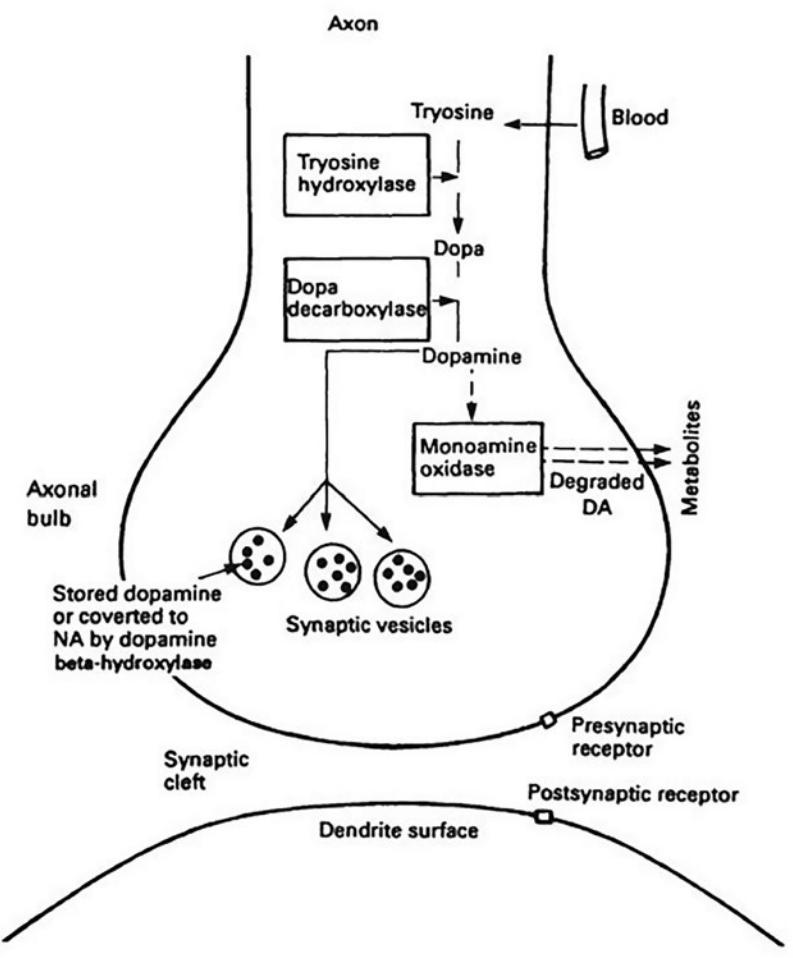
Fig. A.1 Storage and production of catecholamines
If the neuron uses noradrenaline as its neurotransmitter then once inside the synaptic vesicles there is another enzyme called dopamine-beta-hydroxylase which converts dopamine into noradrenaline. Various researchers have attempted to use precursors such as tyrosine or L-dopa and research their antidepressant effects. Although a powerful treatment for Parkinson’s disease, L-dopa has not made much headway as an antidepressant. This may be for a number of reasons to do with MAO activity or low levels of dopamine-beta-hydroxylase in vesicles, implying that little gets converted into NA. L-dopa may have different effects in bipolar as opposed to unipolar depression. This may imply that in bipolars, dopamine plays a greater role in mood regulation than is normal. My thought here is that just as early brain damage may be compensated for if it occurs early enough, it may be that somehow, whereas in normals certain systems would select NA as the transmitter of choice, in the bipolar, DA is selected instead. In other words, during development there is a (perhaps limited) choice as to whether particular neurons are going to be NA or DA active. This is a speculative view but not without some foundation (Bunge et al. 1978).
The precursor tryptophan has also been used to load up the 5-HT system (Spring et al. 1987). Although sometimes a useful addition, it does not have major antidepressant properties in its own right (Willner 1985). Reserpine is known to deplete the synaptic vesicles of monoamines whilst the psychological stress of uncontrollable shock may, as one of its effects, reduce the enzyme tyrosine hydroxylase (Weiss et al. 1979). Reserpine can induce depression in a small number of cases (Mendels and Frazer 1974).
Release and re-uptake
The next step in the signalling process relates to the release of neurotransmitter. The depolarisation of the cell causes an infl ux of calcium ions which triggers the synaptic vesicles to release transmitter into the gap at the end of the axonal bulb and the surface of a dendrite (i.e. in the synaptic cleft). The dendrite is the surface of the receiving cell. Cells may have many thousands of dendrites picking up information from various sources but each cell will have only one axon, i.e. it will have only one sending fi bre. Once in the synaptic cleft two further processes are important. First, the transmitter may be deaminated by an enzyme called catechol-o-methyletransferase (COMT), again producing metabolites of the neurotransmitter. Second, there is an active pump (called a sodium pump) which pumps neurotransmitter back into the axon. This is known as a re-uptake mechanism. Most tricyclic drugs are called re-uptake blockers because one of their properties is to block this uptake mechanism. Hence, both MAOIs and tricyclics increase the availability of transmitter in the synaptic cleft but in rather different ways. Tricyclics increase the contact time of the transmitter in the synaptic cleft. Different tricyclics vary however, as to their potency as uptake blockers – some quite considerably (McNeal and Cimbolic 1986).
Activity at receptor surfaces
The steps in this process are outlined in Fig. A.2 . The way the neurotransmitter interacts with its receptor is highly complex though it can be considered as a kind of key (transmitter) and lock (receptor) mechanism. If the transmitter fi ts the receptor then a chemical process is initiated. There are believed to be three important types of receptor in the catecholamine system known as beta (β), alpha-1 (α1) and alpha-2 (α2), although others have been suggested (see Iversen 1979; Cotman and McGaugh 1980; Willner 1985; McNeal and Cimbolic 1986
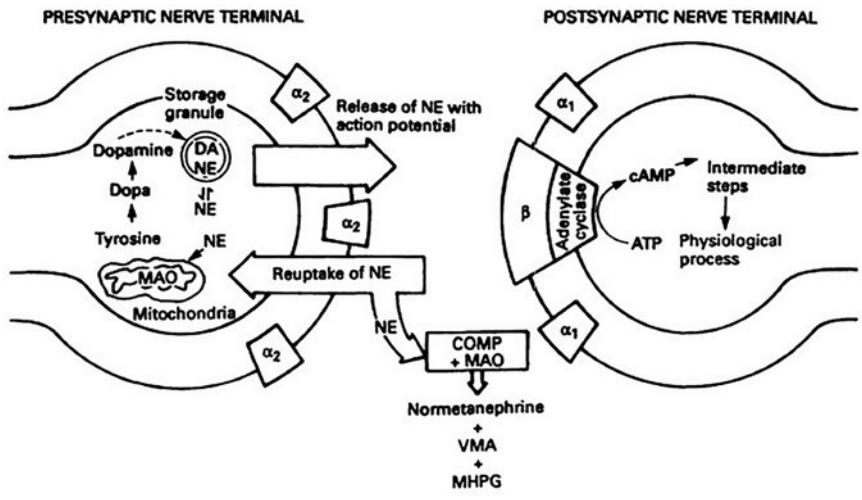
Fig. A.2 Receptor changes in a noradrenergic synapse (see text for explanation). VMA and MHPG are metabolites in the breakdown of norepinephrine (NE)
From McNeal and Cimbolic 1986, with permission.
for a more detailed discussion). The β and α1 receptors lie on the surface of the dendrite. This surface is called the post-synaptic receptor surface. When the neurotransmitter fi ts into these receptors it can have either an excitory or inhibitory effect on chemical processes within the receiving cell. These chemical changes are mediated through adenosine triphosphate (ATP) being converted into andenosine monophosphate (or cyclic AMP – cAMP). This conversion causes a release of energy needed for various chemical changes within the cell. α1 receptors work in a different way to β receptors so that α1 is sometimes called a “secondary messenger”.
The membrane of the axonal bulb is called the pre-synaptic surface and receptors lying on this surface are called α2 presynaptic receptors. (The pre- and postsynaptic reference indicates the side of the synaptic cleft the surface lies on.) β2 receptors are also sensitive to the release of their own transmitter; hence, sometimes they are called auto receptors. Through chemical processes these receptors act to modulate the synthesis of neurotransmitter. Theoretically, sharp increases in neurotransmitter cause the α2 receptor to send back messages to slow down the production of neurotransmitter, possibly by having an effect on the enzyme tyrosine hydroxylase. In other words, α2 receptors are like supervisors monitoring the levels of neurotransmitter in the cleft and signalling activity to speed up or slow down back at the factory according to demand.
In research into the affective disorders, the super-sensitivity or sub-sensitivity of these receptors have been the most recent focus of interest. (Whybrow et al. 1984; Willner 1985; McNeal and Cimbolic 1986, give good reviews.)
Overview
Over recent years there has been a growing awareness of the enormous complexity of neurobiological processes. In this very short overview I have presented a highly simplifi ed account, suffi cient I hope, to enable the unfamiliar reader to understand some the of the issues and the jargon that are taken up in Chapter 4 . The references cited should be suffi cient to allow greater exploration of the area if this is desired. Whybrow et al. (1984) and Willner (1985) give encyclopaedic overviews of the amine theories of depression for those interested. Gray (1982) provides a similar service for theories of anxiety. In our analysis, the details of the biochemistry are less important than their functional activity. Nevertheless, I hope readers will appreciate the rationale of drug therapies. If we are to develop a truly psychobiological approach to psychotherapy and our understanding of psychopathology then at some point we will have to explore this level. We cannot long put off the question of how psychotherapy works at biological levels (see Reiser 1984 for one approach to this challenge.)
The distribution of monoamine pathways
The development of a staining technique called histofl uorescence has made it possible for researchers to identify the pathways of the monoamines (and other neurotransmitters). The cell bodies of the monoamines lie deep in the regions of the brain known as the pons, medulla and mesencephalon. This is referred to by MacLean (1985) as the reptilian brain or R-complex. From these cell bodies the monoamines send out axons which project into all major brain areas. Sometimes they project out from the cell bodies in bundles of fi bres and there are different bundle pathways (Kostowski 1980). For example, the NE dorsal bundle projects in the thalamic, hypothalamic, hippocampal and cerebral cortex areas. Figure A.3 gives a useful though simplifi ed outline of the main distribution networks of the monoamines.
Although the monoamine terminals make up a very small percentage of terminals in the brain (probably less than 4%) their effects on are behaviour profound. It is in the manner of their projections and their involvement in so many brain areas that makes this so. It raises intriguing questions as to why evolution has arranged it thus and suggests, perhaps, the importance of co-ordination of structural activity such that in some areas these transmitters are excitatory while in others they are inhibitory. The reader will recall the points made in Chapter 4 that functional defi cits in transmission can produce disinhibition effects.
Early neurochemical insights
In the 1950s and 1960s, two fi ndings of the effects of drugs used in non-psychiatric conditions opened the door for modern psychiatric neurobiology. Reserpine, used in the treatment of hypertension, was reported to produce clinical depression in
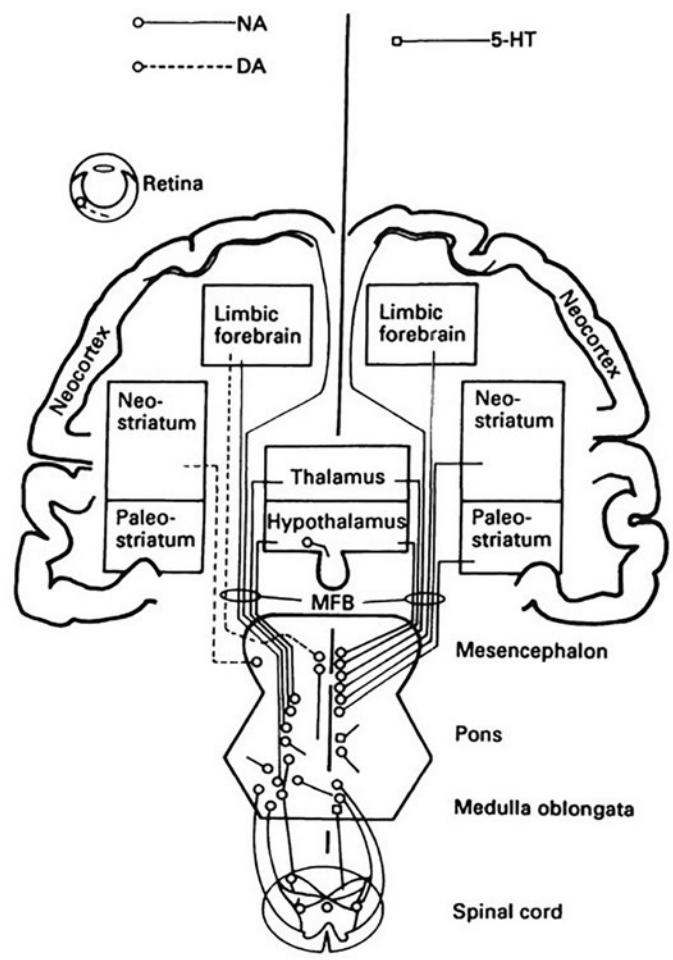
Fig. A.3 Schematic representation of monoamine network From Warburton 1975; with kind permission of John Wiley & Sons Ltd.
10 to 15% of cases. Subsequently, others (Mendels and Frazer 1974) suggested that this fi gure was too high and that sufferers usually had either a personal or family history of psychiatric disorder. Nevertheless, understanding what reserpine did in the brain was an obvious research endeavour. It was found that reserpine depleted the stored level of the catecholamines, noradrenaline (NA) and dopamine (DA) and the indoleamine, 5-hydroxytryptamine (5-HT). About the same time, the drug iproniazide, used in the treatment of tuberculosis, was reported to have mood-elevating properties. This drug was discovered to increase the central availability of monoamines (NA, DA, 5-HT).
With the discovery of histochemical fl uorescence as a way of staining and mapping different neurotransmitters in the brain (Dahlstrom and Fuxe 1964) it became possible to study how these different neurotransmitter pathways innervated different brain regions. (See Cotman and McGaugh 1980.) A major discovery from the use of this technique showed that NA existed in the lateral hypothalamus. This had previously been identifi ed as a reward or pleasure area (Olds and Milner 1954). These researchers had planted electrodes into the medial forebrain bundle and observed the behaviour of rats who could, by lever pressing, stimulate this brain area.
The idea that depressive disorders could be conceptualised in terms of pleasure area dysfunction has been extremely infl uential. Some theorists (e.g. Klein 1974) suggest that pleasure area hypoactivity is a characteristic of endogenomorphic depression. In the analysis suggested here however, this would be seen as one of many changes that take place. These kinds of depression seem to be switched into defensive activation with a predominance in the “stop” mode. Catatonic states may be a form of long-lasting freeze (stop) response.
When it is considered that even as late as the 1940s there was some controversy over whether or not chemical transmission played a major role in the CNS (as opposed to direct electrical transmission), then the achievements of this era are astounding. While one wishes to give due credit to these early pioneers, it has to be said that, as in all scientifi c advancement, these early hypotheses were probably naive. This would not be so much of a problem if the notion of activity in the pleasure areas did not receive such continued support as a model of depression. The problem with the hedonic tone theories is that they are incapable of dealing with the evolution of certain social roles or emotional behavioural displays (Gardner 1988). Moreover, many psychiatric disorders involve changes in patterns of emotional experience and expression (e.g. anger, anxiety, jealousy, hate, excitement, disgust, etc.). This suggests changes in the way a person relates to others (i.e. a switch of PSALICs rather than simple mood changes). Hence, it is useful to consider that much of this early work actually involved identifying general changes in brain patterns out of which a depressive disorder might arise. They were tapping into brain systems which had evolved to co-ordinate (in large part) social behaviour (Gardner 1988).
Current ideas on neurobiological mechanisms
The study of monoamine function opened up the fi eld for a considerable research effort into the neurobiology of mental disorder, especially of the affective disorders. Drugs could now be produced and their effects on the CNS studied. It is important to recognise that even now we still do not fully understand how many of the antidepressants work, or indeed, whether the systems that have been explored are the ones that are centrally involved in affective disorder. There is much suggestive evidence, however, that they are (Whybrow et al. 1984; Willner 1985). Nevertheless, since the 1960s our understanding of the monoamine systems and other neurochemical processes has proliferated.
It is of course the case that research has set off in this particular direction primarily because the state of the art of research and technology confi ned it here. As new techniques develop and new neurotransmitters and regulatory processes have become known, it seems clearer that the monoamines relate more to general processes of go–stop states rather than being disorder specifi c. Indeed, at the last count somewhere in the region of 50 different neurotransmitters had been identifi ed. More to the point, most now agree that it is patterns of activity, at many levels in the brain and other biological systems, that give rise to specifi c syndromes (Whybrow 1984; Whybrow et al. 1984).
The interested reader is also referred to Iversen’s paper (1979) which remains a very clear and accessible introduction to neurochemical processes. Cotman and McGaugh (1980) offer a good textbook on neuroscience. Whybrow et al. (1984) and Willner (1985) also offer excellent texts in regard to the psychobiology of affective disorder.
The reason we need to study patterns in the brain is because brain structures evolved to function as patterned systems co-ordinating sequences of behaviour (e.g. the yielding subroutine, the Alpha routine, the care giving routine and so on). In 1984, I coined the term “psychobiological response pattern” to convey the idea of innately laid down potential patterns of activity.
Appendix 2
Homeostasis and beyond
In Chapters 4 and 5 a distinction was made between baseline states (which prepare or preselect in terms of increasing the accessibility of certain responses; Bailey 1987 refers to this as priming), and the responses actually exhibited to specifi c events. In this appendix, a brief look at factors that may infl uence baseline states is offered. The concept of homeostasis is an important one in psychobiology. We tend to think of systems being disturbed from some steady state to which the system will settle back again after the initial disturbance. However, this view is limiting in some important ways. In many respects the CNS and endocrine systems are now regarded as oscillating dynamic systems which show cyclic variability. A well known oscillating system is the circadian rhythm, which expresses itself in fl uctuations in various hormones such as cortisol and melatonin and body temperature. Cognitive abilities may also vary cyclically. It has long been known that “dawn raids” by the police are more effective because victims are more easily disoriented and their resistance to interrogation is at its lowest at this time in the morning. Major diurnal variations of the symptoms of depression are prominent for some sufferers. These kinds of data have led to the idea of there being “biological clocks” which activate psychobiological processes according to some internal timing mechanism. Interestingly, when allowed to free roll under experimental conditions, circadian clocks tend to move to a 25 rather than 24 hour cycle. However, there are many other biological rhythms which are called infradian rhythms, meaning longer than 24 hours. These rhythms are complex and include rhythms like the menstrual cycle and also seasonal rhythms. As we shall see in the next section, these internally controlled oscillating systems, or biological clocks, can have profound effects on human biosocial functioning.
Homeostasis is limited in that it does not take into account the role of biological maturation. Animals develop and change biologically over time according to preset genetic programmes. These developmental-biologic changes are interpenetrated by the environmental responses to the animal as the animal changes (Meyersburg and Post 1979; Hofer 1981).
Basically then, genetic programming predisposes animals to change their state via development. This takes place in terms of changes in dendrite growth, synaptic branching and so on, and is studied by the science of developmental neurobiology. It is also known that damage to various parts of the CNS can result in changes in dendrite growth in other parts of the CNS. In other words, the state properties of the organism are varied not only as a function of damage but also as a function of how the CNS accommodates itself to and changes as a result of that damage.
In many ways biological systems are not steady-state systems (Jantsch 1980). In the sections that follow a brief overview is given to some of the more important internal oscillating systems.
Oscillating systems within the central nervous system
In Chapter 4 we looked at some organisational principles of CNS function in terms of defence–safety and go–stop. However, to remain consistent we must be wary of delivering an overly static machine-like view of human beings. To remain true to our evolutionary story, that animals are evolved social organisms, we would be advised to consider more fully the ecology in which this evolution took place. In so doing, it becomes immediately apparent that ecologies are far from static. Indeed, animals evolved in a world of constant fl uctuation and cyclic change. Consequently, we discover that many internal biological processes are entrained to ecological fl uctuation (e.g. light–dark cycles, seasons and so on). These discoveries have given rise to the recognition of the importance of internal oscillating systems (Weiner 1982). Various bio-rhythms are known to have a powerful effect on psychopathology. For example, the circadian rhythm not only affects many hormone control systems such as cortisol (Levine and Coe 1985), but is involved in depressive symptoms (e.g. diurnal variation). It is impossible to do justice to this fascinating and important area here, but we can take a cursory look at these phenomena to counteract any idea that homeostasis provides and adequate base for psychological science.
Evolution in a world of changing seasons
The Earth is tilted on its rotational axis so that as it moves around the Sun it experiences changes of season. These seasonal alterations result in ecological changes of light, temperature, rainfall, etc., which have signifi cant effects on the ecology which require adaptation. Two primary adaptations have been made to seasonal change. The fi rst of these relates to coping and living within a changing ecology. This has called into being the capacity to either leave an inhospitable locale (migration), or remain within it until better times arrive (hibernation). Today, we can observe migrators by sea, air and land in species as diverse as fi sh, whales, birds and various mammals. Salmon, birds and whales are, of course, great migrators. Unlike land mammal migrators, these species rarely eat on their journeys, but live on energy stored in the preceding period. During migration, there are changes in many physiological processes including sleep, energy expenditure, rest time and so on. Distinguished from migrators are the hibernators which use the reverse strategy. These species have evolved the capacity to stay put. They do this by reducing energy expenditure, lowering body temperature and sleeping more, all of which results in requiring less food and maintaining the animal in a warm (nest) environment out of harm’s way. Price (1972) gave an interesting discussion on how depression might relate to these variations between moving on versus staying put. The second adaptation is allied to the fi rst yet separate. This relates to the timing of certain social behaviours. It involves a species’ ability to maximise exploitation of favoured breeding conditions when food supply and ecological factors are at their most benefi cial. Hence, behaviour leading up to breeding behaviour (the rutting season for reindeer, for example) and the delivery of and caring for young are seasonally co-ordinated. In many species, dominance behaviour is also seasonally amplifi ed. Clearly, species that are able to nurture their young in favourable ecologies are going to be advantaged. Infants born late in the breeding season may experience parents absent for longer periods of time due the greater diffi culty in fi nding food and their chances of survival are poor. Hofer (1984) notes that an increase in maternal rejections, due to the need for foraging, adversely affects despair responses to separation.
Clearly, to some degree, humans have evolved past the stage of showing breeding and dominance cycles. On the other hand, since the brain structure of humans can be traced back to reptiles and beyond (MacLean 1985; Bailey 1987), it is feasible that some areas of the brain remain sensitive to climatic and seasonal alteration. The exact nature of this sensitivity, however, is complex (Michael and Zumpe 1981). Take for example, the observation made by Kraepelin a century ago that spring is often associated with mania in some individuals. Remember also that Gardner (1982, 1988) suggested that the alpha state was a model for mania. The question is what has been climatically triggered: a migratory–hibernatory cycle or a cycle related to breeding and competing? Clearly, from Gardner’s model, it could well be a primitive breeding-related cycle, especially since changes in sexual behaviour are noted both in seasonally triggered dominance behaviours and also in mania. Agitated depressions, on the other hand, may relate to factors pertaining to migratory patterns (Price 1972). At this juncture, it would be unwise to speculate too freely because there are many unknowns, but it may nevertheless be the case that there are different cyclic forms to staying put and moving on versus breeding and competing. Some affective disorders may relate to mechanisms controlling movement behaviour, whereas others may relate to breeding cycles. Because these are interdependent they may be diffi cult to separate, or they may work through some common pathways.
Although, as we shall see, it is usually temperature and light that are regarded as the triggers for these cycles, the perception of the ecology may also play a role. Take for example the delusions of poverty noted in some depressives. One wonders if this construct system may be attuned to an evolved ecological sensitivity. The critical question here may be whether animals have evolved the capacity to begin their hibernation or migration in relation to ecological change, e.g. moving on sooner if it has been a poor season but delaying if it has been a good season. The suggestion here is that various appraisal systems may have evolved to evaluate how good or bad a local ecology is, and if so, these appraisal systems may become dysfunctional in some individuals leading to the perception of poverty and deprivation in times of plenty. Although under current conditions and phylogenetic developments, these kinds of construct systems are now of little use to humans (especially with the development of agriculture, storage and so on), they may nevertheless exist as archetypal potentials ready to be activated under certain conditions.
This view is in some accord with Beck’s (1987) evolutionary model. He views depression as the activation of a primitive psychobiological program which serves to avoid the depletion of energy before exhaustion and death. In the theory presented earlier, depression represents the activation of defence–stop. Because it is defensive (i.e. self-protective) the sleep disturbance is understood; i.e. in a poor ecology predators would be searching for food also. Not only would one need to reduce foraging that was unproductive, but one would have to be awake at times of predator activity – often the twilight hours. In the absence of hibernation one would have to make sure that one didn’t become another’s meal. Some depressions are often associated with desires to stay in bed (i.e. the nest or burrow) yet be awake during dangerous hours.
In summary, we have seen then that there are two classes of behaviour which seem to be important; one relating to migration and hibernation and the other relating to breeding cycles. In the next section, we look at some of the evidence suggestive of biological changes in background state triggered by various oscillating systems.
The psychobiology of ecological and climatic variation
In this section we are going to touch on some factors related to seasonality. The reader should note that this is an immensely complex area and the cursory journey we are about to take through it in no way does credit to this complexity. Seasonality is part of a larger science interested in rhythms of various kinds, called chronobiology.
Seasonality and biology
In previous sections we have looked at the evidence of changes in 5-HT in go– stop systems and various disinhibition phenomena such as impulsiveness (Soubrie 1986). 5-HT may play a role in changes in dominance behaviours (see Chapter 12 ). For example, if 5-HT does indeed play a role in the dominance position of animals as Raleigh et al. (1984) suggest, then any evidence of seasonal variation in 5-HT mechanisms would be of special interest. Egrise et al. (1986) have examined seasonal variation in H-imipramine binding sites and 5-HT uptake into blood platelets. They found that there were seasonal variations for both parameters. However, in their measure of 5-HT they found that, compared to normals, depressed patients showed signifi cant decreases in May and September. Egrise et al.’s paper highlights the fact that seasonal variation is noted in many biochemical processes. The manner in which these biological shifts may come to activate cognitive, behavioural and affective systems is of interest. It may be that these shifts are capable of activating various cognitive, behavioural or affective patterns which amplify the themes of dominance or defeat or deprivation. In other words, these are shifts of baseline biological states from which certain responses are more likely and others less so. 1
Seasonality and aggressive behaviour
Michael and Zumpe (1986) explored seasonal variation in violent abuse of women. Their results showed a clear seasonal variation with the highest rates of violence occurring during the summer months. Their view is that in a subgroup of men such changes may relate to ambient temperature. Whether or not this occurs as a disinhibition effect in violently prone men is unknown. However, again, the possibility of climatic sensitivity to certain behaviours is an important research question. Moreover, an enquiry into seasonal biological alteration in such men would be useful. Interestingly, these authors noted the possibility that there are different seasonal patterns to spouse abuse as compared to child abuse. It is unknown whether there may be a general tendency to brain state instability such that climatic triggers produce catastrophic alterations of various brain states (see Gilbert 1984 for a discussion of brain state instability). Overall, the relationship between aggression and depression has always been an interesting one. The possibility that 5-HT activity changes in relationship to season, and this in turn disinhibits impulsiveness or hostility in a subgroup of people, is an interesting research avenue.
Seasonality and affective disorder
The most researched seasonally related disorder studied so far has been depression (Kripke et al. 1983a, b; Rosenthal et al. 1984; Lewy et al. 1985; Wehr et al. 1985, 1986). As these researchers suggest, many biological functions seem entrained to light/dark cyclic variation. Of special interest has been the hormone melatonin. 5-HT is a precursor of melatonin. Melatonin appears to be concentrated in the hypothalamus and midbrain and may modify neurotransmitter inputs for the hypothalamic control of various hormones (Gilmore 1981). This pineal hormone increases during dark hours and decreases during light hours. Melatonin hormone change (among other hormone changes) is believed to play a role in jet lag symptoms. There is also a seasonal variation to melatonin, being higher in winter months and lower in summer months. The pathway that is believed to operate in this mechanism is the retinohypothalmic tract. Melatonin plays an important regulatory role in oscillating mechanisms (biological clocks). Rosenthal et al.’s (1984) paper gives an excellent airing of the issues and is well referenced. Rosenthal et al. note Kraepelin’s observation that some patients exhibit clear excitement during the spring period only to lapse into depressive states during the autumn. Their own research suggests that “a few single women reported inability to keep a boyfriend in the winter but no diffi culty in fi nding another one during the following summer.” (p.73). Such observations might be expected if these seasonally triggered changes are co-ordinated with (primitive) reproductive social behaviours.
The typical symptoms of seasonal affective disorder (as it is now called) are characterised by: hypersomnia, carbohydrate craving and overeating in addition to mood and inergic variation (see Rosenthal et al. 1984, table 2, p.73). More importantly, from a clinical point of view, there is the growing evidence that sufferers of this condition can be helped by changing their exposure to bright intensity light (Rosenthal et al. 1984; Wehr et al. 1986). However, the effectiveness of light treatment may not be tied to seasonal affective disorder. Depressives (especially of the bipolar form) may benefi t (Kripke et al. 1983a,b). Melatonin sensitivity to light might be high in this group (Lewy et al. 1985).
We have only begun to explore the role of light as a therapy for some patients and how it works (Wehr et al. 1986). 2 We do not yet know whether those who benefi t will be many in number or few; and whether only depression or other disorders may also be helped. I have had one bulimic patient who showed clear worsening of her cravings seasonally, which were completely cured if she went on holiday to a southern country, but not if she holidayed in Britain or further north. It may be that, in some cases, there is an internal oscillating process which interacts with psychological and social vulnerability. For example, some patients may be more easily able to cope with certain life events in the summer months, but less able if these occur at a critical period, i.e. winter or autumn. At present, the interaction between life event, type of event and season of exposure is still being researched.
A few fi nal speculations might be allowed at this point. Bradbury and Miller (1985) presented a comprehensive overview of the relationship between season of birth and schizophrenia. Although there are many methodological problems in this research area, there does appear to be some evidence that winter births may confer increased risk. These authors consider a number of possible explanations. It may be that internal oscillating mechanisms are disturbed in some women, and that internal biological shifts may have an impact on a developing foetus. In a recent television documentary, Greshwin suggested that circulating progesterone could affect the relative cortical-hemispheric development of the foetus. This, in turn, could skew development towards left-handedness and allergy sensitivity. May it be that other hormonal changes sensitive to climatic variation interact with the foetus? Do mothers of schizophrenics show increased sensitivity to winter depressions? What about increased risk of postnatal depression and psychosis to mothers giving birth in the winter? These fascinating speculations must await further research.
Internal oscillators
So far, it has been suggested that evolution occurred in the context of changing climatic and ecological conditions. The timing of inclusive fi tness directed goals (mating, bearing young and competing) have similarly been entrained to seasonal variation in line with alteration of biological mediators of these goals. Hence, biological processes and the psychological phenomena that they support (affects, cognitions, behaviours or PSALICs) may also be viewed as dynamic and rhythmic. Some of these rhythms are short, some long, but how far are these rhythmic alterations only relevant to those with affective disorders?
Eastwood et al. (1985) explored this issue by asking two groups of subjects (an affective disorder group and a normal group) to record daily measures of time slept, mood, energy and anxiety, over a fourteen-month period. They found that the majority of subjects experience seasonal cycles. By seasonal, they suggest “. . . not a periodicity that precisely recurs seasonally, but a rhythm that is approximately or nearly seasonal in its recurrence.” (p.296)
The idea that there are seasonal-like cycles, which need not be clearly entrained to external triggers (e.g. light) would perhaps suggest some continuation of infradian oscillating mechanisms in the human CNS. These may have become less sensitive to external triggers and less forceful in their amplifi cation (perhaps due to some phylogenetic development producing inhibition of these oscillating systems). In conclusion to their study Eastwood et al. (1985, p.298) suggest that affective cyclic symptoms are universal, those with affective disorders varying in the amplitude of their cycles rather than in the kind of cycle:
In the present study, 83% of patients and 79% of control subjects had signifi cant and sustained mood periodicities; more specifi cally, 60% of the patients and 41% of the control subjects had signifi cant mood cycles. These fi gures are substantially higher than those found by a number of international studies in the past decade, which varied from approximately 5% to 30%, depending on the study, place, sex and type of prevalence.
If Eastwood et al. are correct that cyclic changes of mood are more common than previously acknowledged, then one would like to know to what extent psychotherapy would affect the amplitude of these cycles. Drugs did not appear to remove the tendency for cyclic activity in Eastwood et al.’s study. However, although super-sensitivity to light may be a biological marker for some affective disorders, and possibly other disorders, it can not be ruled out that the amplifi cation of these cycles is related to current state of incentive achievement. In other words, changing the way individuals perceive themselves, removing vulnerability to low self-esteem and lack of control, helping individuals to be less competitive, etc., may have the effect of removing the tendency for high-amplitude changes under internal cyclic provocation. This is a highly speculative theory (and probably something of a long shot), but again, it suggests that we cannot assume a dissociation between psychological, social and biological processes (Michael and Zumpe 1981). Moreover, because baseline biological states regulate long-term response patterns (Leshner 1978), psychotherapy might be aimed at state changes rather than immediate response capabilities. However, this is a complex and controversial issue.
The menstrual cycle
Another major oscillating mechanism is the menstrual cycle. Some have suggested that this cycle might constitute a good model for depressed states in some women (Rubinow et al. 1986). It is known that there are numerous changes in hormone and neural mechanisms throughout the various stages of the cycle, but rather less in known about how these relate to psychopathology (Asso 1983; Collins et al. 1985; Tam et al. 1985; Stout et al. 1986).
The degree to which these oscillating systems hook up into underlying cognitive schemata and concepts that an individual may have and the attributions given to changes in state may be important. Some women may become depressed during their menstrual cycles because they evaluate their changes in state as making them unlovable; or, they may evaluate negatively the fact that they are able to accomplish less; or, minor changes in anxiety may be amplifi ed by a cognitive route in the same way that panic patients appear to cognitively amplify and catastrophise changes in physical sensations (Beck et al. 1985). The degree to which shifts in state alter social relations, and the way social relationships may amplify or dampen these effects on psychological health require further research.
Genetic sensitivity may also play a role. Breier et al. (1986) found that 51% of a group of panic and agoraphobic patients experienced a worsening of the condition in relation to their menstrual cycle. At present, I have a very anxious patient who suggests that she is “two different people”. For fourteen days of her cycle she is confi dent, able to go to supermarkets and so on, but for the other fourteen days she becomes “a nervous wreck”. Whatever the source of these effects, efforts to decondition her during her good days showed no carry-over effect to her bad days.
I have noticed similar variation in some obsessional patients. No biopsychosocial theory is complete without some means to accommodate such data. It also remains to be seen if some phobias are more easily fear conditioned or extinguished at different points in the cycle. Recent research suggests this is indeed the case (van der Molen et al. 1988). If so, behavioural therapists may need to be more sensitive to the timing of their interventions. Changes in hormones during the menopause may also act as one factor among many which increase risk of psychopathology.
Overview
It is not only psychopathologies which are affected by internal oscillating mechanisms. Many forms of diseases may show such an effect. Weiner’s outstanding paper (1982, pp.499–500) on psychosomatic medicine puts the issue well:
The question of the timing of onset of disease may be intimately bound up with our growing understanding of the fact that biological systems function in a periodic and rhythmic manner. During evolutionary development these rhythms have been selected out; endogenous oscillator systems have evolved and are matched to natural frequencies that approximate important environmental cycles. The dominant entrained frequency is circadian matching the light–dark cycle – the length of the day is the periodic environmental cue. Other cyclic patterns have been discovered – infradian, lunar, seasonal and altradian. The endogenous oscillator systems, occurring in all living systems, have led to highly complex time-periodic systems that provide the temporal framework for biological integration.
The signifi cance of these fi ndings are profound with regard to our understanding of normal physiological and pathological mechanisms in Man. It is no longer possible to ignore these rhythmic events as only minor fl uctuations about a daily mean. The evidence is overwhelming that these periodic fl uctuations are large and represent major temporal differences in cell, organ and organismic states. Indeed, the biological system’s continual change produces biological differences that represent differences of kind not of degree.
Hence, we are beginning to have new ideas about psychopathology and other diseases in terms of endogenous oscillator systems. It is not necessary (nor possible) for us to go into the complex biological details of these oscillator systems. Rather, we need to begin to enquire into the psychological implications.
In terms of Leary’s theory (1957) and Beck’s theory (1967), negative latent schemata may be more easily activated at certain stages of cyclic endogenous oscillation. If psychotherapy is capable of changing these latent schemata then the pathological consequences of endogenous oscillator systems may be reduced. All of this awaits future research. It may be that some effects of biological oscillation are more easily controlled than others. I have had examples of women who experienced improvement in premenstrual diffi culties following successful psychotherapy. My impression was that these women had problems with assertiveness. This could of course be a quite spurious observation. But the idea that endogenous changes of state run their course irrespective of psychological factors needs to be considered (Oaker 1988). Helping individuals make allowances to cope with changes of state, to prepare for and re-evaluate such changes might be helpful, but that’s an issue for research.
Notes
Subject index
- abuse 184–95; marital 192–5; physical 184–9; sexual 189–91
- affects 27–33, 172–5, 313–15; as amplifi ers 28; biosocial goals and 27–9; care giving and 172–5; complexes and 32–3; encapsulation and 313–15; as incentive monitors 27–8; levels of processing and 31–3; motives and 29–30; social signals and 29; value and 28–9
- agonic mode 44–6, 47, 193–6, 316, 328; marital relations and 193; mentalities and 316; the self and 328
- altruism: co-operation and 203–5; status and 257–9; see also kin altruism; reciprocal altruism
- anima 37–9
- animus 37–8
- anxiety 74, 83, 148–51, 306; social anxiety 74, 83, 149, 306; see also defence system
- archetypes 36–41; biosocial goals and 39–41; Jung’s theory of 36–9
- attachment 117–20, 122–5, 131–3, 140–4, 151, 153; anxiety and 148–51; biological rhythms and 124–5; evolution and 117–19; depression and 151–3; development and 138–44, 153–6; forms of 131–3, 140–4; morality and 250, 251; object relations theory and 121, 122; physical contact and 122–4; see also separation
- attribution 70, 71, 164, 187, 233–5, 238; abuse and 187; deception and 233–5; interpersonal psychology and 70, 71; morality and 238
- autonomy 293–5; sociotropy and 295 autopoiesis 333, 337
- behavioural inhibition, system of 92, 93, 236, 260; guilt and 236; neuropsychology and 91–3; status and 260
- biological rhythms 124, 125, 386–90, 389–92; infants and 124, 125; internal oscillation and 389–92; seasonal variation and 386–9
- biological states 110–13; see also defeat
biosocial goals 13, 14, 17–18, 27, 39–41, 61–2, 315–20; affects and 27–9; archetypes and 39–41; classifi cation of 24–7; incentives and 27; inclusive fi tness and 17–18; interpersonal psychology and 61–2; mentalities and 315–20
- care giving 165–8, 176–9, 336; attitudes and 336; psychopathology and 167–8; psychotherapy and 176–9; styles of 165–8
- cognitive therapy 10, 71–3, 176–9, 315, 334–9
- complexes 32–3, 38
- culture 345–7
- deception 226–35; beliefs and 228, 229; self evaluation and 227, 229
- defence system 42–6, 78–81, 113–15, 126–33, 140–2; the agonic mode and 44–6; attachment and 140–2; defensive drift and 113–15; neuropsychology of 91–3; nonsocial 42; responses of 78–81; separation and 126, 135; social 42–6; territorial 42–4
- defeat 44–6, 80, 320–1; depression and 45, 46, 80; resource holding and 43–4
- depression 45–6, 108–9, 151–3, 330, 390; attachment and 151, 153; cortisol and
107–9; defeat and 43, 45; endocrinology and 101–2; the menstrual cycle and 390; roles and 330
- dominance 20, 22, 43, 56, 60, 62, 275–80, 289, 290, 295–300; co-operation and 204, 225; followers and 266–7; gender 275–80; the interpersonal circle and 59–61; the reptilian brain and 20, 22; resource holding potential and 43, 289, 290, 342, 343; social roles and 56, 60; Type A and 295–301 dominant goal 291–2
- ego analytic theory 145, 146, 291–2
empathy 173–5, 181, 208–9; guilt and 174; morality and 208–9; psychotherapy and 178; sympathy and 173–5, 181
- evolution 15, 19–22, 41, 43–4, 46, 56–9, 168–72, 201–3, 277, 283, 345, 347; the brain and 19–22; breeding structures and 41–6; care giving and 168, 169; co-operation and 201–3; morality and 211; roles 56–9; sexual selection and 15, 275–8; the social context and 10–11, 345–7
- existentialism 144–5, 239–41, 291; care eliciting and 144–5; guilt and 239–41; specialness and 291
- Facilitators 165–6 fi ght/fl ight/freeze and faint see defence system, responses of
guilt 235–48; culture and 241; entitlement and 236–7; existential 239–41; justifi cation and 237–8; morality and 238; redemption and 241–3; shame and 243–8; submission and 243–4
hedonic mode 51–5, 204, 212, 221, 316, 328; attentional structure and 52–5; co-operation and 204, 221; friendship and 212; mentalities and 316; the self and 328 hypochondrias 150
inclusive fitness 15–18, 20, 21, 198, 201, 209; co-operation and 198, 201; evolution and 15–16, 18; kin altruism
and 169–71; motives and 18; the reptilian brain and 20, 21 internal dialogues 269–71, 325–7; the self and 325–7; shame and 269–71 internal oscillators 389–90 interpersonal circle 59–66; personal adjustment and 62–6
learned helplessness 84–8, 110; biology of 87, 88; the parasympathetic nervous system and 103
- mentalities 312–22
- monoamines 92, 126, 128, 271–3, 375–82; dominance-submission and 271–3; go-stop and 84–91; separation and 126, 128
- morals 205–11; evolution and 211; foresight and 209; rules and 205–6 motives 18, 29–30; see also biosocial goals
nurturing, styles of 163; see also care giving
object relations theory 75, 121, 271
parasympathetic nervous system 102–3 personal adjustment style 62–6 personality, and co-operation 211–12 personality disorder 91, 156–8, 301–8; biology and 91; development and 156–8; narcissism and 301–2; Type A behaviour and 307–8 physical contact 123 popularity, and aggression 214–15 power: child abuse and 186, 187; co-operation and 207, 222, 223; psychobiology of 271–4; in a psychopath 319–20; sadism and 264–5; see also dominance
reciprocal altruism 169–71, 202, 206, 248–51; beliefs and 248–51; co-operation and 202, 203 redemption 241–3, 349
- regulators 165–6
- reptilian brain 20, 21
- resource holding potential 43–9, 321; co-operation and 204; self esteem and 46–9, 321; submission and 270; Type A and 309, 310
- revealing 218, 230, 241–2; confession and 241–2
- ritualistic agonistic behaviour (RAB) 42–4, 289–90, 309
- roles (social) 56–9, 317, 325–30; evolution of 56–9; the internal dialogue and 325–7; mentalities and 317–18, 328–30
- sadism, and power 264–5
- safety system 49–52, 78–84, 96, 97, 135, 138, 158; attachment and 50–1, 135, 138, 143; the hedonic mode and 51–2, 53; neuropsychology of 94–5; responses of 82–4
- seasonal affective disorder 388
- self esteem 46–9; depression and 48; resource holding and 46–9; social attention holding and 55–6
- self schemata 71, 72, 336–9; biosocial goals and 336–8; cognitive therapy and 72, 73
- separation 126–34; psychobiology of 126–34
- shame 243–8, 269; helplessness and 245; submission and 247, 269;
- see also guilt
- sharing 218
- sibling relations 281–4
- social attention holding potential (SAHP) 25, 53, 55–6, 199, 217
- sociobiology 16, 17–18; see also inclusive fi tness
- sociotropy 146–7, 211, 248–50, 295; autonomy and 295; co-operative beliefs
- and 211, 248–50
- space, use of 11–12
- sympathetic nervous system 99–102
- sympathy 173–5, 193; behaviour therapy and 175–6; empathy and 173–5, 181; guilt and 174
- teaching 217
- torture 264–5
- Type A 278, 295–301; beliefs of 297; characteristics of 298–301; narcissistic disorder and 307–8
- unconscious, history of 7–8
- yielding 43–5
Social mentalities
Throughout this book we have been concerned with the evolution of psychobiological processes. We have put the view that the human mind is made up of a variety of competencies laid down at different points over millions of years. The aim has been to convey the notion that humans have a set of evolved competencies (archetypal potentials) which furnish the substance of our meaning making. In this chapter we look in more detail at the case for separate competencies (mentalities), yet also explore the degree to which integration of these separate mentalities can and does take place. Integration, we shall argue, is a property of the psychic system. This concern is examined in more detail in the second half of this chapter, on the self. First, we return to the importance of there being separate competencies within the human mind.
We are at a point of radical change in psychological theorising. The study of mental functioning over the last century has given rise to the important idea that the human psyche consists of multiple special process systems designed to do particular jobs. Human minds are not single entity systems. Ornstein (1986, p.9) puts this point clearly:
The long progression in our self-understanding has been from a simple and usually “intellectual” view to the view that the mind is a mixed structure, for it contains a complex set of “talents”, “modules” and “policies” within . . . All of these general components of the mind can act independently of each other, they may well have different priorities.
The discovery of increased complexity and differentiation has occurred in many different areas of research . . . : in the study of brain function and localisation; in the conceptions of the nature of intelligence; in personality testing; and in the theories of the general characteristics of the mind . . .
Ornstein (1986) suggests that the human mind is organised in increasing levels of complexity. The most basic level is that of the refl exes and set reactions. Above them lie “domain-specifi c data-processing modules”. These are not fl exible but are crude forms of pattern analysers which operate automatically. They are concerned with the extraction of meaning via contrast analysis. At the next level exist the talents which are single ability systems, e.g. for language, playing a musical instrument, and so on. Talents are slower, more fl exible and more open to change. Above them lie “small minds” which are again, special functional systems but which can be wheeled in and out of consciousness as required. Consciousness may act as the screen for the projection of data and evaluations carried out by small minds. Consciousness does not have access to all small-mind data at any one time. Hence, consciousness is controlled by one or a small number of smallmind evaluative systems. What happens in consciousness is an exaggeration of information stored at other levels.
These ideas are mirrored in different ways in many other theories. Jung’s notion of archetypes may also be regarded as special purpose information processing systems. Howard Gardner (1985) suggests the idea that the human mind is made up of multiple intelligences. Each “intelligence” contains a core processing mechanism to do a particular job. These core mechanisms are infl uenced and developed by the surrounding social culture that it relates to. Fodor (1985) has suggested the term “modality of mind” to highlight the idea of varied, separate and special processing capabilities. Hence, the emerging paradigm is that the human mind is a fragmented organisation of mixed special purpose processing capabilities, intelligences, talents and so on. Another, perhaps more familiar way of dissecting the human psyche is in the tripartite system of preconscious, unconscious and conscious. This system is applied to levels of attention and awareness (Dixon 1981; Epstein 1982). It is a system that has most in common with psychoanalytic theories although the operation of the different levels is described somewhat differently (Epstein 1982). Such distinctions are useful but fail to grapple with the issue of innate special purpose information processing systems and how these are psychobiologically coded.